News Break
How to Handle a Summons from Your Credit Card Issuer
April 23, 2026
Blog / News Break
File your California debt lawsuit answer in 30 days. Step-by-step guide to PLD-C-010, defenses, fees & avoid default judgment.
A California debt lawsuit answer is the official written response you file with the court after being served with a debt collection Summons and Complaint. KillDebt provides the specialized tools needed for Californians to navigate this process effectively. Here's the short version of what you need to know:
Quick answer for people in a hurry:
Getting served with a lawsuit is stressful. Your hands are shaking, the paperwork looks like a foreign language, and the clock is already ticking.
But here's the thing: you have more power than you think.
Filing an Answer forces the debt collector to actually prove their case. That's a big deal. Many debt lawsuits — especially from debt buyers — fall apart when they have to produce real evidence.
You don't need a lawyer to respond. Thousands of Californians handle this themselves every year. What you do need is a clear plan and an understanding of the process before that 30-day window closes.
This guide walks you through every step.
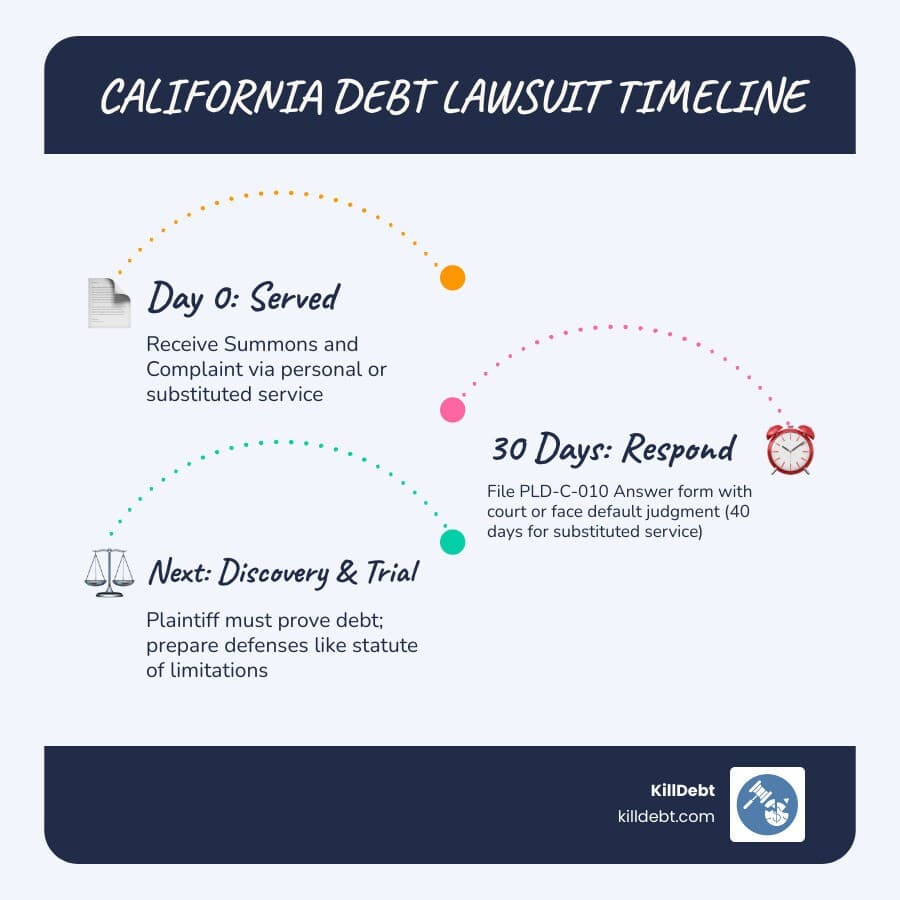
In California law, the clock is your most important adversary. If you miss your deadline, the plaintiff (the person suing you) can ask for a "default judgment." This essentially means they win by forfeit, giving them the legal power to garnish your wages or levy your bank accounts without further notice.

The standard california debt lawsuit answer deadline depends on how you were served:
For a deeper dive into these timelines, check out our guide on the Time to Respond: Debt Collection Lawsuit.
Ignoring the lawsuit won't make it go away. Once a default is entered, the debt collector can take up to 25% of your disposable earnings through wage garnishment. They can also freeze your bank accounts or put liens on your property. By filing an Answer, you stop this "express train" to judgment and force the collector to prove you actually owe the money, that they have the right to sue you, and that the amount is correct.
The California Judicial Council has created standardized forms to make the court system more accessible. For debt lawsuits, which are technically "Breach of Contract" cases, you will almost always use Form PLD-C-010 (Answer — Contract).
Here is how we recommend tackling this form:
The Caption Box: At the very top of the form, enter your name, address, and phone number. Under "Attorney For," write "Pro Se" or "Defendant in Pro Per," which just means you are representing yourself.
Court Information: Copy the name and address of the court exactly as it appears on the Summons you received.
Case Number: Don't forget this! Every document you file must have the specific case number assigned to your lawsuit.
Denials (The Meat of the Form): Under section 3, you have to decide how to respond to the plaintiff's claims.
Prayer for Relief: This is where you tell the court what you want—usually that the plaintiff "takes nothing" and that the case be dismissed.
For official instructions, you can also visit the California Courts Self-Help Guide (opens in a new tab).
An "Affirmative Defense" is a legal reason why you shouldn't have to pay, even if the facts in the complaint are mostly true. You must list these in your Answer, or you might lose the right to use them later.
Common defenses include:
You can find a more exhaustive List of debt defenses (opens in a new tab) on the California Courts website.
Filling out the form is only half the battle. You also have to "serve" the other side and "file" the original with the court.
You cannot mail the Answer to the plaintiff yourself. You must have someone over the age of 18 who is not a party to the case (a friend, relative, or professional process server) mail a copy to the plaintiff’s attorney.
Once they mail it, they must fill out Form POS-030 (Proof of Service by First-Class Mail). This is your receipt that proves you followed the rules. To understand the difference between the papers you received and the ones you are sending back, read our article on the Difference Between Summons & Complaint.
Take your original Answer, the original Proof of Service, and at least two copies of each to the court clerk's office listed on the Summons. The clerk will stamp your copies and keep the originals.
Filing a california debt lawsuit answer isn't free, and California has some of the highest fees in the country.
| Claim Amount | Filing Fee (Approx.) |
|---|---|
| Up to $10,000 (Small Claims/Limited) | $225 |
| $10,000 to $25,000 (Limited Civil) | $370 |
| Over $25,000 (Unlimited Civil) | $435 - $450 |
Can't afford the fee? Don't panic. You can file Form FW-001 to request a fee waiver. If you receive public benefits (like Medi-Cal or Food Stamps) or have a low income, the court will likely waive the fee entirely.
Filing the Answer is just the beginning. It buys you time and shifts the leverage in your favor. Once the Answer is filed, the case enters the "Discovery" phase.
Discovery is the formal process where both sides exchange information. The collector might send you "Form Interrogatories" (written questions) or "Requests for Admission." You must answer these, or you could lose the case automatically. However, you can also send discovery to them. Asking for the original contract or the "Chain of Title" (proof of ownership) often makes debt buyers realize that winning will be harder than they thought.
Learn more about what comes next in our Debt Collection Lawsuit Timeline.
Most debt lawsuits in California never go to trial. Once you file an Answer, you are in a much stronger position to negotiate.
In California, many debt cases under $25,000 are governed by Rule 3.740, which is a "fast-track" system. This means the court expects the case to be resolved or ready for trial within a year. You will likely have to attend a "Case Management Conference" where a judicial officer checks the status of the case. Staying organized and responding to all mail from the court is vital during this period.
Filing a california debt lawsuit answer is the single most important thing you can do to protect your financial future when sued. It stops the collector from taking your money without a fight and gives you the leverage needed to settle or win.
At KillDebt, we believe you shouldn't have to spend thousands on an attorney just to defend your rights. While our physical offices are in Florida and Michigan, our AI-powered platform is specifically designed to help consumers navigate the California court system. Our DIY legal defense system is powered by ParkerGPT, an AI trained specifically on consumer debt law and real-world strategies developed over 30 years by attorney Brian Parker.
Unlike generic templates, KillDebt analyzes your specific lawsuit documents, identifies legal weaknesses in the collector's case, and generates court-ready responses. We’ve even introduced the Court Tester, an AI courtroom simulation where you can practice your arguments against an AI opposing counsel before you ever step foot in a real courthouse.
Don't let the debt collectors win by default. Defend your case with KillDebt and take control of your financial story today.

About the author
Brian Parker
I have over 30 years of experience defending consumers against debt collection lawsuits and have seen every tactic, threat, and pressure play that collectors use. Through KillDebt and ParkerGPT, I have systematized the proven defense strategies that actually work - so consumers can respond from a position of knowledge, not fear. My approach focuses on aggressive legal defense based on documented case success rather than false hope that leads to default judgments.