News Break
How to Answer Interrogatories in a Debt Case Without Breaking a Sweat
June 8, 2026
Blog / News Break
Get professional Court answer drafting service help to respond to debt lawsuits fast and avoid default judgments.
A court answer drafting service helps you prepare and file a legally formatted response to a debt lawsuit — fast, affordably, and without needing to hire a full attorney.
If you've just been served with a summons, here's what you need to know right now:
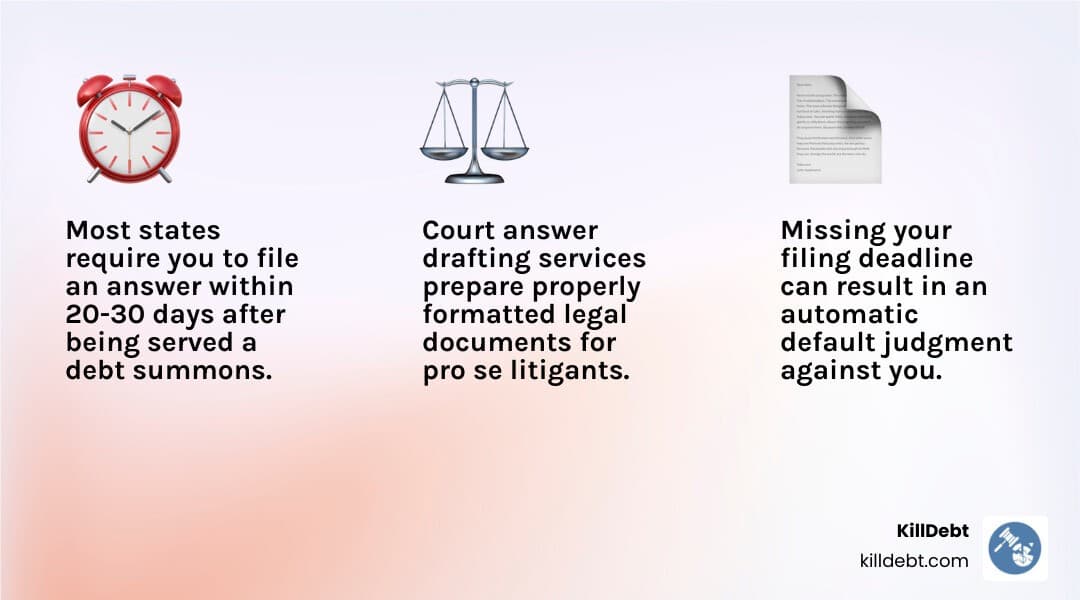
The clock starts ticking the moment you're served. Most people who lose debt lawsuits don't lose because they had no defense — they lose because they never responded at all.
I'm Brian Parker, founder of KillDebt, and I've spent over 30 years in the courtroom fighting debt collectors, creditors, and collection law firms across the country. I built KillDebt's court answer drafting service tools specifically because I've watched too many people lose by default — not on the merits. In the sections below, I'll walk you through the best professional drafting options available today so you can choose the right one before your deadline hits.
A court answer drafting service is a specialized document preparation platform designed to help "pro se" litigants—people representing themselves—navigate the complex world of legal paperwork. Think of it as a professional scribe that understands the "language" of the court.
In traditional legal representation, you pay a retainer for an attorney to handle every aspect of your case. With a drafting service, you remain the captain of your ship. You make the decisions, but the service ensures your response is formatted correctly, uses the right terminology, and meets procedural requirements. This is vital because courts are notoriously picky. A missing case number or a margin that’s half an inch too small can sometimes lead to a clerk rejecting your filing.
If you are in Florida or Michigan, you are dealing with specific rules. For instance, the Florida Courts Help / DIY Florida (opens in a new tab) portal provides some resources, but it doesn't always offer the strategic depth needed to fight a aggressive debt buyer. Learning how to answer a debt summons correctly is the difference between keeping your paycheck and seeing it garnished.
While the "Answer" is the most common document, these services handle a wide range of litigation paperwork:
In the "old days" (which was basically three years ago), an attorney would spend 6 to 8 hours synthesizing facts and local rules to draft a single court order or response. Today, AI-powered automation has flipped the script.
With tools like our ParkerGPT, the entire drafting process is compressed. What used to take a full workday now takes about 10 minutes of AI drafting followed by a brief period of refinement. These tools are excellent at "fact extraction"—pulling the case number, plaintiff name, and specific allegations directly from your uploaded summons to ensure 100% accuracy. This isn't just about speed; it's about error reduction. AI doesn't get tired at 4:00 PM on a Friday and forget to include your affirmative defenses. For a deeper look at these mechanics, check out our debt lawsuit defense guide.
The primary benefit is accessibility. Most people being sued for a $2,000 credit card debt cannot afford a $3,000 attorney retainer. It just doesn't make financial sense. A court answer drafting service bridges that gap, providing a "middle way" between doing nothing and going broke hiring a law firm.

Beyond the money, there is the "confidence factor." Walking into a clerk's office with a professionally formatted document—complete with the correct "Certificate of Service"—changes how you are perceived. The Guide for Proceeding Without a Lawyer (opens in a new tab) from the Florida Middle District emphasizes that pro se litigants must follow the same rules as attorneys. A drafting service ensures you do exactly that.
How you pay for these services usually falls into three buckets:
When deciding, ask yourself: Do I need a lawyer for a debt collection lawsuit? If the debt is massive or the legal issues are incredibly complex, an attorney is best. But for the vast majority of consumer debt cases, a subscription to a drafting tool provides the best value.
Don't just use the first website you find. A reliable service should offer:
Understanding the debt collection lawsuit timeline is also a key feature; a good service will tell you exactly what to do next after your document is ready.
This is where many DIY efforts fail. A court in Jacksonville, Florida, has different procedural expectations than a court in Grand Rapids, Michigan.
In Michigan, for example, the courts provide a specific form called the MC 03 Answer (Civil) (opens in a new tab). If you don't use the approved form or something that mimics its structure exactly, you're asking for trouble.
A high-quality court answer drafting service will ask for your location and then apply:
For a complete breakdown of how to handle these regional quirks, see our fight debt collection lawsuit: complete guide.
To get a "court-ready" document, you need to provide the service with a few key items:
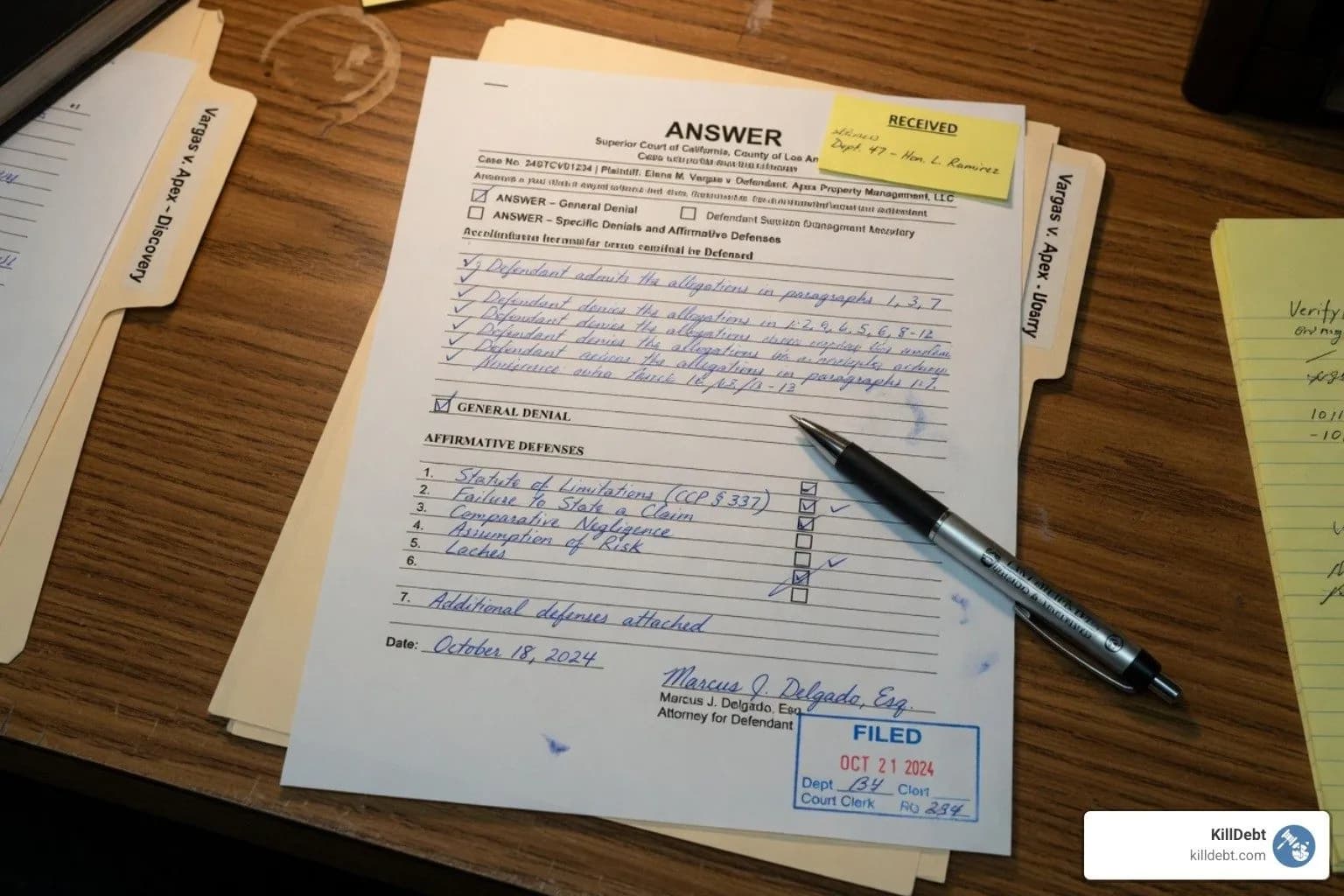
An "Answer" isn't just a "No." It's a strategic document. The most powerful part of your Answer is the Affirmative Defense section. If you don't list them in your first response, you usually waive the right to use them later.
| Defense | What it Means | Why it Works |
|---|---|---|
| Statute of Limitations | The debt is too old to sue over. | In Michigan, this is usually 6 years. In Florida, it's 5 years for written contracts. |
| Lack of Standing | The person suing you doesn't own the debt. | Common with "debt buyers" like Midland Credit or LVNV Funding who lose the paperwork. |
| Accord and Satisfaction | You already settled the debt. | If you have a receipt of a prior settlement, the case is over. |
| Statute of Frauds | The agreement had to be in writing but wasn't. | Effective in cases involving large oral agreements. |
Sometimes, the best defense is a good offense. If a debt collector violated the Fair Debt Collection Practices Act (FDCPA) while trying to collect, you might have a counterclaim.
A court answer drafting service can help you integrate "Counter-Affidavits." This is a sworn statement where you challenge the accuracy of the collector's records. As we explain in our guide on the key to a strong answer: solid counter-affidavit, a well-drafted counter-affidavit can often stop a summary judgment in its tracks. You are essentially telling the judge, "There is a factual dispute here that needs a trial." You can learn more about filing a counter-affidavit to see how it strengthens your defense.
We have to be clear: a drafting service is a tool, not a person.
Ignoring these realities is dangerous. If you want to know what happens after the summons is filed, you need to be prepared for the next steps, like mediation or trial.
Facing a debt lawsuit is stressful, but it's a battle you can win. The debt collection industry relies on 90% of people "rolling over" and accepting a default judgment. By using a court answer drafting service, you immediately put yourself in the top 10% of defendants who actually stand up for their rights.
At KillDebt, we’ve taken my 30+ years of trial experience and packed it into ParkerGPT. It’s not just a generic AI; it’s a system trained on the actual strategies I use in court every day. And for those who are nervous about the courtroom, our brand-new Court Tester allows you to upload your filings and practice your arguments against an AI judge and opposing counsel before you ever set foot in a real courthouse.
Don't let a debt collector dictate your financial future. Protect your future today by taking control of your defense.

About the author
Brian Parker
I have over 30 years of experience defending consumers against debt collection lawsuits and have seen every tactic, threat, and pressure play that collectors use. Through KillDebt and ParkerGPT, I have systematized the proven defense strategies that actually work - so consumers can respond from a position of knowledge, not fear. My approach focuses on aggressive legal defense based on documented case success rather than false hope that leads to default judgments.