
News Break
What Happens When You Are Sued by a Creditor: A Survival Guide
July 13, 2026
Blog / News Break
Master debt collection letter templates that work: FDCPA-compliant samples, validation letters, cease-and-desist notices, and proven defense strategies.
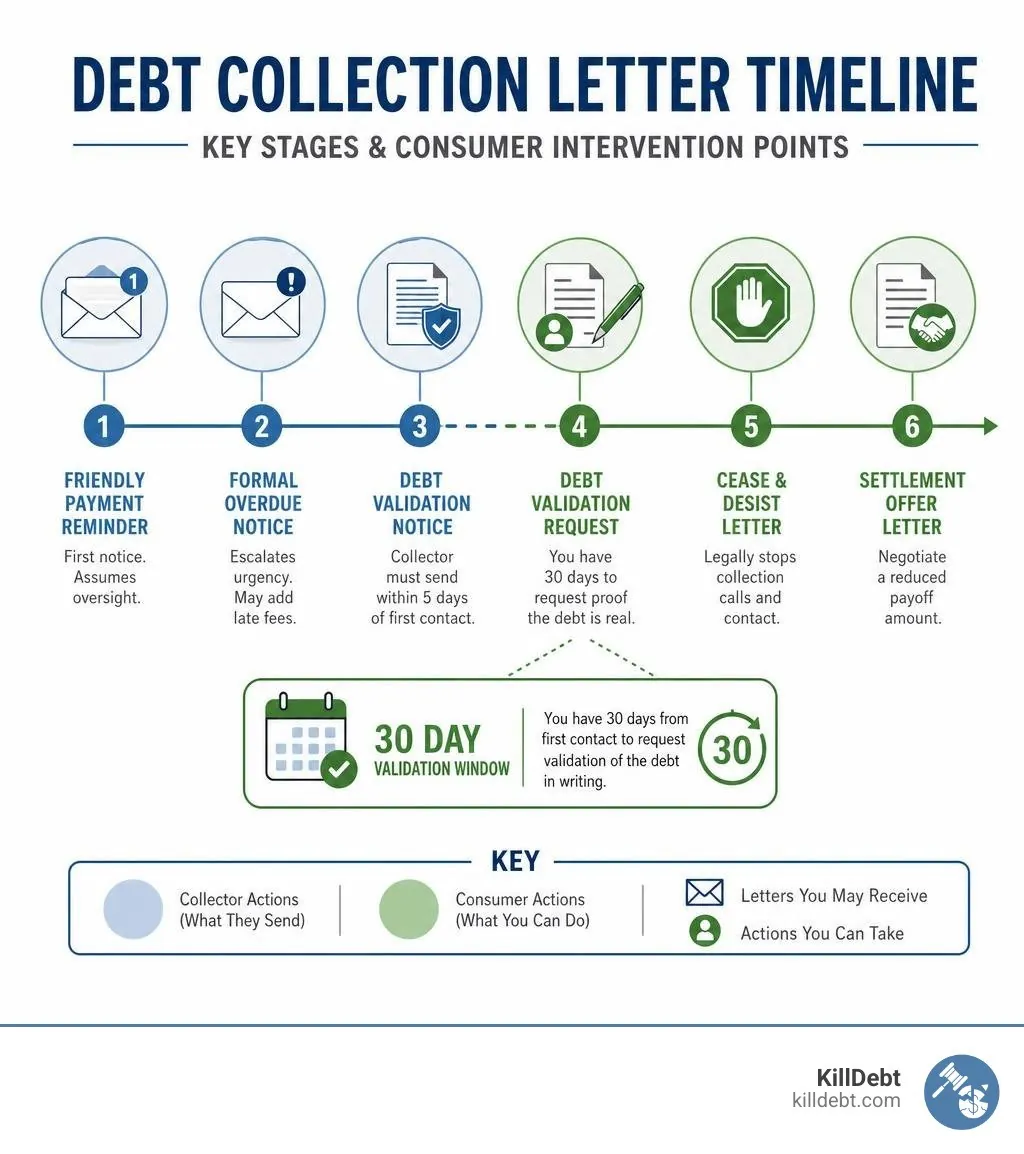
Debt collection letter templates are standardized written documents used to formally request payment of an overdue debt — or to defend yourself against unfair collection attempts.
Here are the most common types you need to know about:
| Letter Type | Who Sends It | Purpose |
|---|---|---|
| Friendly Payment Reminder | Creditor/Collector | First notice, assumes oversight |
| Formal Overdue Notice | Creditor/Collector | Escalates urgency, adds late fees |
| Debt Validation Notice | Creditor/Collector | Required by law within 5 days of first contact |
| Debt Validation Request | You (the consumer) | Forces collector to prove the debt is real |
| Cease and Desist Letter | You (the consumer) | Legally stops collection calls and contact |
| Settlement Offer Letter | You (the consumer) | Negotiates a reduced payoff amount |
The most important thing to know right now: If you received a collection letter, you have 30 days from first contact to request validation of the debt in writing. Miss that window and you lose your strongest legal protection.
77% of American households carry some form of debt, and total U.S. household debt sits at a staggering $14.96 trillion. That means collection letters are landing in mailboxes — and inboxes — every single day across the country. For many people, that letter triggers panic, confusion, and a fear of doing the wrong thing.
Here's the reality: collectors count on that confusion. They know that most people don't realize they have legal rights — rights that can stop harassment, force collectors to prove what they claim you owe, and even get a debt thrown out entirely.
I'm Brian Parker, and for over 30 years I've been in the courtroom fighting creditors, debt buyers, and collection law firms. I've seen every trick they use, including the ones hidden inside debt collection letter templates that look official but are actually designed to pressure you into paying debts you may not owe. This guide gives you the same tools I've used to protect thousands of consumers — so you can fight back from wherever you are.
IMPORTANT LEGAL DISCLAIMER
This educational content is based on general legal principles and my experience in debt collection defense. It is provided for informational purposes only and does not constitute legal advice. Laws vary by state and by local court. For specific legal advice, consult a qualified attorney licensed in your jurisdiction. No attorney-client relationship is created by reading this guide.
Critical Multi-State Variations: FDCPA applies uniformly at the federal level, but state consumer protection laws may provide additional rights and remedies. Statute of limitations periods vary significantly by state and debt type. What constitutes sufficient debt validation varies in practice across jurisdictions. State-specific rules on call frequency, written notice requirements, and permissible collector conduct may differ from federal minimums.
When a collection agency reaches out to you, they are not just sending a casual note. They are deploying highly optimized, legally compliant debt collection letter templates designed to protect their interests while forcing you to pay. To level the playing field, you must understand the rules of the game.
Federal law, specifically the Fair Debt Collection Practices Act (FDCPA), governs how these letters must look and what they must contain. The Consumer Financial Protection Bureau (CFPB) even provides Debt Collection model forms and samples (opens in a new tab) that collectors use to remain compliant.
The most critical legal element of any initial collection letter is the 30-day validation window. Under the FDCPA, once a debt collector contacts you, you have exactly 30 days to dispute the debt in writing. If you do, the collector must halt all collection activities until they provide written validation of the debt. If they fail to do so, continuing to collect is a federal violation.
Additionally, collectors must include the "Mini-Miranda" warning in their communications. This statement clearly discloses: "This communication is from a debt collector. This is an attempt to collect a debt and any information obtained will be used for that purpose." If this disclosure is missing, the collector has violated federal law, giving you significant leverage in your defense.
Whether you are a business trying to recover an unpaid invoice or a consumer analyzing a letter you received, certain elements must be present to ensure legal compliance. A standard, legally sound Debt Collection Letter - FindLaw (opens in a new tab) or commercial Collection Letter Template (opens in a new tab) typically contains:
For consumers, understanding these components is your shield. If a collector sends a letter missing these details, they are violating your rights. You can read more about how to analyze these requirements in our comprehensive Credit Debt Validation Letter Guide 2026.
Not all debt collectors play by the rules. Some use deceptive debt collection letter templates that contain illegal threats or omit required disclosures. Here is what you should look out for:
If you spot any of these violations, you can immediately fight back. One of the most effective first steps is sending a Cease Debt Collection Letter to stop the harassment while you build your defense.
For businesses and creditors, recovering past-due accounts requires a careful balance between preserving customer relationships and protecting cash flow. Most organizations see a 15-20% reduction in Days Sales Outstanding (DSO) after implementing a consistent, progressive collection letter strategy.
This sequence typically moves through four distinct stages, spaced at 14-day intervals.
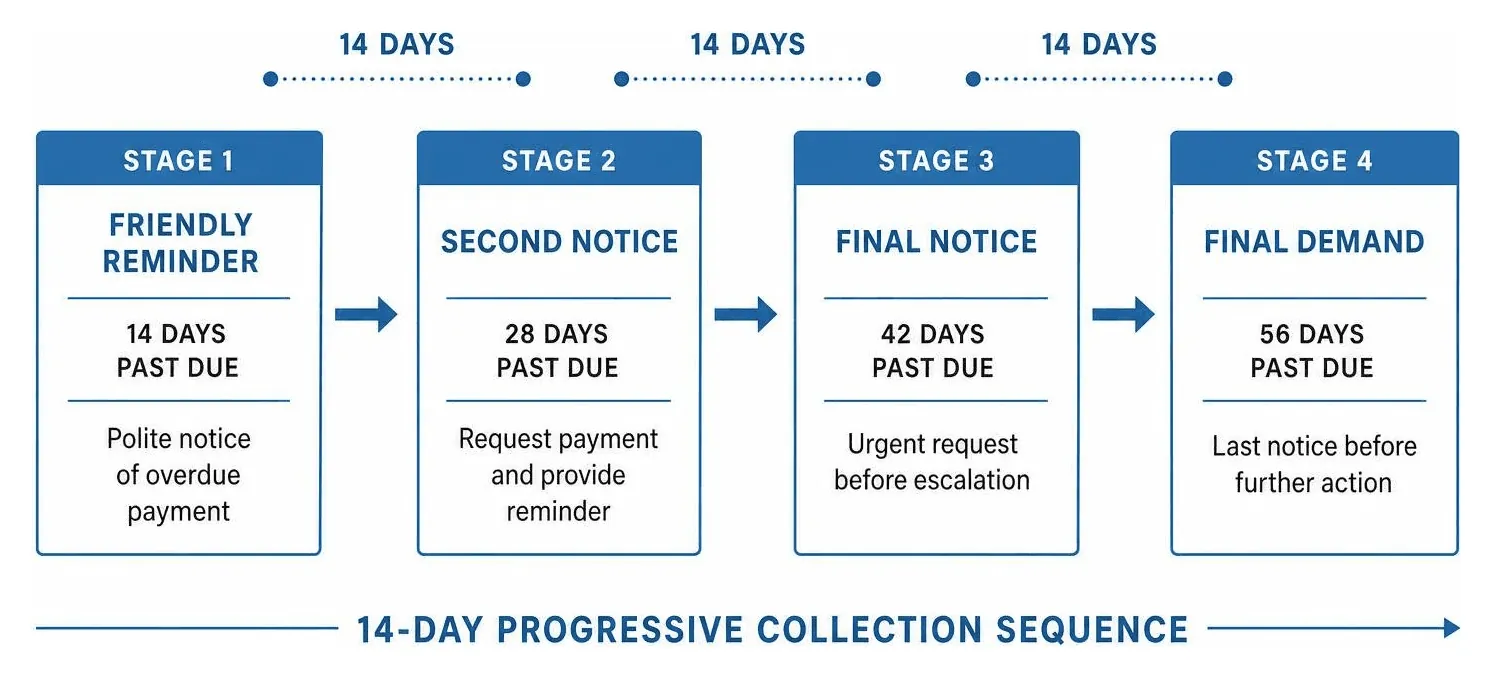
Here is how the stages compare from a consumer defense perspective:
| Stage | Timing | Tone | Key Consumer Defense Action |
|---|---|---|---|
| Stage 1: Friendly Reminder | 14 Days Past Due | Soft, helpful, polite | Verify records; check if the invoice is accurate. |
| Stage 2: Overdue Notice | 28 Days Past Due | Firm, direct, structured | Review original contract terms for late fee validity. |
| Stage 3: Urgent Demand | 42 Days Past Due | Strict, legal, urgent | Send a debt validation request immediately. |
| Stage 4: Final Notice | 56 Days Past Due | Final, legal warning | Prepare defense; check statute of limitations. |
The first collection letter is sent roughly 14 days after an invoice goes past due. At this stage, the creditor assumes the non-payment is simply an oversight.
The tone is friendly and helpful. It includes basic invoice details, the outstanding balance, and convenient payment options. For consumers, this is the best time to resolve any billing discrepancies before the account escalates.
If the first reminder is ignored, a more formal overdue notice is sent around 28 days past due. The tone becomes firmer and more direct.
This letter typically outlines an updated account summary, references the previous communication, and may introduce late fees if authorized by the original contract. If you are drafting these, you can utilize a professional Credit Collection Letter Template to maintain a respectful yet assertive tone.
At 42 days past due, the tone shifts to strict urgency. This letter is often the point where third-party debt collectors get involved.
Under FDCPA §809, this communication must include the 30-day validation notice. If you receive a letter at this stage, you must act quickly. Sending a customized Debt Validation Letter Template is your best tool to force the collector to halt their efforts and prove they have the right to collect.
The final notice, typically sent 56 days past due, is a pre-litigation demand. It warns that if payment is not received within a specified window (usually 14 days), the account will be forwarded to legal counsel, reported to credit bureaus, or filed in small claims court.
These letters are often sent via certified mail to establish court-admissible proof of delivery. If you receive one of these, you are facing a potential lawsuit and must prepare your legal defense.
Receiving a collection letter does not mean you have to pull out your wallet and pay. In fact, doing so blindly can be a massive mistake.
Did you know that debt buyers purchase delinquent accounts from original creditors for an average of just 4% to 10% of the debt's face value? Because they buy these debts in bulk for pennies on the dollar, they rarely receive the complete, accurate paperwork required to prove the debt in a court of law.
When you fight back, you force the collector to spend money to locate those records. Often, they cannot produce them, leaving them with no choice but to drop the collection effort entirely.

Your most powerful weapon is a formal validation request. Under FDCPA §809(b), if you send this request within 30 days of receiving their initial notice, the collector must stop all collection activities—including phone calls and credit reporting—until they mail you validation.
To see what a proper validation request looks like, review our Example Debt Validation Letter. When drafting yours, ensure you ask for:
You can easily generate and customize your own Letter of Debt Validation to send to any agency pursuing you.
If a collector is calling you constantly, contacting your workplace, or stressing you out, you have the legal right to make them stop. Under federal law, if you send a written request telling them to stop contacting you, they must comply.
By sending a Cease and Desist Creditor Letter, you legally restrict their communication channels. Once they receive it, they can only contact you to confirm they are stopping communication or to notify you of a specific legal action (like filing a lawsuit). This stops the daily harassment and gives you peace of mind while you figure out your next steps.
If a collector decides to skip letters and file a lawsuit, ignoring it is the worst thing you can do. If you fail to respond to a court summons within your state's deadline (usually 20 to 30 days), the collector wins a default judgment against you. This allows them to legally garnish your wages or freeze your bank accounts.
Defending yourself starts with filing a formal, written Answer with the court. You can review a Debt Summons Response Letter Sample to understand how to structure your response, deny their unproven allegations, and assert your legal defenses.
Dealing with debt collectors can feel overwhelming, but you do not have to go through it alone or spend thousands of dollars on an expensive attorney. At KillDebt, we provide a DIY legal defense system powered by ParkerGPT—an AI trained specifically on consumer debt law and real-world court strategies developed over 30+ years of active practice.
Whether you need to draft a compliant validation letter, respond to a harassing collector, or analyze complicated court filings, our platform gives you the exact tools you need. We’ve also recently rolled out our brand-new tool, Court Tester!
Court Tester is an AI courtroom simulation built on the actual details of your case. You can upload your real filings and, within minutes, practice arguing your motion in front of an AI judge, face off against an AI opposing counsel, and receive private, strategic tips from an AI co-counsel that only you can see.
Don't let debt collectors dictate the terms. Take control of your financial future, check out our straightforward KillDebt Pricing, and start defending your rights today at KillDebt DIY Legal Defense.
This educational content is based on general legal principles and my experience in debt collection defense. It is provided for informational purposes only and does not constitute legal advice. Laws vary by state and by local court. For specific legal advice, consult a qualified attorney licensed in your jurisdiction. No attorney-client relationship is created by reading this guide.
Critical Multi-State Variations: FDCPA applies uniformly at the federal level, but state consumer protection laws may provide additional rights and remedies. Statute of limitations periods vary significantly by state and debt type. What constitutes sufficient debt validation varies in practice across jurisdictions. State-specific rules on call frequency, written notice requirements, and permissible collector conduct may differ from federal minimums.

About the author
Brian Parker
I have over 30 years of experience defending consumers against debt collection lawsuits and have seen every tactic, threat, and pressure play that collectors use. Through KillDebt and ParkerGPT, I have systematized the proven defense strategies that actually work - so consumers can respond from a position of knowledge, not fear. My approach focuses on aggressive legal defense based on documented case success rather than false hope that leads to default judgments.