News Break
The Ultimate Guide to Debt Collection Letter Templates That Actually Work
July 14, 2026
Blog / News Break
Learn how to challenge credit card balance errors, dispute charges, and defend against lawsuits with this step-by-step guide.

If you've ever looked at your credit card statement and thought something felt off, you're not alone — and you may have every right to challenge a credit card balance that contains errors, unauthorized charges, or amounts you simply don't owe.
Here's a quick answer to what that means and how it works:
How to challenge a credit card balance:
This matters more than most people realize. Total U.S. credit card debt hit $1.252 trillion in Q1 2026, with the average cardholder carrying a balance of roughly $6,595 at an average APR of 21.52%. Every dollar of an incorrect balance you don't challenge is a dollar you may be paying interest on for years.
And if a debt collector or creditor has already taken legal action against you — sent you a summons, a collection letter, or a wage garnishment notice — the stakes are even higher. A wrong balance on a court filing can follow you for decades.
My name is Brian Parker, and I've spent over 30 years in the courtroom fighting creditors, debt buyers, and collection law firms — which means I've seen every way an inflated or inaccurate balance gets used against consumers, and I've built KillDebt specifically to help you challenge a credit card balance with the same tools and confidence a seasoned attorney would use. In the sections below, I'll walk you through exactly what to do — whether you're dealing with a billing dispute, a credit report error, or a lawsuit.
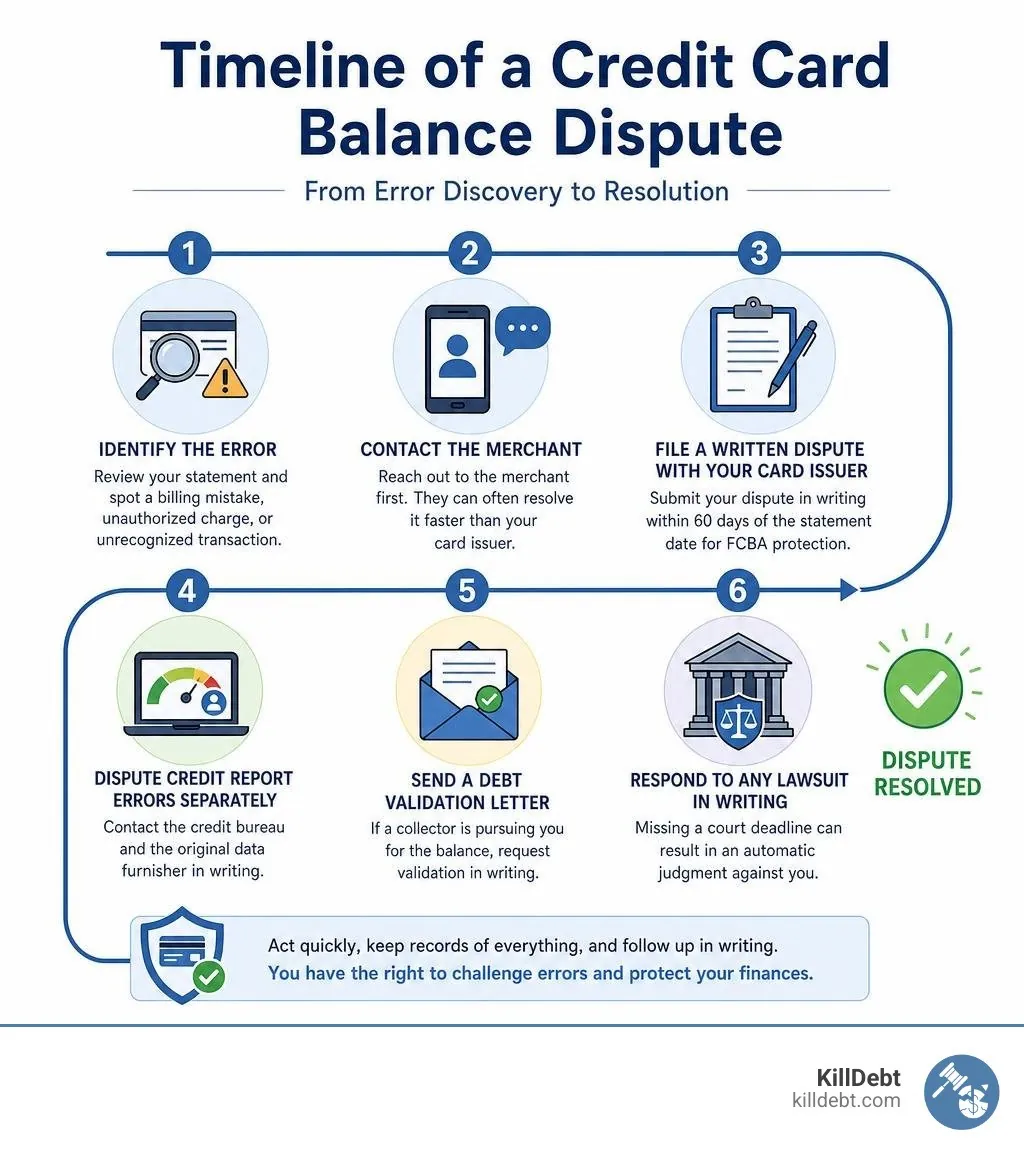

When you spot an error on your credit card statement, your first line of defense is the Fair Credit Billing Act (FCBA). This federal law protects you against "billing errors," which include unauthorized charges, math mistakes on your statement, charges for goods you never received, or charges for products that were delivered but weren't what you ordered.
But before you fire off a formal dispute to your credit card issuer, you need to decide if you should contact the merchant first.
As a general rule, you should contact the merchant directly if the issue is a simple misunderstanding or a customer service failure. Examples include:
Merchants can often issue refunds in a matter of days. Furthermore, credit card networks like Visa and Mastercard require card issuers to check if you've made a good-faith effort to resolve the issue with the merchant before stepping in.
However, you should bypass the merchant and go straight to your issuer if:
For more details on your rights, check out the Using Credit Cards and Disputing Charges - FTC Consumer Advice (opens in a new tab) page.
If the merchant won't help, or if the charge is fraudulent, it is time to formally challenge a credit card balance with your card issuer. To preserve your full legal rights under the FCBA, you must follow a strict, step-by-step process.
Before you submit anything, assemble your evidence. This includes receipts, invoices, photos of damaged goods, cancellation confirmation emails, and any written correspondence you had with the merchant.
Under the FCBA, you must submit your dispute so that it reaches your issuer within 60 days of the date the first statement containing the error was mailed to you. If you miss this window, your issuer may still help you, but you lose your right to hold them legally accountable under federal law.
While many issuers allow you to click a "dispute" button in their mobile app or submit a claim online, we highly recommend following up with a physical letter sent via Certified Mail with Return Receipt Requested. This gives you undeniable, court-ready proof that the issuer received your dispute and when they received it.
Send your letter to the specific address designated for billing inquiries (not the address where you send payments). In your letter, include:
For a helpful framework on drafting these letters, you can review the guide provided by the Credit Cards – Disputing A Charge - California Department of Justice (opens in a new tab).
Once your issuer receives your dispute, they must acknowledge it in writing within 30 days. They are legally required to complete their investigation within two complete billing cycles (but no more than 90 days).
While the investigation is active, you are not required to pay the disputed amount or any associated interest charges. Your issuer will typically apply a temporary credit to your account for the disputed amount. However, you must continue to pay the undisputed portion of your credit card balance to maintain your positive payment history on your Credit Card (opens in a new tab) account.
It can be incredibly frustrating to receive a letter stating that your issuer has denied your dispute and is reinstating the charge. If you disagree with the decision, you still have options:

Many consumers confuse disputing a credit card charge with disputing an error on their credit report. While they both involve your money and your reputation, they are governed by different laws and require completely different procedures.
For example, if you paid off a credit card balance, but the credit card company continues to report that you owe a balance on your credit file, that is a credit report error. To understand your rights regarding your credit file, particularly if you live in Michigan, you can consult resources like Your Credit Report (opens in a new tab).
An inaccurate balance on your credit report can devastate your credit score. Because your credit utilization ratio (how much debt you owe compared to your credit limits) accounts for 30% of your FICO score, an inflated balance can make you look like a high-risk borrower.
To clean up your credit report, you must initiate the dual-dispute process under the FCRA.
You must send a formal dispute letter to each of the three major credit bureaus (Equifax, Experian, and TransUnion) that is reporting the error. In your letter:
The credit bureaus generally have 30 days to investigate your claim. They will forward your dispute to the company that provided the information (the "data furnisher").
To protect your rights fully, you should also dispute the error directly with the credit card company or bank that reported the balance. Send them a copy of your dispute letter and evidence. If they agree that they made an error, they are legally required to notify all three credit bureaus to update your records.
If you are a resident of Florida, you can find additional consumer protection tips on credit reporting and identity theft at How to Protect Yourself: Credit | My Florida Legal (opens in a new tab). If the error is the result of identity theft, make sure to include a copy of your FTC Identity Theft Report with your dispute.
While you are actively disputing a balance, you must manage your overall credit health carefully. If you have an outstanding, undisputed balance on your credit card, carrying it can cost you a fortune.
As of 2026, the average credit card balance is $6,595 at an average APR of 21.52%. If you pay only the minimum on that balance, it will take you over 17 years to pay it off and cost you more than $9,400 in interest alone.
To pay off your legitimate debt quickly, you should evaluate the two most popular DIY payoff strategies: the Debt Avalanche and the Debt Snowball.
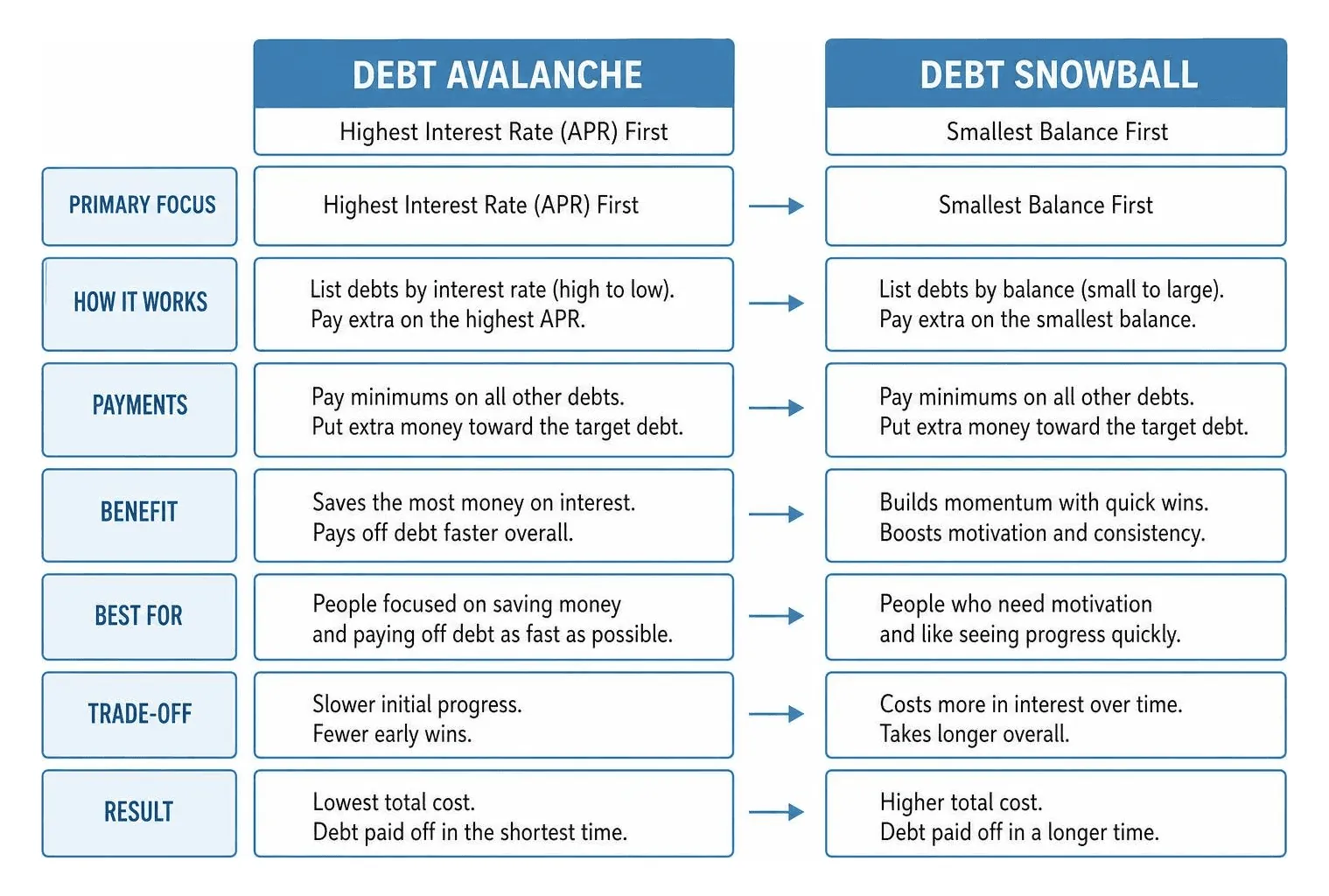
Here is how these two strategies compare side-by-side:
| Feature | Debt Avalanche | Debt Snowball |
|---|---|---|
| Primary Focus | Highest Interest Rate (APR) First | Smallest Balance First |
| Mathematical Goal | Minimize total interest paid | Maximize psychological momentum |
| How It Works | Pay minimums on all cards; throw all extra cash at the card with the highest APR. | Pay minimums on all cards; throw all extra cash at the card with the smallest balance. |
| Pros | Saves the most money; gets you out of debt faster on paper. | Quick psychological wins; keeps motivation high. |
| Cons | Can take months to see your first completely paid-off card. | Mathematically more expensive; you pay more interest overall. |
If you want to run the numbers on your specific balances, you can use the Credit Card Payoff Calculator — Free Months + Interest + AI — CalcBold (opens in a new tab) to see exactly how much you can save. For a comprehensive look at speed-focused payoff methods, read the How to Pay Off Credit Card Debt Fast (2026 Strategy Guide) (opens in a new tab).
If you are dealing with a larger debt load across multiple tiers, you may want to look into structured plans. For balances ranging from $5,000 to over $50,000, read How to Pay Off Credit Card Debt: The Complete Guide for $5K, $10K, $25K, and $50K+ | Deep Learning Finance (opens in a new tab). If you are aiming for a tight, 12-month timeline, check out How to Get Out of Credit Card Debt in 12 Months: A Realistic Step-by-Step Plan - Financedevil (opens in a new tab) or the strategies outlined in How to Pay off Credit Card Debt in 2026 (opens in a new tab) and How to Pay Off Credit Card Debt By Yourself (Step-by-Step Plan + Tips) - RequestLetters (opens in a new tab).
Now, let's talk about the most urgent scenario: What happens if a credit card company or a third-party debt buyer sues you for a balance you believe is inaccurate, inflated, or completely fabricated?
Many consumers panic when they receive a court summons. They assume that because a bank or a debt collector has filed a lawsuit, they have already lost. This is a massive mistake. In fact, debt buyers purchase old credit card debts for pennies on the dollar, often with little to no actual documentation to prove they own the debt or that the balance is correct.
If you do not show up to defend yourself, the court will issue a default judgment against you. This allows the creditor to garnish your wages, freeze your bank accounts, or place liens on your property.
To protect your hard-earned money, you must understand your rights regarding Credit Card Debt Legal actions. If you find yourself in this situation, read our guide on what to do when a Credit Card Company Taking Me to Court to start building your defense.
When you are served with a lawsuit, the clock starts ticking. In Florida, you typically have 20 days to file a written response with the court. In Michigan, you have 21 days (if served in person) or 28 days (if served by mail or outside the state).
Your response must be in the form of a formal, written Answer. In your Answer, you must:
Admit or Deny each allegation: Go through the plaintiff's complaint paragraph by paragraph. If they claim you owe an incorrect balance, you should "Deny" that allegation.
Assert Affirmative Defenses: These are legal reasons why the plaintiff should not win, even if some of their claims are true. Examples include:
Do not let these deadlines pass you by. Learn how to draft your response with our step-by-step guide on How to Answer a Credit Card Lawsuit and our comprehensive overview on Responding to Credit Card Lawsuit.
To win a debt collection lawsuit, the plaintiff must prove three things:
If a third-party debt buyer is suing you, they must also prove the chain of title — a complete, unbroken paper trail of bills of sale showing how the debt moved from the original credit card company to the debt buyer.
You can challenge the validity of the debt by demanding that they produce:
If they cannot produce these documents — and they often can't — you can move to have the case dismissed. For a deep dive into these courtroom strategies, read our Defending Credit Card Lawsuit Guide 2026 and find out exactly how debt buyers operate in Credit Card Debt Collection: How Banks Sell Your Account.
Challenging an inaccurate credit card balance can feel like an uphill battle, especially when you are up against massive financial institutions or aggressive debt collection law firms. But you do not have to do it alone, and you don't need to spend thousands of dollars on an attorney to protect your rights.
At KillDebt, we have created a DIY legal defense system powered by ParkerGPT — an AI trained specifically on consumer debt law and real-world court strategies developed over my 30+ years as a consumer defense attorney. Unlike generic AI tools, ParkerGPT analyzes your actual lawsuit documents, identifies procedural weaknesses in the plaintiff's case, and generates customized, court-ready Answers and motions.
We have also just rolled out our brand-new tool: Court Tester.
Court Tester is an advanced AI courtroom simulation built on the facts of your actual case. You simply upload your real court filings, and within minutes, you can practice arguing your motions in front of an AI judge, face off against AI opposing counsel, and receive real-time, private strategy coaching from an AI co-counsel that only you can see. It is the ultimate way to build your confidence and prepare for your day in court.
Don't let credit card companies or debt buyers bully you into paying for mistakes that aren't yours. Take control of your financial future today and Empower your legal defense with KillDebt.
Get started with KillDebt pricing
IMPORTANT LEGAL DISCLAIMER
This educational content is based on general legal principles and my experience in debt collection defense. It is provided for informational purposes only and does not constitute legal advice. Laws vary by state and by local court. For specific legal advice, consult a qualified attorney licensed in your jurisdiction. No attorney-client relationship is created by reading this guide.
Critical Multi-State Variations: FDCPA applies uniformly at the federal level, but state consumer protection laws may provide additional rights and remedies. Statute of limitations periods vary significantly by state and debt type. What constitutes sufficient debt validation varies in practice across jurisdictions. State-specific rules on call frequency, written notice requirements, and permissible collector conduct may differ from federal minimums.

About the author
Brian Parker
I have over 30 years of experience defending consumers against debt collection lawsuits and have seen every tactic, threat, and pressure play that collectors use. Through KillDebt and ParkerGPT, I have systematized the proven defense strategies that actually work - so consumers can respond from a position of knowledge, not fear. My approach focuses on aggressive legal defense based on documented case success rather than false hope that leads to default judgments.