News Break
The Definitive Guide to Debt Collector Lawsuits Michigan
June 2, 2026
Blog / News Break
Learn how to handle Credit card debt legal issues, avoid judgments, and protect your rights with proven defense strategies.

If you've received a collection letter, a court summons, or a wage garnishment notice, here's what you need to know right now:
Your most important rights and deadlines at a glance:
| Situation | What You Need to Know |
|---|---|
| Received a summons | You have 14–35 days to respond (varies by state) — ignoring it means automatic loss |
| Debt collector calling | They cannot call before 8 a.m. or after 9 p.m., or more than 7 times in 7 days |
| Old debt | Most states have a 3–6 year window to sue — after that, it may be time-barred |
| Sued by a debt buyer | They must prove they own the debt and have the right to collect it |
| Worried about garnishment | Federal law caps wage garnishment at 25% of disposable income — some income is fully protected |
Nearly half of all American households carry credit card debt. When that debt goes unpaid, creditors and debt buyers don't sit still — they sue. According to Federal Reserve data, U.S. credit card debt hit $1.14 trillion in 2024, and collection agencies file millions of lawsuits every year. Most consumers never respond, handing collectors an easy win.
The good news: you have real legal rights, and knowing them changes everything.
This guide walks you through every stage — from the first collection call to the courtroom — in plain language you can act on today.
I'm Brian Parker, and for over 30 years I've fought debt collectors, debt buyers, and collection law firms in courtrooms across the country — defending consumers in exactly the credit card debt legal battles this guide covers. I founded KillDebt to put those same courtroom strategies directly in your hands, so let's get into it.
When we talk about credit card debt legal limits, the "Statute of Limitations" (SOL) is your best friend. This is the legal deadline for a creditor or debt buyer to sue you. Once this clock runs out, the debt is considered "time-barred." While you technically still owe the money, the collector loses their most powerful weapon: the ability to win a judgment in court.
In most jurisdictions, this window is between three and six years. However, these rules are tricky because they vary wildly depending on where you live and the type of contract involved. For example, California Credit Card Debt Statute of Limitations Guide (opens in a new tab) notes a four-year limit for written contracts, while other regions might differ.
It is also important to understand Credit Card Debt Collection: How Banks Sell Your Account. When a bank sells your debt to a third-party buyer, that buyer must still abide by the original statute of limitations. They don't get a fresh start just because they bought the file.
The "clock" usually starts ticking on the date of your last activity—typically the date of your last payment or the date the account became delinquent.
If you are unsure of your dates, don't guess. Check your records or your credit report to find the "date of first delinquency." If a collector tries to sue you after this date has passed, you have a powerful "affirmative defense" that could get the entire case thrown out. For more on this, see Credit Card Company Taking Me to Court.
This is where many people get trapped. In many states, making a partial payment—even just $5—or signing a document that acknowledges you owe the debt can "reset" the statute of limitations. Suddenly, a debt that was about to expire is legally "revived," and the collector has another 5 or 6 years to sue you.
This is why we always tell people: Do not pay a dime on an old debt until you have verified the statute of limitations. Collectors often use "zombie debt" tactics, trying to trick you into a small "good faith" payment just to restart that legal clock. Before talking to them, read More info about debt validation.

The Fair Debt Collection Practices Act (FDCPA) is a federal law that protects you from abusive, deceptive, and unfair debt collection practices. If a collector violates these rules, you might not only get them to stop—you could actually sue them for damages.
One of the most important rules is the "7-in-7" rule: debt collectors cannot call you more than seven times within a seven-day period. They also cannot call you within seven days after having a phone conversation with you about a specific debt.
Additionally, a collector must provide you with "validation information" either during the first contact or within five days of it. This notice must tell you exactly how much you owe and give you 30 days to dispute the debt. For residents in our area, How to Deal with Debt Collectors | Michigan Legal Help (opens in a new tab) and the resources at Debt Collection & Debt Collection Scams - State of Michigan (opens in a new tab) provide excellent localized guidance.
Collectors love to use fear, but the law limits their toolbox. They cannot:
If you're in the Sunshine State, Credit and Debt Relief | My Florida Legal (opens in a new tab) outlines specific state-level protections that mirror and sometimes exceed federal laws.
If you get served with a lawsuit, the clock is ticking. You usually have between 14 and 35 days to file a formal "Answer" with the court.
| Action | Filing an Answer | Ignoring the Lawsuit |
|---|---|---|
| Outcome | You force the creditor to prove their case. | You lose automatically via "Default Judgment." |
| Defense | You can raise defenses like "expired statute" or "lack of standing." | You waive all your legal rights and defenses. |
| Garnishment | Cannot happen until the case is over (and if you win, never). | Collector can immediately apply to freeze your bank account or wages. |
| Cost | Usually a small filing fee (which can sometimes be waived). | Potentially thousands in interest, fees, and legal costs added to your debt. |
When you file an Answer, you aren't just saying "I don't owe this." You are challenging their standing. Debt buyers often buy thousands of accounts at once for pennies on the dollar and often lack the "chain of title"—the paperwork proving they actually own your specific account.
To get started, check out Sued for a Debt? Here's Exactly What to Do in the First 7 Days. We also provide a Sample Answer to Debt Collection Lawsuit and a guide on How to Answer a Debt Summons.
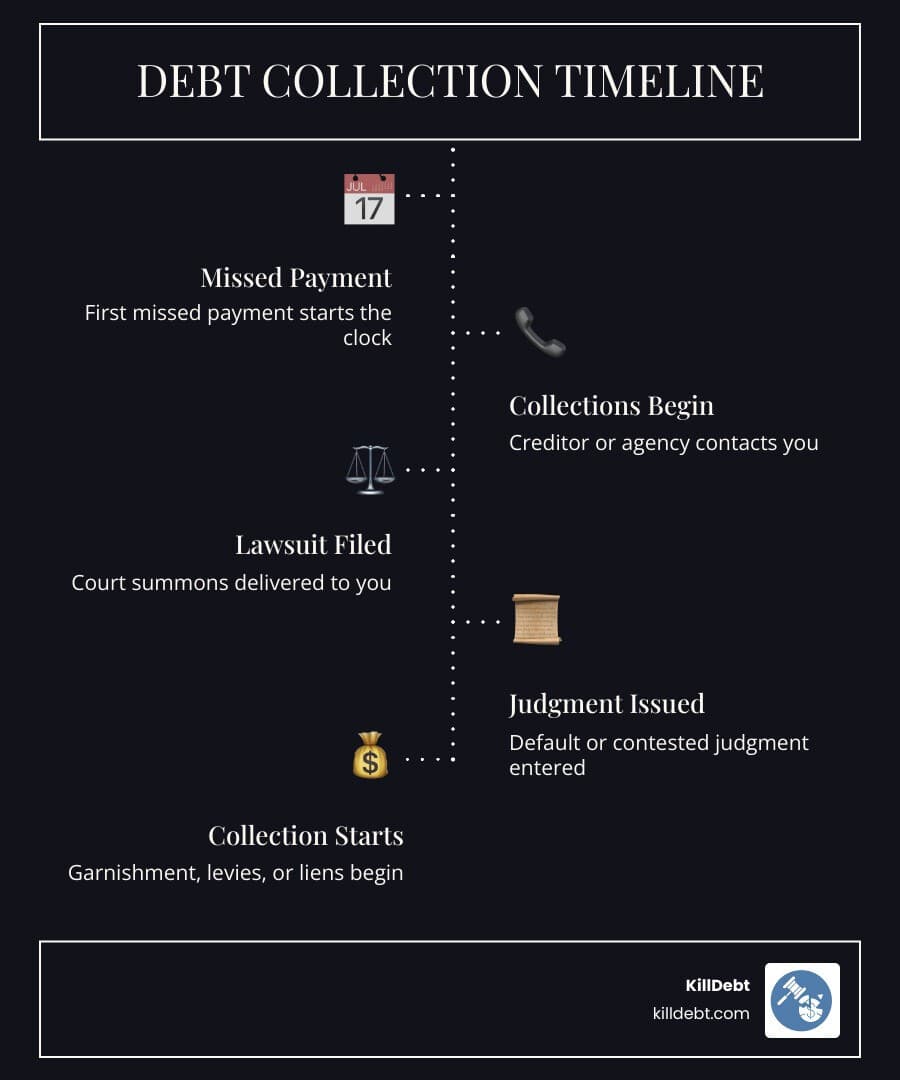
If you ignore the lawsuit, the court will enter a default judgment. This is a piece of paper that gives the collector massive power to take your money. They can use this to garnish your wages (taking up to 25% of your paycheck), freeze your bank accounts, or put liens on your property.
In Florida, a judgment can be particularly aggressive, as detailed in Legal Judgment: Unpaid Credit Card Debt (opens in a new tab). However, even with a judgment, you have rights. You can find a path forward in our Debt Lawsuit Defense Guide and the What to Do When Sued by a Debt Collector: Complete First Steps Guide.
Not everything you own can be taken. Many people are what we call "collection proof," meaning their income and assets are legally protected from creditors.
For Florida-specific defense strategies, Florin Legal - Florida Credit Card Defense and Consumer Protection (opens in a new tab) is a great resource to understand these exemptions.
Don't take the collector's word for the balance. They often add massive interest rates (sometimes exceeding 25% APR) and "collection fees" that may not be legal.
During the discovery process, you have the right to demand proof. You can ask for the original signed agreement, a full breakdown of every charge and payment, and evidence that the person suing you actually owns the debt. If the debt resulted from identity theft or a billing error, this is your chance to prove it. See the Debt Collection Lawsuit Timeline: What Happens Next After You're Served for more.

You don't always have to go to trial. Often, the best credit card debt legal strategy is to negotiate a settlement. Because debt buyers purchase accounts for roughly 4 cents on the dollar, they are often willing to accept a lump-sum payment that is significantly less than the total balance—sometimes as much as 60% to 70% off.
In the case of MIDLAND FUNDING, LLC v. JOHNSON (opens in a new tab), the Supreme Court looked at how debt buyers handle time-barred claims in bankruptcy. The takeaway for you? Collectors will try to get away with whatever you let them. If you fight back, they are much more likely to settle for a reasonable amount. Check out our Fight Debt Collection Lawsuit: Complete Guide for negotiation tips.
If the debt is truly unmanageable, you have other options:
Facing a credit card debt legal issue is stressful, but you don't have to do it alone or spend thousands on a lawyer. At KillDebt, we’ve built the tools to help you fight back and win.
Our DIY legal defense system is powered by ParkerGPT, an AI trained specifically on consumer debt law and the real-world strategies I’ve used for over 30 years. ParkerGPT doesn't just give you generic advice; it analyzes your specific court documents, identifies the collector's weaknesses, and generates court-ready responses with step-by-step instructions.
Want to see how you'd fare in court? Our brand-new Court Tester is an AI courtroom simulation built on your actual case. You can upload your filings and practice arguing your motion in front of an AI judge, with a private AI co-counsel whispering strategy only you can see.
Don't let a default judgment ruin your financial future. Whether you're in Florida or Michigan, you have the power to defend yourself. Start your DIY legal defense today and turn the tables on debt collectors.

About the author
Brian Parker
I have over 30 years of experience defending consumers against debt collection lawsuits and have seen every tactic, threat, and pressure play that collectors use. Through KillDebt and ParkerGPT, I have systematized the proven defense strategies that actually work - so consumers can respond from a position of knowledge, not fear. My approach focuses on aggressive legal defense based on documented case success rather than false hope that leads to default judgments.