
News Break
Don't Pay for Their Mistakes: How to Challenge a Credit Card Balance
July 14, 2026
Blog / News Break
Boost credit after lawsuit with active defense and proven steps to rebuild your score fast.

If you want to boost credit after a lawsuit, here's the short answer:
How to boost credit after a debt lawsuit:
A debt lawsuit is one of the most stressful financial events you can face. The summons arrives. The clock starts ticking. And if you do nothing, the damage to your credit — and your bank account — can last for years.
Here's what most people don't realize: the lawsuit itself doesn't appear on your credit report. Civil lawsuits have been removed from consumer credit reports since 2018. But what happens because of the lawsuit absolutely does show up — through missed payments, charge-offs, wage garnishments, and bank levies that make it nearly impossible to keep up with everything else.
The good news? The damage isn't permanent. And how you respond to the lawsuit matters far more than the lawsuit itself.
I'm Brian Parker, founder of KillDebt, and for over 30 years I've fought debt collectors, debt buyers, and collection law firms in courtrooms across the country — helping thousands of consumers boost their credit after a lawsuit and take back control of their financial lives. In the sections below, I'll walk you through exactly what the lawsuit does to your credit, what your real options are, and the step-by-step path to recovery.
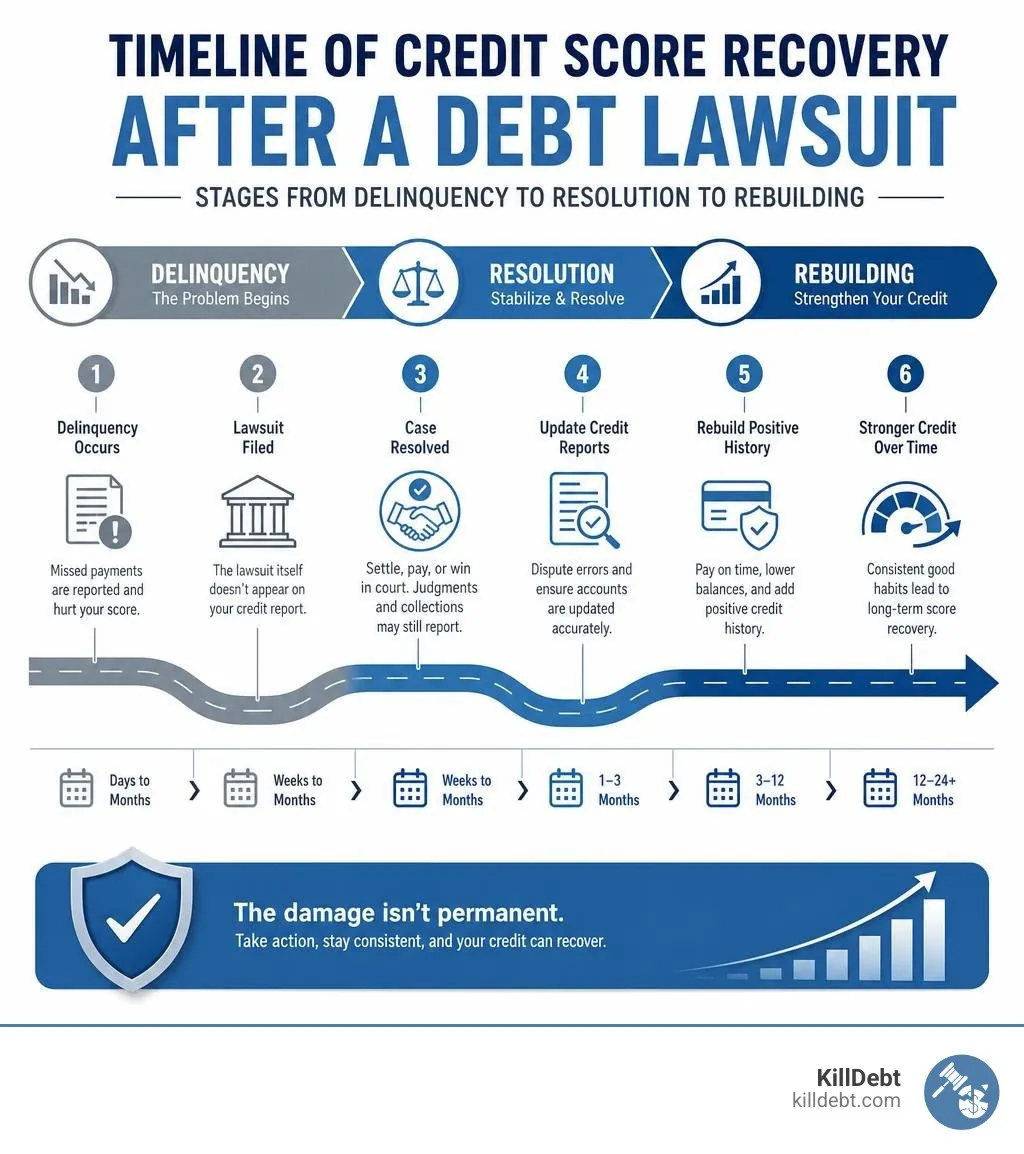
When a debt collector files a lawsuit, many people panic and assume their credit score is instantly ruined. But we need to separate the lawsuit itself from the financial trail it leaves behind.
Understanding this distinction is the first step toward figuring out how to boost credit after a lawsuit. Let's look at exactly how the credit reporting bureaus handle lawsuits and where the actual scoring damage comes from.
The truth is, by the time a process server knocks on your door with a summons, your credit score has already taken its biggest hit.
According to credit scoring models, payment history makes up 35% of your FICO score. The delinquency rate on credit cards reached 7.2% in the second quarter of 2023, surpassing pre-Covid levels, and many of those accounts eventually end up in court.
Here is how the damage cascades before you even see a judge:
According to The Credit Score Protection Playbook: How to Survive a Life (opens in a new tab), the average life crisis drops credit scores by 50 to 150 points. This drop is driven by high credit utilization (which accounts for 30% of your score) and missed payments. The lawsuit is simply the legal consequence of this existing credit damage, not the cause of it. For a deeper look at this process, review our Debt Lawsuit Defense Guide.
In 2018, the three major credit bureaus (Equifax, Experian, and TransUnion) removed civil judgments from consumer credit reports due to widespread public record matching errors. Today, if a creditor wins a lawsuit against you, the judgment itself will not appear on your credit report.
However, a judgment still damages your credit score indirectly through the financial chaos it causes. If you ignore the lawsuit, the creditor will likely obtain a default judgment. With this judgment in hand, they can legally pursue aggressive collection tactics:
When a quarter of your paycheck is gone or your bank account is suddenly emptied, you lose the ability to pay your other monthly bills. This leads to new late payments, rising credit card balances, and a secondary drop in your credit score. If you are already dealing with a judgment, you can learn how to protect yourself in our guide on How to Remove Default Judgment Debt.
To protect your credit during and after a lawsuit, you must understand your options. Your strategy will depend on whether you are defending against a debt collection lawsuit or seeking financial recovery during active litigation.
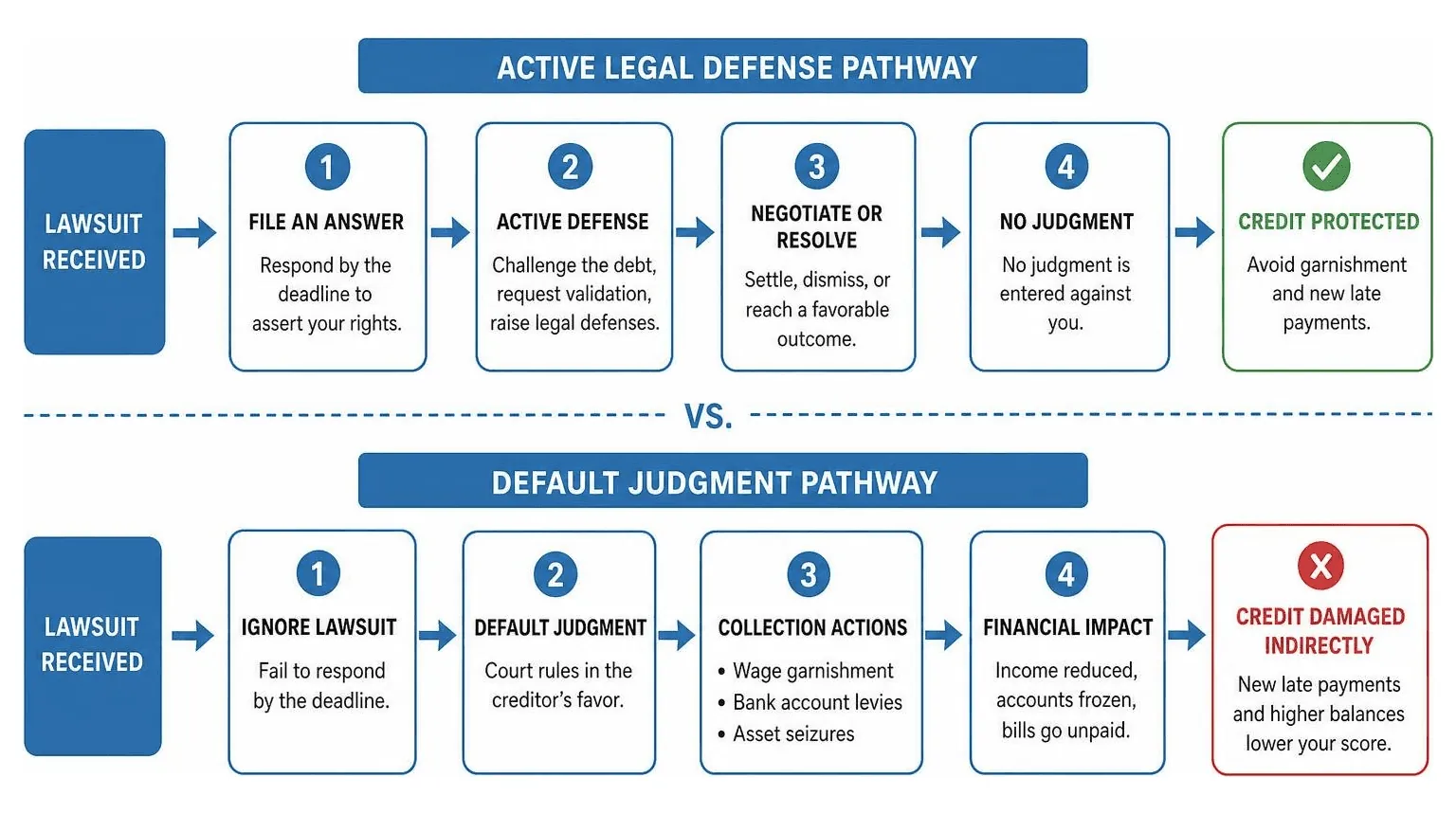
When you are sued for a debt, the single best way to protect your credit is to file an active defense. Ignoring the lawsuit guarantees a default judgment, which leads to wage garnishments and frozen bank accounts.
By filing an Answer, you stop the collector from getting an easy win. In Michigan, you can utilize the resources provided by Defenses in a Debt Collection Case - Michigan Legal Help (opens in a new tab)to understand your legal rights.
Active defense protects your credit score in several ways:
The way your lawsuit ends determines how quickly you can rebuild your credit. Your goal should always be a dismissal (with or without prejudice) or a mutual settlement agreement.
If you settle the debt, ensure the agreement is put in writing before you pay a single dollar. According to How To Use A Settlement To Pay Off Debt And Improve Credit | Bankrate (opens in a new tab), settled accounts remain on credit reports for seven years from the original delinquency date. However, getting the account status updated to "settled" or "paid in full" is critical because modern credit scoring models (like FICO 9 and VantageScore 3.0/4.0) ignore paid collection accounts entirely.
If you are the plaintiff in a personal injury or accident lawsuit rather than the defendant in a debt case, you face a different financial challenge. You may be unable to work due to injuries, causing you to fall behind on bills while waiting for your settlement.
In this scenario, consumer lawsuit funding (pre-settlement funding) can help protect your credit. Unlike traditional loans, lawsuit funding is a non-recourse cash advance, typically under $10,000.
As noted in How Lawsuit Funding Can Protect Your Credit Score During Recovery (opens in a new tab), this funding allows injured plaintiffs to pay rent, medical bills, and utilities on time during recovery, preventing missed payments from damaging their credit scores.
Let's look at a direct comparison of what happens when you actively defend your case versus when you ignore a court summons.
| Feature / Outcome | Active Legal Defense | Ignoring a Summons (Default) |
|---|---|---|
| Immediate Credit Impact | Stabilizes; prevents further indirect score drops. | Severe; leads to garnishments and secondary late payments. |
| Risk of Wage Garnishment | Low; case must be argued and proven first. | Extremely High; creditor easily wins garnishment rights. |
| Bank Account Seizure | Prevented during active litigation. | High; checking and savings accounts can be frozen. |
| Settlement Leverage | High; collectors often settle for 30–50% of the debt. | None; collector demands 100% plus court fees. |
| Credit Report Clean-up | Possible to negotiate "pay-for-delete" or complete removal. | Account remains marked as an active, unpaid judgment debt. |
Ignoring a lawsuit is a guaranteed way to damage your financial future. When you ignore a summons, the court enters a default judgment against you for the full amount claimed by the collector, plus interest, attorney fees, and court costs.
By fighting back, you can demand that the collector prove they have the legal right to sue you. You can use our Fight Debt Collection Lawsuit Complete Guide to learn how to respond to a summons.
Demanding debt validation is often enough to make junk debt buyers walk away, as they frequently lack the original contract or chain-of-title documentation. If they cannot prove the debt, you can push for a dismissal, which is the best possible outcome for your credit recovery.
Once your lawsuit is resolved — whether through a dismissal, a settlement, or even a bankruptcy discharge — the rebuilding process begins.
If your debts are completely unmanageable, bankruptcy can actually serve as a credit recovery tool. According to How Filing Bankruptcy Actually Raises Your Credit Score - Bankruptcy.Blog (opens in a new tab), filing bankruptcy can improve credit scores for those already in the 400s or 500s by stopping active delinquency reporting and resetting their debt-to-income (DTI) ratio.
While Chapter 7 bankruptcy remains on credit reports for 10 years and Chapter 13 remains for 7 years, most bankruptcy filers see meaningful score recovery within 2 to 4 years if they actively rebuild. In Florida, you can find practical guidance on this recovery path through How Can You Rebuild Credit After Bankruptcy in Florida? 7 Practical ... (opens in a new tab).
Rebuilding your credit after a lawsuit requires a structured approach. There are no shortcuts, but consistent positive habits will steadily raise your score.
The Fair Credit Reporting Act (FCRA) gives you the right to an accurate credit report. Studies show that at least 25% of consumer credit reports contain material errors. Once your lawsuit is resolved, you must verify that your credit reports reflect the correct status of the account.
Pull Your Reports: Get your free credit reports from Equifax, Experian, and TransUnion via AnnualCreditReport.com.
Verify the Reporting Status:
Dispute Inaccuracies: If a collector continues to report a settled debt as active or delinquent, file a dispute with the credit bureaus. For a step-by-step guide on how to handle this, read about how to Remove Paid Debt from Credit.
To boost credit after a lawsuit, you must replace old negative marks with new positive payment history.
Going through a debt lawsuit is incredibly stressful, but it does not have to destroy your financial future. By actively defending your case, understanding your legal rights, and taking structured steps to rebuild your credit, you can successfully boost credit after a lawsuit and regain your peace of mind.
At KillDebt, we provide a DIY legal defense system powered by ParkerGPT — an AI trained specifically on consumer debt law and real court strategies developed over 30+ years by attorney Brian Parker. Unlike generic AI legal tools, ParkerGPT analyzes your actual lawsuit documents, identifies weaknesses in the collector's case, and generates court-ready responses with clear, step-by-step instructions at a fraction of the cost of hiring an attorney.
We also recently introduced Court Tester, an AI-powered courtroom simulation built on the details of your actual case. You can upload your court filings and practice presenting your arguments in front of an AI judge, against AI opposing counsel, with private AI co-counsel providing real-time strategic advice.
To learn more about our tools, templates, and subscription options, visit KillDebt DIY Legal Defense and check out our pricing page to find the right plan for your recovery.
IMPORTANT LEGAL DISCLAIMER
This educational content is based on general legal principles and my experience in debt collection defense. It is provided for informational purposes only and does not constitute legal advice. Laws vary by state and by local court. For specific legal advice, consult a qualified attorney licensed in your jurisdiction. No attorney-client relationship is created by reading this guide.
Critical Multi-State Variations: FDCPA applies uniformly at the federal level, but state consumer protection laws may provide additional rights and remedies. Statute of limitations periods vary significantly by state and debt type. What constitutes sufficient debt validation varies in practice across jurisdictions. State-specific rules on call frequency, written notice requirements, and permissible collector conduct may differ from federal minimums.

About the author
Brian Parker
I have over 30 years of experience defending consumers against debt collection lawsuits and have seen every tactic, threat, and pressure play that collectors use. Through KillDebt and ParkerGPT, I have systematized the proven defense strategies that actually work - so consumers can respond from a position of knowledge, not fear. My approach focuses on aggressive legal defense based on documented case success rather than false hope that leads to default judgments.