
News Break
Keep Your Hard-Earned Cash and Stop Wage Garnishment Today
June 17, 2026
Blog / News Break
Learn how to fight a credit card lawsuit with step-by-step answers, defenses, and settlement options to protect your rights.

Knowing how to fight a credit card lawsuit could be the difference between keeping your paycheck and losing it to a garnishment order.
Here's the short answer if you need it fast:
The stakes are real. More than 70% of credit card debt lawsuits end in default judgments — simply because the person being sued never responded. That judgment can lead to wage garnishment, bank account levies, and liens on your property.
And the debt doesn't have to be enormous. The average U.S. cardholder carries around $8,000 in credit card debt — enough for a debt buyer to file suit and win automatically if you do nothing.
Here's what makes this especially frustrating: many of these lawsuits are filed by debt buyers — companies that purchased your account for as little as 2 to 5 cents on the dollar, often with incomplete records. They may not even be able to prove they own your debt. But if you don't show up, it doesn't matter.
I'm Brian Parker, and for over 30 years I've defended consumers against creditors, debt buyers, and collection law firms in courtrooms across the country — which means I've seen exactly how to fight a credit card lawsuit and win, even when the odds look stacked against you. I founded KillDebt to put those same strategies directly in your hands, without the $1,500+ attorney price tag.
Let's walk through exactly what to do.
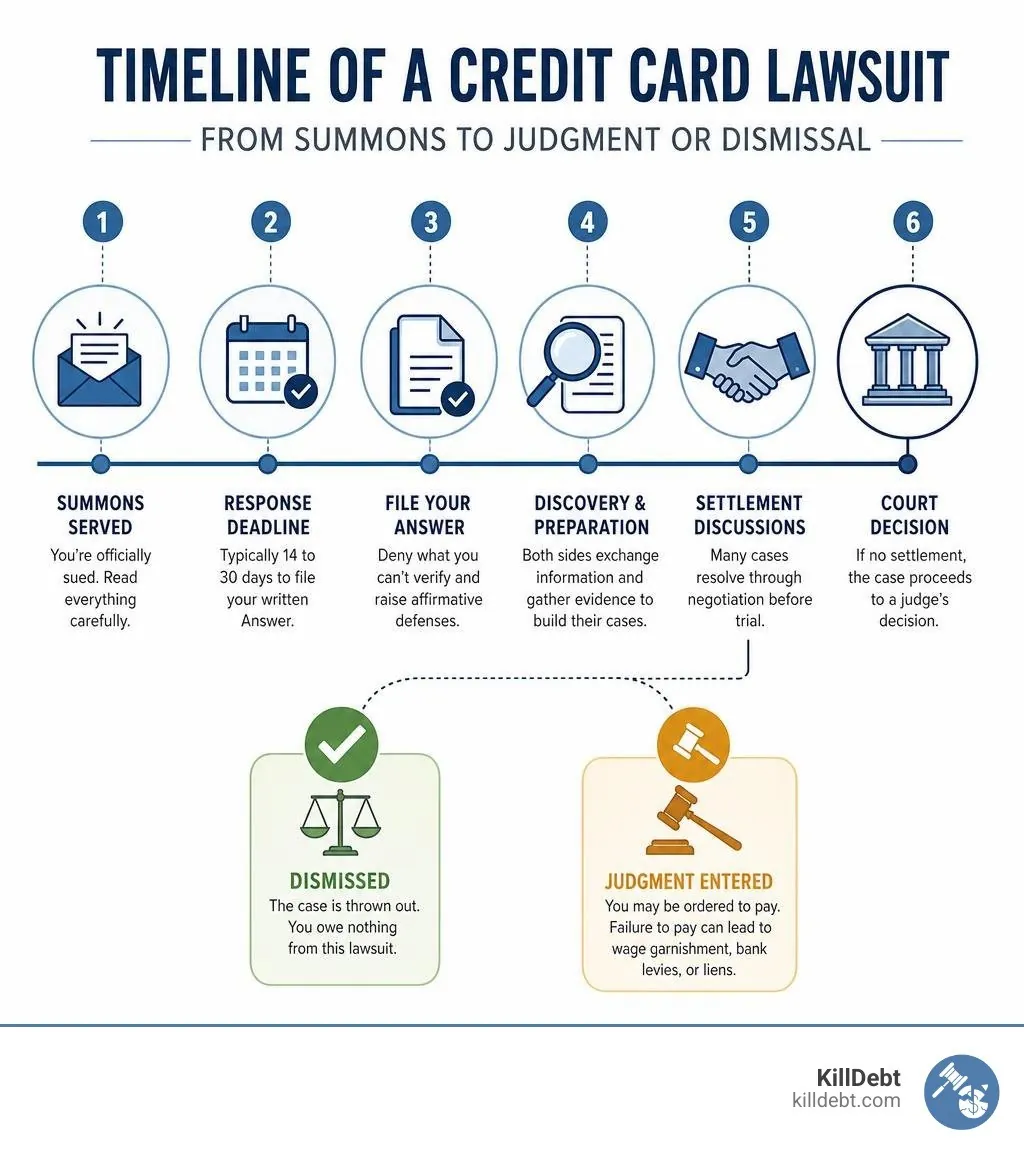
IMPORTANT LEGAL DISCLAIMER
This educational content is based on general legal principles and my experience in debt collection defense. It is provided for informational purposes only and does not constitute legal advice. Laws vary by state and by local court. For specific legal advice, consult a qualified attorney licensed in your jurisdiction. No attorney-client relationship is created by reading this guide.
Critical Multi-State Variations: FDCPA applies uniformly at the federal level, but state consumer protection laws may provide additional rights and remedies. Statute of limitations periods vary significantly by state and debt type. What constitutes sufficient debt validation varies in practice across jurisdictions. State-specific rules on call frequency, written notice requirements, and permissible collector conduct may differ from federal minimums.

When you are first served with a lawsuit, your adrenaline spikes. It is completely normal to feel a wave of panic, but the absolute worst thing you can do is stick those papers in a drawer and pretend they do not exist. Instead, take a deep breath. You have a window of time to act, and we are going to use every single day of it to build your defense.
During the first 7 days, your primary goal is information gathering and verification.
The lawsuit package consists of two main documents:
To make sure you do not miss any critical first steps, check out our guide on Sued for a Debt: Exactly What to Do in the First 7 Days.
Is the plaintiff your original credit card issuer (like Chase, Citibank, or Capital One), or is it a third-party debt buyer? Debt buyers purchase portfolios of defaulted accounts for pennies on the dollar and then file mass lawsuits to collect. Common debt buyers include:
Knowing the difference between an original creditor and a debt buyer is the cornerstone of your defense strategy. Original creditors usually have direct access to your monthly statements and original signed agreements. Debt buyers, on the other hand, frequently buy these accounts as digital spreadsheets with little to no physical backup documentation.
Did you actually receive the lawsuit papers legally? "Service of process" is the formal delivery of the summons and complaint. If a process server left the papers with a random neighbor, or simply tossed them on your porch without speaking to you, the service may be legally defective. While improper service can sometimes buy you time to get the case dismissed, it rarely kills the lawsuit permanently because the creditor can simply serve you again. Still, it is a vital detail to note.
For a comprehensive overview of your initial options, you can also read the FTC's advice on What To Do if a Debt Collector Sues You or review our checklist on What to Do When Sued by a Debt Collector.
Once you have analyzed the summons, you must prepare your formal response, known as an Answer. This is a legal document where you respond directly to each numbered allegation in the plaintiff's complaint.
If you ignore the summons, the court will enter a default judgment against you. A default judgment is an automatic win for the creditor. Once they have this judgment, they can legally:
To prevent this nightmare scenario, you must learn How to Answer a Credit Card Lawsuit and follow the proper legal channels. For a deep dive into the drafting process, read our breakdown on How to Write an Answer to a Credit Card Lawsuit.
Let's break the process down into two manageable steps.
Your Answer must follow specific formatting rules (often referred to as Rule 10 formatting). This includes a "caption" at the top of the page showing the court name, the parties' names, and the case/file number.
Below the caption, you will address each numbered paragraph of the complaint using one of three standard responses:
After responding to the individual paragraphs, you must list your affirmative defenses—the legal reasons why the plaintiff should not win even if some of their statements are true. (We will cover the best defenses in detail below).
To see what this looks like in practice, you can reference our Sample Answer to a Credit Card Lawsuit.
Once your Answer is drafted and signed, you must file it with the court clerk and serve a copy on the plaintiff's attorney.
For more details on small claims court processes, you can review the guide on About Small Claims Collection Lawsuits - The Florida Bar or review Michigan-specific options at What Can You Do In Michigan If You Are Sued By A Credit Card ... .
When you file your Answer, you must include your "affirmative defenses." If you do not raise these defenses in your initial Answer, the court may consider them waived forever.
The burden of proof rests entirely on the plaintiff. They must prove that you owe the debt, that they have the legal right to collect it, and that the amount they are claiming is accurate to the penny.
The following table compares the typical defense strategies depending on whether you are being sued by the original creditor or a third-party debt buyer:
| Defense Strategy | Sued by Original Creditor | Sued by Third-Party Debt Buyer |
|---|---|---|
| Statute of Limitations | Highly effective if the account has been inactive for years. | Highly effective; debt buyers frequently buy very old accounts. |
| Lack of Standing / Chain of Title | Weak; they are the original party to the contract. | Extremely Strong; they must prove ownership of your specific account. |
| Inaccurate Accounting / Fees | Moderate; challenge interest calculations and late fees. | Strong; debt buyers rarely have complete statement histories. |
| FDCPA Counterclaims | Generally N/A (FDCPA applies to third-party collectors). | Strong; can be used as leverage if they used deceptive tactics. |
For a broader look at defensive legal strategies, check out our Debt Lawsuit Defense Guide and explore local consumer advocacy insights at Credit Card Defense - Florin Legal, P.A. .
The statute of limitations is the legal time limit a creditor has to file a lawsuit against you. Once this period passes, the debt is considered "time-barred," and they can no longer legally sue you to collect.
The clock typically starts ticking from the date of your last payment or the date you first defaulted on the account.
Let’s look at a June 2026 timeline example: If you live in Florida and your last credit card payment was made in March 2021, the 5-year statute of limitations expired in March 2026. If a debt buyer sues you in June 2026, you can raise the expired statute of limitations as an affirmative defense, and the judge should dismiss the case.
Warning: Be incredibly careful. Making even a tiny partial payment or formally acknowledging the debt in writing can "restart" the statute of limitations clock in many jurisdictions!
If a third-party debt buyer is suing you, they must prove they have the legal right to do so. This is known as standing. To establish standing, they must produce a clean, unbroken "chain of title" showing the transfer of your specific account from the original creditor to any intermediary buyers, and finally to the plaintiff.
Often, debt buyers only attach a generic "Bill of Sale" to their lawsuit. This Bill of Sale usually says something like: "Originating Bank hereby sells a portfolio of 10,000 accounts to Debt Buyer LLC."
Unless they can produce the specific, redacted "Schedule A" or data tape printout showing your exact name, account number, and balance, they have not proven they own your debt. If they cannot produce these records during the discovery phase of the lawsuit, their case falls apart.
For a detailed explanation of this dynamic, read Who is Suing Me: Original Creditor vs. Debt Buyer and learn about local defense tactics in Debt Collection Lawsuits: How to Fight Back and Win in Florida .
Do not assume the plaintiff's math is correct. Debt collectors frequently tack on unauthorized interest, convenience fees, and attorney costs that were never agreed to in your original cardholder agreement.
Additionally, mistaken identity is incredibly common in the debt buying industry. Clerical errors, similar names, or identity theft can result in a debt collector suing the completely wrong person for a debt they never incurred. If you do not recognize the account, demand that they produce the original signed credit agreement and full monthly statements to prove you are the responsible party.
Under the federal Fair Debt Collection Practices Act (FDCPA), third-party debt collectors are strictly prohibited from using abusive, unfair, or deceptive practices. If a debt collector has violated your rights, you can file a counterclaim against them. Common violations include:
If you sue a debt collector for FDCPA violations, you can recover up to $1,000 in statutory damages, plus actual damages and your attorney fees. This provides massive leverage when negotiating a dismissal of their lawsuit. You have a strict one-year limit from the date of the violation to file an FDCPA claim.
If you do not want to fight the case all the way to a trial, you have other viable paths to resolve the litigation.
Most debt buyers purchase portfolios for 2 to 5 cents on the dollar, which means they have a massive profit margin. Because of this, they are highly motivated to settle. You can often negotiate a lump-sum settlement for 30% to 60% of the total balance claimed.
If you choose to settle, follow these golden rules:
For a comprehensive strategic guide, check out our Fight Debt Collection Lawsuit Complete Guide or read Michigan's court navigation resources at Going to Court to Defend a Debt Collection Case | Michigan Legal ... .
If you are facing multiple lawsuits, overwhelming medical bills, or credit card balances you have no hope of paying, bankruptcy might be the right path.
Filing for bankruptcy triggers an automatic stay. This is a powerful federal injunction that immediately halts all collection activities, including active lawsuits, pending court dates, bank levies, and wage garnishments. A Chapter 7 bankruptcy can completely discharge (wipe out) your credit card debt, giving you a totally clean financial slate.
You do not need to spend thousands of dollars on a defense attorney to protect your hard-earned money. Defending yourself pro se (without a lawyer) is entirely possible when you have the right tools.
At KillDebt, we have built a DIY legal defense system designed to level the playing field. Powered by ParkerGPT—an AI trained specifically on consumer debt law and real-world court strategies developed over 30+ years by attorney Brian Parker—our system analyzes your actual lawsuit documents, uncovers hidden weaknesses, and generates professional, court-ready Responses.
And if you want to practice before stepping foot in a real courtroom, we just rolled out Court Tester. It is an AI courtroom simulation built on your actual case. You upload your real filings, and within minutes, you are arguing your motion in front of an AI judge, facing off against AI opposing counsel, with a private AI co-counsel whispering winning strategies directly to you.
Do not let a default judgment ruin your credit and drain your bank account. Check out our KillDebt Pricing page today and discover how easy it is to fight back and win.
IMPORTANT LEGAL DISCLAIMER
This educational content is based on general legal principles and my experience in debt collection defense. It is provided for informational purposes only and does not constitute legal advice. Laws vary by state and by local court. For specific legal advice, consult a qualified attorney licensed in your jurisdiction. No attorney-client relationship is created by reading this guide.
Critical Multi-State Variations: FDCPA applies uniformly at the federal level, but state consumer protection laws may provide additional rights and remedies. Statute of limitations periods vary significantly by state and debt type. What constitutes sufficient debt validation varies in practice across jurisdictions. State-specific rules on call frequency, written notice requirements, and permissible collector conduct may differ from federal minimums.

About the author
Brian Parker
I have over 30 years of experience defending consumers against debt collection lawsuits and have seen every tactic, threat, and pressure play that collectors use. Through KillDebt and ParkerGPT, I have systematized the proven defense strategies that actually work - so consumers can respond from a position of knowledge, not fear. My approach focuses on aggressive legal defense based on documented case success rather than false hope that leads to default judgments