News Break
Best AI Legal Assistant for Florida Motion Summary Judgment Response
July 31, 2026
Blog / News Break
Learn how to defend personal loan defaults and find FDCPA violation lawyer help to stop harassment and build your case.
If you're searching for FDCPA violation lawyer help, here's the short answer:
You may be able to stop the harassment and get paid — even if you owe the debt.
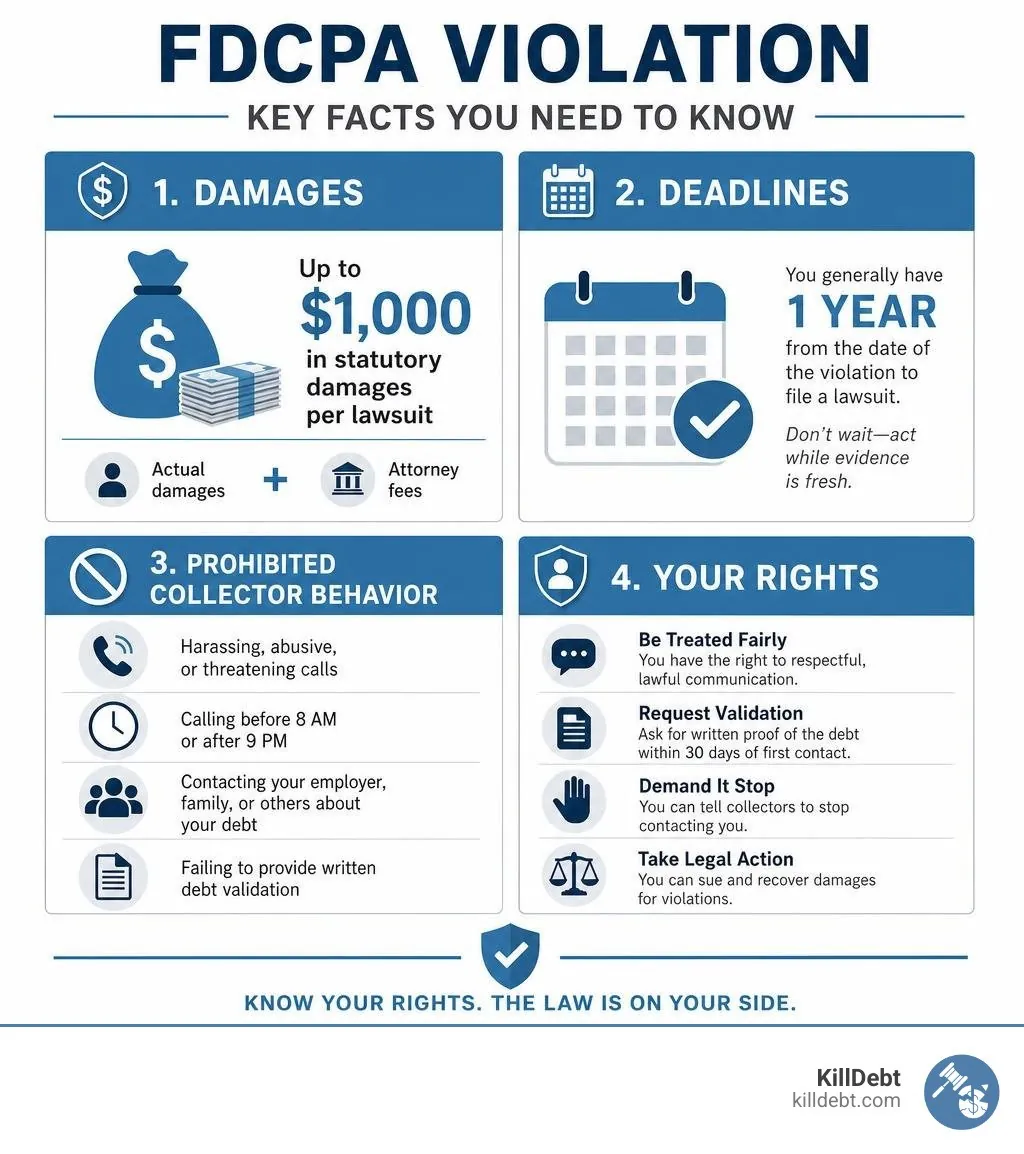
Under the Fair Debt Collection Practices Act (FDCPA), debt collectors who break the rules can be sued. You can recover up to $1,000 in statutory damages per lawsuit, plus actual damages and attorney fees — often at no out-of-pocket cost to you.
Quick answers to the most urgent questions:
| Your Situation | What You Can Do Right Now |
|---|---|
| Getting harassing or repeated calls | Document every call with dates and times |
| Called before 8 AM or after 9 PM | That's an FDCPA violation — save proof |
| Collector contacted your employer or family | That may be illegal — document it immediately |
| Never received a written debt validation notice | Dispute in writing within 30 days of first contact |
| Still being contacted after filing bankruptcy | Stop all contact — you may have two separate claims |
| Can't afford an attorney | Fee-shifting means the collector may pay your legal fees |
The calls start slowly. Then they become a constant, unwelcome presence — at home, at work, sometimes through your family. Collectors count on you feeling isolated and confused about your rights. Most people don't realize that the law is squarely on their side, and that a collector's illegal behavior can actually be turned against them as powerful legal leverage.
Here's what matters most right now: you do not have to be a victim, and you do not need to spend thousands on a lawyer to fight back.
I'm Brian Parker. For over 30 years, I've fought debt buyers, collection agencies, and collection law firms in courtrooms across the country — and I've built KillDebt specifically to give you the same FDCPA violation lawyer help strategies I've used to protect thousands of consumers. In this guide, I'll walk you through exactly what your rights are, how to document violations, and how to defend yourself — fast and affordably.
IMPORTANT LEGAL DISCLAIMER
This educational content is based on general legal principles and my experience in debt collection defense. It is provided for informational purposes only and does not constitute legal advice. Laws vary by state and by local court. For specific legal advice, consult a qualified attorney licensed in your jurisdiction. No attorney-client relationship is created by reading this guide.
Critical Multi-State Variations: FDCPA applies uniformly at the federal level, but state consumer protection laws may provide additional rights and remedies. Statute of limitations periods vary significantly by state and debt type. What constitutes sufficient debt validation varies in practice across jurisdictions. State-specific rules on call frequency, written notice requirements, and permissible collector conduct may differ from federal minimums.
When you are facing a personal loan default, it can feel like the weight of the world is on your chest. You might feel embarrassed, stressed, and completely overwhelmed by the constant barrage of letters and phone calls. However, as a consumer, you are protected by a powerful shield: the Fair Debt Collection Practices Act (FDCPA).
To learn more about the fundamentals of this law, read our detailed guide on FDCPA Explained.
The FDCPA is a federal consumer protection law passed by Congress in 1977. Its primary goal is to eliminate abusive, deceptive, and unfair debt collection practices. Congress officially recognized that debt collection abuse is a major contributor to personal bankruptcies, marital instability, and job loss. Because of this, the law was designed to give you a private right of action — meaning you can sue a debt collector who crosses the line.
But before you can use this law to defend yourself, you must understand who it applies to. To dive deeper into these definitions, check out What is a Debt Collector Under the FDCPA – Your Rights Explained.
The FDCPA strictly protects individual consumers against abusive practices related to personal, family, or household debts. This includes credit card debt, medical bills, auto loans, mortgages, and personal loans. It does not, however, cover debts incurred for business purposes.
The federal law establishes a clear set of "dos and don'ts" for collectors. For example, collectors are legally prohibited from:
If a collector violates any of these rules, they have committed a strict liability offense. This means you do not have to prove they intended to break the law; the mere fact that they did is enough to establish a violation.
A common point of confusion is whether the federal FDCPA applies to the original creditor — the bank, credit union, or personal loan company that originally lent you the money.
Under federal law, the answer is generally no. The federal FDCPA applies strictly to third-party debt collectors, collection agencies, debt buyers, and attorneys acting as debt collectors. If the original lender is using its own in-house billing or collection department under its own name, the federal FDCPA does not apply to them.
However, this is where state laws come into play. In our target states of Florida and Michigan, local consumer protection laws step in to fill this gap, extending many of these strict protections directly to original creditors. We will cover these state-specific protections in detail below.
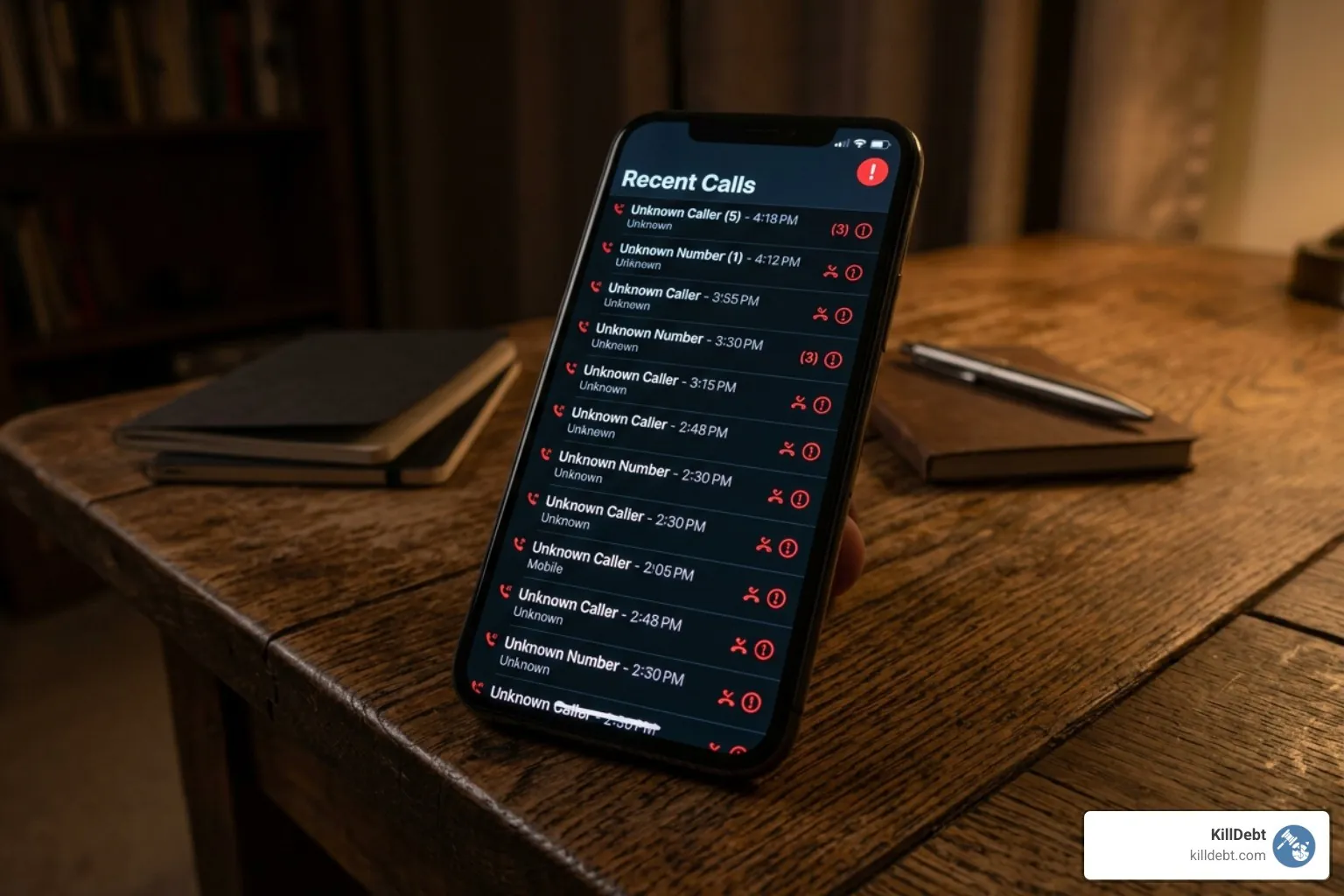
Many debt collection agencies operate on a business model that intentionally pushes legal boundaries, counting on your silence and lack of legal knowledge. Recognizing when a collector has crossed from persistent calling into illegal harassment is the first step in turning the tables.
If you are experiencing constant calls, learn how to make them stop by reading Debt Collector Harassment Stop.
What does illegal harassment actually look like in real life? Here are some of the most common violations consumers experience:
If you believe a collector is harassing you, read Debt Collector FDCPA Violation for an in-depth breakdown of your rights.
Meticulous analysis of communication records is the key to proving an FDCPA violation. When evaluating your case, you should look for patterns of behavior. Did they call your cell phone multiple times in a single day? Did they leave confusing voicemails that failed to disclose their identity? Did they send a letter that looked like an official court document but was actually a deceptive marketing tactic?
Identifying these violations doesn't just stop the calls; it provides you with incredible leverage. If you can prove a violation, you can file a claim. To understand how to report this behavior, see Illegal Debt Collection Harassment Reporting.
If you have filed for bankruptcy, an "automatic stay" is immediately put in place under federal law. This stay legally halts all collection activities, lawsuits, and foreclosure proceedings.
If a debt collector contacts you after you have filed for bankruptcy, they are violating the bankruptcy stay. This triggers a powerful dual-claim strategy. You can sue them for violating the bankruptcy automatic stay under 11 U.S.C. § 362(k), and simultaneously sue them for an FDCPA violation under 15 U.S.C. § 1692k. This can result in two separate damage awards. For residents in Michigan facing this, consulting a Creditor Harassment Attorney in Michigan can help clarify how these dual claims operate in local bankruptcy courts.
While the federal FDCPA sets a baseline of consumer protection across the United States, individual states often pass their own laws to provide even stronger rights. If you live in Florida or Michigan, you have access to excellent state-level protections.
In Florida, the primary state-level debt collection statute is the Florida Consumer Collection Practices Act (FCCPA). Unlike the federal FDCPA, the FCCPA applies to both third-party debt collectors and original creditors. This means if your original personal loan lender harasses you, you can sue them directly under Florida law.
Under the FCCPA, consumers have the right to recover statutory damages of up to $1,000, actual damages, and punitive damages. Furthermore, the FCCPA makes it illegal for any collector (including original creditors) to:
For more details on Florida-specific rules, consult a Debt Collection Lawyer in Florida | Consumer Law Florida or review Florida Fair Debt Collection Practices Act (FDCPA) Violations .
Michigan also provides robust protections through the Michigan Occupational Code (for licensed collection agencies) and the Michigan Regulation of Collection Practices Act (which covers original creditors).
Under Michigan law, original creditors are prohibited from engaging in misleading, deceptive, or confusing collection practices. Violating Michigan's state-level collection laws can result in statutory damages, actual damages, and attorney's fees.
To learn more about how Michigan protects its residents, check out the resources provided by a Michigan Fair Debt Collection Practices Act Attorney or contact a Michigan FDCPA Violation Lawyer | 248-398-7100 .
If you want to stop collector harassment and potentially recover financial compensation, you must build a bulletproof paper trail. Debt collectors will often deny making harassing calls or using abusive language, so having clear, documented evidence is vital.
Follow this process to document every potential FDCPA violation:
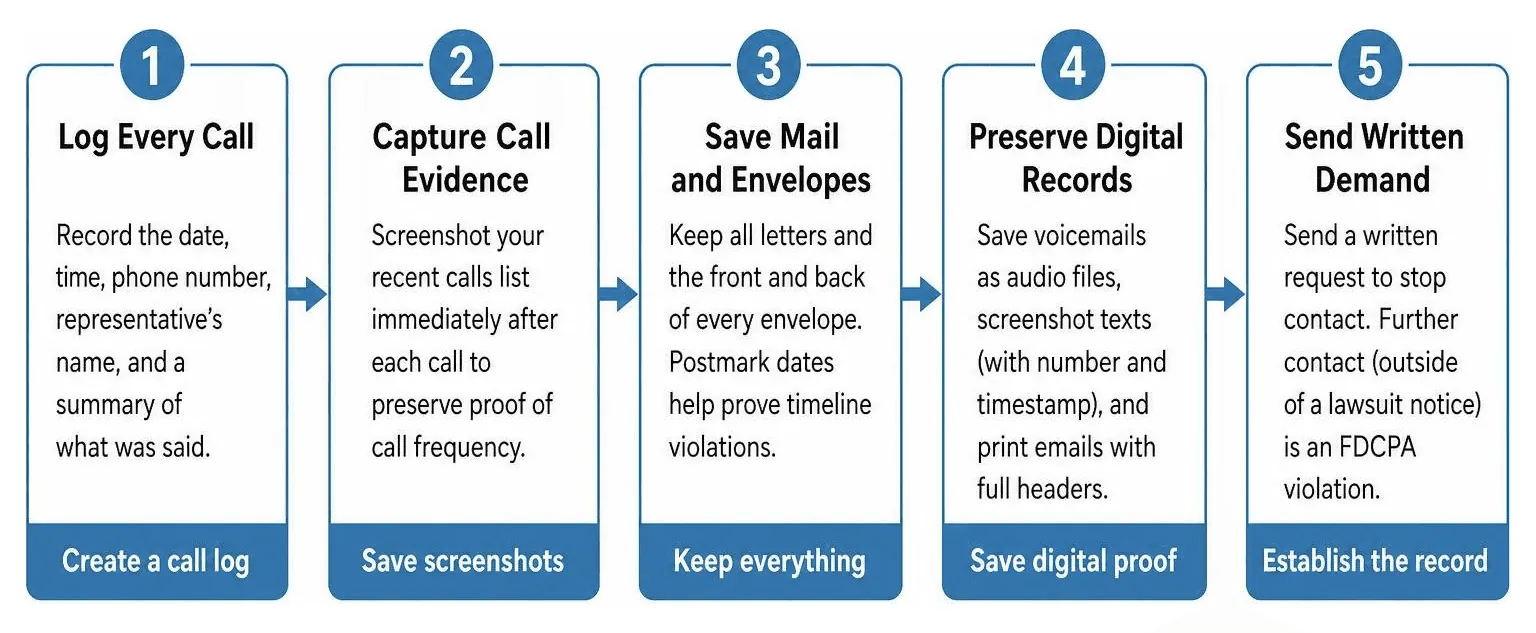
To better prepare your documents, review the checklist provided in Fair Debt Collection Practices Act (FDCPA) – Intake Process & Documents - Consumer Attorneys .
Time is of the essence when dealing with FDCPA violations. Under federal law (15 U.S.C. § 1692k(d)), you have exactly one year from the date of the violation to file a lawsuit in court. If you wait even one day past the one-year mark, your claim is barred forever. This is why immediate documentation and action are so critical.
When a debt collector violates your rights, the law provides clear civil remedies. You can turn their mistakes into financial leverage to settle your debts or recover cash damages.
Under the federal FDCPA, a successful consumer can recover:
To understand how to initiate a lawsuit, read our Sue Debt Collector Complete Guide, and learn more about consumer investigations in Harassing Debt Collector Calls? Learn About Your Rights .
If you are facing a personal loan default or a collection lawsuit, you have a major decision to make: should you hire a traditional attorney, or can you defend yourself?
To help answer this, read Do I Need a Lawyer for a Debt Collection Lawsuit.
Hiring a traditional attorney can be highly effective, but it often comes with high costs. Many defense lawyers charge hourly rates or flat fees exceeding $1,500, which can worsen your financial situation when you are already struggling with debt. While some FDCPA attorneys will take cases on a contingency basis (where they only get paid if you win, via fee-shifting), they are highly selective and may not take your case if the documentation isn't absolutely perfect.
For an overview of how traditional firms handle these defenses, see Fair Debt Collection Practices Act (FDCPA) | Attorneys .
At KillDebt, we believe that legal defense should be accessible to everyone. We provide an AI-powered platform designed specifically for self-defense against debt collectors.
Our platform features ParkerGPT, an AI trained on consumer debt law and real-world court strategies developed over 30+ years by defense attorney Brian Parker. ParkerGPT can analyze your collection letters, identify FDCPA violations, and generate court-ready dispute letters and lawsuit responses in minutes.
We have also rolled out our brand-new tool: the Court Tester. This is an AI courtroom simulator built on your actual case. You simply upload your real legal filings, and within minutes, you can practice arguing your motion in front of an AI judge, against AI opposing counsel, with a private AI co-counsel whispering strategies that only you can see. It gives you the ultimate preparation to face collectors confidently without paying thousands in attorney fees.
To view our affordable options, visit KillDebt Pricing.
Facing a personal loan default is incredibly stressful, but you do not have to let debt collectors steal your peace of mind. The FDCPA and state laws in Florida and Michigan give you powerful rights to stop the harassment, dispute unverified debts, and even sue abusive collectors for damages.
Whether you choose to hire a traditional attorney or take control of your own defense, the key is to act quickly and document everything. With KillDebt's ParkerGPT and our Court Tester, you have the ultimate tools to analyze your letters, draft professional legal responses, and simulate courtroom arguments — all at a fraction of the cost of a traditional law firm.
Take a deep breath. You are in control now. Empower your debt defense with KillDebt and put an end to collector harassment today.
Get started with KillDebt pricing
IMPORTANT LEGAL DISCLAIMER
This educational content is based on general legal principles and my experience in debt collection defense. It is provided for informational purposes only and does not constitute legal advice. Laws vary by state and by local court. For specific legal advice, consult a qualified attorney licensed in your jurisdiction. No attorney-client relationship is created by reading this guide.
Critical Multi-State Variations: FDCPA applies uniformly at the federal level, but state consumer protection laws may provide additional rights and remedies. Statute of limitations periods vary significantly by state and debt type. What constitutes sufficient debt validation varies in practice across jurisdictions. State-specific rules on call frequency, written notice requirements, and permissible collector conduct may differ from federal minimums.

About the author
Brian Parker
I have over 30 years of experience defending consumers against debt collection lawsuits and have seen every tactic, threat, and pressure play that collectors use. Through KillDebt and ParkerGPT, I have systematized the proven defense strategies that actually work - so consumers can respond from a position of knowledge, not fear. My approach focuses on aggressive legal defense based on documented case success rather than false hope that leads to default judgments.