News Break
15 Tips to Influence Your Next Settlement Negotiation
July 30, 2026
Blog / News Break
Learn about Where can I find an AI-powered legal assistant that helps draft a florida motion summary judgment response for a consumer debt case.

If you are facing a consumer debt lawsuit in Florida, receiving a Motion for Summary Judgment (MSJ) is a critical, make-or-break moment. This is not just another piece of court paperwork you can set aside. It is the creditor’s attempt to fast-forward the lawsuit and win the case without ever having to go to trial.
To understand why responding is so urgent, we have to look at the broader landscape of consumer debt litigation in America today.
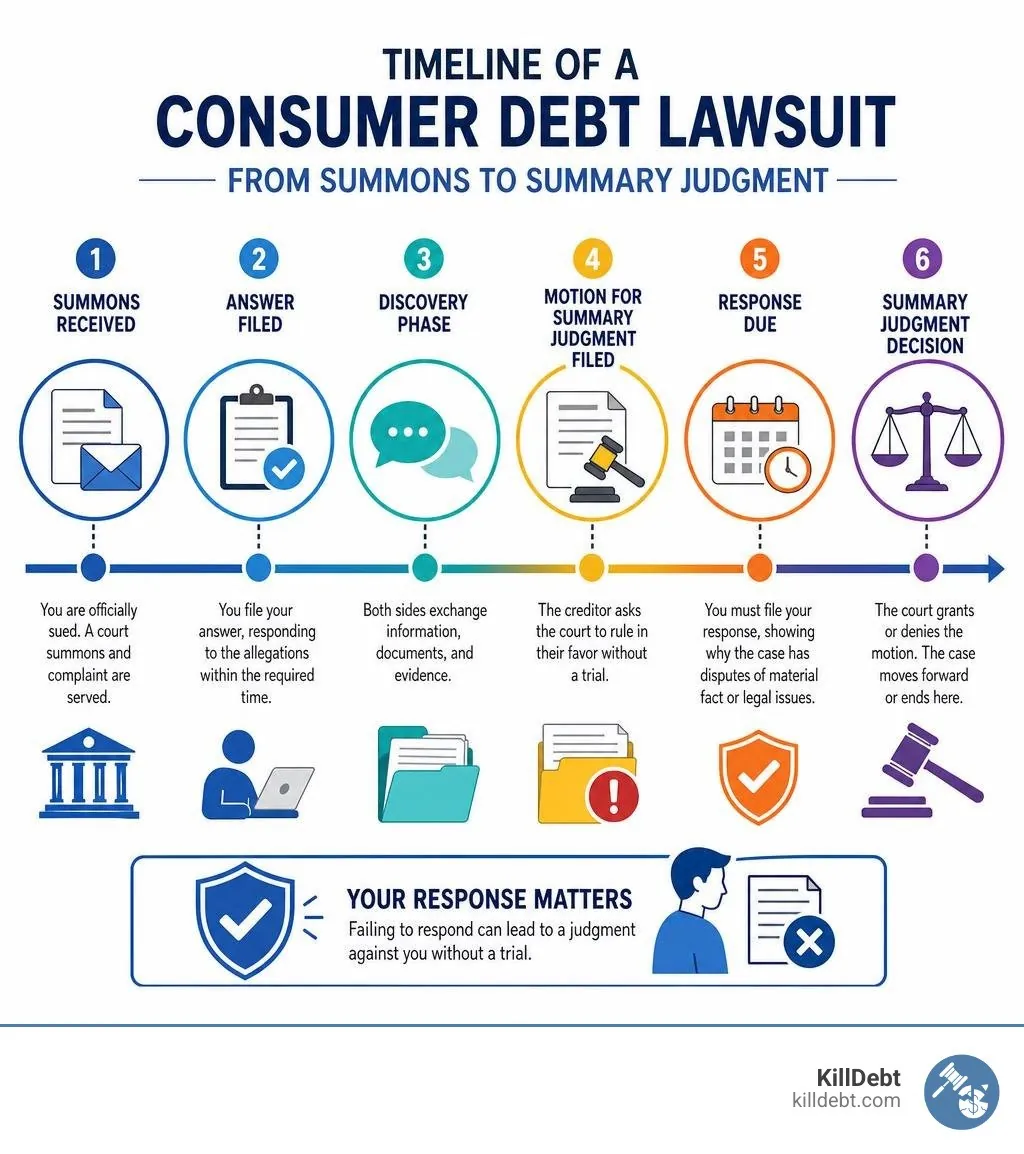
When a creditor files a Motion for Summary Judgment, they are telling the judge: "There is no reason to waste time on a trial. The facts are clear, the consumer owes this money, and they have no valid legal defense. Give us an immediate judgment."
If you fail to respond to this motion, the judge will almost certainly take the creditor's word for it. Failing to file a written response guarantees an automatic win for the creditor.
Once the court enters a final summary judgment against you, the creditor gains powerful legal mechanisms to collect the money. They can immediately move to freeze your bank accounts, place liens on your personal property, or initiate wage garnishment. To protect your hard-earned income, you must understand your rights and how to stop them. For more details on what they can take, read our guide on Florida Wage Garnishment Laws.
Navigating the complex world of legal technology can feel overwhelming, especially when you are trying to defend yourself pro se (without a lawyer). It is important to understand the difference between general generative AI and specialized legal assistants.
General AI tools (like standard ChatGPT or Claude) are incredibly smart, but they are generalists. They are prone to "hallucinations"—making up fake case law or misinterpreting highly specific state court procedures. If you want to learn about the general state of AI in the legal field, you can browse the University of Michigan's guide on AI Tools & Resources - Generative AI . However, relying on a general chatbot to draft a formal court pleading in Florida is highly risky.
On the other hand, many professional legal AI tools on the market are built strictly for practicing trial attorneys. While highly effective for lawyers, these professional platforms are often too expensive and complex for everyday consumers.
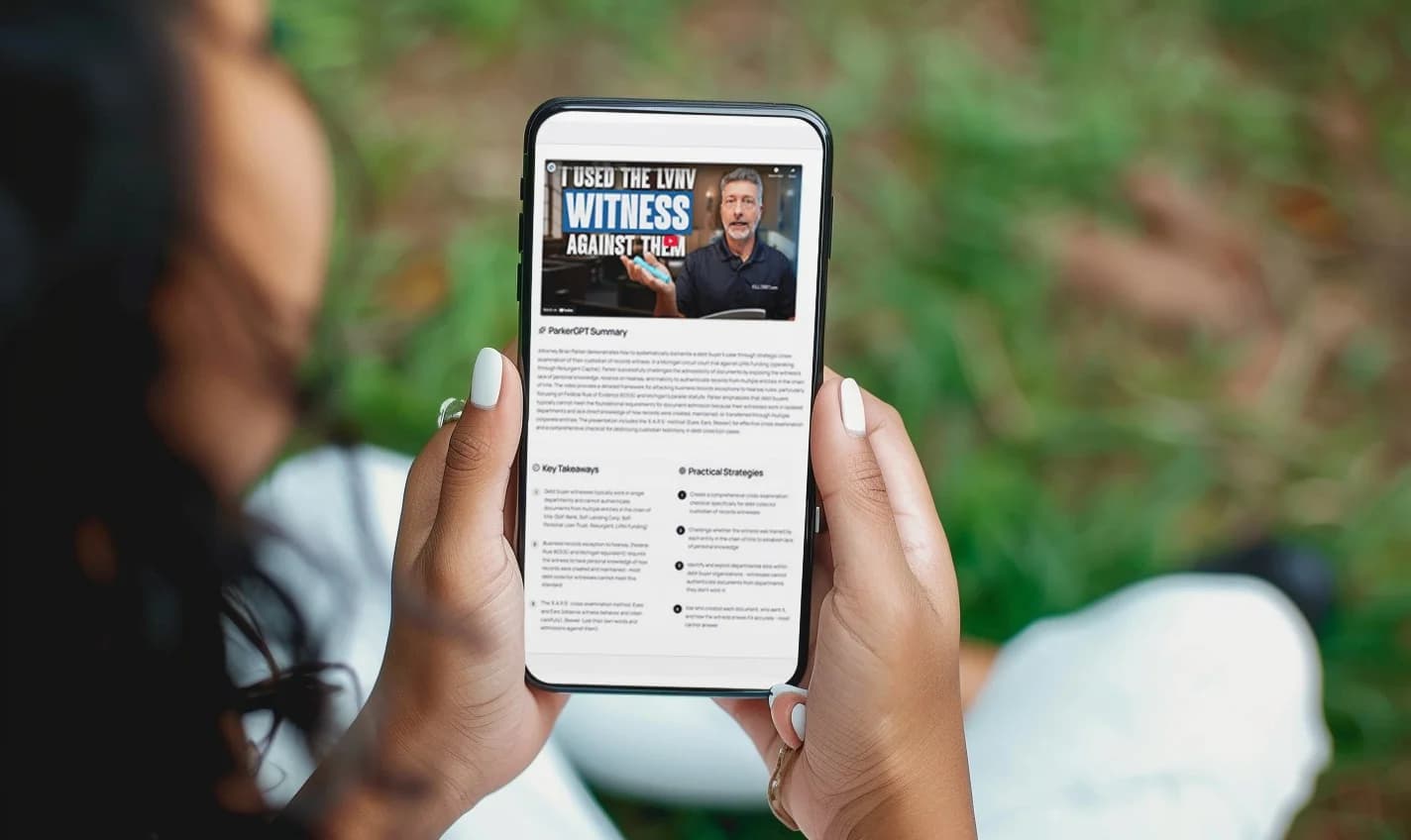
This is exactly why we built ParkerGPT.
We designed ParkerGPT to be the ultimate DIY legal defense system specifically for consumer debt cases. It is not a generic AI; it is trained on consumer debt law and real-world courtroom strategies developed over 30+ years by veteran defense attorney Brian Parker.
Unlike other legal tech, ParkerGPT:
We also recently introduced a game-changing tool: the Court Tester. This is an AI courtroom simulation built entirely around your actual case. Once you upload your lawsuit documents, you can step into a virtual courtroom. Within minutes, you will practice arguing your motion in front of an AI judge, facing off against an AI opposing counsel, while a private AI co-counsel whispers real-time strategic advice only you can see. It is the perfect way to build confidence before your actual hearing.
To explore how these technologies are changing the game for everyday consumers, check out our breakdown of Legal Tech Debt Tools.

If you are defending a debt lawsuit in Florida, you must play by the official rules of the court. The most important rule governing this stage of your case is Florida Rule of Civil Procedure 1.510.
Historically, Florida had its own unique standard for summary judgments. However, the Florida Supreme Court amended Rule 1.510 to align closely with the federal summary judgment standard. This change has major implications for your defense:
In Florida, timing is everything. Under Rule 1.510(c)(5), the non-moving party (you) must serve your written response and all supporting factual materials (such as affidavits or discovery documents) at least 20 days before the scheduled summary judgment hearing.
If you miss this deadline, the court is legally allowed to ignore your response entirely. If the judge refuses to consider your late-filed defense, the creditor wins automatically.
This is where an AI legal assistant is invaluable. ParkerGPT helps you track these critical deadlines, ensuring you draft, format, and serve your response well ahead of the 20-day cutoff. To learn more about navigating these procedural hurdles, read our detailed guides on the Florida Rules of Court, How to Answer a Debt Summons, and your fundamental Florida Debt Lawsuit Rights.
To defeat a Motion for Summary Judgment, your response must raise strong legal arguments known as affirmative defenses. An affirmative defense is a reason why, even if the creditor's claims are true, they still cannot legally win the lawsuit.
Here are the most effective affirmative defenses in Florida consumer debt cases, and how AI can help you identify and organize them:
In Florida, creditors have a strict time limit to sue you. Under Florida law, the statute of limitations is 5 years for written contracts and 4 years for open-ended accounts (like credit cards). The clock starts ticking from the date of your last missed payment. If a debt buyer sues you after this time limit has passed, the lawsuit is legally dead. Our AI can analyze your credit statements, pinpoint the exact date of default, and draft a rock-solid statute of limitations defense. For a complete breakdown, see our Statute of Limitations Florida Guide 2026.
Most debt lawsuits are filed by third-party "junk debt buyers" (like Midland Credit Management or Portfolio Recovery Associates) who bought your debt for pennies on the dollar. To win, they must prove they actually own your specific account. This requires a clean "chain of title"—a series of signed assignments showing the transfer of the debt from the original creditor to the debt buyer.
If there is a single gap in this chain, they lack "standing" to sue you. AI tools are incredibly efficient at scanning bulk bill-of-sale documents to find these missing links.
If the creditor never properly served you with the lawsuit papers according to Florida rules, the court lacks jurisdiction over you.
Preparing a summary judgment response requires a deep command of the facts. In professional litigation, specialized software is often used to map out facts chronologically, linking every claim to a specific piece of evidence to avoid redundant document re-review.
ParkerGPT brings this same level of rigorous organization to pro se litigants. By analyzing the creditor's motion, our AI can extract key discrepancies, such as:
If the creditor has failed to provide these documents, our AI can help you draft a Motion to Compel Discovery to force them to hand over the evidence before the court rules on their summary judgment motion. Learn how to execute this strategy in our guides: How Compel Discovery Debt Case and the Debt Lawsuit Defense Guide.
While AI-powered legal assistants are incredibly powerful, they are tools to assist you—they are not a complete replacement for a human attorney. It is vital to understand what AI can and cannot do so you can make informed decisions about your defense.
You should strongly consider consulting a qualified human attorney if:
Many consumers do not realize they don't have to choose between an expensive full-representation attorney and going completely DIY. Under Florida Rule of Civil Procedure 1.041, attorneys are allowed to make a "Limited Appearance."
This means you can hire a lawyer to handle just one specific part of your case—such as representing you at the summary judgment hearing—while you handle the rest of the document preparation and discovery DIY using AI. This hybrid approach can save you thousands of dollars while ensuring you have professional representation when it matters most.
| Feature | AI Legal Assistant (e.g., ParkerGPT) | Traditional Human Attorney |
|---|---|---|
| Cost | Highly affordable (Subscription-based) | High ($250 - $500+ per hour) |
| Drafting Speed | Minutes | Days or weeks |
| Court Representation | None (Self-represented / Pro Se) | Full representation in court |
| Document Analysis | Instant, algorithmic scanning | Manual, detailed review |
| Best Used For | Drafting responses, finding defenses, practicing hearings | Complex arguments, live hearings, depositions |
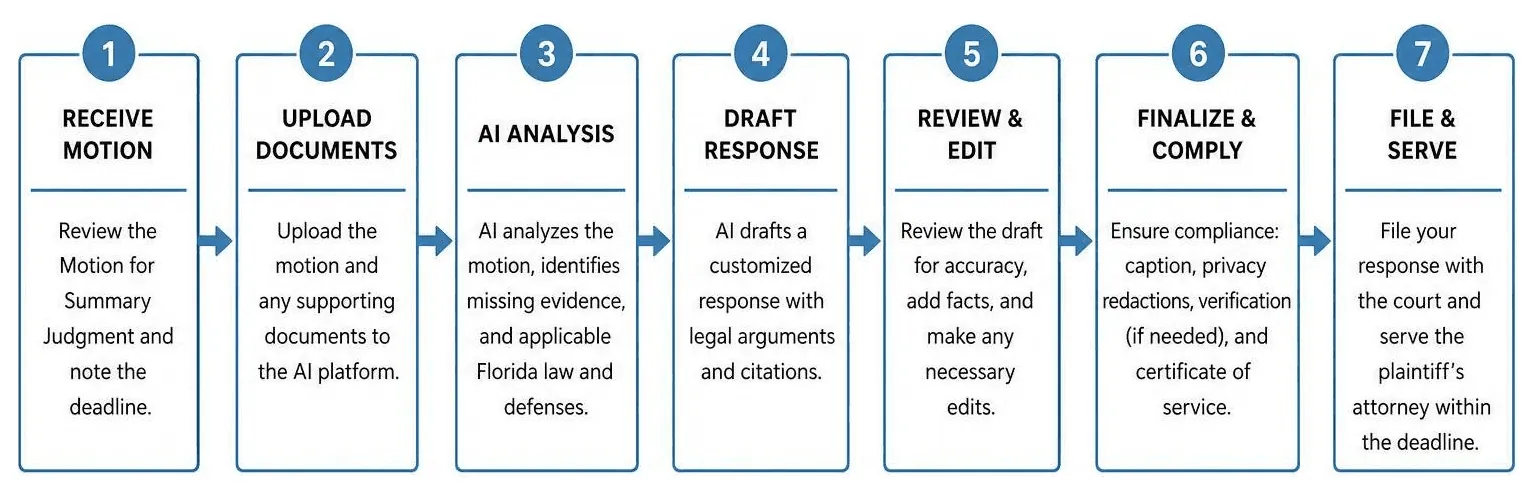
If you have been served with a Motion for Summary Judgment, time is of the essence. We built KillDebt to give you the tools, confidence, and legal strategies you need to fight back and protect your financial future.
Here is how you can get started with us today:
Don't let debt collectors win by default. Let us help you fight back.
IMPORTANT LEGAL DISCLAIMER
This educational content is based on general legal principles and my experience in debt collection defense. It is provided for informational purposes only and does not constitute legal advice. Laws vary by state and by local court. For specific legal advice, consult a qualified attorney licensed in your jurisdiction. No attorney-client relationship is created by reading this guide.
Critical Multi-State Variations: FDCPA applies uniformly at the federal level, but state consumer protection laws may provide additional rights and remedies. Statute of limitations periods vary significantly by state and debt type. What constitutes sufficient debt validation varies in practice across jurisdictions. State-specific rules on call frequency, written notice requirements, and permissible collector conduct may differ from federal minimums.

About the author
Brian Parker
I have over 30 years of experience defending consumers against debt collection lawsuits and have seen every tactic, threat, and pressure play that collectors use. Through KillDebt and ParkerGPT, I have systematized the proven defense strategies that actually work - so consumers can respond from a position of knowledge, not fear. My approach focuses on aggressive legal defense based on documented case success rather than false hope that leads to default judgments.