
News Break
How to Report Debt Harassment on a Budget
June 24, 2026
Blog / News Break
Learn how Florida wage garnishment laws work and protect your paycheck with exemptions, limits, and legal defense strategies.

Florida wage garnishment laws set strict limits on how much a creditor can take from your paycheck — and in some cases, they can protect every single dollar you earn.
Here's a quick summary of the key rules:
| Rule | Details |
|---|---|
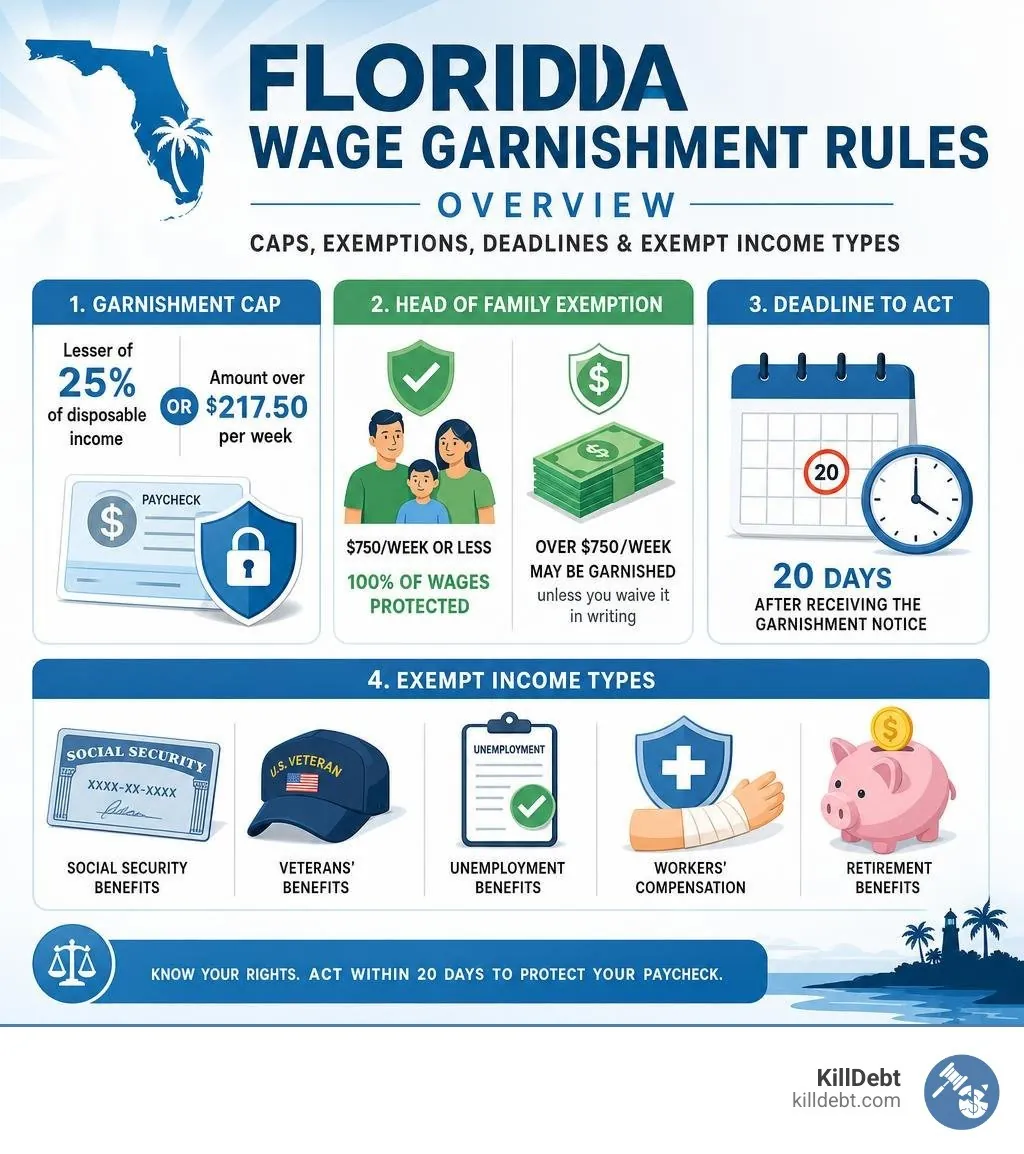
| Standard garnishment cap | Lesser of 25% of disposable income OR the amount over $217.50/week |
| Head of Family full exemption | 100% of wages protected if you earn $750/week or less and support a dependent |
| Head of Family partial exemption | Wages above $750/week may be garnished, unless you waive it in writing |
| Exempt income types | Social Security, veterans' benefits, unemployment, workers' comp, retirement |
| Debts that skip the court process | Child support, IRS tax levies, federal student loans in default |
| Deadline to claim exemption | 20 days after receiving the garnishment notice |
If a writ of garnishment has landed on your employer's desk — or you've just received a notice — the clock is already ticking. Missing the 20-day deadline to claim your exemptions can cost you wages you were legally entitled to keep.
Florida follows the federal Consumer Credit Protection Act (CCPA) as a baseline, but it also adds its own protections — most notably, the head of family exemption, which can shield your entire paycheck if you qualify.
I'm Brian Parker, and for over 30 years I've fought creditors, debt buyers, and collection law firms in courtrooms across the country — including countless cases involving Florida wage garnishment laws. I've seen how fast things move once a writ is issued, and I built KillDebt so you don't have to face it alone.
At its core, wage garnishment is a legal process where a court orders your employer to withhold a portion of your earnings and send them directly to a creditor to satisfy a debt. In Florida, this is not something a standard credit card company or medical provider can do on a whim. They cannot simply call your boss or send a threatening letter demanding your pay.
For ordinary consumer debts, a creditor must first sue you in court, win the lawsuit, and obtain a formal money judgment against you. Once they have that judgment in hand, they can file a Motion for Continuing Writ of Garnishment.
If the court approves the motion, it issues a "continuing writ of garnishment" to your employer, who is legally referred to as the "garnishee." Under Florida law, this writ acts as a continuous order. It requires your employer to systematically strip away a portion of your wages every single pay period as they become due. This process continues until the judgment is fully paid, you leave the job, or the court orders the garnishment to stop.
Understanding how this process unfolds is the first step in mounting an active defense. If you are currently facing this threat, you can learn more about the immediate mechanics of halting this process in our guide on Stopping a Wage Garnishment.
If you do not qualify for special exemptions, Florida law limits how much of your paycheck a creditor can actually seize. These limits are designed to ensure you still have enough money to survive. Florida’s standard limits align closely with the federal protections established by the Consumer Credit Protection Act (CCPA).
The amount that can be garnished is calculated based on your "disposable earnings." Your disposable earnings are not the same as your gross pay, nor are they exactly your take-home pay. Disposable earnings are calculated by taking your gross wages and subtracting only the deductions that are legally required. These mandatory deductions include:
Voluntary deductions — such as health insurance premiums, union dues, 401(k) contributions, or charitable donations — do not reduce your disposable earnings for garnishment purposes.
Under the standard rules set by the federal CCPA and Statutes & Constitution :View Statutes : Online Sunshine, the maximum amount that can be garnished from your paycheck in any workweek is the lesser of:
Currently, the federal minimum wage is $7.25 per hour. Therefore, 30 times the federal minimum wage is $217.50.
Here is how this plays out in real numbers:
While the 25% standard cap offers basic protection, Florida provides an incredibly powerful defense known as the Head of Family exemption (sometimes called the Head of Household exemption). Under Fla. Stat. 222.11, if you qualify as a "head of family," your wages enjoy immense protection.
For a creditor to garnish wages above the $750 weekly threshold from a head of family, they must present a valid, signed waiver. Florida law is incredibly strict about these waivers. Under the statute, a waiver is only valid if it meets the following criteria:
If a creditor tries to garnish your wages using a general clause buried in the fine print of a standard contract, the waiver is completely invalid, and your wages remain protected. You can read more about how this powerful defense works in our deep-dive on the Head of Household Exemption.
To claim this exemption, you must meet the legal definition of a "head of family." Under Florida law, a head of family is any natural person who provides more than one-half (50%) of the financial support for a child or another dependent.
Crucially, the dependent does not have to be a minor child, nor do they have to live under the exact same roof as you, as long as you are providing more than half of their financial support. Qualifying dependents can include:
Both spouses cannot claim "head of family" status for the exact same dependents. Additionally, if you are a self-employed business owner who controls your own pay or draws irregular cash flow from a business, creditors may challenge your status, arguing that your income consists of business profits rather than personal "earnings" for services.
The most important thing to know about the head of family exemption is that it is not automatic. If you do not claim it, your employer will be forced to comply with the writ, and your wages will be sent to the creditor.
When a creditor serves a writ of garnishment, they are legally required to send you a package containing a "Notice to Defendant of Right Against Garnishment." To claim your exemption, you must act quickly:
If you are facing an urgent garnishment in the Southern District, you can view the official court form and instructions via the UNITED STATES BANKRUPTCY COURT SOUTHERN DISTRICT OF FLORIDA Notice to Defendant.
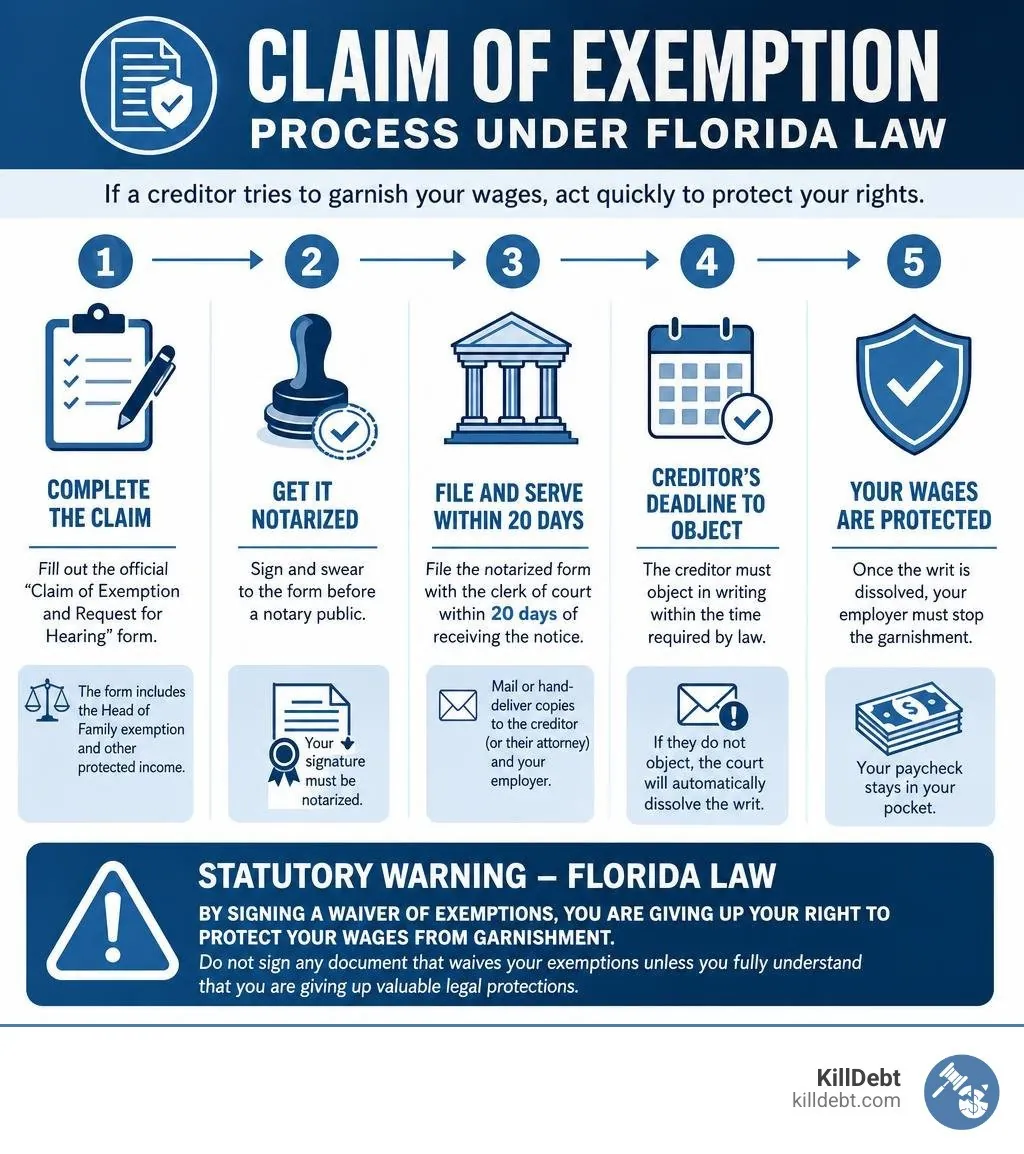
Once you file, the creditor has a strict deadline to object. If they do not object in writing within the required time, the court will automatically dissolve the writ of garnishment, and your paycheck will be safe.
While standard judgment creditors (like credit card companies, medical providers, and personal loan lenders) must jump through all the hoops described above, certain types of debts do not play by the same rules. These are known as administrative garnishments, and they can bypass the typical court judgment process entirely.
There are three primary categories of debt that can garnish your wages without a court judgment and can exceed standard CCPA limits:
The Florida garnishment statutes are incredibly technical. If a creditor makes a single procedural error or misses a deadline, you can use that mistake to have the garnishment thrown out.
Under Chapter 77 Section 041 - 2025 Florida Statutes - The Florida Senate and surrounding sections, creditors and employers must meet these strict rules:
If you are facing an active garnishment or have been served with a debt lawsuit, you have several powerful strategies to fight back:

Facing a wage garnishment threat in Florida can feel overwhelming, but the law provides you with incredibly powerful tools to defend yourself. Whether you qualify for the Head of Family exemption or need to challenge a creditor's procedural mistakes, you do not have to navigate this complex system alone.
At KillDebt, we provide a DIY legal defense system powered by ParkerGPT — an advanced AI trained specifically on consumer debt law and real-world court strategies developed over 30+ years by defense attorney Brian Parker. Unlike generic legal tools, ParkerGPT analyzes your actual lawsuit documents, uncovers critical weaknesses in the creditor's case, and generates court-ready responses with simple, step-by-step instructions.
We also recently introduced our brand-new Court Tester tool. Court Tester is an AI-powered courtroom simulation built around your actual case. You can upload your real filings and, within minutes, practice arguing your motion in front of an AI judge, against AI opposing counsel, with a private AI co-counsel whispering winning strategies that only you can see.
Don't let debt collectors strip away your hard-earned wages. Empower yourself, understand your rights, and take control of your financial future today. Learn more about our subscription plans on our pricing page, and Protect your paycheck with KillDebt today!
IMPORTANT LEGAL DISCLAIMER
This educational content is based on general legal principles and my experience in debt collection defense. It is provided for informational purposes only and does not constitute legal advice. Laws vary by state and by local court. For specific legal advice, consult a qualified attorney licensed in your jurisdiction. No attorney-client relationship is created by reading this guide.
Critical Multi-State Variations: FDCPA applies uniformly at the federal level, but state consumer protection laws may provide additional rights and remedies. Statute of limitations periods vary significantly by state and debt type. What constitutes sufficient debt validation varies in practice across jurisdictions. State-specific rules on call frequency, written notice requirements, and permissible collector conduct may differ from federal minimums.

About the author
Brian Parker
I have over 30 years of experience defending consumers against debt collection lawsuits and have seen every tactic, threat, and pressure play that collectors use. Through KillDebt and ParkerGPT, I have systematized the proven defense strategies that actually work - so consumers can respond from a position of knowledge, not fear. My approach focuses on aggressive legal defense based on documented case success rather than false hope that leads to default judgments.