
News Break
How to Defend Court Debt, Even When You Don't Feel Like It
June 15, 2026
Blog / News Break
Stop wage garnishment today with proven legal strategies and court-tested defenses to protect your paycheck.

Stopping a wage garnishment is possible — and you have more options than you think.
Here are the fastest ways to stop it:
Opening your paycheck to find a chunk of it already gone is a gut punch. One week you're managing, the next you're short on rent because a creditor quietly got a court order and told your employer to start withholding.
Here's the hard truth: by the time garnishment starts, a court has already ruled against you. The creditor sued, you may not have even known about it, and a default judgment was entered. Now your employer is legally required to hand over part of your pay.
But that does not mean it's over.
Federal law caps most consumer debt garnishments at 25% of your disposable earnings — or the amount above $217.50 per week, whichever is less. And depending on your state, income type, and household situation, you may be able to reduce or eliminate the garnishment entirely through legal channels.
I'm Brian Parker, founder of KillDebt, and I've spent over 30 years in the courtroom fighting creditors, debt buyers, and collection law firms — which means I've seen every tactic used to take money from people who didn't know they had the right to fight back. Stopping a wage garnishment is one of the most urgent situations I help people navigate, and this guide walks you through exactly what to do.
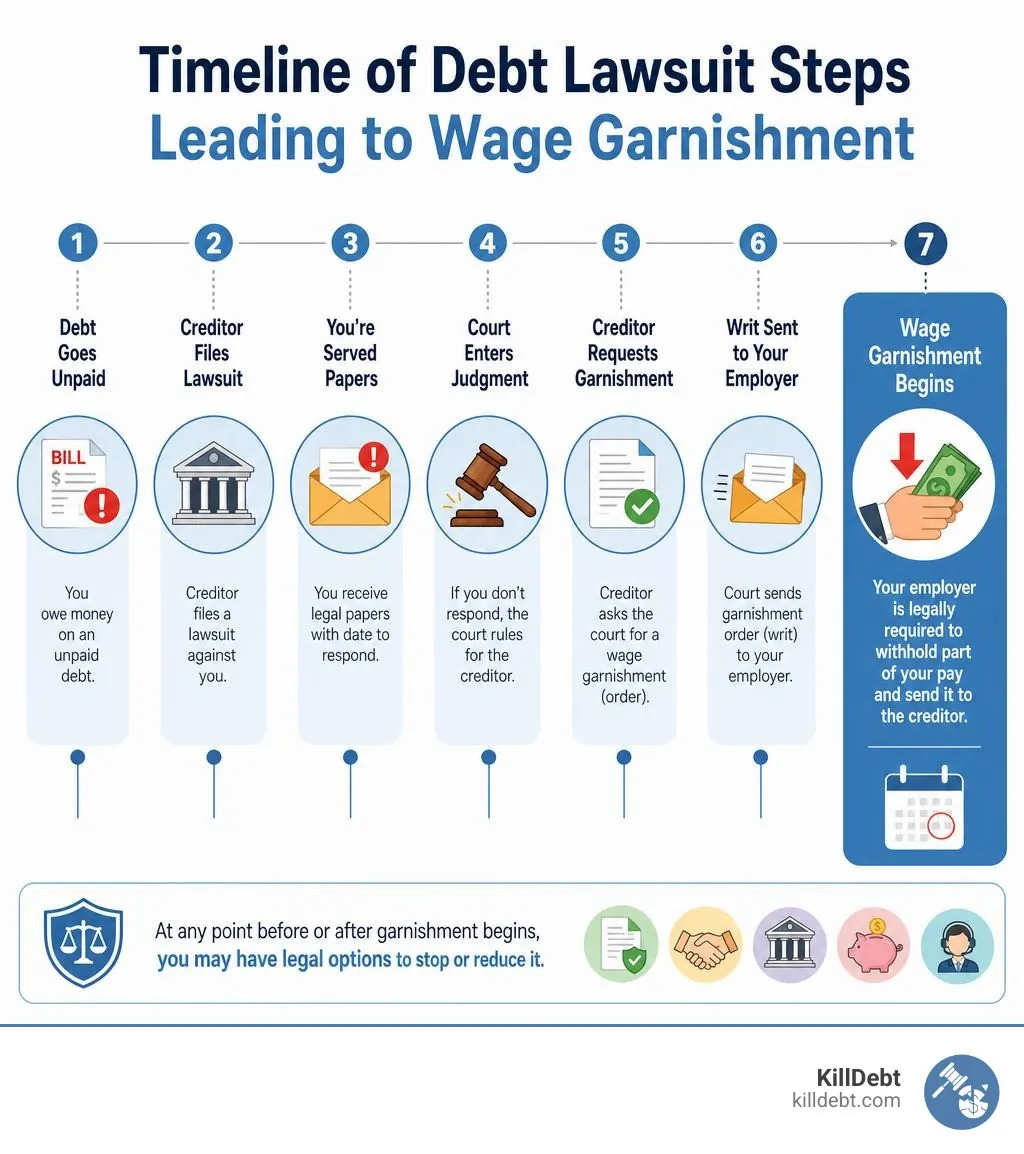
Wage garnishment isn’t just an aggressive collection call; it is a legally binding court order. For ordinary consumer debts — like credit cards, medical bills, or personal loans — a creditor cannot simply call your boss and demand your pay. They must go through a structured legal process first.
Understanding this chain of events is critical if you want to find a weak link and break it:
Your employer has a limited window (typically 20 days in Florida) to respond to this writ. If they fail to comply, they can actually be held liable for your debt. This is why your HR department cannot "do you a favor" by ignoring the order.
It is vital to know that while private creditors must sue you first, certain debts skip the courtroom entirely. Government agencies collecting on federal student loans, back taxes, or unpaid child support can garnish your wages administratively without ever obtaining a court judgment.
If you are wondering how far a debt collector can go with your assets, you can read our deep dive on Can Debt Collectors Take My Wages and Bank Account to protect your cash.

If you are facing a garnishment, you are likely wondering: How much of my paycheck is actually at risk?
Under the federal Consumer Credit Protection Act (CCPA), ordinary consumer debt garnishments are strictly capped. The maximum amount that can be withheld from your paycheck in any workweek is the lesser of:
This means if your weekly disposable income is $217.50 or less, a private creditor cannot garnish a single penny under federal law. If your weekly disposable income is between $217.50 and $290.00, they can only garnish the amount above $217.50. If you make more than $290.00, they can take up to 25%.
However, state laws can provide much stronger protections. Because we specialize in helping consumers in Florida and Michigan, let’s look at how these two states handle limits:
| Jurisdiction | Maximum Garnishment (Consumer Debt) | Key Protections & Exemptions |
|---|---|---|
| Federal Law (CCPA) | Lesser of 25% of disposable income OR amount exceeding $217.50/week | Baseline protection across the United States. |
| Florida | Up to 25% of disposable income | 100% Exemption for Head of Household earning $750/week or less. |
| Michigan | Up to 25% of disposable income | Ability to file a Motion for Installment Payments to stop active garnishments. |
While some states like Texas, Pennsylvania, North Carolina, and South Carolina completely prohibit wage garnishment for private consumer debt, Florida and Michigan allow it but offer unique procedural shields that we can use for stopping a wage garnishment.
The absolute best way to stop a wage garnishment is to prevent the creditor from obtaining a judgment in the first place. When you receive a lawsuit summons, the clock starts ticking. You typically have 20 to 30 days to file a written answer with the court.
If you ignore the summons, a default judgment is practically guaranteed. Instead of ignoring it, use these proactive strategies to halt the creditor in their tracks:
For a comprehensive breakdown of your options before the garnishment hits your payroll department, check out this guide on How to Stop a Wage Garnishment: Your Options, Including the One That Works Immediately.
If a judgment has already been entered and a writ of garnishment has been issued, you still have the right to fight back. You can file a formal objection or motion to challenge the garnishment in court.
In Michigan, for example, you have a strict 14-day deadline from the date you receive the garnishment notice to file a written objection. Once you file, the court is required to schedule a hearing within 21 days. During this time, your employer may still withhold funds, but the money is held in escrow and cannot be released to the creditor until the judge rules.
To learn more about the specific steps required to file an objection in Michigan, you can review the resources provided by Objecting to Garnishments \| Michigan Legal Help.
When you stand in front of a judge to object to a garnishment, you cannot simply say, "I don't want to pay this." You must present valid legal grounds. Successful objections typically rely on one of the following arguments:
If you are representing yourself in Michigan, you can use the Do-It-Yourself Objection to Garnishment \| Michigan Legal Help tool to prepare your court documents correctly.
Another highly effective way of stopping a wage garnishment is claiming that your income is legally exempt. Certain types of income are completely protected from private creditors, including:
Additionally, if you live in Florida, you have access to one of the strongest debtor protections in the country: the Head of Family (or Head of Household) exemption.
Under Florida law, if you provide more than 50% of the financial support for a dependent (such as a child, spouse, or elderly parent), your wages are 100% exempt from garnishment if your disposable earnings are $750 a week or less. If you make more than $750 a week, your wages still cannot be garnished unless you agreed to waive this protection in writing.
To claim this, you must act quickly. Once you receive the garnishment notice, you must file a Claim of Exemption and Request for Hearing form with the court immediately. For a detailed breakdown of how this protection works, see our guide on the Head of Household Exemption.
For more details on Florida's specific limits and exemption forms, you can read Wage Garnishment in Florida: Limits, Exemptions, and How to Stop It \| Alper Law.
When a garnishment is active and eating away at your ability to buy groceries or pay rent, you need a solution that works immediately. That is where bankruptcy comes in.
Filing for bankruptcy under either Chapter 7 or Chapter 13 is the most powerful legal tool available for stopping a wage garnishment. The moment your bankruptcy petition is filed with the court, a powerful federal injunction known as the Automatic Stay goes into effect.
To understand which option is right for your financial recovery, consider this quick comparison:
If you want to explore how bankruptcy can protect your income, you can read more at Stop A Wage Garnishment By Filing Bankruptcy \| My Daytona Attorney.
The automatic stay is not a delayed process; it is instantaneous. The very second your case is filed, the creditor is legally prohibited from taking any collection action against you. This includes phone calls, letters, lawsuits, bank levies, and active wage garnishments.
Once your bankruptcy petition is filed, we advise immediately sending a copy of the bankruptcy filing and case number to both your employer's payroll department and the garnishing creditor's attorney. Your employer must stop withholding money from your paycheck immediately. If the creditor continues to take money after being notified of the bankruptcy, they can be heavily sanctioned by the court for violating federal law.
To see how this process plays out step-by-step for residents in Michigan, read How to Stop a Wage Garnishment \| Detroit Lawyers, PLLC.
Dealing with a wage garnishment threat or an active paycheck deduction is incredibly stressful, but you do not have to navigate the court system alone or spend thousands of dollars on expensive lawyers.
At KillDebt, we provide a revolutionary, DIY legal defense system powered by ParkerGPT — an advanced AI trained specifically on consumer debt law and real-world court strategies developed over 30+ years by myself, attorney Brian Parker. Unlike generic AI tools, ParkerGPT analyzes your actual court documents, finds weaknesses in the creditor's case, and generates court-ready answers and motions tailored to Florida and Michigan laws.
We have also just introduced our brand-new Court Tester tool. Court Tester is an AI courtroom simulation built on your actual case filings. You can upload your documents and, within minutes, practice arguing your motion in front of an AI judge, facing AI opposing counsel, while a private AI co-counsel whispers winning strategies only you can see.
Don't let debt collectors quietly drain your bank account. Take action, protect your hard-earned paycheck, and Take control of your debt defense today with KillDebt.
Get started with KillDebt pricing
Important Legal Disclaimer
This educational content is based on general legal principles and my experience in debt collection defense. It is provided for informational purposes only and does not constitute legal advice. Laws vary by state and by local court. For specific legal advice, consult a qualified attorney licensed in your jurisdiction. No attorney-client relationship is created by reading this guide.
Critical Multi-State Variations: FDCPA applies uniformly at the federal level, but state consumer protection laws may provide additional rights and remedies. Statute of limitations periods vary significantly by state and debt type. What constitutes sufficient debt validation varies in practice across jurisdictions. State-specific rules on call frequency, written notice requirements, and permissible collector conduct may differ from federal minimums.

About the author
Brian Parker
I have over 30 years of experience defending consumers against debt collection lawsuits and have seen every tactic, threat, and pressure play that collectors use. Through KillDebt and ParkerGPT, I have systematized the proven defense strategies that actually work - so consumers can respond from a position of knowledge, not fear. My approach focuses on aggressive legal defense based on documented case success rather than false hope that leads to default judgments.