News Break
How to Defend Against Personal Loan Defaults and Keep Your Sanity
July 31, 2026
Blog / News Break
Learn what to do when sued by debt collector and how to fight back with a step-by-step defense strategy to avoid default judgment.

If you're trying to figure out what to do when sued by a debt collector, here is the short answer:
Getting served with a court summons is scary. Most people freeze up or hope it goes away on its own.
It won't.
Research from The Pew Charitable Trusts found that more than 70% of debt collection lawsuits end in default judgments — simply because the person being sued never responded. A default judgment hands the collector the power to garnish your wages, freeze your bank account, or place a lien on your property. All without you ever getting a chance to fight back.
Here's the truth most people don't know: responding to a lawsuit does not mean you agree you owe the money. It simply means you're showing up and making the collector prove their case. And that's a much harder task for them than it looks — especially if the debt was sold to a third-party buyer who may not have the paperwork to back up their claims.
You have rights. You have options. And you have time — but not much of it.
I'm Brian Parker, founder of KillDebt. For over 30 years I've been in the courtroom fighting creditors, debt buyers, and collection law firms, and I've seen what happens when people know exactly what to do when sued by a debt collector — and what happens when they don't. This guide gives you the same step-by-step strategy I've used to protect thousands of consumers, broken down into plain language you can act on today.
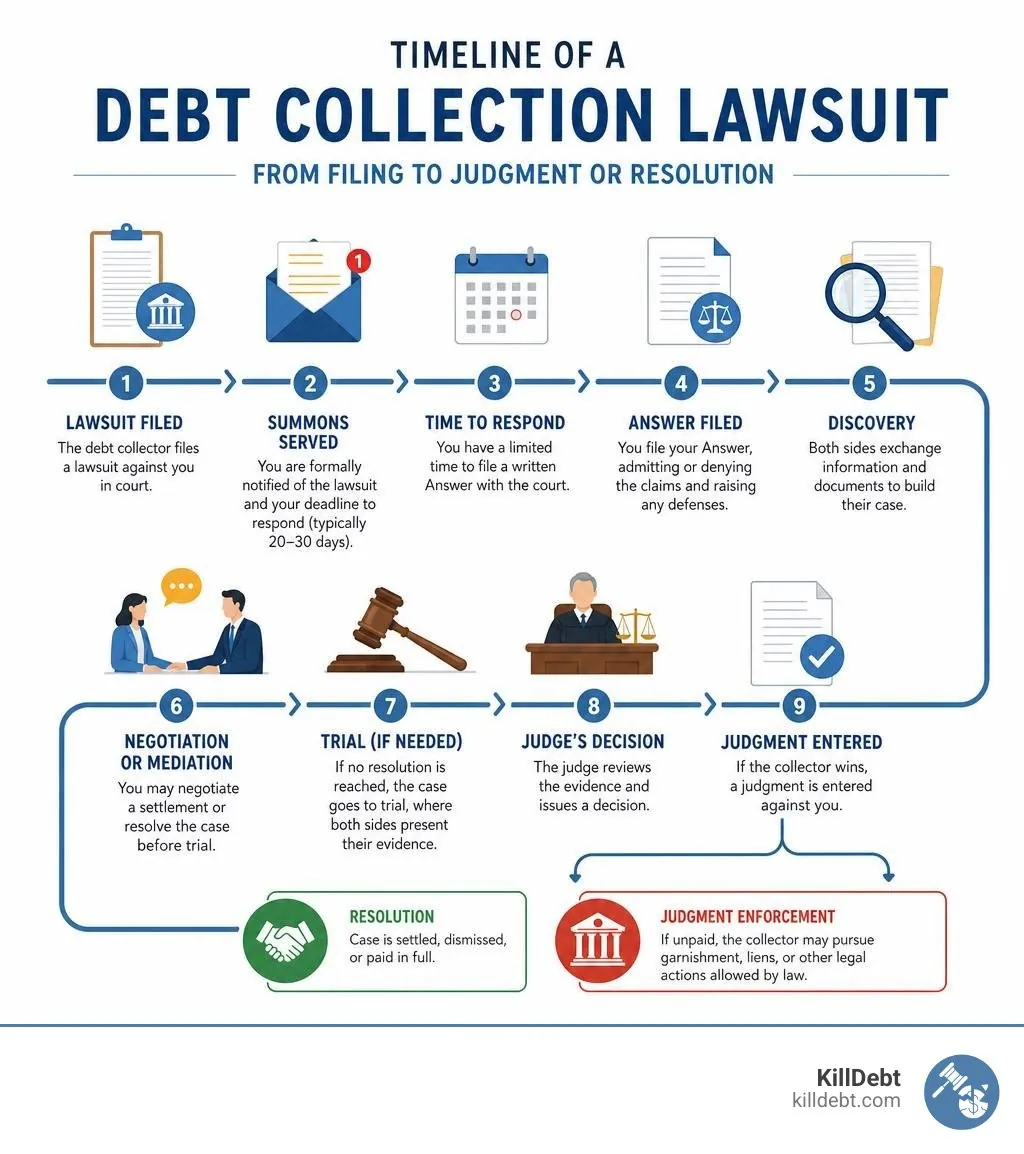
The moment a process server knocks on your door or you find a court summons in your mailbox, your heart rate spikes. Your immediate instinct might be to panic or throw the papers in a drawer and pretend they don't exist.
Don't do that.
Instead, take a deep breath. We need to transition from panic mode to strategic defense mode. Your first move is to organize your timeline. What you do in the first few days determines whether you maintain control or hand an easy victory to the debt collector. For a detailed breakdown of your immediate action items, look at our guide on Sued for a Debt? Here's Exactly What to Do in the First 7 Days.
First, confirm the lawsuit is real. Sometimes collectors send letters that look like court documents but are actually just aggressive collection notices. Check the court name, case number, and county. If you are unsure, call the official court clerk directly using a number you find on the county's official government website—not the phone number printed on the letters you received.

Before a debt collector can proceed with a lawsuit, they must legally notify you. This is called "service of process."
In Florida and Michigan, proper service usually requires:
If the collector claims they served you but actually just threw the papers on your porch or left them with a neighbor, they may not have completed proper service.
However, do not use improper service as an excuse to ignore the case. If you discover a lawsuit was filed against you on the public court docket but you haven't been served yet, you are in what we call "garbage time." This is the strategic window where the lawsuit exists but your official response clock hasn't started ticking. You can use this time to gather documents, research the plaintiff, and prepare your defense without legal jeopardy.
Once you are properly served, the legal clock starts ticking immediately. Missing this deadline is the single biggest mistake consumers make.
Your deadline depends entirely on where you live:
To protect yourself, calculate your exact deadline and mark it on your calendar. Then, establish a "default prevention date" exactly two days before the real deadline. This acts as your absolute safety buffer. If you haven't filed your response by your default prevention date, you must drop everything and get your paperwork to the courthouse immediately.
Once you have established your timeline, it is time to dissect the lawsuit itself. You need to know exactly who is suing you and why. To see how this stage fits into the bigger picture, explore our article on the Debt Collection Lawsuit Timeline: What Happens Next After You're Served.
Start by identifying the Plaintiff (the entity suing you). There are two main types of plaintiffs in debt lawsuits:
If you are being sued by a debt buyer, your chances of winning increase dramatically. Debt buyers purchase portfolios containing thousands of accounts, but they rarely receive the actual contracts, complete payment histories, or transfer documents for individual accounts. They rely on the expectation that you won't show up. If you force them to prove their case, they often fold.
In any civil lawsuit, the person suing has the "burden of proof." This means the debt collector must prove three distinct elements to win:
According to the FTC Consumer Advice on Debt Collection Lawsuits, collectors often lack the necessary documentation to back up these claims at the time of filing. If they cannot produce the original signed contract or the complete chain of title, they cannot meet their burden of proof.
As you review the history of your communications with the collector, look closely for violations of the Fair Debt Collection Practices Act (FDCPA). Under federal law, debt collectors are strictly prohibited from engaging in abusive, deceptive, or unfair practices.
Common violations include:
If a collector broke the law, you can use these violations as powerful leverage in your defense. Under the FDCPA, you have the right to sue a collector in federal or state court within one year of the violation. For more tips on documenting these illegal actions, check out the Florida Attorney General Debt Collection Guide and learn how to What to do if a Debt Collector Sues or Contacts You.

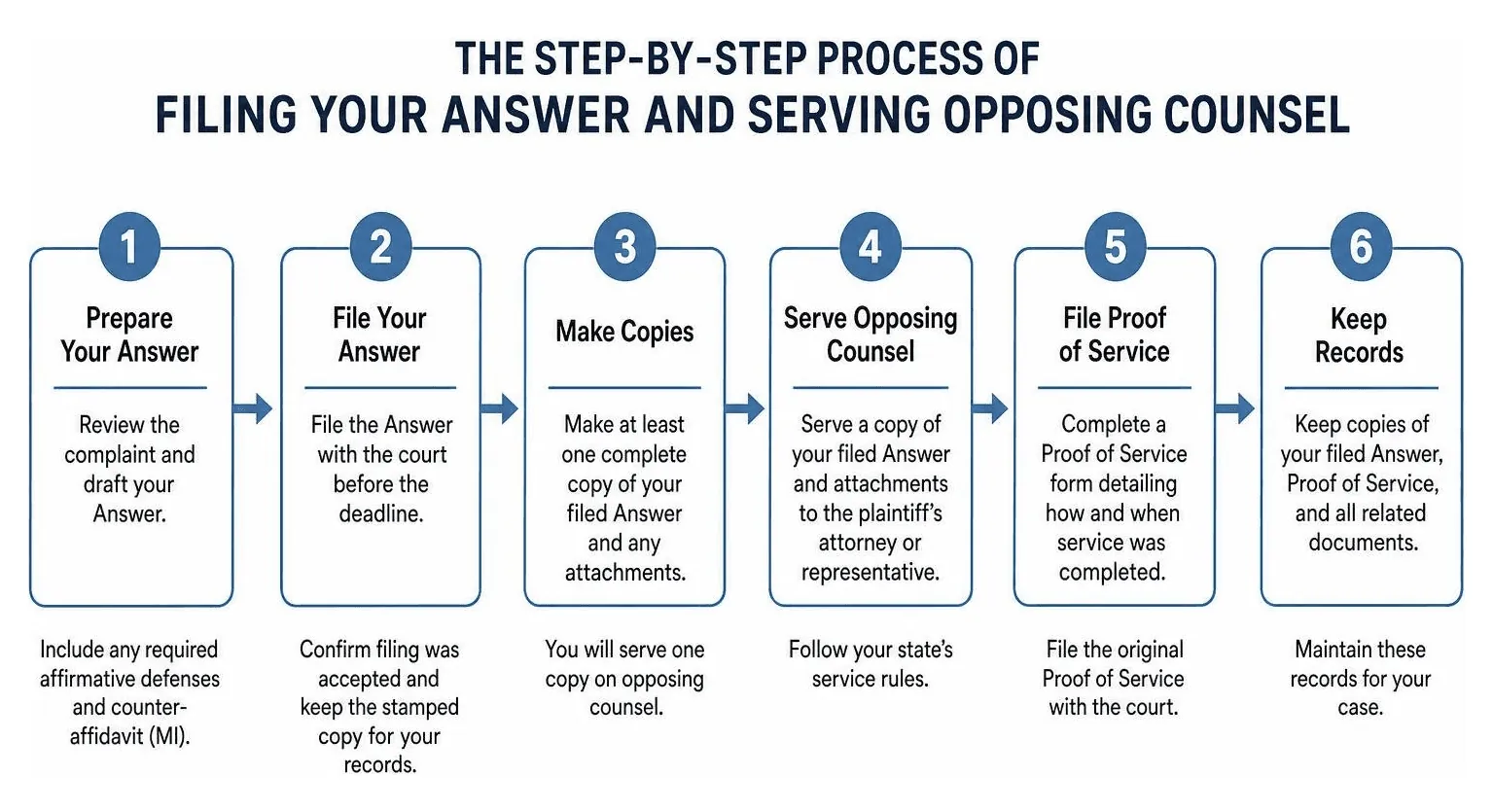
Now that you've analyzed the lawsuit, it is time to take action. You must draft and file a formal written Answer with the court. An Answer is your official response to the allegations listed in the complaint. To learn how to structure this document correctly, review our comprehensive guide on How to Answer a Debt Summons.
Filing an Answer keeps you active in the case, prevents an automatic default, and forces the debt collector to schedule a court hearing where they must present actual evidence.
A lawsuit complaint is structured as a list of numbered paragraphs. When drafting your Answer, you must respond to each numbered paragraph individually.
For every single allegation, you have three options:
As outlined in How to answer a debt collection summons: A practical rights guide - Consumer Attorneys, you should avoid writing long, emotional stories in your Answer. Keep your responses short and objective. For a visual template of how this looks, you can download our Sample Answer to Debt Collection Lawsuit.
An Affirmative Defense is a legal reason why the plaintiff shouldn't win, even if the basic facts of their complaint are true. If you do not raise your affirmative defenses in your initial Answer, you legally waive your right to bring them up later in the case.
Common affirmative defenses in debt collection lawsuits include:
If you do nothing when sued, the court will issue a Default Judgment against you. This is the "Default Trap," and it is exactly what debt collectors rely on. Once a collector has a default judgment, they gain powerful legal mechanisms to collect the money directly from you. Our guide on What to Do When Sued by a Debt Collector: Complete First Steps Guide explains how to protect your financial life from these aggressive tactics.
If a judgment is entered, the collector can pursue:
Sometimes, a consumer's financial situation is so limited that they are considered "judgment proof." Being judgment proof does not mean you cannot be sued; it simply means that even if the collector wins a judgment, they cannot legally seize your income or assets because they are protected by federal or state exemptions.
Exempt sources of income and assets include:
If your only source of income is exempt, you must still respond to the lawsuit to assert these protections. Do not assume the court or the collector will protect your funds automatically.
If you are being sued in Michigan, you must pay close attention to how the collector styles their lawsuit. Many collectors file what is known as an "Account Stated" claim. Under Michigan law (MCL 600.2145), if a plaintiff attaches a sworn affidavit of the amount owed to their complaint, the allegations are legally deemed true unless the defendant files a written counter-affidavit denying the debt.
If you fail to file a notarized counter-affidavit along with your Answer in Michigan, you can lose the case automatically on a summary disposition, even if you filed a basic Answer. For detailed guidance on navigating this specific Michigan court rule, consult the resources at I Have Been Sued to Collect a Debt.
Once you have filed your Answer and protected yourself from a default judgment, you need to choose your long-term resolution strategy. You have two primary paths: fight the case in court to get it dismissed, or negotiate a settlement out of court. For a deep dive into both paths, read our Fight Debt Collection Lawsuit: Complete Guide.
| Strategy | Pros | Cons | Best For |
|---|---|---|---|
| Fight in Court | Potential to eliminate the debt entirely; forces the collector to prove their case; exposes FDCPA violations. | Requires time, effort, and learning basic court procedures. | Debt buyer lawsuits with weak documentation; expired statute of limitations. |
| Settle Out of Court | Guarantees a resolution; avoids the stress of a trial; often reduces the debt balance significantly. | Requires a lump-sum payment or monthly payment plan; potential tax implications on forgiven debt. | Valid debts owed to original creditors who have strong documentation. |
If you decide to settle the debt, do not call the collector and make an emotional offer. You must approach negotiations strategically.
As discussed in Sued by a Debt Collector? A Calm, Practical Guide to Responding (and What to Document) - Consumer Attorneys, you should follow these rules for safe negotiation:
Many consumers believe they must hire an expensive defense attorney to handle a debt lawsuit. While having legal representation is helpful, attorney fees can easily exceed the total amount of the debt itself. To help you decide which path makes sense for your budget, read Do I Need a Lawyer for a Debt Collection Lawsuit?.
If you choose the DIY path, you don't have to go it alone. At KillDebt, we developed ParkerGPT, a specialized AI platform trained on consumer debt law and real-world courtroom strategies. Unlike generic AI chatbots, ParkerGPT analyzes your specific lawsuit filings, spots weaknesses in the collector's documentation, and generates court-ready Answers and counter-affidavits tailored to Florida and Michigan rules.
We also recently introduced Court Tester, an AI courtroom simulation tool built directly on your actual case. By uploading your filings, you can practice arguing your case in front of an AI judge, face off against an AI opposing counsel, and receive real-time strategy tips from a private AI co-counsel. This allows you to walk into a real courtroom with absolute confidence, at a fraction of the cost of a traditional attorney. You can view our available options and find a plan that fits your needs on our Pricing Page.
Getting sued by a debt collector is a challenge, but it is also an opportunity to resolve the issue on your own terms. Remember: 70% of people lose because they never respond. By simply showing up, filing a written Answer, and demanding proof, you instantly put yourself in the top 30% of consumers who stand up for their rights.
Whether you choose to fight the lawsuit in court or negotiate a favorable out-of-court settlement, taking action is your key to financial freedom. You don't have to navigate this stressful process alone. Use our AI-powered defense system at KillDebt to analyze your case, generate professional court documents, and practice your defense with our Court Tester tool. You have the power to fight back—and we are here to help you win.
Get started with KillDebt pricing
IMPORTANT LEGAL DISCLAIMER
This educational content is based on general legal principles and my experience in debt collection defense. It is provided for informational purposes only and does not constitute legal advice. Laws vary by state and by local court. For specific legal advice, consult a qualified attorney licensed in your jurisdiction. No attorney-client relationship is created by reading this guide.
Critical Multi-State Variations: FDCPA applies uniformly at the federal level, but state consumer protection laws may provide additional rights and remedies. Statute of limitations periods vary significantly by state and debt type. What constitutes sufficient debt validation varies in practice across jurisdictions. State-specific rules on call frequency, written notice requirements, and permissible collector conduct may differ from federal minimums.

About the author
Brian Parker
I have over 30 years of experience defending consumers against debt collection lawsuits and have seen every tactic, threat, and pressure play that collectors use. Through KillDebt and ParkerGPT, I have systematized the proven defense strategies that actually work - so consumers can respond from a position of knowledge, not fear. My approach focuses on aggressive legal defense based on documented case success rather than false hope that leads to default judgments.