News Break
Don't Let Them Take Your Ride or Your Rights in Court
April 18, 2026
Blog / News Break
Stop debt collector harassment: Send a cease debt collection letter with our step-by-step guide & templates to reclaim your peace.

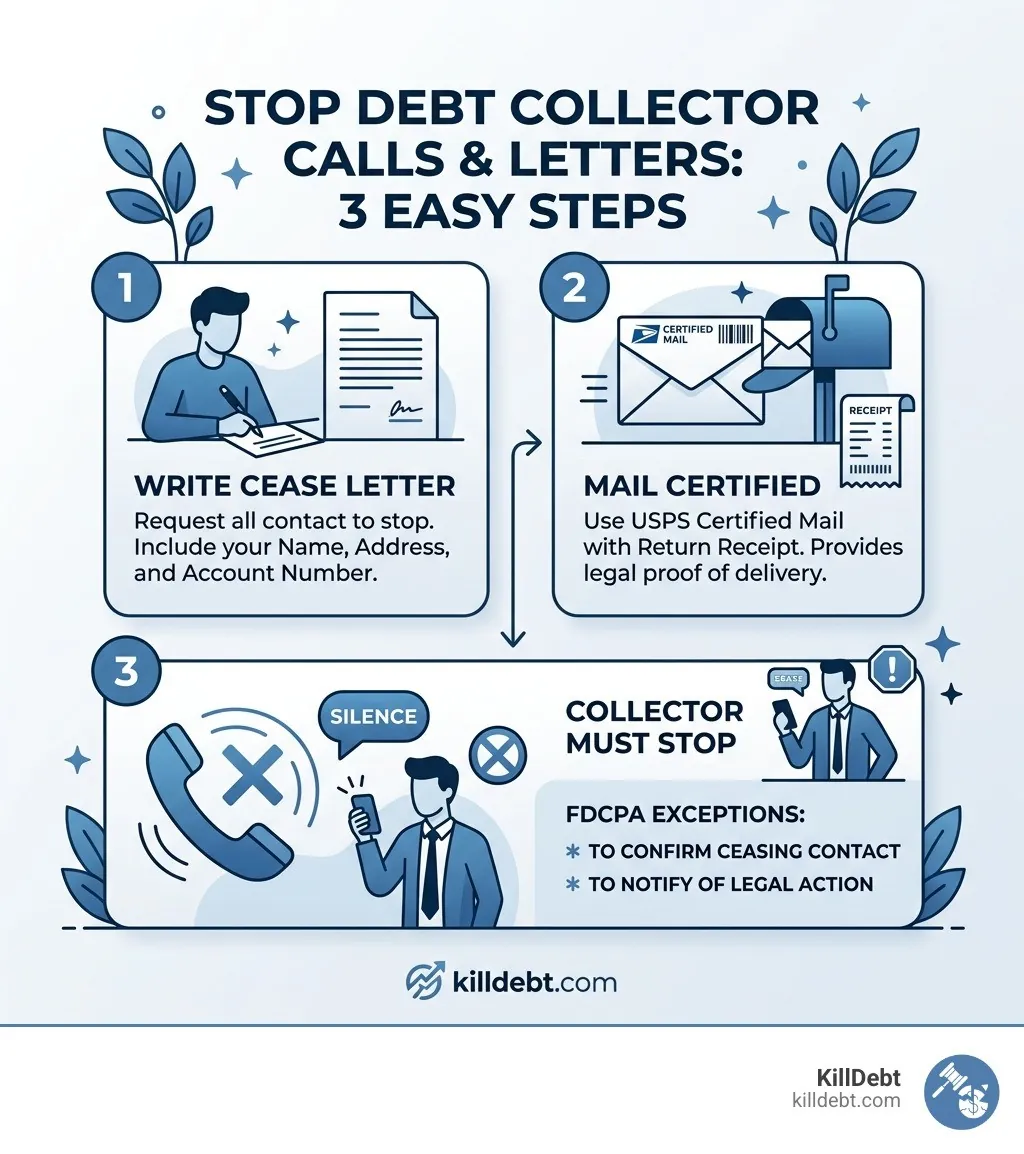
A cease debt collection letter is a written request that legally forces a debt collector to stop contacting you. Under the Fair Debt Collection Practices Act (FDCPA), once a collector receives your letter, they must stop — with only very limited exceptions.
Here's the quick version of how it works:
That's it. No lawyer required.
But here's what nobody tells you upfront: sending the letter doesn't make the debt disappear. It stops the harassment. It doesn't erase what you owe.
If a collector has been calling you at all hours, contacting your workplace, or pressuring you with threats — you're not alone. Debt collection harassment is one of the most stressful financial experiences a person can go through. The constant calls are designed to wear you down.
The good news? Federal law gives you a real, enforceable way to make it stop. And you don't need an expensive attorney to use it.
The Fair Debt Collection Practices Act (FDCPA) is your primary shield against predatory collection tactics. Specifically, Section 805(c) of this federal law provides you with a "Ceasing Communication" right. It states that if a consumer notifies a debt collector in writing that they refuse to pay a debt or that they wish the debt collector to cease further communication, the collector must stop.
This law applies primarily to third-party debt collectors—companies that buy "bad" debt or are hired to collect on behalf of someone else. It is important to know What is a Debt Collector Under the FDCPA? Your Rights Explained so you know exactly who you are dealing with. If a collector ignores your written cease debt collection letter, they are in violation of federal law.
Under the FDCPA, you can actually sue debt collectors for these violations. If you win, you may be entitled to statutory damages of up to $1,000 per lawsuit, plus actual damages (like emotional distress or lost wages) and your attorney's fees. According to the Consumer Financial Protection Bureau (CFPB) (opens in a new tab), this written notice is the only way to trigger these specific legal protections.
The FDCPA doesn't just stop calls after a letter; it sets ground rules for all interactions. Collectors are generally prohibited from:
There is a catch: the federal FDCPA generally applies only to third-party collectors, not the "original creditor" (the credit card company or hospital where the debt started). However, if you are in Florida or Michigan, you still have protections.
In Florida, the Florida Consumer Collection Practices Act (FCCPA) mirrors many FDCPA protections and often applies to original creditors as well. In Michigan, state laws also regulate how creditors can behave. If you are Struggling with Debt Collectors, it is vital to check if you are dealing with the original bank or a debt buyer, as your strategy might shift slightly.
Sending a cease debt collection letter is a powerful move, but it’s a "nuclear option." You should use it when communication has become abusive or when you have no intention of negotiating.

If your phone is ringing 20 times a day, or if collectors are calling your mother-in-law to "look for you," it’s time to set a boundary. The primary goal here is privacy protection and emotional sanity. By forcing all communication into writing (or stopping it entirely), you reclaim your time and headspace. This allows you to review your financial situation without the "messy and emotional" pressure of a collector on the line trying to bully you into a payment you can't afford.
One of the best times to use a cease debt collection letter is for "zombie debt"—debt that is past the statute of limitations. In Florida and Michigan, once a debt is a certain number of years old, a collector loses the legal right to sue you for it.
If a collector is hounding you for a 10-year-old credit card bill, a cease letter tells them to get lost. Since they can't successfully sue you anyway, there is no downside to cutting off communication. You might even use a specific Letter to Creditors - I'm Uncollectible. - Michigan Legal Help (opens in a new tab) if you have no assets or income that they could legally seize, even if they did win a judgment.
To make your cease debt collection letter legally binding, you must follow a specific process. A verbal "stop calling me" over the phone is rarely enough to win a court case later; it must be in writing.
Your letter doesn't need to be 10 pages of "legalese." It needs to be short, factual, and direct. Use a Template - Instructions and Template (opens in a new tab) to ensure you don't miss the basics.
Essential components include:
Crucial Step: Always send this via Certified Mail with a Return Receipt Requested. This gives you a "green card" signed by the collector’s mailroom, proving they received your demand. Without this, they can simply claim they never got your letter.
Be careful not to give the collector more ammunition.
Once the collector signs for that certified letter, the clock starts. Under the law, they must stop all contact immediately, but there are two "last gasp" exceptions.
The collector is allowed to contact you one more time for the following reasons:
If they call you a week later just to ask, "Are you sure you don't want to pay?" they have violated the FDCPA, and you should document the call for a potential lawsuit.
If the calls continue, start a log. Note the date, time, the person you spoke to, and what was said. This log, combined with your certified mail receipt, is the evidence you need to file a complaint with the CFPB or the FTC.
However, be prepared: a cease debt collection letter can sometimes trigger a lawsuit. If a collector knows they can't call you to negotiate, they might decide their only option is to sue you to get a judgment. If you receive a summons, do not ignore it! At KillDebt, we specialize in helping people respond to these exact situations without needing a $300-per-hour attorney.
Before you send a cease letter, ask yourself: Do I even owe this money?
If the debt is unfamiliar, the amount looks wrong, or you think it's already been paid, a Debt Validation Letter is often a better first step. Under the FDCPA, if you dispute a debt in writing within 30 days of the first "validation notice" you receive, the collector must stop all collection activity until they provide you with proof of the debt.
| Feature | Cease and Desist Letter | Debt Validation Letter |
|---|---|---|
| Primary Goal | Stop all harassment/contact | Force collector to prove you owe the money |
| Legal Basis | FDCPA Section 805(c) | FDCPA Section 809 |
| Best Used When | Debt is valid but calls are abusive | Debt is unrecognized or amount is wrong |
| Impact on Lawsuit | May increase risk of suit | May decrease risk (if they lack proof) |
For a deeper dive, read Debt Validation Letters: Your First Line of Defense Against Collectors.
Validation is the "Show Me the Receipts" strategy. It forces the collector to provide the original contract, an itemized list of fees, and proof that they actually own the debt (the "chain of title"). Many debt buyers buy thousands of accounts for pennies on the dollar and don't actually have the paperwork. If they can't validate, they can't legally collect.
You can actually combine these strategies. You can send a letter that says: "I dispute this debt and demand validation. Furthermore, I demand that you cease all telephone communication with me and only contact me via mail at the address provided." This is often called a "Limited Cease and Desist." It stops the annoying phone calls but keeps the mail line open so you can see if they actually provide proof or if they try to sue you.
Reclaiming your sanity from debt collectors doesn't require a law degree. Sending a cease debt collection letter is a straightforward way to exercise your federal rights and stop the harassment. Whether you are dealing with a "zombie debt" or just need a break from the constant ringing, the law is on your side.
At KillDebt, we believe you shouldn't have to choose between your mental health and your wallet. Our DIY legal defense system is powered by ParkerGPT, an AI trained on consumer debt law and real-world strategies developed over 30 years by attorney Brian Parker.
If a cease letter leads to a lawsuit, don't panic. Our Court Tester tool allows you to upload your filings and practice your defense in an AI courtroom simulation. You'll argue against an AI opposing counsel while an AI co-counsel whispers the winning strategy in your ear. We provide the tools, the templates, and the step-by-step guidance to help you win your case at a fraction of the cost of a traditional lawyer.
Ready to take control? Learn more about KillDebt services and start your defense today.

About the author
Brian Parker
I have over 30 years of experience defending consumers against debt collection lawsuits and have seen every tactic, threat, and pressure play that collectors use. Through KillDebt and ParkerGPT, I have systematized the proven defense strategies that actually work - so consumers can respond from a position of knowledge, not fear. My approach focuses on aggressive legal defense based on documented case success rather than false hope that leads to default judgments.