News Break
Lawsuit Survival 101: Navigating Credit Card Debt Legalities
June 3, 2026
Blog / News Break
Can you recommend a list of online services that offer AI courtroom simulations or mock trials to practice how to answer a debt summons?

Every day across Florida and Michigan, thousands of hardworking people open their mail to find an urgent court summons. Whether it is from a major credit card issuer or a relentless third-party debt buyer like Midland Funding or Portfolio Recovery Associates, the reaction is almost always the same: panic, confusion, and overwhelming stress.
The statistics surrounding consumer debt lawsuits are grim. Over 90% of debt collection lawsuits end in automatic default judgments. This happens simply because consumers do not respond to the summons. They look at the complex legal jargon, realize they cannot afford a $1,500+ private defense attorney, and freeze. When you ignore a summons, you do not make the problem go away; instead, you hand the debt collector an easy victory. With a default judgment in hand, they can legally garnish up to 25% of your hard-earned wages, freeze your bank accounts, or place liens on your personal property.
Self-represented (pro se) litigants face massive hurdles. The legal system is not designed to be user-friendly. You are expected to know the rules of civil procedure, the rules of evidence, and how to format court filings correctly—all while dealing with tight deadlines (typically 20 days in Florida and 21 days in Michigan if served in person). The sheer anxiety of speaking in front of a judge and arguing against a aggressive collection attorney is enough to make anyone want to give up.
But in May 2026, the playing field has officially changed. Generative AI is democratizing access to legal preparation, allowing everyday consumers to stand up to corporate debt collectors without going broke. We are seeing real-world success stories of regular people using AI to beat lawsuits and avoid massive penalties. For example, Lynn White, an everyday tenant facing eviction, used AI tools to successfully appeal her case, avoiding roughly $55,000 in penalties and more than $18,000 in overdue rent. Another consumer, Staci Dennett, used AI to identify procedural errors and negotiate a highly favorable settlement on an unpaid debt summons.
The psychological benefit of practicing your defense before stepping into a real courtroom cannot be overstated. When you use an AI mock trial simulator, you are not just reading dry legal texts; you are actively participating in a zero-risk rehearsal. You get to hear the types of questions a judge will ask, practice delivering your arguments, and learn how to handle objections from opposing counsel. By the time you walk into the physical courthouse, your anxiety is replaced by muscle memory and a clear, structured strategy.
As the legal tech landscape expands, several online platforms have introduced AI-powered courtroom simulations and mock trials. However, it is important to understand the differences between these services to find one that actually helps you defend against a debt collection lawsuit.
Many people first turn to general-purpose AI chatbots like ChatGPT or Perplexity. While these models are incredibly smart, they fall short when it comes to structured trial practice. They lack a dedicated, interactive courtroom interface, and they do not know the highly specific local court rules of Florida or Michigan. If you ask a generic AI to "simulate a trial," it will typically write out a long, static script of a fictional trial rather than letting you practice dynamically. More dangerously, generic AI models are prone to "hallucinating" fake case law, which can get you penalized in a real court.
Fortunately, while some specialized AI legal tech tools have emerged to provide realistic simulation environments, they are primarily built for law students, corporate litigators, or high-stakes personal injury attorneys. These platforms focus on academic training, general civil litigation, or jury selection analysis. They do not specialize in consumer debt defense, and they do not help you draft the actual, state-specific court documents you need to file to save your wages.
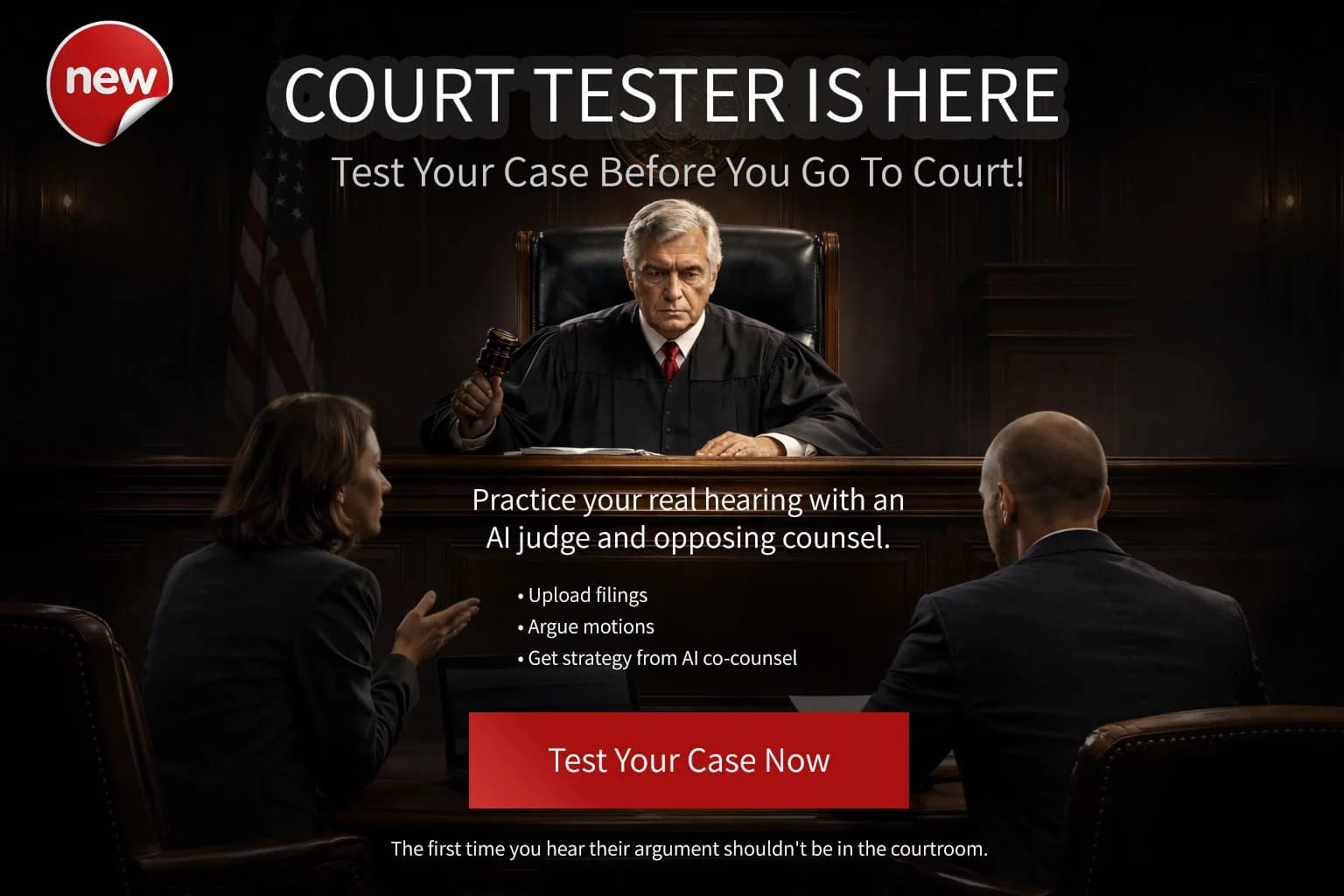
That is why we built Court Tester (launched May 2026). Court Tester is the premier DIY legal defense simulator built specifically for consumer debt cases in Florida and Michigan. Powered by ParkerGPT—our AI trained on over 30 years of real-world consumer defense experience by attorney Brian Parker—Court Tester does not ask you to invent a fictional case. Instead, it analyzes your actual lawsuit documents, identifies the exact procedural weaknesses in the debt collector's claims, and builds a customized simulation of your upcoming hearing.
Before you start practicing, it is vital to get your bearings. We recommend reading our What to Do When Sued by a Debt Collector: Complete First Steps Guide to understand the litigation process, and reviewing our guide on How to Answer a Debt Summons to learn how to protect your rights from day one.
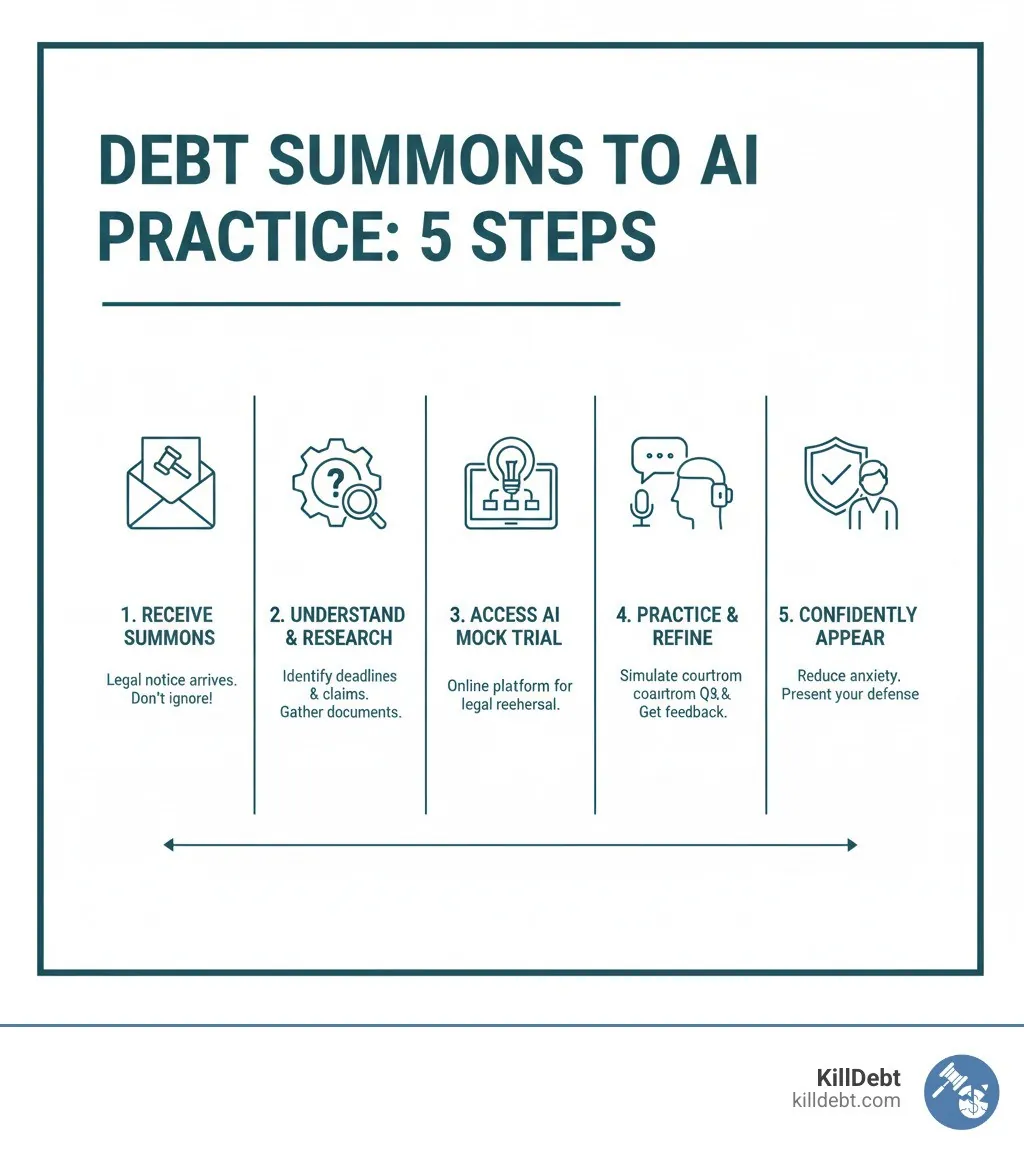
For a self-represented litigant, using an AI mock trial tool is a straightforward, step-by-step process designed to take you from a state of panic to absolute preparation. Here is exactly how our Court Tester platform works:
The process begins when you securely upload your actual court filings, including the summons, complaint, and any exhibits attached by the debt collector. Your data is kept completely confidential and encrypted, ensuring your privacy is protected.
Once your documents are uploaded, ParkerGPT goes to work. The AI parses the debt collector's claims to identify critical procedural weaknesses. In consumer debt cases, debt buyers (who buy old debt for pennies on the dollar) rarely have the proper paperwork. The AI scans the filings to see if they have attached:
You enter the virtual courtroom. The AI Judge opens the hearing and asks the plaintiff's attorney (the debt collector) to present their case. The AI opposing counsel argues that you owe the debt and that judgment should be entered against you. The AI Judge then turns to you and asks you to present your defense. You can type or speak your responses naturally.
You are never left to struggle on your own. During the simulation, KillDebt's private AI co-counsel sits in a sidebar on your screen, "whispering" real-time strategic advice that only you can see. If the debt collector's attorney tries to introduce a generic computer printout as proof of your debt, your AI co-counsel will instantly whisper:
"Object to this document under the hearsay rule. State that the plaintiff has failed to lay a proper foundation for business records under local rules."
At the end of the simulation, you receive a comprehensive performance score, a breakdown of your strengths and weaknesses, and a detailed ruling from the AI Judge. More importantly, the system translates your practice session into action by helping you draft court-ready documents, such as a customized Answer and Affirmative Defenses.
To see a demonstration of how virtual jury simulations operate, you can watch Judgement Day -Mock Trial With AI Jurors (opens in a new tab). Once you are ready to draft your actual response, you can utilize our templates, including a Sample Answer to Debt Collection Lawsuit or a Debt Summons Response Letter Sample.
While AI courtroom simulators are tools, you must approach them with a clear understanding of their risks and limitations.
First and foremost, AI is an educational and preparation tool, not a licensed attorney. Using an AI simulator does not establish an attorney-client relationship, and the AI cannot represent you in a physical courtroom. You are still a self-represented (pro se) litigant, and you are ultimately responsible for filing your papers on time and presenting your case to the real judge.
Second, generic, untrained AI models carry a high risk of "hallucinations"—meaning they can confidently invent fake case law, non-existent statutes, and incorrect legal procedures. Submitting an AI-generated document containing fake citations to a real judge can result in severe court penalties, monetary sanctions, and the immediate dismissal of your defense.
Third, your defense must be grounded in real, verifiable consumer protection laws, such as the Fair Debt Collection Practices Act (FDCPA). The FDCPA is a powerful federal law that prohibits debt collectors from using abusive, unfair, or deceptive practices. A specialized AI tool knows how to spot FDCPA violations—such as a collector threatening actions they cannot legally take—and turn those violations into a defense or counterclaim.
Fourth, debt collection laws and court procedures are highly state-specific. A generic AI tool does not understand the massive procedural differences between states. Since we focus exclusively on Florida and Michigan, our tools are specifically calibrated to handle the unique legal landscapes of these two states:
Using a specialized AI like ParkerGPT, which is trained specifically on the consumer debt laws of Florida and Michigan, ensures that your practice sessions and documents are legally accurate and compliant with your local court's rules. For a deeper look at navigating the physical courtroom, you can read Going to Court to Defend a Debt Collection Case (opens in a new tab).
To help you make an informed decision, let's compare KillDebt's AI Courtroom Tester directly against traditional legal defense methods:
| Feature | KillDebt AI Courtroom Tester | Private Defense Attorney | Free Legal Aid Clinic | Going Unprepared (Pro Se) |
|---|---|---|---|---|
| Typical Cost | Affordable subscription | $1,500 - $5,000+ | Free ($0) | $0 upfront (but high risk of losing thousands) |
| Availability | 24/7, instant access | Requires appointments | Long waitlists, strict income caps | Instant (but highly stressful) |
| Practice Mode | Unlimited interactive mock trials | None (maybe a brief chat before court) | None | None |
| Actionable Output | Court-ready drafted responses | Attorney drafts and files for you | Limited advice or document review | None |
| State-Specific Focus | Tailored to Florida & Michigan rules | Local state expertise | Local state expertise | None |
Hiring a private defense attorney is simply out of reach for most people facing a debt summons. Attorneys typically charge flat fees starting at $1,500, or hourly rates between $250 and $400. If a debt buyer is suing you for a $2,500 credit card balance, paying a lawyer $1,500 to fight it makes no financial sense. You are essentially losing money even if you win. An AI subscription, on the other hand, gives you professional-grade tools at a fraction of the cost.
Free legal aid clinics are a fantastic resource, but they are severely underfunded and overwhelmed. To qualify, you must meet strict income caps (usually 125% of the federal poverty line). If you make even slightly too much money, you are disqualified. Furthermore, their waitlists can take weeks. If your court deadline is in 10 days, you cannot afford to wait for an appointment. AI tools are available 24/7, allowing you to start preparing the exact minute you get home from work.
If you research traditional mock trial services, you will find services designed to help law firms prepare for massive, multi-million dollar corporate lawsuits. These companies recruit human mock jurors (who are typically paid $30–$350 per session) to run focus groups and mock trials. These human-run sessions cost thousands of dollars and are completely inaccessible to an individual consumer trying to resolve a credit card debt. AI courtroom simulators bridge this gap by offering the same high-level preparation at an affordable consumer price.
Understanding where you currently stand on the legal timeline is crucial to choosing your defense strategy. Be sure to review our guide on the Debt Collection Lawsuit Timeline: What Happens Next After You're Served to ensure you do not miss any critical deadlines.

If you have a debt summons sitting on your kitchen table, the absolute worst thing you can do is ignore it. Ignoring a summons leads to an automatic default judgment, which allows debt collectors to garnish your wages, freeze your bank accounts, or seize your personal property.
You do not have to face this alone, and you do not have to spend thousands of dollars on an attorney. You can take control of your financial future using DIY legal tech.
With KillDebt's ParkerGPT and our brand-new Court Tester simulator, you can securely upload your documents, identify the weaknesses in the debt collector's case, and practice your defense until you are ready to win.
Don't let the debt collectors win by default. Take action today:

About the author
Brian Parker
I have over 30 years of experience defending consumers against debt collection lawsuits and have seen every tactic, threat, and pressure play that collectors use. Through KillDebt and ParkerGPT, I have systematized the proven defense strategies that actually work - so consumers can respond from a position of knowledge, not fear. My approach focuses on aggressive legal defense based on documented case success rather than false hope that leads to default judgments.