News Break
Debt Collection Defense: Your Complete List of Affirmative Defenses
July 29, 2026
Blog / News Break
Learn how to negotiate settlement with 15 psychological and tactical tips to influence your next dispute resolution.

How to negotiate a settlement is one of the most valuable skills you can learn when facing a debt collector, a lawsuit, or any legal dispute — and the good news is that you don't need a law degree to do it effectively.
Quick answer: How to negotiate a settlement in 6 steps
Roughly 97% of all civil cases are settled or dismissed without ever reaching a courtroom. That statistic isn't just trivia — it's a signal. The system is built for negotiation. The question isn't whether a settlement is possible. It's whether you'll walk away with a fair one or a terrible one.
The gap between those two outcomes is often not about who has the best legal argument. It's about preparation, psychology, and tactics.
Unrepresented claimants settle for dramatically less than represented ones — on average, represented claimants receive settlements roughly 3.5 times larger. But that doesn't mean you're powerless without a lawyer. It means you need to negotiate smarter.
I'm Brian Parker. For over 30 years, I've been in the courtroom fighting creditors, debt buyers, and collection law firms — and I've used every one of the strategies in this guide to negotiate better settlements for real people in real financial pressure. Below, I'll hand you the same playbook.
When a dispute arises, it's easy to think of the courtroom as the ultimate destination. But the reality of litigation is that trials are expensive, time-consuming, and highly unpredictable. For both individuals and major corporations, the transaction costs of taking a case to a final judgment are often staggering.
In fact, going to court can turn a legal victory into a "paper victory." We have seen cases where a plaintiff spends tens of thousands of dollars on litigation, wins a judgment, and then recovers absolutely nothing because the other party declares bankruptcy or has no collectible assets.
By choosing to settle out of court, you keep control of the outcome. Instead of leaving your financial future in the hands of a judge or jury, you and the opposing party decide exactly how to resolve the matter. Settling also preserves your privacy, as court trials are public record, while settlement agreements can remain private contracts.
To explore the structural differences between these paths, look at the comparison below:
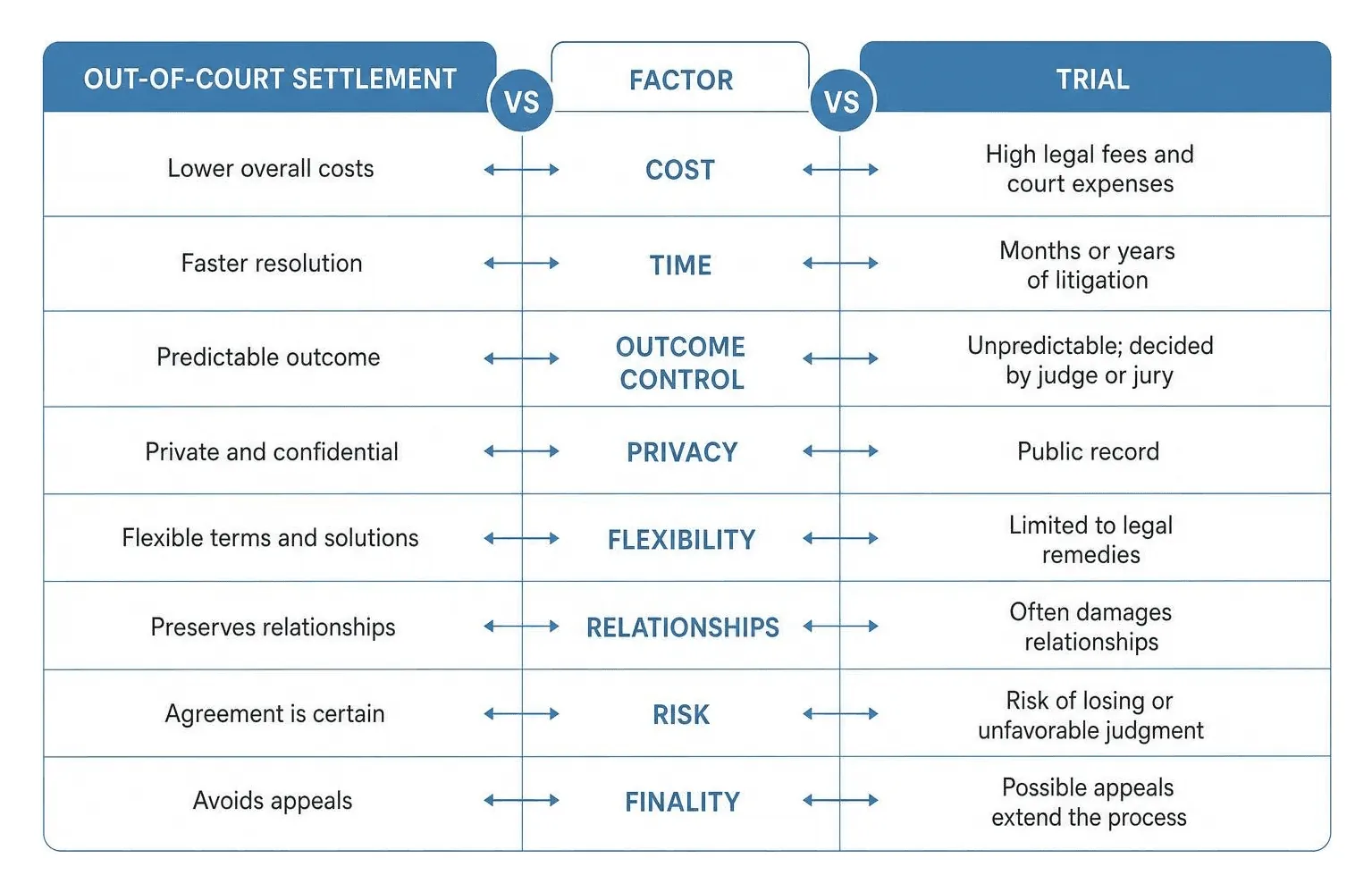
To successfully navigate this landscape, you must understand how to balance the threat of court costs against your opponent's willingness to compromise. If you are dealing with a dispute in Michigan, for example, utilizing local resources like the Settlement and Negotiation Strategies guide can help you understand how local courts view out-of-court resolutions.
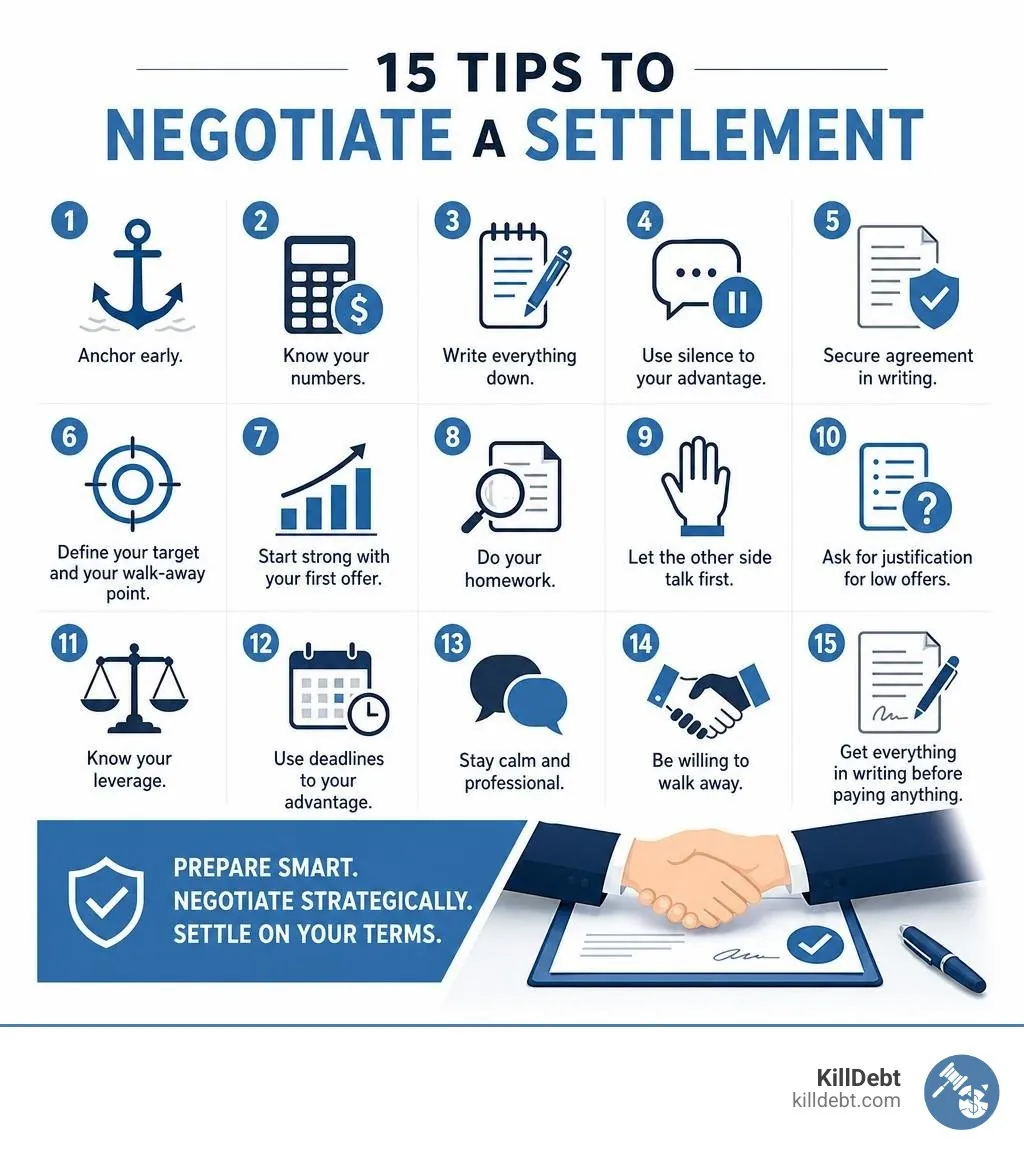
Negotiation is as much a mental game as it is a legal one. To help you level the playing field, we have compiled 15 essential psychological and tactical strategies that you can deploy right now, in July 2026, to maximize your leverage and secure a favorable outcome.
The "anchoring effect" is a well-documented cognitive bias. It dictates that the first number introduced in a negotiation disproportionately influences the final outcome, regardless of how arbitrary or extreme that number might seem. A landmark 2005 meta-analysis by Orr and Guthrie found a correlation of approximately 0.497 between initial offers and final negotiation outcomes.
If you let the other side set the anchor, you will spend the rest of the negotiation fighting uphill. By making the first reasonable, evidence-backed offer, you pull the conversation onto your turf. For more on how to strategically deploy anchoring when dealing with claims adjusters, see the How to Negotiate with an Insurance Adjuster: Cited 2026 Guide.
Before you speak to a collector or an adjuster, you must calculate three crucial numbers:
Never reveal your walk-away number to the opposing party. Keeping this boundary private prevents them from squeezing you down to your absolute limit.
Human psychology is wired to return favors. In negotiations, you can use the rule of reciprocity by granting minor, low-value concessions early in the process. When you give up something small, it triggers a powerful social obligation for the opposing negotiator to reciprocate on a larger point.
For instance, you might agree to a slightly faster payment timeline in exchange for a substantial drop in the total balance owed. For a deeper dive into these behavioral dynamics, consult the guide on NEGOTIATING THE BEST SETTLEMENT.
Many negotiators make the mistake of talking too much because silence feels uncomfortable. Expert negotiators use the "70/30 rule": listen 70% of the time and speak only 30% of the time.
If the other side makes an offer, don't immediately counter. Let a long, uncomfortable silence hang over the conversation. Often, the opposing party will rush to fill the silence by clarifying their position, explaining their math, or even sweetening their offer before you have said a single word.
People are naturally risk-averse; we hate losing far more than we enjoy winning. This is known as loss aversion or the "Deal or No Deal" effect.
Instead of framing your settlement proposal around what the other side stands to gain, frame it around what they stand to lose if they refuse. Remind them of the unpredictable costs of trial, the risk of a sympathetic jury, and the guaranteed expense of ongoing litigation. By making a guaranteed out-of-court settlement look like a safe haven, you make your proposal highly attractive.
When a debt collector or insurance adjuster hits you with an insultingly low offer, do not get angry or lower your demands. Instead, politely ask them to justify their low offer in writing.
Ask them to break down the specific math, software outputs, or evidence they used to reach that number. This forces the negotiator to defend a weak position. If they rely on automated claim-valuation software, asking for written justification exposes the arbitrary nature of their valuation and gives you a clear target for your counter-response.
Negotiating over the phone hands a massive home-court advantage to institutional negotiators who use aggressive, automated scripts. Written communication (via email or certified mail) forces a formal, documented paper trail. It gives you time to think, consult resources, and craft a calm, strategic response without real-time pressure.
If you are trying to resolve outstanding accounts, keeping a paper trail is essential when learning how to negotiate lower payments.
A "position" is a rigid demand (e.g., "I will only pay $1,000"). An "underlying interest" is the core motivation behind that demand (e.g., "I need to ensure this debt is marked as fully satisfied so I can qualify for a mortgage next month").
By asking open-ended questions, you can uncover what the other side actually needs. If a debt buyer's interest is simply closing a file quickly to meet a monthly quota, you can leverage that need by offering a rapid lump-sum payment in exchange for a massive discount.
Never make a concession without getting something in return. Use "if-then" framing to maintain the perceived value of your position.
For example, do not say, "Okay, I can pay $2,000." Instead, say, "If you agree to completely delete this account from my credit report and dismiss the pending lawsuit with prejudice, then I can agree to pay $2,000." This ensures that every step you take closer to their position drags them closer to yours.
It is easy to view negotiations as a battlefield, but treating the opposing representative like an enemy usually backfires. People make concessions to those they like and trust.
Maintain a professional, polite, and collaborative tone. Use inclusive, collaborative language like "we" and "us" to frame the negotiation as a joint problem-solving exercise. If you establish a good rapport, the opposing attorney or adjuster is much more likely to work with you to find a creative compromise.
The greatest leverage you can have in any negotiation is the genuine willingness to walk away and go to court. Even if you have no desire to step inside a courtroom, you must act as if you are trial-ready from day one.
Gather all your medical bills, police reports, proof of income, or debt verification documents into a highly organized file. When the other side realizes you have a solid, well-documented case, their risk calculations change dramatically. Consider the case of Roxanne Martinez: Allstate offered her just $15,000 to settle her claim. Because she was trial-ready, she rejected the lowball offer and went to court, where a jury awarded her approximately $167,000 plus interest.
Laws vary wildly between jurisdictions, and these variations can completely shift your negotiation leverage.
Under the Fair Debt Collection Practices Act (FDCPA), debt collectors are legally required to send you a validation notice within five days of their initial contact. If you suspect the debt is inaccurate, old, or doesn't belong to you, you have 30 days to send a written dispute.
Forcing a collector to validate the debt can halt collection activities and give you massive leverage — especially if they cannot locate the original contract. Learn how to draft this critical document by reading about debt validation letters: your first line of defense against collectors.
If negotiations stall and the other side refuses to make a reasonable offer, you must know your BATNA (Best Alternative to a Negotiated Agreement). If your BATNA is stronger than their final offer, walk away.
In many civil and employment disputes, bringing in a neutral third-party mediator can break a stalemate. In fact, up to 80% of disputes that go to mediation are resolved successfully without a trial. To understand the mechanics of professional negotiations, explore the How Do Lawyers Negotiate Settlements? 2026 Guide.
A settlement is not legally binding until it is written down and signed by both parties. Never send a payment based on a verbal promise from a collector or adjuster.
The written agreement must include a clear "Release of Liability" clause, ensuring they cannot sue you for the remaining balance in the future. In court cases, the settlement should be written up as a consent judgment or stipulated order and signed by the judge. For a deeper look at ensuring court enforceability, read Enforcement of Settlements: A Jurisdictional Perspective.
Institutional negotiators deal with hundreds of claims a week. They rely on standard scripts, automated software, and high-pressure tactics to get you to settle quickly for as little as possible. To protect yourself, you must learn how to spot and counter these plays.
It is a documented industry fact: initial insurance settlement offers average just 52% of the actual fair value of the claim. Many adjusters rely on automated claim-valuation software (like Colossus) to generate highly conservative settlement ranges. Furthermore, many corporate strategies are designed around the "Three Ds": Delay, Deny, and Defend — a systematic approach to wear down unrepresented claimants.
To counter a lowball offer, do not lower your demand immediately. Instead, demand a written breakdown of their valuation, cite hard evidence (like medical records, repair bills, or validation failures), and refuse to sign broad, blanket medical releases. For a complete guide on fighting back against these corporate tactics, see Insurance Lowball Settlement Offers: 9 Tactics + How to Fight Back [2026].
If you have been served with a summons and complaint, the clock is ticking. In Florida, you typically have 20 days to file a written answer; in Michigan, you have 21 days (or 28 days if you were served by mail). If you miss this deadline, the creditor will win a default judgment, allowing them to freeze your bank accounts, garnish your wages, or place liens on your property.
When facing a lawsuit, your first priority is to prevent that default judgment. If you are panicking about where to start, read Sued for a debt? Here's exactly what to do in the first 7 days.
This is exactly where KillDebt comes in. We provide a powerful, DIY legal defense system powered by ParkerGPT — an AI trained on real court strategies developed over 30+ years by defense attorney Brian Parker. Instead of spending thousands on a private attorney, you can upload your lawsuit documents to ParkerGPT. Within minutes, it analyzes the filings, identifies the collector's procedural weaknesses, and generates court-ready answers and motion templates tailored to Florida or Michigan law.
And if you want to practice before you step into a courtroom, our brand-new Court Tester tool lets you run a full AI simulation of your actual case. You can argue your motion in front of an AI judge, face off against AI opposing counsel, and receive private, real-time strategic tips from an AI co-counsel whispering in your ear.
Negotiating a settlement doesn't have to be a terrifying experience. Whether you are dealing with an aggressive debt collector, an insurance adjuster, or a formal court summons, the key to success lies in preparation, keeping communications in writing, and knowing your legal rights under state and federal law.
You do not have to face institutional negotiators empty-handed. At KillDebt, our mission is to put the power of a 30-year defense attorney right in your pocket. With ParkerGPT and our Court Tester simulator, you can analyze your lawsuit, uncover the collector's hidden weaknesses, and practice your defense in a risk-free environment.
Ready to take control of your financial future and settle your debt for a fraction of what you owe? Explore our affordable options on our KillDebt Pricing page and start building your defense today.
IMPORTANT LEGAL DISCLAIMER
This educational content is based on general legal principles and my experience in debt collection defense. It is provided for informational purposes only and does not constitute legal advice. Laws vary by state and by local court. For specific legal advice, consult a qualified attorney licensed in your jurisdiction. No attorney-client relationship is created by reading this guide.
Critical Multi-State Variations: FDCPA applies uniformly at the federal level, but state consumer protection laws may provide additional rights and remedies. Statute of limitations periods vary significantly by state and debt type. What constitutes sufficient debt validation varies in practice across jurisdictions. State-specific rules on call frequency, written notice requirements, and permissible collector conduct may differ from federal minimums.

About the author
Brian Parker
I have over 30 years of experience defending consumers against debt collection lawsuits and have seen every tactic, threat, and pressure play that collectors use. Through KillDebt and ParkerGPT, I have systematized the proven defense strategies that actually work - so consumers can respond from a position of knowledge, not fear. My approach focuses on aggressive legal defense based on documented case success rather than false hope that leads to default judgments.