
News Break
The Ultimate Guide to Surviving a Business Debt Collection Lawsuit
June 23, 2026
Blog / News Break
Learn how to stop illegal debt collection harassment reporting violations with free tools and FDCPA strategies—no expensive lawyer needed.

When we talk about stopping debt collectors, we must first understand what they can and cannot legally do. The primary federal shield protecting you is the Fair Debt Collection Practices Act (FDCPA), codified at 15 USC 1692d: Harassment or abuse . Under this federal law, debt collectors are strictly prohibited from engaging in any conduct where the natural consequence is to harass, oppress, or abuse you.
However, federal law is only the baseline. Depending on where you live, state laws can offer even stronger protections. Because we operate and defend consumers specifically in Florida and Michigan, we focus heavily on how these state-level statutes integrate with federal protections:
To understand who qualifies as a collector under these laws, see our guide on What is a Debt Collector Under the FDCPA - Your Rights Explained.
Debt collectors do not have unlimited access to your life. The law establishes strict boundaries on how, when, and where they can contact you:
Harassment isn't just about calling too many times; it also includes lying, intimidation, and deceptive practices. A debt collector is breaking the law if they engage in any of the following:

If you are being hounded by collectors, you do not have to wait for a government agency to investigate before you get relief. You have the legal right to shut down their communication channels immediately.
When a collector contacts you, the clock starts ticking. You have a critical 30-day window from the time you receive their initial written validation notice to dispute the debt or request formal validation. Taking action within this window forces the collector to halt all collection efforts until they provide proof.
However, be extremely cautious when dealing with old debts. If a debt is past the statute of limitations, making even a tiny partial payment or signing a payment agreement can accidentally "revive" the debt, restarting the legal clock and giving the collector the right to sue you. Always request validation first, and never agree to a payment plan on an old debt without verifying its legal status. For a comprehensive overview of your rights during these initial contacts, review the Debt Collection FAQs | Consumer Advice .
The most effective way to stop the calls is to send a formal cease and desist letter. Under the FDCPA, once a third-party debt collector receives your written request to stop contacting you, they must cease all communications, with only two strict exceptions:
To do this properly, write a simple letter stating: "Under the FDCPA, I am exercising my right to request that you cease all communications with me regarding this account."
Crucial Step: You must send this letter via Certified Mail with a Return Receipt Requested. This gives you physical, legally admissible proof of the exact date the collector received your demand. Keep a copy of the letter and the green return receipt for your records. If they call you even once after receiving that letter (outside of the allowed exceptions), they have violated federal law, and you can sue them for damages.
To get started, you can use our free templates for a Cease Debt Collection Letter or a Cease and Desist Creditor Letter.
By law, a debt collector must send you a written "validation notice" either during their initial contact or within five days of first speaking with you. This notice must include the amount of the debt, the name of the creditor, and a statement explaining your right to dispute it.
If you do not recognize the debt or believe the amount is incorrect, you should send a formal debt validation letter within 30 days of receiving their notice. Once they receive your written dispute:
If they fail to validate the debt but continue calling or writing to you, they are in direct violation of the FDCPA. For a step-by-step strategy on handling these calls, refer to our guide on What to Do When a Debt Collector Calls Your Complete Action Plan.
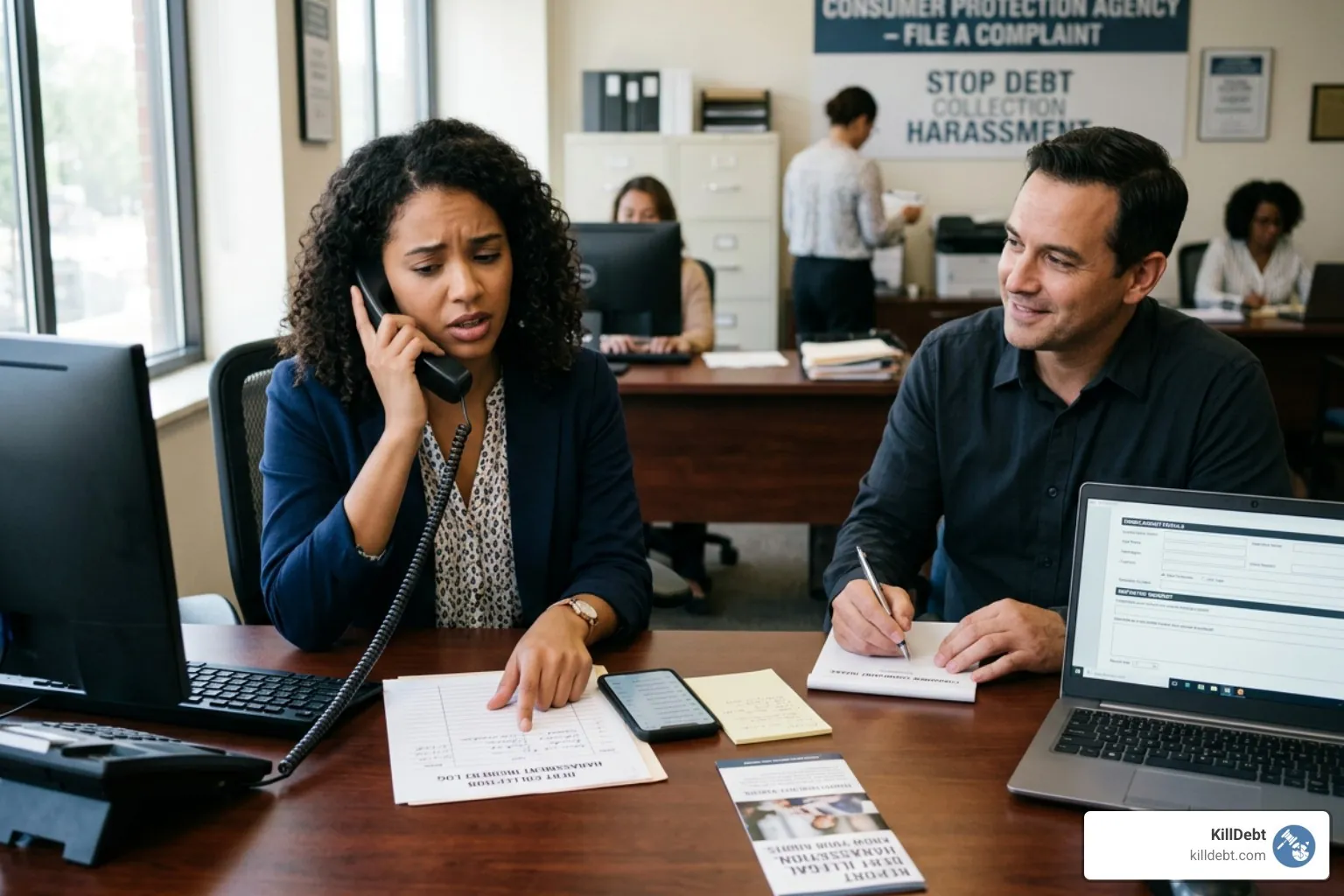
When collectors violate your rights, reporting them does more than just document the problem—it triggers formal regulatory investigations that can force the collection agency to back down. Federal and state agencies maintain powerful portals designed to hold abusive collectors accountable.
For a detailed breakdown of how to structure your complaint, read our guide on How to Report a Collection Agency.
| Reporting Channel | Best Used For | What Happens Next |
|---|---|---|
| CFPB (Consumer Financial Protection Bureau) | Violations of federal FDCPA rules, call frequency, or failure to validate debts. | Complaint is forwarded to the company; they must respond within 15 days. |
| FTC (Federal Trade Commission) | Scams, identity theft, "phantom" debts, and fraudulent collectors. | Data is entered into Sentinel database used for major federal law enforcement actions. |
| State Attorney General (FL / MI) | Violations of state-specific laws (FCCPA in Florida, MRCPA in Michigan). | State investigators review for local licensing violations and deceptive business practices. |
For more academic details on how these channels operate, you can consult Filing a Complaint Against a Debt Collector | Collections Authority .
The Consumer Financial Protection Bureau is the primary federal regulator overseeing the debt collection industry. Submitting a complaint through their portal is highly effective because they have a direct line to the compliance departments of major collection agencies.
If you are dealing with a "phantom" debt collector—someone trying to collect on a debt that does not exist, has already been paid, or was discharged in bankruptcy—you should report them directly to the Federal Trade Commission (FTC). The FTC actively investigates and shuts down fraudulent collection rings. You can learn more about identifying these bad actors by reading the FTC's guide on Fake and Abusive Debt Collectors | Consumer Advice .
Additionally, you should file a complaint with your state's Attorney General:
Reporting a collector to a government agency is an excellent way to trigger an investigation, but it does not automatically put money in your pocket. To recover financial compensation for the abuse you have suffered, you can file a civil lawsuit against the debt collector.
Under the civil liability provisions of the Fair Debt Collection Practices Act , consumers have the right to sue collectors in state or federal court. If you win, the court can order the collector to pay you damages and cover your legal expenses. For a detailed breakdown of how this works, see our guide on the FDCPA Explained.
The One-Year Clock: You must file an FDCPA lawsuit within one year from the exact date the violation occurred. If you wait longer than 365 days, your legal claim is time-barred, and you lose the right to sue. If you are currently facing a debt lawsuit, you can also use documented FDCPA violations as an affirmative defense or counterclaim to get the collection lawsuit dismissed entirely. Read more about this strategy in our guide on how to make a Debt Collector Harassment Stop.
If a court finds that a debt collector violated the FDCPA, you are entitled to several types of financial recovery:
To win a harassment lawsuit or successfully argue a counterclaim, you must have rock-solid, admissible evidence. Do not rely on your memory—start building your paper trail immediately:
Maintain a Contemporaneous Call Log: Keep a dedicated notebook next to your phone. Every time a collector calls, write down the date, the exact time, the phone number displayed on your caller ID, the name of the representative, and a detailed summary of what was said.
Save Digital Evidence: Take screenshots of your phone’s call history showing repeated calls. Save every voicemail, text message, email, and letter you receive.
Understand Recording Laws (Florida vs. Michigan):
Hiring a traditional consumer defense attorney can cost thousands of dollars in upfront retainers—money that most people struggling with debt simply do not have. This financial barrier often forces consumers to ignore collection letters or default on lawsuits, allowing predatory debt buyers to win by default.
We built KillDebt to solve this exact problem. We provide an affordable, DIY legal defense platform that gives you the tools, templates, and strategies needed to defend yourself and hold abusive collectors accountable, without the high attorney fees. You can view our transparent subscription options on our KillDebt Pricing page.
Our platform is powered by ParkerGPT, a highly specialized AI trained on consumer debt law and real-world courtroom strategies developed over 30+ years by our founder, attorney Brian Parker. Unlike generic AI chatbots, ParkerGPT understands the precise procedural rules of Florida and Michigan courts, allowing you to fight back like a seasoned professional. If you are Struggling with Debt Collectors, our platform can help you take control of your case in minutes.
When you receive a confusing court summons, a collection lawsuit, or a threatening letter, time is your worst enemy. Missing a court deadline in Florida or Michigan can result in an automatic default judgment, leading to immediate wage garnishment.
With KillDebt, you can upload your legal documents directly into our secure platform. Within minutes, ParkerGPT will:
To learn more about how our AI-driven system works, check out the details on ParkerGPT.
We recently rolled out our most tool yet: Court Tester.
Going to court is terrifying, especially if you are representing yourself against an aggressive collection attorney. Court Tester is an advanced AI courtroom simulation built directly on your actual case.
Here is how it works:
To watch Court Tester in action and learn more about DIY legal defense strategies, visit the KillDebt YouTube Channel.
Dealing with debt collection harassment is incredibly stressful, but you do not have to take the abuse lying down. The law gives you powerful, enforceable rights to stop the calls, force collectors to validate their claims, and hold them financially accountable when they cross the line.
By keeping detailed call logs, sending your disputes and cease-and-desist demands via certified mail, and filing formal complaints with the CFPB, FTC, and state Attorneys General, you can build an airtight case against abusive agencies.
You also don't have to face this battle alone or spend thousands of dollars on attorney fees. With modern, budget-friendly legal tech tools like KillDebt's ParkerGPT and our interactive Court Tester simulation, you can analyze your documents, identify collector weaknesses, and confidently defend your rights in court for a fraction of the cost. Take action today, protect your peace of mind, and fight back against illegal debt harassment.
This educational content is based on general legal principles and my experience in debt collection defense. It is provided for informational purposes only and does not constitute legal advice. Laws vary by state and by local court. For specific legal advice, consult a qualified attorney licensed in your jurisdiction. No attorney-client relationship is created by reading this guide.
Critical Multi-State Variations: FDCPA applies uniformly at the federal level, but state consumer protection laws may provide additional rights and remedies. Statute of limitations periods vary significantly by state and debt type. What constitutes sufficient debt validation varies in practice across jurisdictions. State-specific rules on call frequency, written notice requirements, and permissible collector conduct may differ from federal minimums.

About the author
Brian Parker
I have over 30 years of experience defending consumers against debt collection lawsuits and have seen every tactic, threat, and pressure play that collectors use. Through KillDebt and ParkerGPT, I have systematized the proven defense strategies that actually work - so consumers can respond from a position of knowledge, not fear. My approach focuses on aggressive legal defense based on documented case success rather than false hope that leads to default judgments.