
News Break
What to Do When a Bill Collector Sues You and How to Fight Back
June 29, 2026
Blog / News Break
Stop debt collector FDCPA violation tactics with proven validation letters, cease-and-desist steps, and court remedies.
A debt collector FDCPA violation occurs when a third-party debt collector breaks the rules set by the Fair Debt Collection Practices Act — a federal law that strictly limits how collectors can contact you, what they can say, and what tactics they can use.
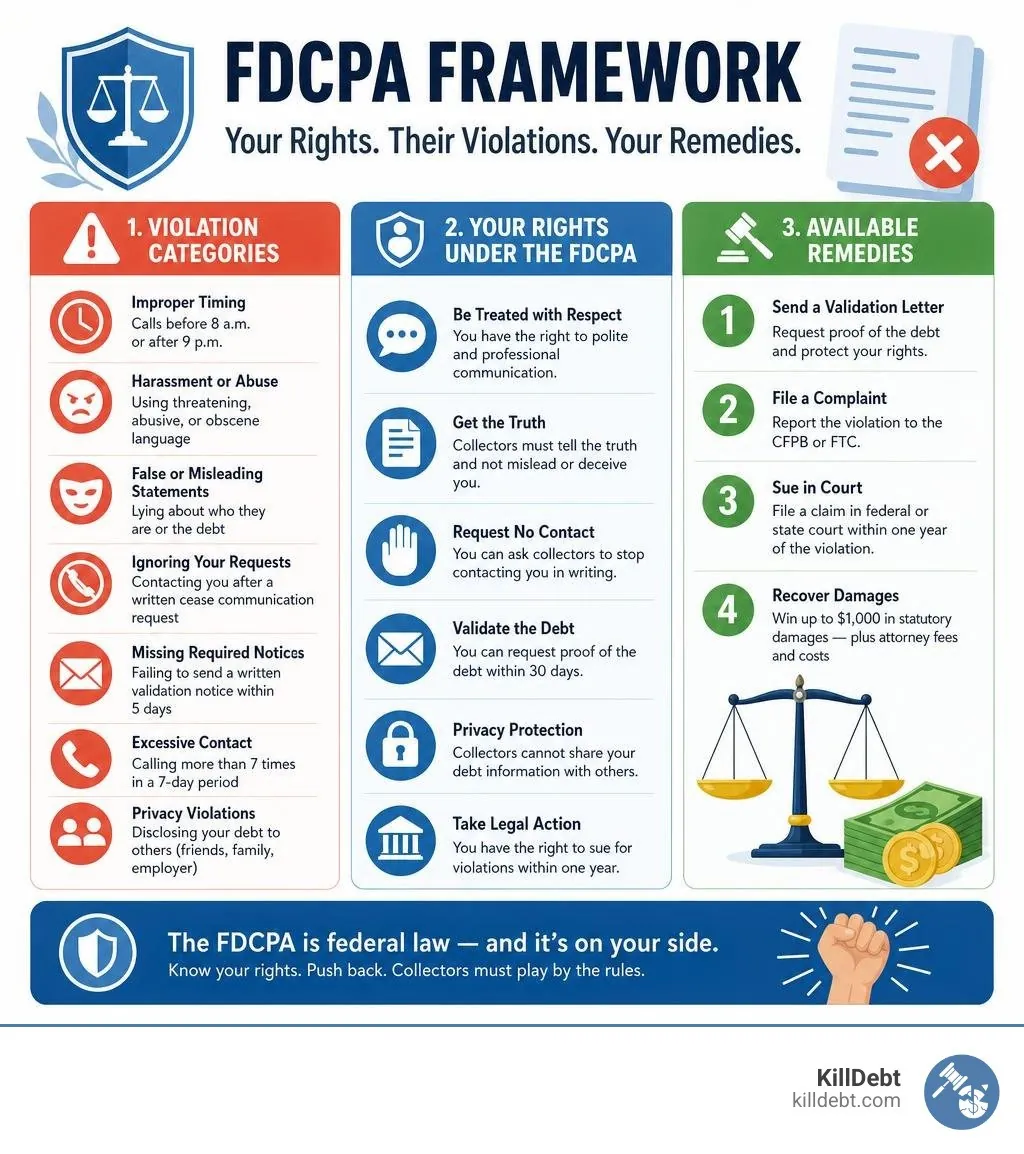
Common debt collector FDCPA violations include:
If a collector has violated these rules, you have real options:
If you're staring at a collection letter, a court summons, or fielding calls that feel threatening or relentless, you're not powerless. The FDCPA gives you tools to fight back — and collectors are counting on you not knowing that.
The CFPB received over 82,000 debt collection complaints in 2023 alone, making it one of the most complained-about industries in the country. Behind every one of those complaints is a real person being pressured, misled, or outright lied to.
I'm Brian Parker. For over 30 years, I've fought debt collectors, debt buyers, and collection law firms in courtrooms across the country — and I've seen every debt collector FDCPA violation tactic imaginable. I built KillDebt to put those same strategies directly in your hands, so you can defend yourself with confidence, even without a lawyer.
The Fair Debt Collection Practices Act (FDCPA) is a powerful federal shield enacted by Congress in 1977 to protect consumers from abusive, deceptive, and unfair debt collection tactics. If you want to understand the full strength of this law, you can read more in our comprehensive guide on FDCPA Explained.
To use the FDCPA effectively, we first have to understand who and what it covers. The law applies strictly to third-party debt collectors and debt buyers—companies or individuals who regularly collect debts owed to someone else. It does not generally cover original creditors (like the bank that issued your original credit card) collecting their own debts under their own name. For a deeper dive into these legal definitions, check out our article on What is a Debt Collector Under the FDCPA? Your Rights Explained.
The FDCPA only covers consumer debts. These are debts incurred primarily for personal, family, or household purposes. Examples include:
It does not cover business debts, commercial transactions, or certain government obligations like agricultural loans. If you are dealing with a third-party collector chasing a consumer debt, they must strictly adhere to the official FTC FDCPA text. If they step out of line, they have committed a actionable debt collector FDCPA violation.
When collectors are calling you, they often bank on the fact that you do not know where the legal boundaries are. The FDCPA broadly groups prohibited behavior into three major buckets: harassment or abuse, false or misleading representations, and unfair practices.
One of the most objective boundaries is the "7-in-7 rule" introduced under the CFPB's Regulation F. Under this rule, a debt collector is presumed to violate the law if they call you more than 7 times within a 7-day period regarding a single debt, or if they call you within 7 days after having a phone conversation with you about that debt.

You can find a complete breakdown of these rules and real-world scenarios in this list of FDCPA Violation Examples.
Harassment isn't just a feeling; under the FDCPA, it has a strict legal definition. Collectors are legally prohibited from engaging in conduct meant to oppress, harass, or abuse you.
If you're dealing with relentless calls at all hours, you can learn how to put an end to it with our guide on Debt Collector Harassment Stop and understand how to proceed with Illegal Debt Collection Harassment Reporting.
Debt collectors cannot lie to you. Period. Yet, they do it constantly. Common deceptive practices that constitute a debt collector FDCPA violation include:
This last point was heavily reinforced in the federal case Russell v. Absolute Collection Services, where the court affirmed that debt collectors are liable for making false statements about paid debts, even if the consumer did not formally dispute the debt within the initial 30-day window.
Under Section 809 of the FDCPA, collectors have strict validation duties. Within five days of their initial communication with you, they must send you a written "validation notice" containing:
If you dispute the debt in writing within this 30-day window, the collector must cease all collection efforts until they obtain verification of the debt and mail it to you.
Using this window is your absolute best defense. You can draft a highly effective response using our resources on Debt Validation Letters: Your First Line of Defense Against Collectors. If you simply want them to stop contacting you altogether, you can use our template for a Cease Debt Collection Letter.
If you prove a debt collector FDCPA violation in court, the law provides robust remedies to compensate you and punish the collector:
However, to sue in federal court, you must establish "legal standing." Two landmark cases show how courts analyze this requirement:
While the FDCPA sets a baseline of protection across the entire United States, states can—and do—enact stronger laws. Because KillDebt operates in Florida and Michigan, let's look at how these two states supercharge your consumer rights.
Florida’s state-level law is incredibly powerful because, unlike the federal FDCPA, the FCCPA applies to both third-party debt collectors and original creditors. If your original credit card company harasses you in Florida, they can be sued under state law.
Under the FCCPA, consumers can recover $1,000 in statutory damages, actual damages, and punitive damages. You can read more about navigating these local rules on Florida legal rights.
Michigan also provides robust state-level protections through the RCPA (MCL § 445.251 et seq.). Similar to Florida, Michigan’s law applies to "regulated persons," which includes original creditors collecting their own debts.
Michigan law makes it illegal to use misleading or deceptive communications, and violators can be held liable for actual damages or $150 (whichever is greater), which can be tripled for willful violations, plus attorney fees. For local guidance, see Michigan legal help.
| Feature / Protection | Federal FDCPA | Florida FCCPA | Michigan RCPA |
|---|---|---|---|
| Applies to Original Creditors? | No | Yes | Yes |
| Applies to Third-Party Collectors? | Yes | Yes | Yes |
| Statutory Damages | Up to $1,000 per action | Up to $1,000 per action | Actual damages or $150 (can be tripled) |
| Punitive Damages Allowed? | No | Yes | No |
| Attorney's Fees Recoverable? | Yes | Yes | Yes |
If a collector violates your rights, don't just get mad—get organized. Your path to turning the tables starts with gathering evidence.
First, send a written dispute or stop-contact notice. Always send this via Certified Mail with Return Receipt Requested. This gives you undeniable, court-admissible proof of when the collector received your letter.
Next, you'll want to formally report the behavior to regulatory agencies. Learn the exact process with our guide on How to Report a Collection Agency. If you want to stop the calls immediately while preserving your legal claims, use our Cease and Desist Creditor Letter.
If you ever end up in front of a judge, your success will depend entirely on your documentation. Follow these steps to build an airtight case:
Keep a Detailed Call Log: Write down the date, exact time, phone number, name of the agent, and a summary of what was said during every single call.
Save All Written Correspondence: Keep every envelope, letter, email, and text message. Do not throw anything away—even if it is addressed to the wrong person.
Capture Screenshots: If a collector messages you on social media or sends text messages, take immediate screenshots and back them up.
Know the Recording Laws:
When debt collectors break the law, they rely on your fear and silence to get away with it. But by recognizing a debt collector FDCPA violation, documenting the evidence, and knowing your state and federal rights, you can completely turn the tables on them.
At KillDebt, we believe you shouldn't have to spend thousands of dollars on an attorney just to defend yourself against predatory collection practices. That’s why we created our DIY legal defense system powered by ParkerGPT—an AI trained specifically on real-world courtroom strategies developed over 30+ years by consumer defense attorney Brian Parker.
Whether you need to analyze a confusing court summons, draft a ironclad response, or practice your arguments, our platform has you covered. We even offer the Court Tester, an AI courtroom simulation built on your actual case. You can upload your real filings and, within minutes, practice arguing your motion in front of an AI judge, against AI opposing counsel, with a private AI co-counsel whispering winning strategies directly to you.
Ready to take control of your financial peace of mind? Explore our DIY Legal Defense Platform and find the right path for your case today.
Get started with KillDebt pricing
IMPORTANT LEGAL DISCLAIMER
This educational content is based on general legal principles and my experience in debt collection defense. It is provided for informational purposes only and does not constitute legal advice. Laws vary by state and by local court. For specific legal advice, consult a qualified attorney licensed in your jurisdiction. No attorney-client relationship is created by reading this guide.
Critical Multi-State Variations: FDCPA applies uniformly at the federal level, but state consumer protection laws may provide additional rights and remedies. Statute of limitations periods vary significantly by state and debt type. What constitutes sufficient debt validation varies in practice across jurisdictions. State-specific rules on call frequency, written notice requirements, and permissible collector conduct may differ from federal minimums.

About the author
Brian Parker
I have over 30 years of experience defending consumers against debt collection lawsuits and have seen every tactic, threat, and pressure play that collectors use. Through KillDebt and ParkerGPT, I have systematized the proven defense strategies that actually work - so consumers can respond from a position of knowledge, not fear. My approach focuses on aggressive legal defense based on documented case success rather than false hope that leads to default judgments.