
News Break
How to Beat a Debt Collector Who Lacks the Standing to Sue You
June 25, 2026
Blog / News Break
Learn won a judgement how to collect with proven steps for wage garnishment, bank levies, liens, and judgment renewal.

If you've won a judgement and need to know how to collect, here's the short answer:
Winning in court feels like a victory — and it is. But here's the hard truth: the court does not collect the money for you. That judgment paper is not a check. It is a legal recognition that someone owes you money. What happens next is entirely up to you.
This catches a lot of people off guard. Approximately 50–75% of small claims judgments go unpaid simply because winners don't know the next step. The debtor isn't going to show up with cash. In most cases, you have to go get it.
The good news? You have real legal tools available — wage garnishment, bank levies, property liens, and more. This guide walks you through each one, step by step.
I'm Brian Parker, founder of KillDebt and a consumer debt defense attorney with over 30 years of courtroom experience fighting creditors and collection law firms. I've seen how confusing it can be to won a judgement and know how to collect on it — especially without a lawyer guiding you through the process. Let's break it down so you can move forward with confidence.
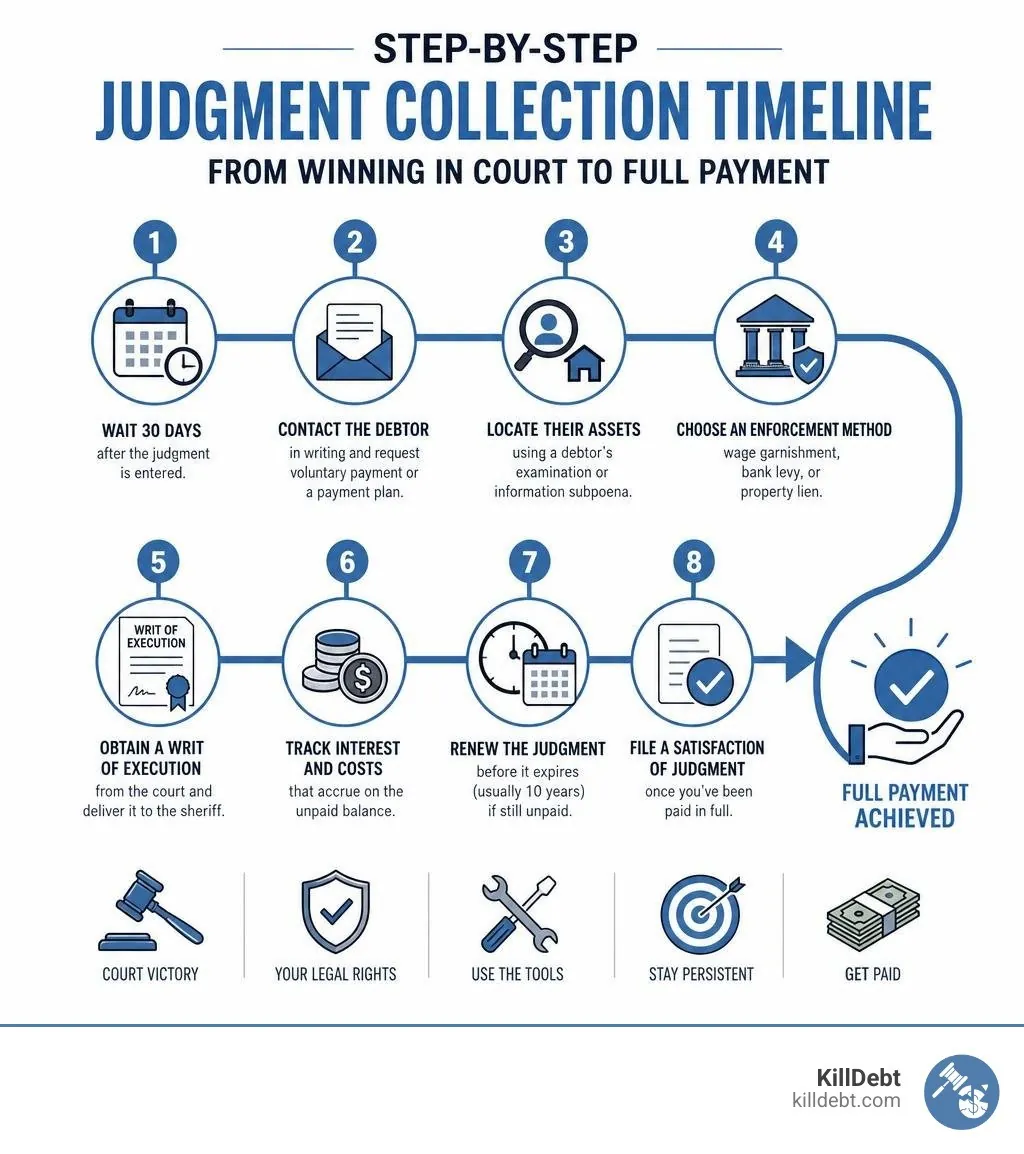
When the judge bangs the gavel and signs the order, you might feel a rush of relief. But as we often tell our clients, winning the lawsuit is only half the battle. In fact, it is often the easier half.
The cold reality is that a court judgment is essentially a piece of paper declaring you are legally owed a debt. The court clerk is not going to open a cash drawer and hand you your money, nor will the court actively police the debtor to make sure they write you a check. The burden of active enforcement falls entirely on your shoulders.
Because many judgment winners do not understand the procedural steps required to force a payment, a staggering 50% to 75% of small claims judgments end up completely unpaid. To avoid becoming part of this statistic, you must transition from a litigant to an active collector. This means learning how to navigate post-judgment discovery, work with local county sheriffs, and utilize statutory tools to legally seize assets or intercept income.
Before you rush to the local sheriff's office, you must understand the legal timeline. In most jurisdictions, including Florida and Michigan, there is a mandatory waiting period immediately following the entry of a judgment.
This waiting period—typically 21 to 30 days—exists to give the losing party (the judgment debtor) time to file an appeal, request a new trial, or file a motion to vacate the judgment. If you try to garnish wages or levy a bank account during this window, the court will reject your request.
During this quiet period, your best initial move is to seek voluntary payment. Sometimes, a simple, professional written demand letter is all it takes. You can lay out the reality of the situation: paying now avoids post-judgment interest, court costs, and the embarrassment of wage garnishment or asset seizure. You can also offer a structured payment plan to make compliance easier for them.
If the debtor is cooperative, you can draft a payment agreement. However, if they ignore you, you must prepare for formal enforcement. The very first administrative step is to ensure your judgment is properly docketed. Docketing or recording the judgment officially puts it on the public record, which is crucial for creating property liens. If you are dealing with a default judgment that was entered because the other party failed to show up, they might try to fight back. You can learn more about how debtors handle these situations in our guide on How to Remove a Default Judgment Debt.
Once the statutory appeal window has closed and your formal demand letter has gone unanswered, it is time to get organized. Keep a meticulous ledger. Every single expense you incur while trying to collect—certified mail fees, court filing fees, process server fees, and sheriff execution costs—can often be added to the total balance the debtor owes you.
When you contact the debtor to negotiate a payment plan, always do so in writing. This prevents disputes over what was promised and builds a paper trail that you can show a judge if the debtor defaults on the payment plan.
You cannot garnish a bank account if you do not know where the debtor banks, and you cannot garnish wages if you do not know where they work. So, how do you get this information? You use post-judgment discovery.
The two most powerful tools for asset discovery are:
In Michigan, creditors utilize specific State Court Administrative Office (SCAO) forms to initiate this process, which you can review in detail using resources like the [PDF] DCI 84, Collecting Your Money From a Small Claims Judgment packet. If the debtor fails to answer these questions or fails to appear for a scheduled examination, they can be held in contempt of court.
If voluntary negotiations fail and you have identified the debtor's assets, you must turn to the court to issue a Writ of Execution. This is the golden ticket of judgment collection. It is a formal court order that authorizes the local sheriff or court officer to seize the debtor's property, garnish their wages, or levy their bank accounts.

Once you obtain the Writ of Execution from the court clerk, you must deliver it to the sheriff's office in the county where the debtor's assets are located, along with instructions on what to seize.
To help you decide which path to take, here is a quick comparison of the primary enforcement methods:
| Collection Method | Speed | Difficulty | Cost | Best Used For |
|---|---|---|---|---|
| Wage Garnishment | Moderate | Moderate | Low | Debtors with stable, W-2 employment |
| Bank Account Levy | Fast | Moderate | Moderate | Debtors with known checking or savings accounts |
| Real Estate Lien | Slow | Easy | Low | Debtors who own real property and may sell or refinance |
| Personal Property Seizure | Moderate | Hard | High | Debtors with high-value, non-exempt personal assets (e.g., vehicles) |
Wage garnishment allows you to intercept a portion of the debtor's paycheck directly from their employer before the debtor ever sees it. However, you cannot take their entire paycheck.
Under federal law, wage garnishment is capped at 25% of the debtor's disposable earnings (the amount left after legally required deductions) or the amount by which their weekly income exceeds 30 times the federal minimum wage, whichever is less.
Furthermore, state-specific rules can be much stricter. For example, in Florida, if a debtor qualifies as a "head of family" (meaning they provide more than half of the support for a child or other dependent), their wages are completely exempt from garnishment unless they agree to it in writing. If you are on the receiving end of a collection action, understanding these limits is vital; see our article on Stopping a Wage Garnishment for deep-dive strategies.
A bank levy is one of the fastest ways to collect a large sum of money. When the sheriff serves a bank levy on the debtor's financial institution, the bank must immediately freeze the funds in the debtor's accounts up to the amount of the judgment.
However, certain funds are legally protected from being seized. Federal law protects public benefits, including:
If a bank account contains these types of funds, the bank is generally required to protect a specific amount of those deposits from being frozen. If you want to know more about how these protections work in practice, check out Can Debt Collectors Take My Wages and Bank Account.
If the debtor owns real estate, you can place a lien on it. In Florida, you do this by recording a certified copy of your judgment in the public records of the county where the property is located. This acts as a cloud on the title. The debtor will not be able to sell or refinance the property without paying off your judgment first.
You can also request that the sheriff seize and sell the debtor's personal property, such as a car or a boat, at a public auction. However, this is a highly complex and expensive route. You must pay upfront sheriff deposit fees, towing fees, and storage fees.
Additionally, you must respect state homestead and personal property exemptions. For instance, a primary residence is often protected from forced sale by robust homestead laws. You can read more about how property is shielded from creditors in our guide to Homestead Exemption Wage Garnishment.
Judgments do not last forever, but they do have a remarkably long shelf life. In most states, a civil judgment is valid for 10 years.
Because collection can take a long time, the law allows judgments to accrue post-judgment interest. This interest begins accumulating automatically from the date the judgment is entered by the court, and it compound over time, meaning the debtor will owe you significantly more than the original trial award if they delay payment.
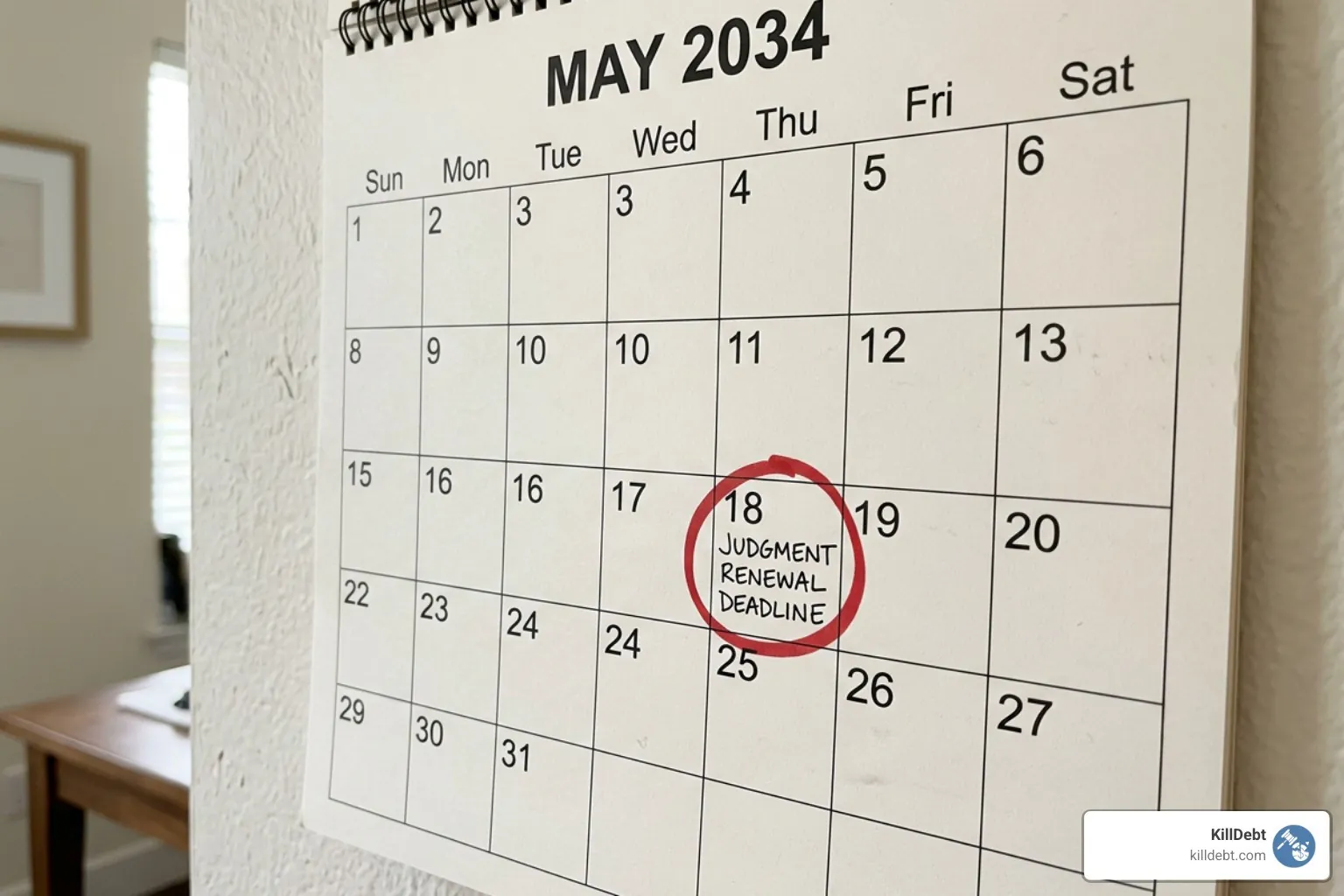
If the 10-year mark is approaching and you still have not collected the full amount, you must file renewal paperwork (such as Michigan's judgment renewal process or Florida's extension procedures) before the original expiration date. If you let the judgment expire, your legal right to collect evaporates.
Because we operate primarily in Florida and Michigan, let's look at how post-judgment collection rules differ between these two states.
In Florida, a judgment is legally enforceable for up to 20 years. To establish a lien on the debtor's personal property (like vehicles or business equipment), you must file a Judgment Lien Certificate with the Florida Department of State via Sunbiz. According to the How to Collect a Judgment in Florida - Division of Corporations guide, these personal property liens last for 5 years and can be renewed once for an additional 5 years. Real property liens must be recorded in the county where the land sits and are valid for 10 years, renewable up to the 20-year maximum. You can read more about these specific procedures in the [PDF] How to Collect a Judgment in Florida Under the New Judgment Lien ... document.
In Michigan, judgments are valid for 10 years. You can renew them for another 10-year term by filing a motion or action to renew before the initial 10 years expire. To understand the exact steps for small claims in Michigan, you can review Collecting Your Judgment \| Michigan Legal Help or consult county-specific guidelines like How To Collect On A Judgment \| Jackson County, MI .
For a broader view of how these rules compare across the country, check out the How to Collect a Small Claims Judgment by State (2026) directory.
When the debtor finally pays you every penny of the principal, accumulated interest, and allowable collection costs, your job is still not quite done. You are legally required to notify the court that the debt has been resolved.
You do this by filing a formal document called a Satisfaction of Judgment (or an Acknowledgment of Satisfaction) with the court clerk. In many states, you must file this within 15 to 30 days of receiving final payment. Failing to file this timely can result in severe court-ordered penalties and financial liability to the debtor, as an outstanding judgment heavily damages their credit report and financial standing. Once filed, the court records will be updated, and the debtor can send proof to credit bureaus to clear their record.
When you have won a judgement, knowing how to collect is the key to turning your legal victory into actual cash. The process requires patience, strict adherence to court procedures, and a clear understanding of state-specific asset exemptions.
Whether you are trying to navigate wage garnishments, bank levies, or property liens in Florida or Michigan, you do not have to go through it alone. At KillDebt, we specialize in simplifying complex legal battles. Our DIY legal defense platform is powered by ParkerGPT, an AI trained on real-world court strategies developed over 30+ years of consumer law practice.
And if you are facing debt collection yourself, we've just rolled out our brand-new Court Tester tool—an AI-powered courtroom simulation built on your actual case. You can upload your real filings and, within minutes, practice arguing your motions in front of an AI judge against AI opposing counsel, with a private AI co-counsel whispering winning strategies directly to you.
Empower yourself today and take control of your financial future by visiting KillDebt DIY Legal Defense.
Get started with KillDebt pricing
IMPORTANT LEGAL DISCLAIMER
This educational content is based on general legal principles and my experience in debt collection defense. It is provided for informational purposes only and does not constitute legal advice. Laws vary by state and by local court. For specific legal advice, consult a qualified attorney licensed in your jurisdiction. No attorney-client relationship is created by reading this guide.
Critical Multi-State Variations: FDCPA applies uniformly at the federal level, but state consumer protection laws may provide additional rights and remedies. Statute of limitations periods vary significantly by state and debt type. What constitutes sufficient debt validation varies in practice across jurisdictions. State-specific rules on call frequency, written notice requirements, and permissible collector conduct may differ from federal minimums.

About the author
Brian Parker
I have over 30 years of experience defending consumers against debt collection lawsuits and have seen every tactic, threat, and pressure play that collectors use. Through KillDebt and ParkerGPT, I have systematized the proven defense strategies that actually work - so consumers can respond from a position of knowledge, not fear. My approach focuses on aggressive legal defense based on documented case success rather than false hope that leads to default judgments.