News Break
Answered! A Sample Answer to Complaint Guide
June 11, 2026
Blog / News Break
Learn how homestead exemption wage garnishment protection works and stop creditors from taking your wages and home today.

Homestead exemption wage garnishment laws can be the difference between keeping your paycheck and losing a chunk of it to a creditor — and most people facing garnishment don't even know these protections exist.
Here's the quick answer:
The catch? You have to claim these protections. They don't kick in automatically. Miss the deadline on your garnishment summons, and you could lose your right to fight back entirely.
I'm Brian Parker, and I've spent over 30 years in courtrooms defending consumers against creditors, debt buyers, and collection law firms — including fighting homestead exemption wage garnishment cases where the right filing at the right moment made all the difference. In this guide, I'll walk you through exactly how these protections work and how to use them before it's too late.
At its core, a homestead exemption is a legal shield designed to keep you from becoming homeless. It protects a specific amount of equity (and in some states, an unlimited amount) in your primary residence from being seized by judgment creditors to pay off debts.

If a creditor wins a debt collection lawsuit against you, they usually receive a judgment. With that judgment in hand, they can place a judgment lien on your property or attempt a forced sale. However, the homestead exemption ensures that a designated dollar amount of your home's value is completely off-limits to these creditors.
How much is protected depends heavily on where you live. For a complete breakdown of how each state handles this protection, you can review the Homestead Exemptions by State: Creditor Protection Comparison Chart (opens in a new tab).
It is important to remember that homestead exemptions only protect you against unsecured creditors (like credit card companies, medical debt collectors, or personal loan providers). They will not stop a foreclosure if you stop paying your mortgage, nor will they protect you from property tax liens or federal tax levies.
You might be wondering: What does a home exemption have to do with my weekly paycheck?
In many jurisdictions, the legal definitions of "homestead" and "personal property" exemptions overlap. When a creditor attempts to garnish your wages or execute a bank levy, they are targeting your disposable earnings. In certain states, the law allows you to apply your unused homestead exemption balances or general personal property exemptions to shield cash, bank accounts, and even active wage garnishments from being handed over to a creditor.
This is a critical strategy in urgent self-defense. If a creditor has already won a debt collection lawsuit and obtained a judgment, they will typically target your bank account next. To understand how they do this and what is at risk, read our guide on Can Debt Collectors Take My Wages and Bank Account.
By understanding how state laws allow for "asset conversion" or the application of homestead deeds to cash assets, you can legally block a creditor's attempt to siphon money directly from your employer or your checking account.
Virginia has a highly specific and unique method for using a homestead exemption to protect wages. Under Virginia Code § 34-17, a debtor can set apart their homestead exemption to protect garnished wages, but the timing is incredibly strict.
To protect your wages using this method, you must file a Homestead Deed in the land records of the city or county where you live, and then file a Request for Exemption Hearing (Form DC407) with the court.
Other states also allow residents to protect their wages or bank balances using state-specific property and homestead exemptions:
Because asset protection laws are determined at the state level, the amount of protection you receive depends entirely on your zip code.
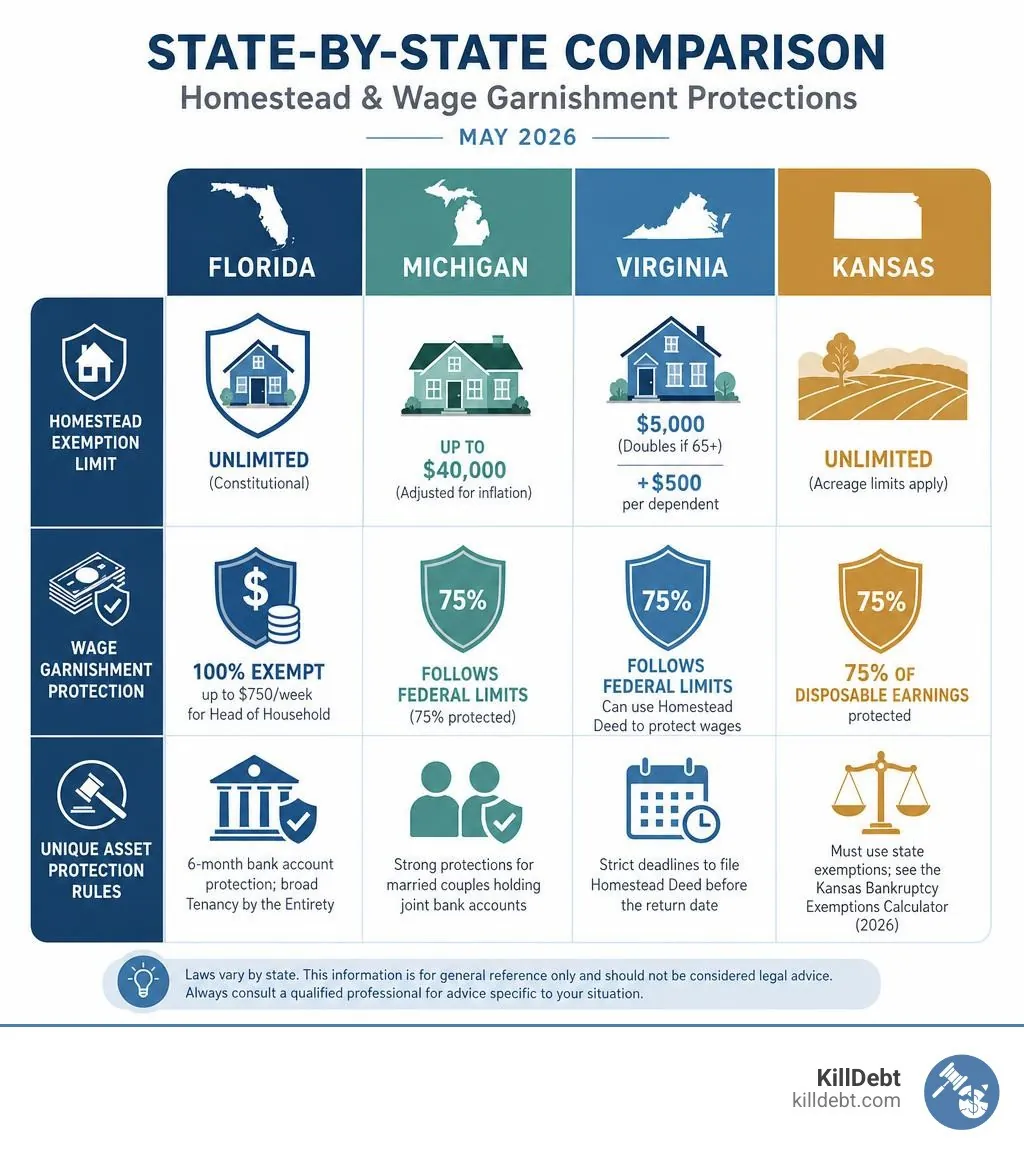
Below is a comparison of how different states handle homestead and wage protections as of May 2026:
| State | Homestead Exemption Limit | Wage Garnishment Protection | Unique Asset Protection Rules |
|---|---|---|---|
| Florida | Unlimited (Constitutional) | 100% exempt up to $750/week for Head of Household | 6-month bank account protection; broad Tenancy by the Entirety |
| Michigan | Up to $40,000 (adjusted for inflation) | Follows federal limits (75% protected) | Strong protections for married couples holding joint bank accounts |
| Virginia | $5,000 (doubles if 65+) | Follows federal limits; can use Homestead Deed to protect wages | Strict deadlines to file Homestead Deed before the return date |
| Kansas | Unlimited (Acreage limits apply) | 75% of disposable earnings protected | Must use state exemptions; see the Kansas Bankruptcy Exemptions Calculator (2026) (opens in a new tab) |
For Michigan residents, keeping your home safe is straightforward but capped. You can learn more about the specific limits by checking Michigan's homestead exemption (opens in a new tab) rules.
Florida is widely considered the strongest asset protection state in the country. If you live in Florida, you have access to a suite of constitutional and statutory protections that can stop creditors cold.
First, Florida offers an unlimited homestead exemption for your primary residence (up to 1/2 acre in a municipality or 160 acres in an unincorporated area).
Second, Florida's wage protections are incredibly robust. Under the Head of Household Exemption, if you provide more than half of the financial support for a child or other dependent, your wages are 100% exempt from garnishment if your net earnings are $750 or less per week.
Even better, Florida extends this protection to your bank account. Under Fla. Stat. 77.041 (opens in a new tab), these exempt wages remain completely protected for up to six months after they are deposited into your financial institution, even if they are commingled with other funds, as long as they can be traced back to your earnings.
If you are lucky enough to reside in one of these four states, creditors cannot touch your paycheck for ordinary consumer debts (like credit cards, medical bills, or personal loans) at all:
In these states, wage garnishment is reserved almost exclusively for child support, alimony, taxes, and federal student loans. For standard credit card judgments, your wages are completely safe from garnishment.
If you do not qualify for a homestead exemption or a head-of-household wage protection, you still have options to shield your assets from collection.

State and federal laws provide several other common exemptions:
To learn more about how to assert these rights in Florida, refer to Debtors' Rights in Florida: Claiming Your Exemptions From Judgments (opens in a new tab).
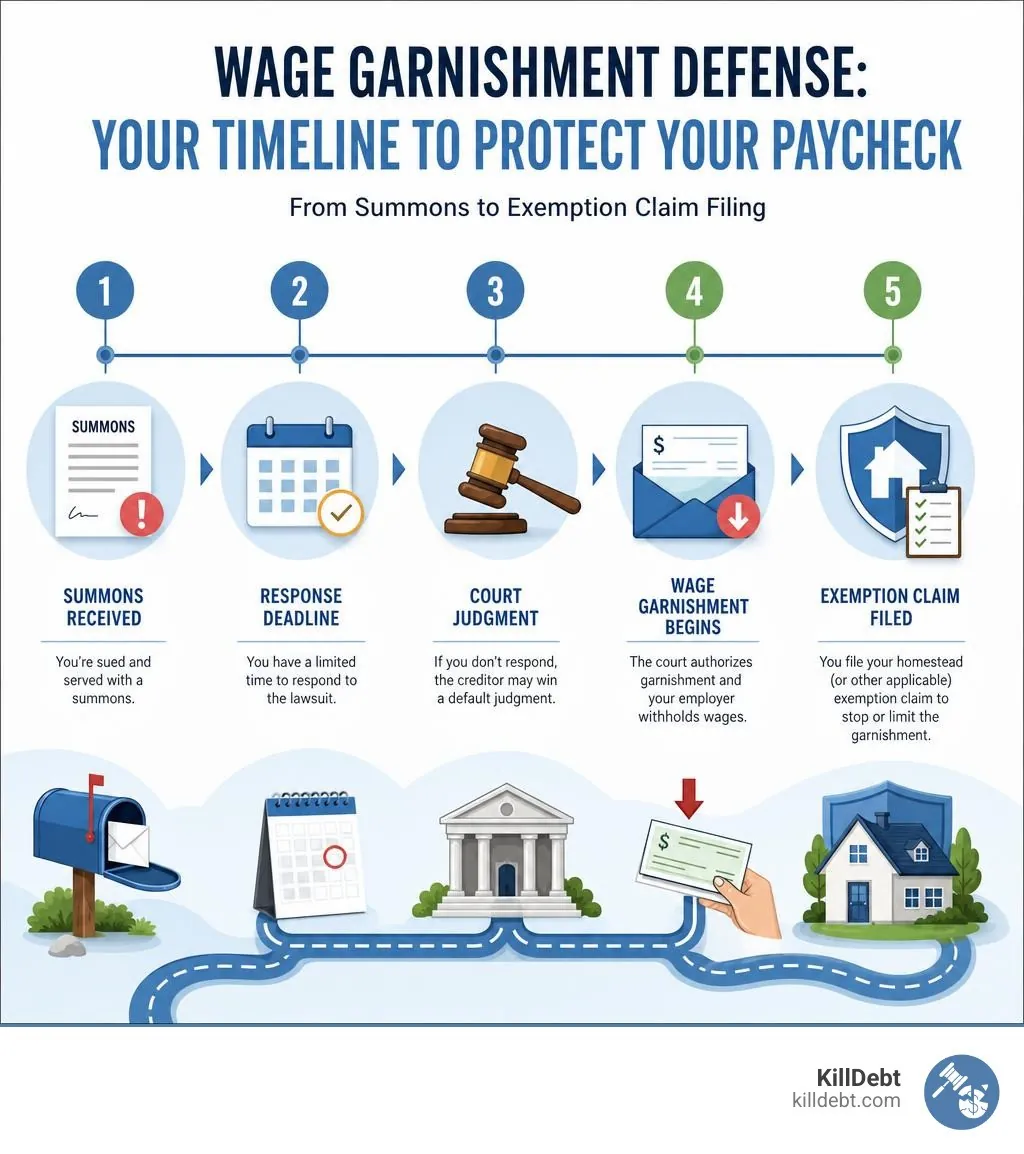
If you have received a garnishment summons or a notice of a bank levy, you must act quickly. This is a time for urgent self-defense.
Here is the step-by-step process to protect your money:
Warning: Be careful not to sign any contracts that contain a "waiver of exemptions." Some predatory lenders insert clauses where you voluntarily waive your right to claim a homestead or wage exemption. Always read the fine print before signing loan documents.
Facing a wage garnishment or a bank levy is stressful, but you do not have to navigate the complex legal system alone. Hiring an expensive attorney isn't your only option to protect your hard-earned wages and your home.
At KillDebt, we provide a DIY legal defense system powered by ParkerGPT—an AI trained specifically on consumer debt law and real-world court strategies developed over 30+ years by myself, attorney Brian Parker.
Unlike generic AI tools, ParkerGPT analyzes your actual lawsuit or garnishment documents, identifies critical procedural weaknesses, and generates court-ready responses with simple, step-by-step instructions.
And if you want to practice before you step into a real courtroom, our brand-new Court Tester allows you to run an AI courtroom simulation. You can upload your actual filings and argue your motion in front of an AI judge, against AI opposing counsel, while a private AI co-counsel whispers winning strategies directly to you.
Don't let debt collectors take what is yours. Protect your wages and home with KillDebt today, and stop wage garnishments in their tracks.

About the author
Brian Parker
I have over 30 years of experience defending consumers against debt collection lawsuits and have seen every tactic, threat, and pressure play that collectors use. Through KillDebt and ParkerGPT, I have systematized the proven defense strategies that actually work - so consumers can respond from a position of knowledge, not fear. My approach focuses on aggressive legal defense based on documented case success rather than false hope that leads to default judgments.