News Break
The Ultimate Guide to Your Credit Card Debt Summons Response
April 15, 2026
Blog / News Break
Discover how a civil judgement collection agency enforces judgments via garnishment, liens, and asset tracing. Boost recovery rates now!

A civil judgement collection agency is a specialized firm that enforces unpaid court judgments on behalf of creditors - locating debtor assets and using legal tools like wage garnishment, bank levies, and property liens to recover money the court has already awarded.
Here's what you need to know at a glance:
| What it is | A company hired to enforce an existing court judgment |
|---|---|
| Who uses them | Creditors who won in court but haven't been paid |
| Main tools used | Wage garnishment, bank levies, property liens, asset seizure |
| Typical cost | Contingency fee (% of recovery) or outright judgment purchase |
| Minimum judgment | Usually $1,000-$10,000+ depending on the agency |
| Key law governing collectors | Fair Debt Collection Practices Act (FDCPA) |
Winning a lawsuit feels like the finish line. But for most people, it's only the beginning of a much harder fight.
According to the American Bar Association, over 80% of civil judgments are never collected. The court hands you a piece of paper saying you're owed money. What it doesn't do is put that money in your bank account.
That gap - between a legal win and actual payment - is exactly where civil judgment collection agencies operate.
Whether you're a creditor trying to recover what you're owed, or a debtor suddenly facing enforcement actions, understanding how this process works is critical. Enforcement can mean frozen bank accounts, garnished paychecks, or liens on property - often without much warning.
This guide breaks down the full process in plain language, so you know exactly what to expect on either side of a judgment.
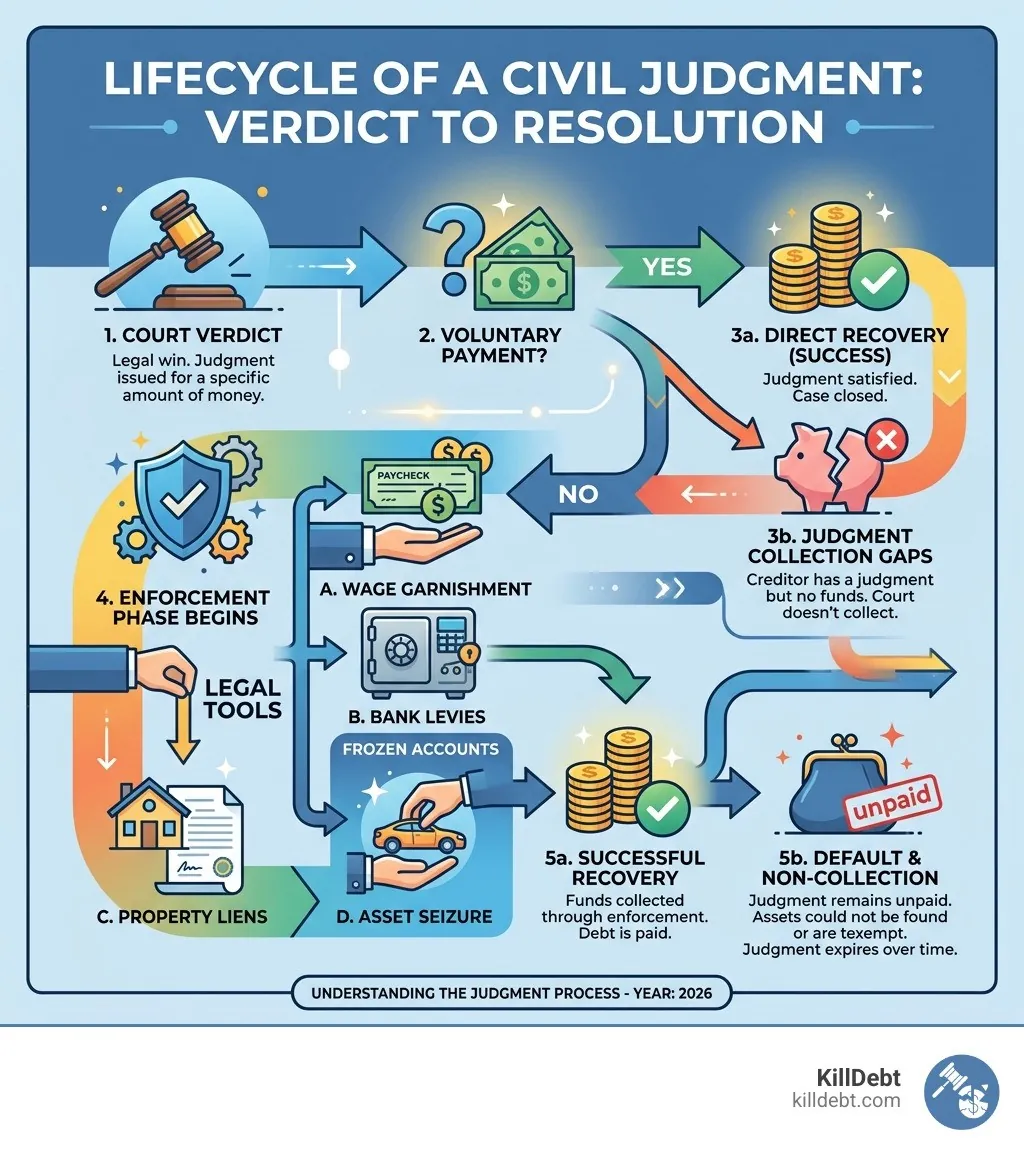
When a court issues a judgment, it is essentially a legal declaration that one party owes another a specific amount of money. However, the court does not act as a collection service. It is the responsibility of the creditor to actually get the money. This is where a civil judgement collection agency steps in.
These agencies are not your typical "call and harass" debt collectors. They are Judgment Recovery Specialists (opens in a new tab) who focus specifically on the post-judgment phase. Their work involves deep-dive asset tracing, skip-tracing (finding people who have moved or are hiding), and professional enforcement of court orders.
A civil judgement collection agency (opens in a new tab) employs a team that often includes private investigators, skip-tracers, and specialized attorneys. Their goal is to turn that piece of paper from the judge into actual cash. They operate under strict legal frameworks, including the Fair Debt Collection Practices Act (FDCPA), which dictates how they can interact with debtors. If you are on the receiving end of these calls, it is vital to understand What is a Debt Collector Under the FDCPA? Your Rights Explained to ensure your rights aren't being trampled during the enforcement process.
It is a staggering statistic: nearly 80% of all civil judgments are never recovered. But why is the "success rate" of the American legal system so low when it comes to actually paying out?
The primary reason is debtor resistance. Many debtors, especially in business disputes, are experts at "judgment proofing" themselves. This includes:
For many individuals, Struggling with Debt Collectors becomes a game of cat and mouse. Without the specialized tools of a civil judgement collection agency, most creditors simply give up because the cost of finding the money exceeds the value of the judgment itself.
To beat the 80% failure rate, agencies use high-tech and high-pressure tactics. They don't just wait for a check to arrive in the mail; they go hunting.
The process usually begins with a "digital magnifying glass" approach. Agencies use proprietary financial databases and public records to build a profile of the debtor’s life. They look for real estate filings, vehicle registrations, and even professional licenses. In states like Florida, the process is very specific; for instance, you can learn How to Collect a Judgment in Florida (opens in a new tab) through the Division of Corporations, where judgment liens are filed to "attach" to a debtor's personal property.
Once assets are located, the agency moves to seize them. This is the "teeth" of the judgment.
If you're worried about these actions, you should read our guide on Can Debt Collectors Take My Wages and Bank Account? to see what the limits are in Michigan and Florida.
If a debtor’s assets aren't obvious, the agency uses "discovery" tools. This includes Debtor’s Examinations, where a debtor is forced to appear in court and answer questions under oath about their finances. If they lie, it’s perjury. If they don't show up, a judge can issue a bench warrant for their arrest.
Agencies also use subpoenas to get records from third parties, like banks, utility companies, or even the debtor’s customers. In Michigan, the process is detailed through resources like Michigan Legal Help (opens in a new tab), which outlines how to use the court system to force a debtor to reveal where their money is hidden.
Hiring a civil judgement collection agency isn't free, but the "price" depends on how much risk you want to take. Most agencies specialize in judgments over a certain amount—typically $5,000 or $10,000.
| Feature | Contingency Model | Outright Purchase | Upfront Fee Model |
|---|---|---|---|
| Cost to You | $0 upfront | $0 (You get paid) | Fixed initial fee |
| Your Profit | 50% - 65% of recovery | 1% - 10% of judgment value | 100% of recovery |
| Risk | Agency takes the risk | Agency takes the risk | You take the risk |
| Speed | Slow (months/years) | Immediate cash | Varies |
When looking for Judgment Collection Services (opens in a new tab), it’s important to see if they offer "future pay" or "assignment" options.
Most people prefer the contingency model. The agency covers all the legal costs, filing fees, and investigator bills. In exchange, they keep a large percentage (often 50%) of whatever they recover. If they recover nothing, you owe nothing.
An outright purchase is different. Some agencies will "buy" your judgment for a small lump sum (pennies on the dollar). You get cash today, and they own the right to collect the full amount later. This is a great option if you just want to move on with your life. Understanding the Debt Collection Lawsuit Timeline can help you decide if you have the patience for a long-term contingency battle.
Not all agencies are created equal. When choosing, look for:
You might wonder, Do I Need a Lawyer for a Debt Collection Lawsuit? Often, a specialized agency is more effective at the collection stage than a general practice attorney.
If you are the one being collected against, don't panic. You still have rights. Even with a judgment, a civil judgement collection agency must follow the FDCPA. They cannot threaten you with violence, use profane language, or call you at 3:00 AM.
More importantly, certain assets are exempt from collection:
The first step in defending yourself is often sending Debt Validation Letters. Even if there is a judgment, you have a right to see the accounting of how much is owed, including interest and fees. If you've just discovered a judgment against you, check out our Complete First Steps Guide.
Whether you are a creditor tired of holding a worthless piece of paper or a debtor facing aggressive enforcement, the key is proactive defense and expert knowledge. A civil judgement collection agency has powerful tools, but they aren't invincible.
At KillDebt, we believe in leveling the playing field. We provide a DIY legal defense system powered by ParkerGPT, an AI trained specifically on consumer debt law and real court strategies developed over 30+ years by attorney Brian Parker.
If you’re being sued or facing a judgment, don't go in blind. Use our Court Tester—an AI courtroom simulation built on your actual case. You can upload your real filings and, within minutes, practice arguing your motion in front of an AI judge. You'll face AI opposing counsel while a private AI co-counsel whispers the winning strategy only you can see.
Don't let a judgment ruin your financial future. Whether you need to fight a lawsuit or settle a debt for pennies on the dollar, we have the tools to help you win.
Start your defense with KillDebt today and turn the tables on the collectors.

About the author
Brian Parker
I have over 30 years of experience defending consumers against debt collection lawsuits and have seen every tactic, threat, and pressure play that collectors use. Through KillDebt and ParkerGPT, I have systematized the proven defense strategies that actually work - so consumers can respond from a position of knowledge, not fear. My approach focuses on aggressive legal defense based on documented case success rather than false hope that leads to default judgments.