News Break
Ask Brian: Garbage Time, the Arbitration Trap, and the Collector That Bought a Debt From Itself
August 28, 2026
Blog / News Break
Round two of reader questions: forcing the forward flow agreement into discovery, undoing a default you never saw coming, and the settlement term that cleans your credit.
The first Ask Brian mailbag landed well enough that Brian came back three days later with round two: more questions from the YouTube comments and the community forum, including a few the community answered for itself before he got there. Same ground rule as always: the people asking are not his clients, and these are answers about kinds of situations, not instructions for anyone's specific case.
He opens by reading a comment telling him to get to the point sooner. Fair, he says, and does.
Key Takeaways
- The bill of sale in your case almost certainly says it was made pursuant to a master agreement. That sentence is your discovery argument.
- A default built on service that never happened can be set aside, and the clock matters more than the argument.
- When you settle with a debt buyer, ask for deletion from your credit report in writing. They almost always agree.
- Plead the affirmative defenses that fit, not the kitchen sink, and anchor each one to your counter affidavit.
Three readers asked versions of this, which makes sense: the forward flow agreement is the document debt buyers least want produced, because it holds the real terms of the sale.
Brian's tip is that the discovery argument is printed on the collector's own exhibit. Ninety-nine times out of a hundred, the bill of sale says it is made pursuant to the terms and conditions of a master forward flow agreement, or a master service and purchase agreement. Read that sentence the way a court will. The plaintiff says the bill of sale proves it owns your debt. The bill of sale says, on its face, that it exists only under the terms of another document. The plaintiff made that document relevant the moment it relied on the exhibit that incorporates it.
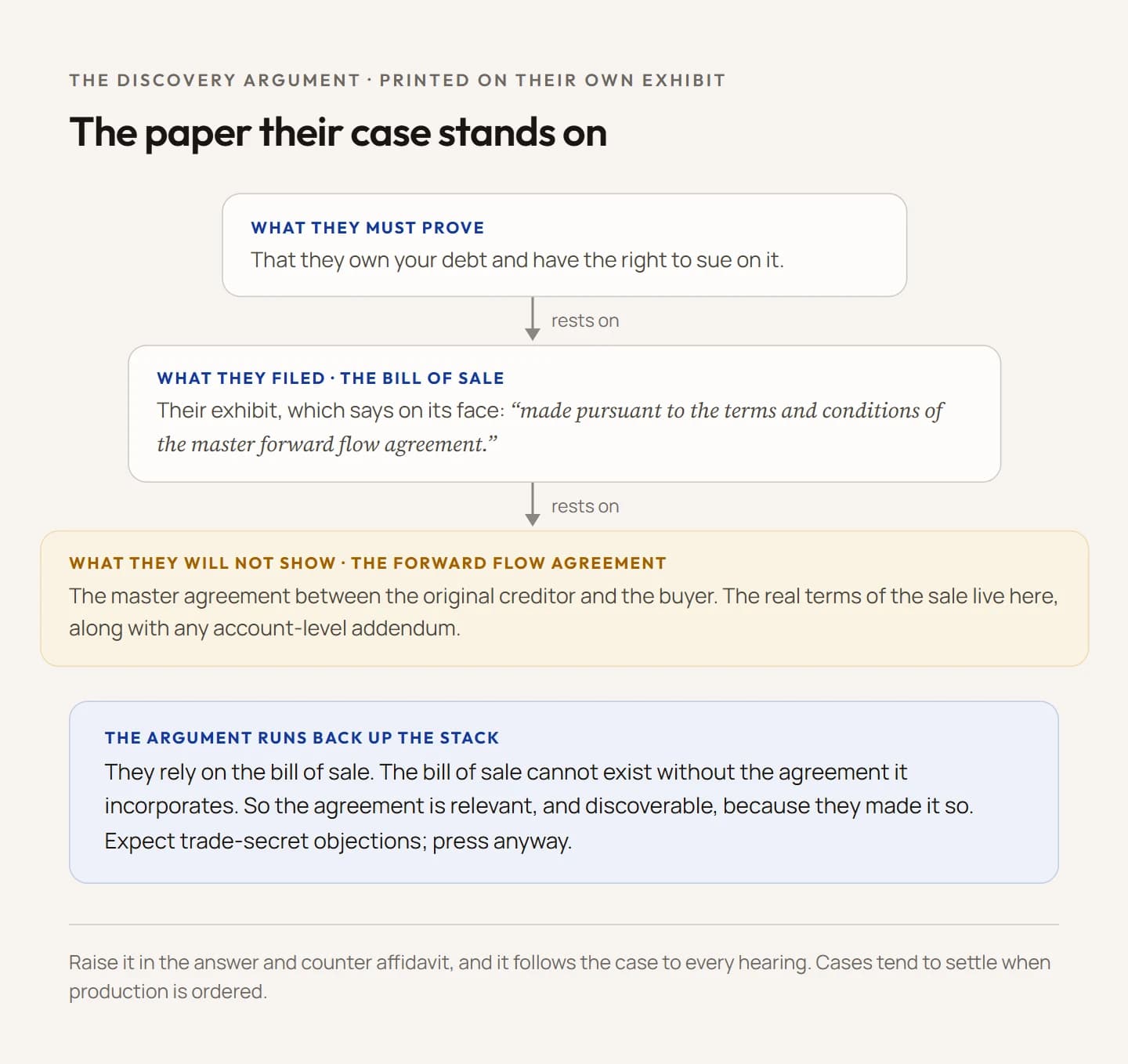
So ask for the agreement, and if the bill of sale references an account-level addendum, ask for that too. They will object that it contains trade secrets. Press anyway, in Brian's words, like a dental instrument on a raw tooth. And when a reader asked how to raise all this at a pretrial conference, the answer was that it should already be raised: the place this argument lives is your answer and counter affidavit, which follow you through the whole case. Brian pastes the goofy parts of a plaintiff's paperwork directly into his, and once annotated a filing so enthusiastically that a court told him it got the point without the arrows and sticky notes.
A reader ignored the first two letters and asked how to respond to the third. Brian's answer is respectful and blunt: doing nothing is what propels a collector to do everything. The number one goal of a debt buyer is the default judgment, because a judgment is an annuity, and ignoring the process is how they get one. The way out is not a magic reply to letter three. It is answering the lawsuit with a counter affidavit, which is also what turns a garnishment threat into a negotiation, and sometimes into a counterclaim.
A commenter offered a confident rule: when a debt collector calls, the original debt was discharged and is no longer enforceable. Brian's correction is worth keeping, because versions of this claim circulate everywhere. A collector calling means the opposite: someone believes the debt is enforceable and intends to collect it. Whether they are right is exactly what you make them prove. The sale of a debt does not discharge it, and treating the call as legally meaningless is a cousin of the myths that lose winnable cases. Test what you read online, this blog included, against what the person telling you has actually litigated.
A reader learned about their case only after losing it: the process server swore service happened, and it did not. The industry has a name for that, sewer service, and Brian has a playbook for it.
File a motion to set aside the default, with a counter affidavit, and do it immediately, because timing is most of the fight. Courts want their community to have a day in court, and the earlier a default is caught, the less you have to prove. In Michigan, caught within 21 days, a set-aside is nearly automatic. Florida's rule expects the motion promptly. Argue about a default seven months later and you need a very good reason.
False service is that very good reason, and it is provable from their own paperwork. The docket records the date, place, and manner of service the plaintiff claimed. If the proof of service says you were handed papers at home on a day you can show you were somewhere else, their own filing becomes your best exhibit. Sometimes Brian shows the draft motion to the other side before filing it and asks whether they would rather resolve the case than defend that document. The details of the process live in the vacating-a-judgment guide and the improper-service explainer.
A reader pointed out that the major debt buyers have been repeatedly sanctioned by the federal government, and asked whether courts can be made aware of it. Brian's tactic goes further than mentioning it. The CFPB's enforcement history, whatever the agency's current posture, is a library of public documents that still exist, including consent orders (opens in a new tab) in which companies like Portfolio Recovery Associates agreed they engaged in specific practices and promised to stop.
A consent order is an agreement, signed by the company. So when the plaintiff in your case is doing the thing it promised a federal regulator it would stop doing, download the order from the CFPB enforcement database (opens in a new tab), attach it to your answer, and let the two documents talk to each other. We live in a contract-law society, and a judge can read.
A reader assumed the credit damage is permanent once a debt buyer reports the account, so settling buys nothing. Brian's practice says otherwise. When he settles a debt buyer case, the written terms always include deletion of the trade line from the credit report, and debt buyers almost always agree: the account is not a customer relationship they care about, and deletion ends the dispute cheaply. The catch is the same as every settlement term that matters: it exists only if it is in writing. Ask for it every time.
A member asked what to do in a court too informal for the usual filings, and another member answered before Brian did, which is the forum working as designed. In Maryland small claims, the advice went, you file your notice of intention to defend, bring your evidence, and use the counter affidavit as your own notes rather than a filing. Brian added the general rule: check whether any rule actually forbids filing a denial, because usually nothing does, and he has watched cases collapse on nothing more than a filed answer denying every claim. A defendant who visibly will not roll over changes the economics of the case all by itself. The member who beat LVNV twice on appeal in Maryland is the long version of that lesson.
A reader building an unlicensed-collector defense hit a wall: the state office would confirm current status but not produce a certified history of lapses, expirations, and renewals. Brian's answer is to right-size the ask. What the defense needs first is something official showing the collector holds no effective license, and current-status confirmation often covers it. If the case turns on history, a subpoena reaches records that a public-records request cannot. In Florida, an unlicensed collector cannot maintain the suit, so the one document is worth the process it takes to get.
Brian closed with craft. Affirmative defenses carry a yin and a yang: some are waived forever if you do not raise them at the start, but that is not a reason to plead thirty. Plead the ones that fit, one to ten of them, and make each one carry weight. His signature move ties the package together: each defense ends with "see Exhibit 1," and Exhibit 1 is always the counter affidavit. The defenses point at the evidence, the evidence supports the defenses, and the whole thing follows you to every hearing as your blueprint.
Questions for the next round go in the video comments or the community forum.

About the author
Brian Parker
I have over 30 years of experience defending consumers against debt collection lawsuits and have seen every tactic, threat, and pressure play that collectors use. Through KillDebt and ParkerGPT, I have systematized the proven defense strategies that actually work - so consumers can respond from a position of knowledge, not fear. My approach focuses on aggressive legal defense based on documented case success rather than false hope that leads to default judgments.