News Break
The Forward Flow Agreement: The One Document Debt Buyers Never Want You to See
August 18, 2026
Blog / News Break
Some states bar an unlicensed collector from suing at all. Brian Parker explains Henson v. Santander, the Illinois Axiom ruling, and the five-step license check.
A company called Axiom Financial Services built its business on buying defaulted mortgage loans and filing foreclosure actions on them. No servicing, no statements, no payment plans. Buy the zombie debt, then sue. In July 2026 an Illinois appellate court shut that down in the state, and the reason had nothing to do with whether the debts were real. Axiom had never registered as a collection agency, so it was not permitted to collect at all.
That is the defense Brian Parker walks through in this video, and it is a different kind of argument from the ones this blog usually teaches. You are not proving you paid. You are not attacking the chain of title. You are asking one question: was the company standing in front of the judge licensed to be there?
Key Takeaways
- A licensing defense needs no payment records and no proof about the debt. It runs on public databases you can search in minutes.
- Henson v. Santander protects debt buyers under one prong of the FDCPA definition. It expressly left the other prong open.
- States write their own definitions, and Illinois covers debt buyers by name. That is what beat Axiom.
- An unlicensed collector's problem does not erase your debt. It removes their leverage and hands it to you.
Most collection defenses ask you to prove something about the account: what you paid, what you signed, who actually owns it. The licensing question asks nothing about the account. It asks about the collector.
That gives it three properties worth noticing. It does not depend on records you no longer have. It is answerable from public sources, because licensing databases and corporate filings are searchable, often free, and often in seconds. And in several states it is not only a defense but a claim: a reason to sue or enjoin the collector, whether or not the underlying debt is completely real.
To see why state law carries this defense, start with the federal case debt buyers love to cite. In Henson v. Santander Consumer USA (opens in a new tab), 582 U.S. 79, decided unanimously on June 12, 2017, the Supreme Court looked at the FDCPA's definition of a debt collector.
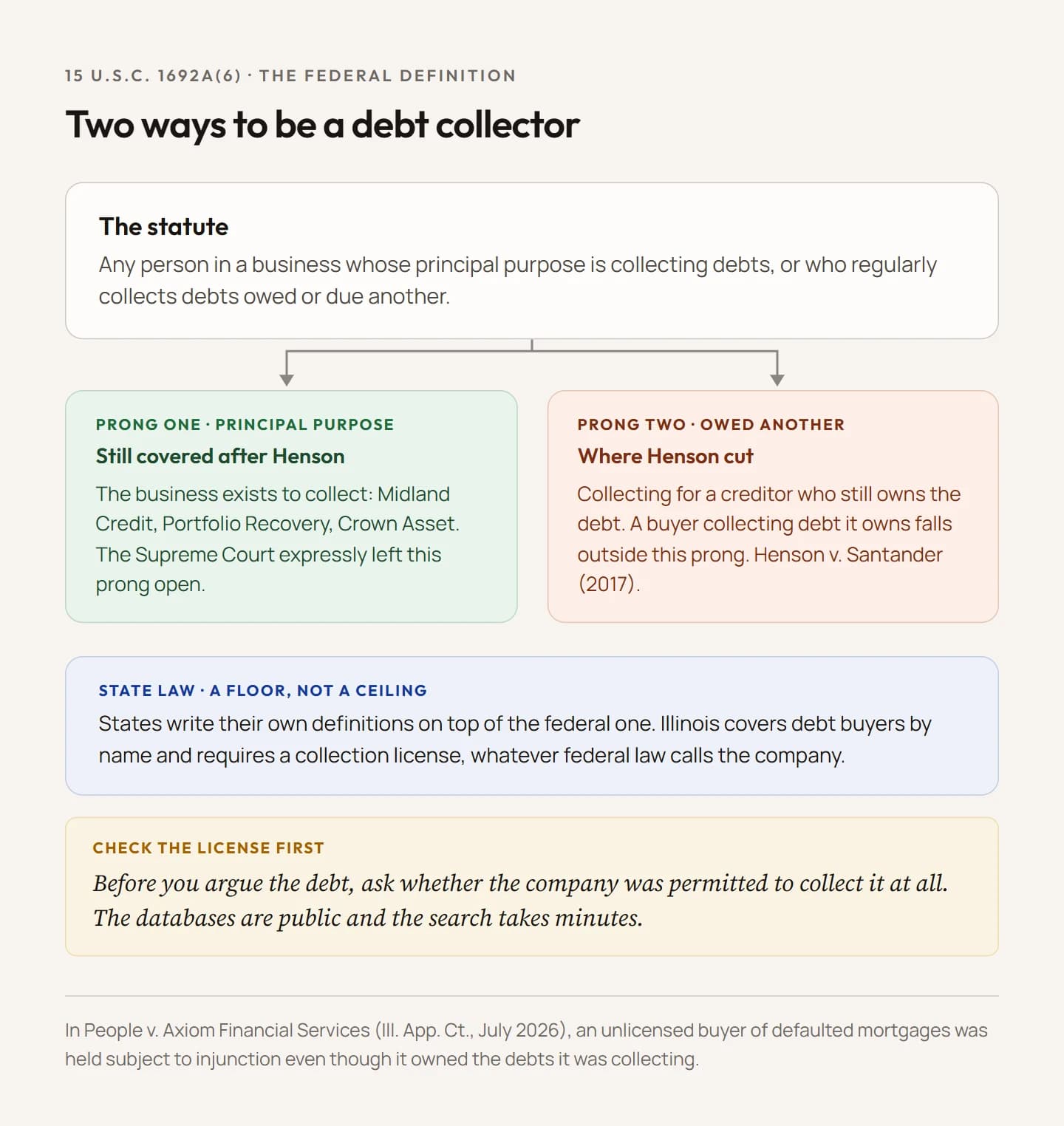
The definition, 15 U.S.C. 1692a(6) (opens in a new tab), has two prongs. A debt collector is any person in a business whose principal purpose is the collection of debts, or who regularly collects debts owed or due another. The first prong describes companies like Midland Credit or Portfolio Recovery, whose whole business is collecting defaulted accounts. The second describes collection agencies and law firms collecting on behalf of a creditor who still owns the debt.
Santander had bought a portfolio of CitiFinancial auto loans, some in default, and kept collecting on them. Borrowers sued under the second prong: you are collecting debts that were owed to CitiFinancial, so you are collecting the debts of another. Santander answered that "owed" describes the present, not the past. The debts are owed to us now, because we bought them. We are collecting for ourselves.
The Supreme Court agreed with Santander. A company collecting debts it owns is not collecting debts owed another, even if it bought them after default. For a while after the opinion came down, debt buyers told anyone suing them that the FDCPA could no longer reach them at all.
They were reading the case wrong, in two ways.
First, Henson interpreted the second prong only. The Court expressly declined to decide the principal-purpose question, and that prong is where the pure debt buyers live. Santander looked like a creditor because it also serviced accounts: you could call it, ask whether your payment posted, and get an answer. A company like Midland Credit services nothing. Its principal purpose is buying defaulted debt and collecting it, and courts around the country have held that such a company is a debt collector under the first prong, Henson notwithstanding.
Second, Henson interpreted one federal statute. It says nothing about state law, and federal consumer law is a floor, not a ceiling. A state cannot take away FDCPA protections, but it can add its own, and the states that matter here define their regulated parties in their own words.
That brings us back to Axiom. In People v. Axiom Financial Services, LLC (opens in a new tab), decided July 28, 2026, the Illinois Appellate Court faced a debt buyer making exactly the Henson argument: we bought the loans, we own them, we are a creditor, leave us alone. The trial court had agreed and dismissed the case.
The appellate court reversed, because the Illinois Collection Agency Act (opens in a new tab) is not the FDCPA. The state statute regulates any person engaged in collection, and it defines a debt buyer expressly: a person or entity in the business of purchasing delinquent or charged-off consumer debt for collection purposes, whether it collects itself, hires third parties, or sues. There is no "owed another" language to argue about. Buying debt to collect it is the covered activity, by name.
Two details from the opinion are worth remembering, because they are the kind of homework anyone can do.
Axiom's own paperwork sank it. When it applied for authority to do business in Illinois, it described its proposed purpose as debt collection and debt purchasing. Its own corporate filing used the exact words the statute regulates. The plaintiff found that in public records and used their paperwork against them, which regular readers will recognize as the house method.
Axiom never claimed an exemption. The Act carves out categories that do not need a collection license, including one for loan and finance companies that Axiom might have fit. It never argued the point, and the court noted it.
One more Illinois feature made the case possible at all. The Act lets the attorney general, a state's attorney, or any person sue in the name of the people of the State of Illinois for an injunction against unlicensed collection. That is why a civil collection case carries a caption that looks criminal. A private plaintiff walked into court representing the people, as the statute invites, and won an injunction against a company that owned the debts it was collecting.
| State | What a missing license means |
|---|---|
| Maryland | The strongest rule. Maryland's high court treats collecting without a required license as attempting to enforce a right the collector knows does not exist. |
| Illinois | The Collection Agency Act covers debt buyers by name, and any person can sue in the name of the state for an injunction. This is the statute that stopped Axiom. |
| Massachusetts | Unlicensed or unfair collection is an unfair and deceptive practice, with double or treble damages plus attorney fees. Fee awards are what bring consumer attorneys to the table. |
| Washington | The Collection Agency Act ties into the Consumer Protection Act, so a licensing failure feeds a consumer claim. |
| West Virginia | Registration is required, and the state consumer act carries statutory damages per violation that reach several thousand dollars once inflation adjustments apply. |
Not every state takes licensing seriously, and some regulate only agencies, not buyers. The statute's definitions section is where the answer lives, the same lesson as the Capital One case and the creditor gap.
Do not confuse unlicensed with nonexistent. A licensing problem usually does not make the debt disappear. Axiom's borrowers may well have owed those mortgages, and Axiom may well have owned them. What the violation does is close the collector's path: it could not open those courthouse doors without the license. That removes their leverage, and sometimes it hands the leverage to you, to settle the debt on your terms instead of theirs.
One housekeeping note from the video: professionals who serve consumers in this fight, including attorneys, paralegals, debt settlement companies, and credit repair consultants, can now use KillDebt through a business enterprise plan instead of squeezing through a consumer membership.

About the author
Brian Parker
I have over 30 years of experience defending consumers against debt collection lawsuits and have seen every tactic, threat, and pressure play that collectors use. Through KillDebt and ParkerGPT, I have systematized the proven defense strategies that actually work - so consumers can respond from a position of knowledge, not fear. My approach focuses on aggressive legal defense based on documented case success rather than false hope that leads to default judgments.