News Break
Unlicensed Debt Collectors: The Defense That Works Even When the Debt Is Real
August 19, 2026
Blog / News Break
Judges, clerks, and collection attorneys all invite you to explain how you fell behind. Brian Parker's scripts for all three rooms, and the rule of five.

Picture a defendant. He lost his job to AI. He fell behind on his bills. His mother died, his father moved in, and the living expenses went up. His child has special needs. He just went through a divorce, and the new job pays half of what the old one did. Every word of that is true, and Brian Parker has met thousands of people living some version of it across more than 30 years of collection defense.
Now here is the hard part of this video, and Brian says it plainly: told in a courthouse, that story loses the case. Not because it does not matter. Because of where it lands.
Key Takeaways
- The plaintiff has the burden of proving it owns the debt and has the right to sue you. Your hardship is irrelevant to that question.
- Courthouses sort cases into piles. A defendant who explains how they fell behind goes on the easy pile: no dispute, quick resolution, bad outcome.
- Three people will invite you to tell the story: the judge, the clerk, and the plaintiff's attorney. Each one gets a script instead.
- The rule of five: no or yes, do not guess, five words or less, and wait five seconds before every answer.
Start with the frame that makes everything else make sense. In a civil case, the party that sues carries the burden of proof. A debt collector suing you must prove it owns the debt and has the right to collect it. You still need to file an answer, affirmative defenses, and a counter affidavit, because silence is how default judgments happen. But whether you fell behind, and why, is not the question in front of the court. Whether they can prove their case is.
Go looking for your story in the court rules and you will not find it. Nothing in the rules of procedure, the rules of evidence, or the list of affirmative defenses asks about your living expenses or your father moving in. A story that appears nowhere in the rules can only do one thing when you tell it: signal that you do not dispute the debt.
That signal has a destination. A collection docket is a sorting operation, and the sort is into piles. Cases that will fight, and cases that will resolve themselves. Tell the story and you have filed yourself on the easy pile. The same story reaches three different people on court day, and each one needs a different script.
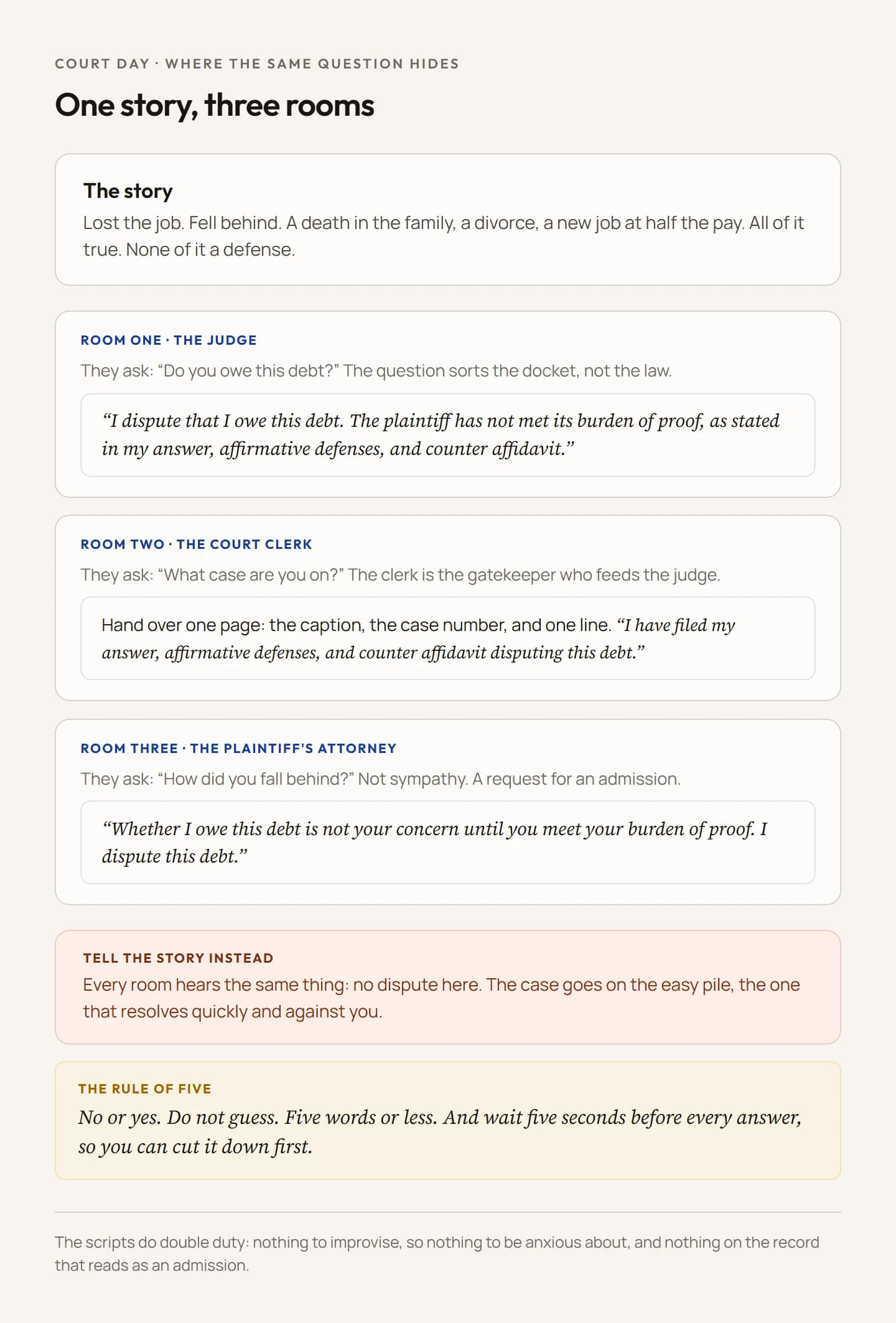
Judges ask a question they arguably should not: "Do you owe this debt?" It is irrelevant to the burden of proof, but judges are human, they have 40 cases on the docket, and the question sorts fast. The defendant who answers with the story about the job and the divorce has just told the court there is no dispute here. Easy pile. A judge who was neutral thirty seconds ago now sees a case that can come off the docket today.
The script:
"Judge, I dispute that I owe this debt to the plaintiff. They have not met their burden of proof, as stated in my answer, affirmative defenses, and counter affidavit."
One sentence, three messages. You filed your paperwork. You know the standard the plaintiff has to meet. And this case does not belong on the easy pile. Then stop. Do not apologize for your situation, especially to a plaintiff that showed up without complete proof and is hoping to slide the case through. An apology is the story in miniature.
The first person you reach after security is the clerk, and Brian's warning here is the bluntest in the video: the clerk holds the real power in that courtroom. Clerks are the gatekeepers who feed the judge, and a defendant who melts down in the check-in line gets remembered exactly the way you would expect.
So do not talk. Hand over paper. Before court, write one page:
The clerk takes the page, puts it in your file, and does not have to listen to anything. You have made her job easier, which is the opposite of what the crying defendant two spots ahead of you in line just did. And the page carries a bonus: if the court somehow does not have your filings, you find out at the counter, with time to fix it, instead of in front of the judge.
Brian's small mischief, offered take-it-or-leave-it: he writes the caption with his client's name first, ahead of the plaintiff's. Nothing turns on it. It just refuses the framing.
In the hallway, a warm and friendly attorney approaches. Odds are it is not the lawyer who filed the case; collection firms send coverage attorneys who may not know your name. The opener is always some version of "so how did you get into this situation?"
That is not sympathy. The plaintiff needs two things: to meet its burden of proof, and to show you did not dispute the debt. The hallway question exists to hand them the second one for free, in your own words, while an attorney takes notes.
The script:
"Whether I owe this debt is not your concern until you meet your burden of proof. As stated in my answer, my affirmative defenses, and my counter affidavit, I dispute this debt."
The discipline underneath all three scripts comes from how Brian preps clients for depositions, and tens of thousands of people have watched him teach it. Some attorneys now hand the video to their own clients. It has four parts:
People are an accommodating species. A stranger asks for directions and we help, because helping is who we are. Brian's point is that a courthouse runs on that reflex: the judge's question, the clerk's small talk, the attorney's warmth all pull on the button that makes you explain. The minute you accommodate, you admit. Be polite, be respectful, and be a robot.
None of this says your hardship does not matter. It says a courtroom is the one place it cannot help you, and the anxiety most people feel about court is the fear of having to perform there. The scripts are the cure for both problems at once. You never improvise, so there is nothing to be anxious about, and nothing in the transcript ever reads as an admission. If you want to rehearse the whole day before you live it, Court Tester exists for exactly that, and the cheat sheets carry what to say when a judge pushes back, on one page you can hold.
There is a place for your numbers: a settlement conversation about what you can actually pay, on paper, with nothing personal in it. That is a different room and a different playbook. In every other room, dispute everything, admit nothing, and count to five.

About the author
Brian Parker
I have over 30 years of experience defending consumers against debt collection lawsuits and have seen every tactic, threat, and pressure play that collectors use. Through KillDebt and ParkerGPT, I have systematized the proven defense strategies that actually work - so consumers can respond from a position of knowledge, not fear. My approach focuses on aggressive legal defense based on documented case success rather than false hope that leads to default judgments.