
Blog / News Break

Re-Aged Debt: The Two Clocks Debt Collectors Hope You Confuse

The credit reporting clock never restarts. The lawsuit clock can. Brian Parker explains re-aging, the date of first delinquency, and nine ways to catch it.

Consumer defense attorney Brian ParkerBrian ParkerAugust 24, 2026 · 7 min read

Brian Parker once litigated against a Michigan debt buyer so often it was a weekly appointment. The pattern was always the same. The company had bought a pile of very old debt, and accounts that had fallen off credit reports years earlier were suddenly popping back up as new ones. A ten-year-old balance would reappear with a fresh date, and the collector would sue on it, insisting the statute of limitations had not run.

That trick has a name: re-aging. It works because most people think a debt has one clock. It has two, they answer different questions, and only one of them can ever be restarted. Confusing them is what collectors count on.

Key Takeaways

  • The credit reporting clock is federal: seven years plus 180 days from the date of first delinquency. Nothing restarts it.
  • The lawsuit clock is your state's statute of limitations, roughly three to ten years. In many states, a payment or written acknowledgment restarts it.
  • The date of first delinquency travels with the debt like a serial number. A DOFD that moved is the signature of re-aging.
  • Furnishing a false delinquency date violates the FDCPA, and catching it turns their trick into your claim.

Clock one: the reporting clock, set in cement

The Fair Credit Reporting Act, 15 U.S.C. 1681c, bars the bureaus from reporting accounts placed for collection or charged off more than seven years before the report, and it says exactly when the seven years start: at the end of the 180-day period that begins with the commencement of the delinquency that led to the collection or charge-off.

In plain English, the clock starts at your date of first delinquency: the first time you went late on the account and never caught back up. Add 180 days, then seven years. That date is the part collectors count on you not knowing, so hold on to what it is not. It is not the date the account charged off. Not the date a debt buyer bought it, or flipped it to a second buyer. Not the date a new collector opened a trade line in its own name. Not the date you made a payment, and not the date you disputed. None of those restart it. The DOFD travels with the debt like a serial number, and nobody is permitted to move it.

That is what the Michigan buyer was doing: writing a new DOFD on old accounts, buying itself a fresh seven years of reporting and a debt that scored like a new default.

Clock two: the lawsuit clock, which can restart

The statute of limitations is state law and answers a different question: how long a collector has to sue. It runs from roughly three years in states like Delaware, Mississippi, North Carolina, and New York to ten in Rhode Island, and the length can turn on the type of debt, so look up your state's rule before you rely on it.

Here is the trap. Unlike the reporting clock, this one can restart. In many states, making a payment on a time-barred debt, even a $10 good-faith gesture, or acknowledging the debt in writing, starts the limitations period over (CFPB). That is the whole point of the collector who concedes the debt is old but suggests a small payment to show willing. New York and a handful of states have closed that door, but outside them, the good-faith payment hands the collector a lawsuit.

So the two clocks make a grid, and where your debt sits in it decides everything about how to handle the call.
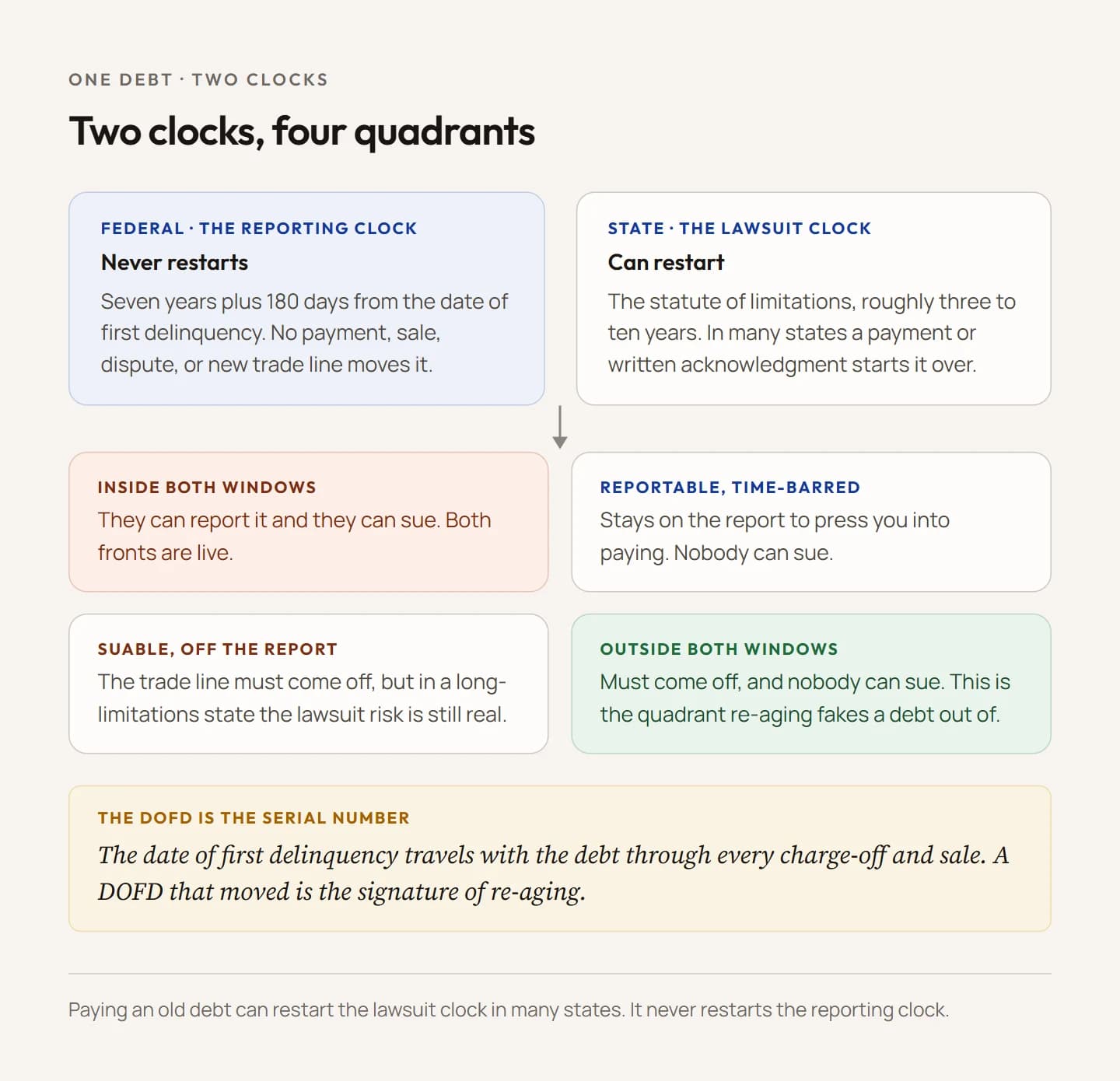
A two-by-two grid of the four quadrants a debt can occupy. Inside both windows, the debt can be reported and sued on. Reportable but time-barred, it stays on the credit report but no one can sue. Suable but too old to report, the trade line must come off while lawsuit exposure remains, as with a ten-year statute of limitations. Outside both windows, the debt must come off and no one can sue, which is exactly where zombie debt and re-aging appear. Above the grid, the federal reporting clock is marked as never restarting while the state lawsuit clock can restart.

The four quadrants

Inside both windows. The debt can be legally reported and the collector can sue. You deal with both fronts.

Reportable but time-barred. The trade line can legally sit on your report, pressing you to pay, but no one can sue. This is the New York three-year situation: correct on the report, dead in court.

Suable but too old to report. The mirror image. Past seven years and 180 days the trade line must come off, but in a long-limitations state like Rhode Island the lawsuit exposure is still real. An invisible debt is not a dead one.

Outside both windows. It must come off the report and nobody can sue. This is where zombie debt lives, and it is exactly the quadrant re-aging is designed to fake a debt out of.

Nine signs your debt was re-aged

Pull all three of your reports at annualcreditreport.com, which is free, and save every one before you read them. Then check the list.

  1. The date of first delinquency moved. Compare against an older copy of your report, an old collection letter, or an original creditor statement.
  2. The DOFD matches the date the collector bought the debt. Impossible. A buyer that acquired the account years into delinquency cannot share a date with your first missed payment.
  3. The date opened is recent on an old account. A trade line opened in 2025 on a card you last used in 2016 says nothing about your delinquency, but it scores like a new debt.
  4. Last activity moved and you paid nothing. Watch for internal fees or interest postings dressed up as your payment. Brian sees this on student loan debt constantly, and it surfaces in court as "look, a payment inside the limitations period."
  5. Two collectors report the same debt with different delinquency dates. They cannot both be right. One debt, one trade line, one DOFD.
  6. The status flipped from charged off to current or active. A charged-off debt does not become current because it got sold.
  7. A trade line you got deleted through a dispute is back. Classic reinsertion, which has its own strict federal notice rules that are almost never followed. Brian calls it the strongest claim on this list.
  8. A trade line that aged off at seven years reappeared. Different problem, different theory: that is an obsolescence and accuracy claim, not a reinsertion claim. Keep the two straight.
  9. The validation response does not match the trade line. What comes back from a validation letter has to square with what the bureaus show. A mismatch is evidence.

What to do, in order

  1. Build your file before you say a word. All three reports, saved and printed, plus every old report, statement, and collection letter you can dig up. Your case is only as strong as your proof.
  2. Do not pay, promise to pay, or acknowledge anything until you know which quadrant you are in. Outside New York and a handful of states, a good-faith payment on a time-barred debt is the lawsuit.
  3. Dispute with the credit bureaus, not just the collector. This is the move that matters, and the reason is procedural: a bureau dispute triggers the furnisher's duty to investigate under the FCRA, and that duty is one you can personally sue on. A furnisher that rubber-stamps a false date after your dispute has handed you the claim.
  4. Use the validation window. If a collector sent a validation notice, you have 30 days from receiving it to dispute in writing, and collection must pause until verification is mailed. The pause is temporary, but in Brian's experience a validated old debt often just disappears back up the chain.
  5. Calendar everything. The bureaus have 30 days to reinvestigate, stretched to 45 if you add information mid-window.
  6. A dispute that comes back verified is the beginning, not the end. If you know the date is false and the furnisher confirmed it anyway, you are holding the best version of the claim.
  7. If you have been sued, answer the complaint and plead the statute of limitations as an affirmative defense. Skip it and the defense is waived, however dead the debt was.

The statute that catches re-aging

The FDCPA's list of false and misleading practices includes one written for exactly this. 15 U.S.C. 1692e(8) prohibits communicating, or threatening to communicate, credit information which is known or which should be known to be false, including failing to note that a disputed debt is disputed.

A furnished delinquency date that is not your delinquency date fits squarely. So does a collector reporting your debt without the dispute flag after you disputed it. Those were the cases Brian was filing weekly against the Michigan buyer, and they are the reason he likes re-aging cases: the violation is written on the trade line, in the collector's own reporting, and the comparison that proves it takes two documents you can pull for free.

Members get the re-aging checklist alongside the cheat sheets, and ParkerGPT reads a credit report and a collection file against each other the same way it reads a lawsuit.

Old debt back from the dead? ParkerGPT checks the dates, drafts the disputes, and builds the answer that pleads every defense you have.

Frequently Asked Questions (FAQ)

What is re-aging of a debt?
Re-aging is moving a debt's date of first delinquency forward so it looks newer than it is. That keeps a collection on your credit report past the federal limit, makes an old debt score like a fresh one, and can dress up a time-barred account as one a collector can still sue on. Furnishing a false delinquency date violates the FDCPA and gives you an FCRA dispute.
Does paying an old debt restart the seven-year credit reporting clock?
No, never. The reporting clock is federal, runs from the date of first delinquency plus 180 days, and nothing restarts it: not a payment, not a dispute, not a charge-off, not a sale to a debt buyer. What a payment can restart, in many states, is the separate statute of limitations for suing you. Anyone who says paying resets your seven years is mistaken or lying.
What is the date of first delinquency?
The DOFD is the date you first went late on the account and never caught back up. It travels with the debt like a serial number, through charge-off and every sale, and it is the anchor for the federal reporting limit. It is not the date a debt buyer bought the account or opened its file, and no one is permitted to change it.
How long can a collection stay on my credit report?
Seven years plus 180 days from the date of first delinquency, under the Fair Credit Reporting Act. After that the trade line must come off, whatever happens with payments, sales, or new collectors. Whether anyone can still sue you is a separate question answered by your state's statute of limitations, which runs anywhere from about three to ten years.
What law covers a false delinquency date?
The FDCPA, at 15 U.S.C. 1692e(8), prohibits communicating credit information the collector knows or should know is false, and a fabricated delinquency date fits squarely. The same section covers reporting a debt without noting that you disputed it. On the credit report side, disputing through the bureaus triggers furnisher duties under the FCRA that you can sue on if the false date gets rubber-stamped.
Consumer defense attorney Brian Parker

About the author

Brian Parker

I have over 30 years of experience defending consumers against debt collection lawsuits and have seen every tactic, threat, and pressure play that collectors use. Through KillDebt and ParkerGPT, I have systematized the proven defense strategies that actually work - so consumers can respond from a position of knowledge, not fear. My approach focuses on aggressive legal defense based on documented case success rather than false hope that leads to default judgments.

All articles