News Break
Re-Aged Debt: The Two Clocks Debt Collectors Hope You Confuse
August 24, 2026
Blog / News Break
Two federal appeals courts call unauthorized pay-to-pay fees illegal. Brian Parker's two-door check: your HOA's own declaration, then your state's law.
You know the fee. You go to pay the HOA assessment online and the portal adds $12 or $13 just for clicking the button. Brian Parker pays one himself, and he spent years suing homeowners association law firms, back when the pattern was already familiar: bills that grow, owners who cannot push back, and liens waiting behind every dispute.
This video is about a small fee that turns out to be a real lever. Two federal courts of appeals have held that unauthorized pay-to-pay fees violate federal debt collection law, and checking whether yours qualifies takes about ten minutes and two documents.
Key Takeaways
- The FDCPA bars a debt collector from collecting any fee unless the agreement creating the debt expressly authorizes it or a law permits it.
- The Fourth and Eleventh Circuits have both held that unauthorized pay-to-pay fees violate that rule.
- Door one is your HOA's recorded declaration. Door two is your state's law. If neither authorizes the fee, you have a case.
- Stop paying the fee first, by certified mail, and add up every receipt. Small fees compound into real money.
The FDCPA, at 15 U.S.C. 1692f(1) (opens in a new tab), makes it an unfair practice for a debt collector to collect any amount, including any fee, charge, or expense incidental to the principal obligation, unless it is expressly authorized by the agreement creating the debt or permitted by law.
Read that against a convenience fee. For an HOA assessment, the agreement creating the debt is the recorded declaration and bylaws, and most of those were drafted in the 1980s and 1990s. Nobody writing them was thinking about payment portals. And there is generally no statute that affirmatively permits a collector to charge you for the privilege of paying. A fee with no authorization in the documents and no permission in the law fails the test.
This is not a theory. In Alexander v. Carrington Mortgage Services (opens in a new tab) (4th Cir. 2022), the court held that Carrington, collecting mortgage payments, violated 1692f(1) by charging pay-to-pay fees that no agreement or law authorized, reversing a district court that had gone the other way. In Glover v. Ocwen Loan Servicing (opens in a new tab) (11th Cir., February 2025), the court reached the same holding against a mortgage servicer.
Between those two circuits sit Maryland, Virginia, West Virginia, North Carolina, South Carolina, Florida, Georgia, and Alabama, where the rule is now binding precedent. Elsewhere the same statutory text and the same reasoning are there to argue.
One more detail from Glover matters later: the payment processor kept 40 cents of each fee and remitted the rest to the servicer. Hold that thought.
Before anything else, stop volunteering. Once you believe the fee is unauthorized, quit the portal and pay by mail, certified with return receipt requested, so the association signs for every payment and can never claim one did not arrive. You are in a weak position complaining about a fee you keep clicking yes to.
Then do the arithmetic. Pull every receipt and statement showing the fee. Twelve dollars a month for six years is $864, and if the same fee runs association-wide, that is how a small claim becomes a class action. The math is also your leverage even if you never sue: an association shown, in good faith, that its fee program looks unlawful across every unit has a reason to back off.
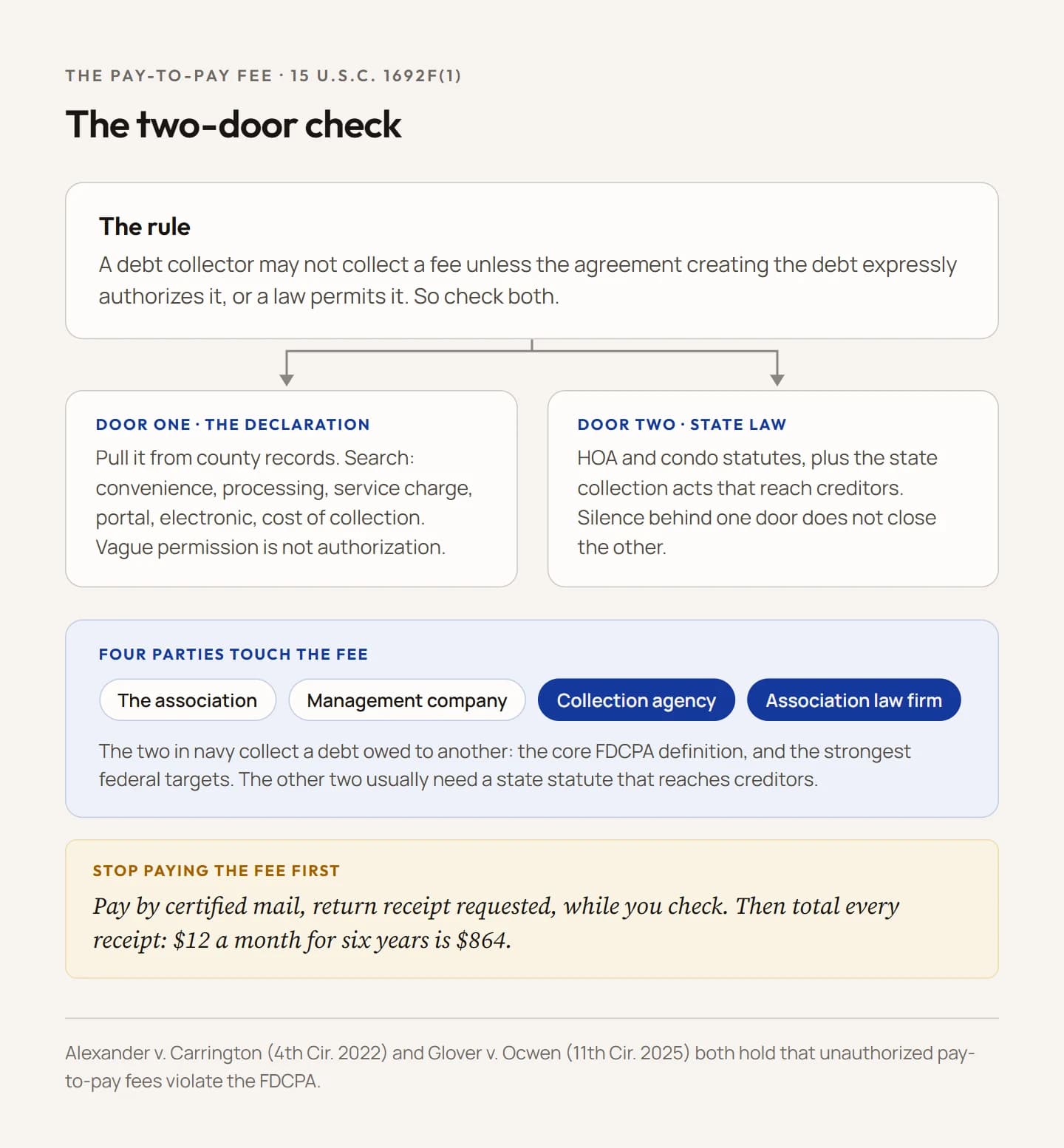
The declaration and bylaws your HOA operates under are public. They are recorded in the county records, and most associations also hand them out on request or post them behind the portal login.
Get your copy and search it for the words that would authorize the fee: convenience, processing, service charge, technology, portal, electronic, method of payment, cost of collection. In most documents from the 80s and 90s, you will find nothing.
If you find something vague, it probably does not save them. In Bradley v. Franklin Collection Service (opens in a new tab) (11th Cir. 2014), the collector pointed to a general line in the agreement and the court rejected it: the agreement has to actually authorize the specific charge. Vague permission is not authorization.
States regulate this space twice over. Many have statutes specific to HOAs and condo associations, with their own rules about what an association may charge. And separately, the state collection statutes this blog keeps returning to can reach parties the FDCPA cannot: Florida's FCCPA covers any person collecting a consumer debt, creditors included. If your declaration is silent and your state's law adds its own restrictions, both doors are open.
Four entities touch an HOA fee: the association itself, the management company, the payment portal, and whatever collection agency or association law firm collects delinquent assessments.
The strongest federal targets are the last two. An agency or law firm collecting assessments owed to the association is collecting a debt owed to another, which is the core definition of a debt collector and the posture in which both circuit cases were decided. The management company may have arguments about its role, and the association is a creditor collecting its own debt, which is where a state statute that reaches creditors does the work the FDCPA cannot.
Remember Glover's 40 cents. Who keeps the fee matters, because the CFPB's 2022 advisory opinion on pay-to-pay fees (opens in a new tab) concluded that a collector violates the FDCPA when a payment processor collects the fee and remits any amount of it back to the collector.
So put the question in writing, inside a collection context they have to answer: does the collector receive any rebate, revenue share, or per-transaction payment out of the convenience fee? They probably do, and the answer is evidence either way.
Members get the letter that asks it, the state-law worksheet, the fee tracking sheet, the document request letters, and the action cheat sheet that walks the whole sequence. The video closes with a membership discount code, which Brian bills as the opposite of a convenience fee.

About the author
Brian Parker
I have over 30 years of experience defending consumers against debt collection lawsuits and have seen every tactic, threat, and pressure play that collectors use. Through KillDebt and ParkerGPT, I have systematized the proven defense strategies that actually work - so consumers can respond from a position of knowledge, not fear. My approach focuses on aggressive legal defense based on documented case success rather than false hope that leads to default judgments.