News Break
What to Say at a Debt Lawsuit Pretrial: 5 Rules Before You Settle
August 14, 2026
Blog / News Break
Capital One got sued over two 9 p.m. collection calls. Brian Parker explains why the FDCPA cannot touch a creditor, and which state laws and the TCPA can.
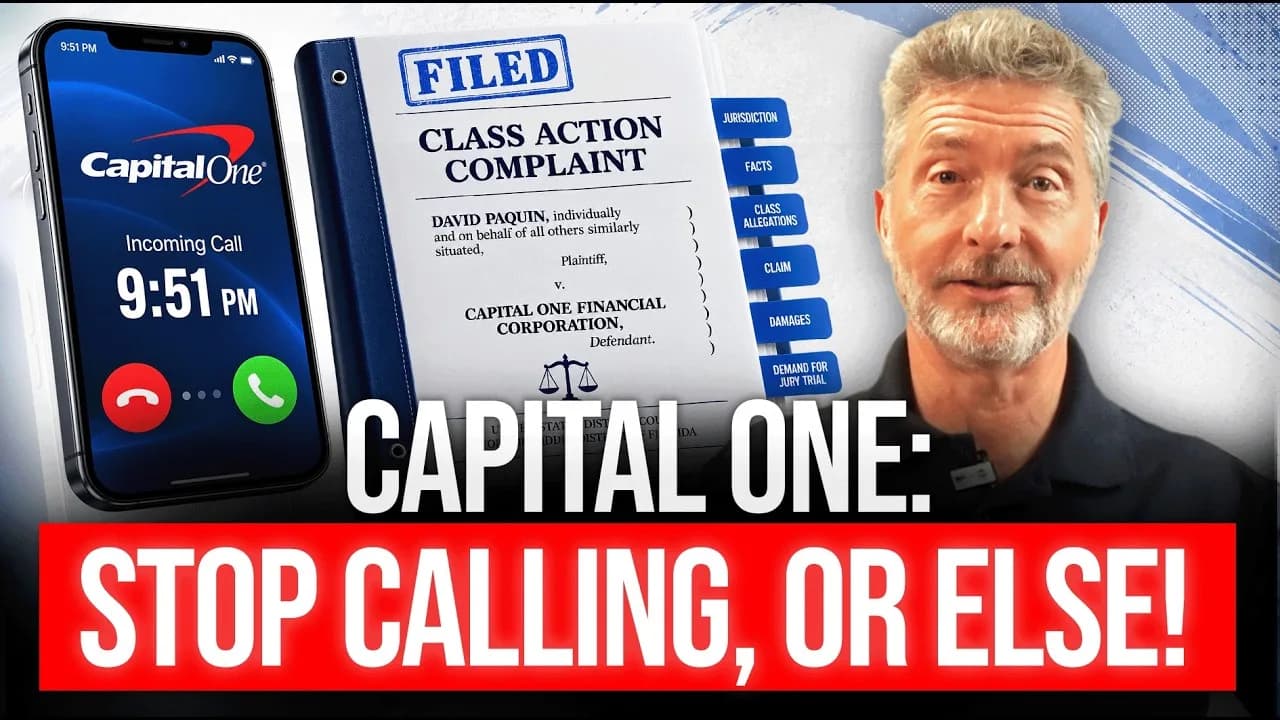
A Florida man says Capital One called his cell phone twice about a credit card debt: once at 9:51 p.m., once at 9:08 p.m. In July 2026 those two calls became Paquin v. Capital One Financial Corporation (opens in a new tab), a class action in the Middle District of Florida pleading more than $5 million in controversy.
Brian Parker pulled the complaint apart on camera, and his verdict is mixed. He would not have filed this one himself. But the case is built on a legal move every person getting creditor calls should understand: when the federal debt collection law cannot touch the caller, the right state statute can.
Key Takeaways
- The FDCPA does not regulate original creditors. Capital One collecting its own account is outside it, with two narrow exceptions.
- Statutes that regulate "any person" collecting a debt close that gap. Florida's FCCPA is one; California and Texas have their own.
- Calls between 9 p.m. and 8 a.m. in your time zone are the classic violation. The caller's clock does not matter.
- A written revocation of consent letter, sent certified mail, turns every later call into evidence of willfulness.
The complaint alleges that Capital One began trying to collect a consumer debt from David Paquin around December 2025, and that two of its calls landed after 9 p.m. in his time zone: April 20, 2026 at 9:51 p.m. and April 24, 2026 at 9:08 p.m. He says he never consented to calls in that window, and that Capital One knew it.
The claim runs under one subsection of the Florida Consumer Collection Practices Act (opens in a new tab), section 559.72(17): in collecting consumer debts, no person shall communicate with the debtor between 9 p.m. and 8 a.m. in the debtor's time zone without the debtor's prior consent.
Two words in that sentence carry the whole case. The statute says no person. Not "no debt collector." Not "no collection agency." A statute written around the word person reaches everybody who collects, and that includes a bank collecting its own credit card account. Brian has seen callers argue the clock too, so note the other detail: the debtor's time zone controls. An agent calling from California at 6 p.m. is still calling a Florida phone at 9 p.m.
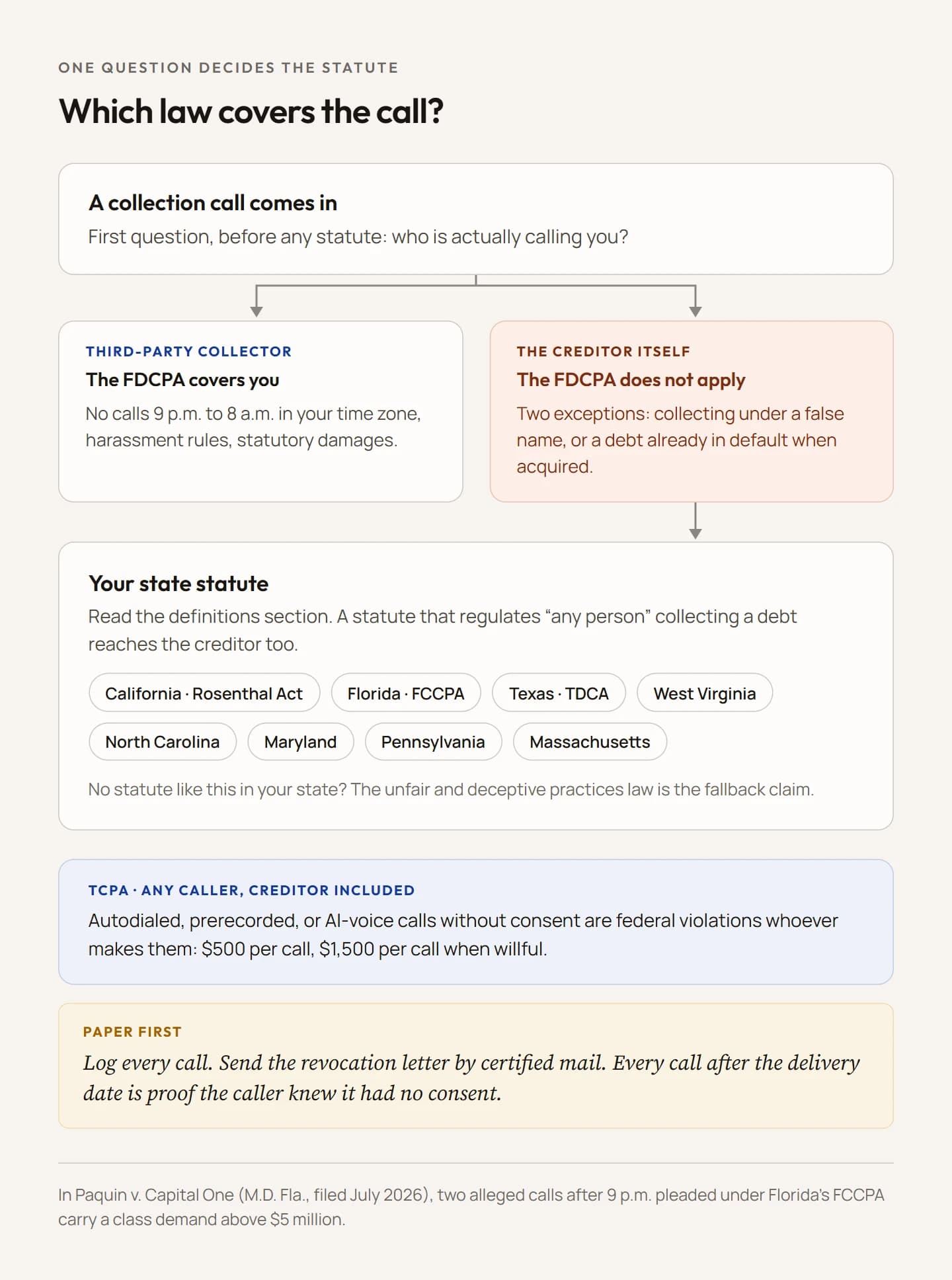
The FDCPA is the federal law most people reach for, and against Capital One it mostly does not work. The statute regulates third-party debt collectors, and an original creditor collecting its own account is not one. Its 9-to-8 calling window, 15 U.S.C. 1692c(a)(1) (opens in a new tab), protects you from a collection agency, not from your own bank.
Two narrow exceptions pull a creditor into the FDCPA. A creditor that collects under a different name, so you believe a third party is involved when it is really them. And a creditor that acquired the debt when it was already in default. Outside those, suing a creditor means finding another statute, and that is the whole reason the Paquin complaint pleads Florida law.
The complaint pleads no federal cause of action, yet it was filed in the United States District Court for the Middle District of Florida. The door it uses is the Class Action Fairness Act, 28 U.S.C. 1332(d) (opens in a new tab), which gives federal courts jurisdiction over a state-law class action when three things line up:
That is why the complaint recites that Capital One is organized in Delaware with its principal place of business in Virginia while the plaintiff lives in Florida, and why two phone calls scale to a $5 million demand. One person's statutory damages are capped in the hundreds; a class of everyone Capital One called after 9 p.m. is a different number.
To stay in federal court, a plaintiff needs a concrete injury under Article III of the Constitution, and the Supreme Court has spent the last decade trimming consumer cases that cannot show one. So the complaint itemizes. The call lit up his phone and made a sound that intruded on his peace. He spent several minutes identifying the caller. He became upset, frustrated, and annoyed, lost at least six hours of sleep, and was fatigued at work the next day.
Brian reads that list and laughs, and he is candid about why: he stopped bringing cases like this because he thinks they give consumer lawyers a bad name. His own rule is that a client signs an affidavit detailing real damages, and if there are no real damages he does not take the case. He also spotted a drafting miss. The complaint spends a paragraph arguing that Capital One's conduct was willful enough to warrant punitive damages, then never asks for punitive damages in the relief requested. If you want something from a court, it has to be in the ask.
None of that changes the legal spine of the case. Two calls after 9 p.m. without consent is a violation of the statute as written, whoever the caller is.
Florida is not alone. The statutes worth knowing define the regulated party broadly, and the difference between "person" and "collection agency" in a definition section decides whether you have a claim at all.
| State | Statute | Who it reaches |
|---|---|---|
| California | Rosenthal Fair Debt Collection Practices Act | Anyone who regularly collects debts, on their own behalf or for others. Creditors are written into the definition. |
| Florida | FCCPA, section 559.72 | "No person" shall commit the listed practices. Courts have long read it to reach original creditors. |
| Texas | Texas Debt Collection Act, Finance Code chapter 392 | A debt collector is any person who directly or indirectly engages in debt collection. Capital One qualifies. |
| West Virginia | Consumer Credit and Protection Act | A creditor collecting its own debt, including a bank, is subject to the act. |
| North Carolina, Maryland, Pennsylvania, Massachusetts | State collection and consumer protection acts | Each reaches creditors in its own terms. Check the definitions section first. |
Some of these beat the federal law on remedies too. The FCCPA carries a two-year statute of limitations and punitive damages; the FDCPA gives you one year and no punitives. And if your state's collection statute covers only agencies, its unfair and deceptive acts and practices law is the fallback claim.
One federal law does apply to creditors: the Telephone Consumer Protection Act (opens in a new tab), 47 U.S.C. 227. It regulates the caller, whoever the caller is: Capital One, Midland Credit Management, Bank of America.
Be precise about what it covers, because a late call alone is not enough. A live human calling about a debt you actually owe is generally not a TCPA violation. The statute bites on autodialed calls to cell phones, prerecorded and artificial voices, and telemarketing without consent. The FCC confirmed in a February 2024 declaratory ruling (opens in a new tab) that an AI-generated voice counts as an artificial voice, and that includes the conversational kind that responds in real time and almost passes for a person.
The private right of action pays $500 per violating call, and a court can treble it to $1,500 per call for a willful or knowing violation. Willfulness is where your paperwork does the work.
When you signed up for the card or the loan, you almost certainly consented to calls, texts, and emails about the account. It is in the agreement. That consent is what makes most collection calls lawful, and you can take it back.
Brian's tool for this is a revocation of authority and cease and desist letter: a written statement that the caller no longer has your consent to contact you by phone. Send it certified mail, return receipt requested, and keep the green card. The delivery date splits your call log in two. Everything before it is arguable; every call after it is a call the company made knowing it had no consent. That is the record willfulness is built from, at $1,500 per call under the TCPA.
Members get the documents Brian names in the video: the revocation and cease and desist letter, the TCPA demand letter, the call log, and a state statute quick reference. Upload what the creditor sends you and ask ParkerGPT for the cheat sheet before you act.

About the author
Brian Parker
I have over 30 years of experience defending consumers against debt collection lawsuits and have seen every tactic, threat, and pressure play that collectors use. Through KillDebt and ParkerGPT, I have systematized the proven defense strategies that actually work - so consumers can respond from a position of knowledge, not fear. My approach focuses on aggressive legal defense based on documented case success rather than false hope that leads to default judgments.