Success Stories
He Lost His Debt Lawsuit. Then He Appealed and Won Both Cases.
August 13, 2026
Blog / News Break
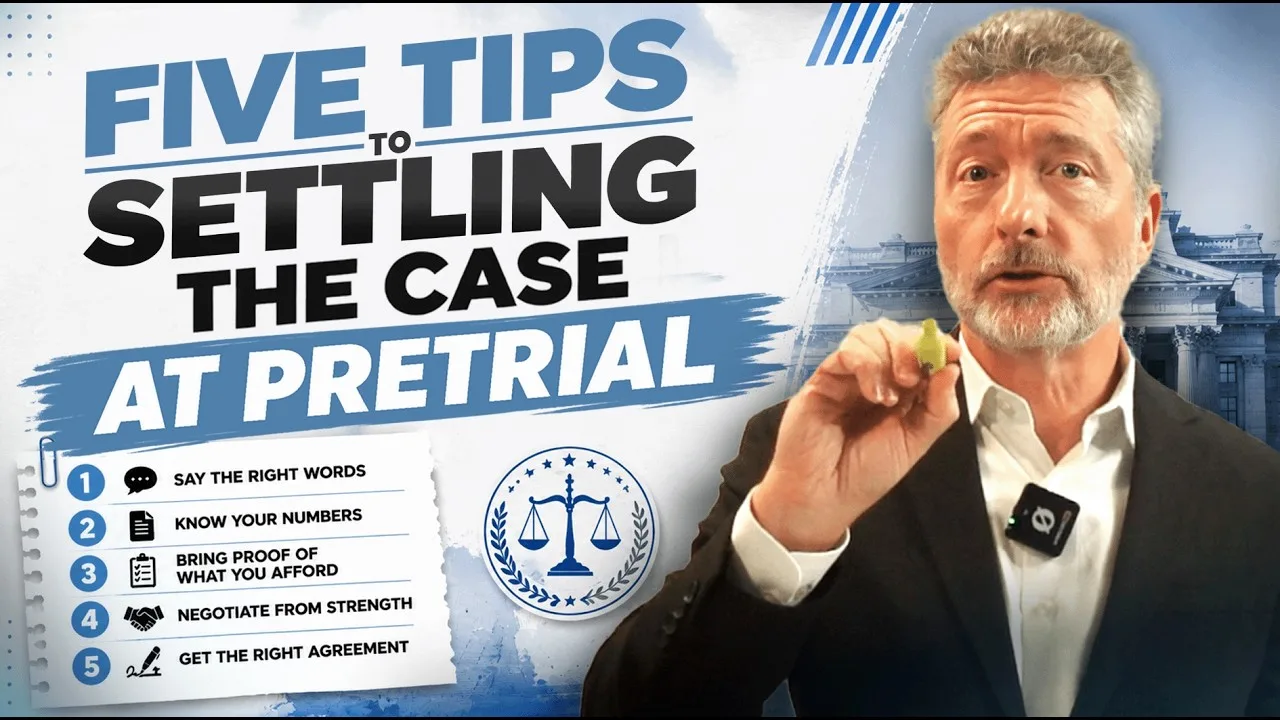
Courts push self-represented defendants to settle at pretrial. Five rules from Brian Parker: what to say, what to refuse, and what to check before you sign.
Robert, the Maryland member who beat LVNV Funding twice on appeal, counted the room on his first court date. About 20 people never showed up and took default judgments. Four showed up and were walked into a back room with the collector's attorney. All four settled. That was one docket, on one morning, in a courthouse that runs two of these sessions a day, two days a week.
This article is for the four. Brian Parker has spent more than 30 years on the defense side of these cases, and in the video below he lays out five rules for the moment the judge sends you off to talk settlement with the plaintiff's attorney. What to say first, what to refuse to answer, what to ask, what never to sign on the spot, and what to tell the judge if no deal lands.
Key Takeaways
- The pretrial conference is built to produce settlements. The pressure to take a deal in the back room is normal, and it is not in your interest.
- Your leverage is the answer and counter affidavit you filed. Without them, you negotiate under the threat of a same-day default.
- Open with the words "this discussion is for settlement purposes only, and I dispute this debt." Say them before anything else.
- Never sign a consent judgment the day it is handed to you. Terms in writing, a copy for you, days to review.
A pretrial conference sounds like a discussion of your case. In a high-volume collection docket it rarely is. Brian's word for it is a cattle call: dozens of defendants, one judge, and one attorney representing every plaintiff in the room. The court's goal is to clear the docket. The fastest way to clear a docket is settlements and defaults.
The numbers behind that pressure are documented. Fewer than 10 percent of defendants in debt collection lawsuits have a lawyer, while the plaintiff nearly always does, and in jurisdictions with available data courts have resolved more than 70 percent of these suits by default judgment (Pew Charitable Trusts, 2020 (opens in a new tab)).
The person across the table is usually not the attorney who filed the case. Collection firms send a coverage attorney: a stand-in hired to appear at hearings the firm cannot staff. They may have received the file days before, they may know little beyond the balance claimed, and they have a settlement script rather than answers. By the time you sit down, they may have run that script 40 times that morning.
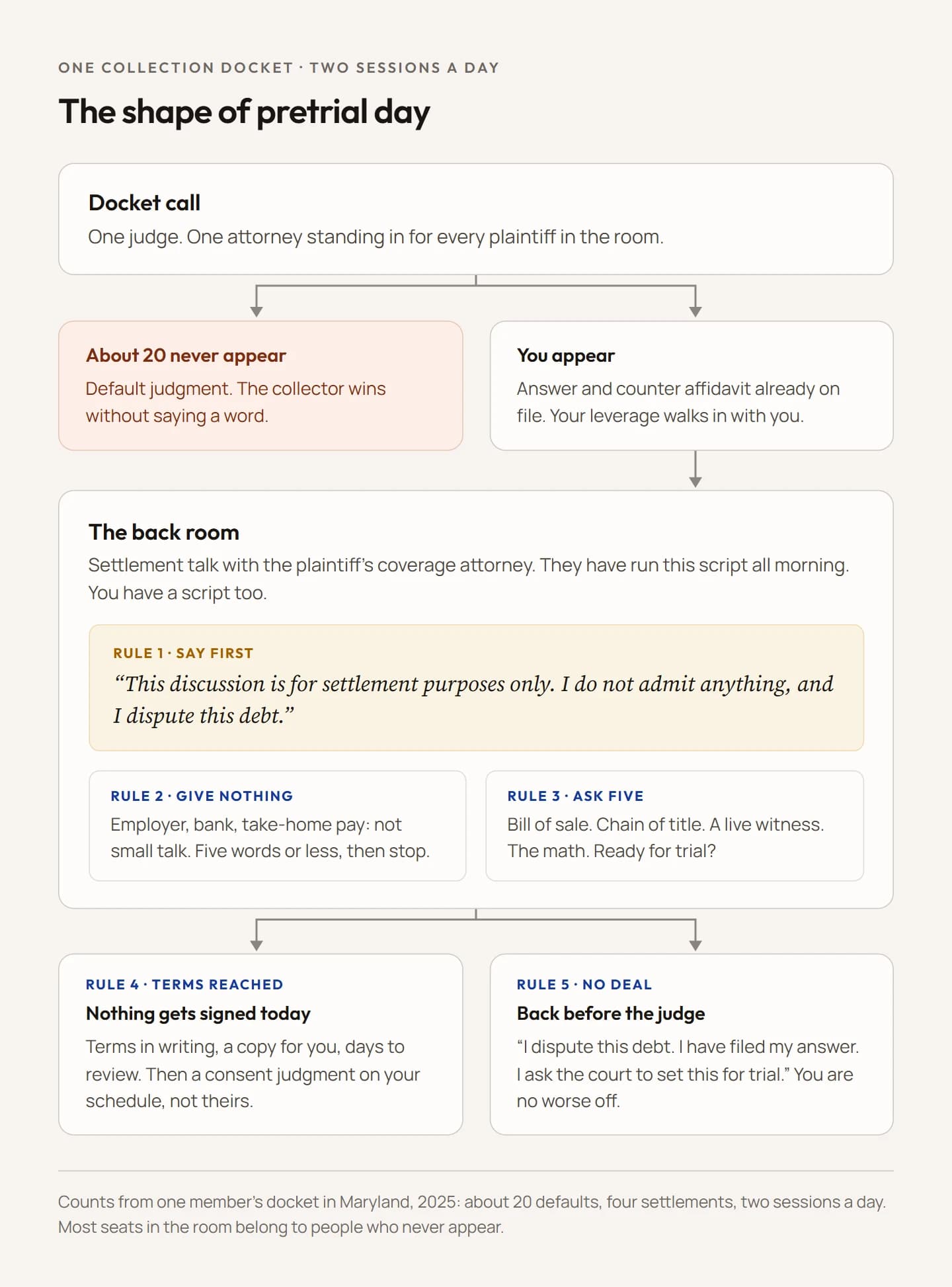
That is the room. Here is the shape of the day, and where each rule applies.
Before any tactic, one fact decides how the conversation goes: whether you filed an answer and a counter affidavit before the court date.
| You filed an answer and counter affidavit | You filed nothing | |
|---|---|---|
| Walking out with no deal | Fine. The case proceeds and the plaintiff still has to prove it. | A risk. The attorney can ask the judge for a default that day. |
| The offers you hear | Get better. Your file is a problem the firm would rather close. | Get worse. They are pricing a case they have already won. |
| The burden of proof | Stays on the plaintiff, where the law puts it. | Feels like it lands on you, because a default is one request away. |
If your deadline has not passed, fix this before you walk in. Everything below assumes you have a position to negotiate from.
The first words out of your mouth, before the attorney says anything:
"This discussion is for settlement purposes only. I do not admit anything, and I dispute this debt."
There is an evidentiary reason. Federal Rule of Evidence 408 (opens in a new tab) and its state equivalents, such as MRE 408 in Michigan, keep offers and statements made in compromise negotiations over a disputed claim out of evidence. Without that protection nobody could negotiate honestly. The rule has exceptions and the wording varies by state, so say the words anyway. They cost nothing and they frame everything that follows.
Then keep the frame. As the attorney leads you to the back room, go at your own pace. If they think they are controlling you, they are. Once the door closes, ask three things:
The answers tell you who you are actually dealing with. And the last question matters most. However friendly the conversation gets, this person's job is to close your file on the plaintiff's terms. Brian's comparison is a police officer who chats warmly while building a case: the friendliness is real, and so is the file.
At some point the questions start. Where are you working these days? Still at the same bank? Is this still your address? What is your take-home pay?
None of that is small talk. It is asset discovery, and if the case continues, what you volunteer in that room can shape how the collector comes after you later. Your answers:
Brian teaches deposition witnesses a habit he calls the rule of five: yes, no, do not guess, five words or less. Use it here. Give your answer and stop talking. Silence is not rudeness in a negotiation. It is discipline.
Do not let the attorney ask all the questions. These five put the weakness of a debt buyer's file on the table, and a coverage attorney can rarely answer any of them.
The third and fifth questions carry the most weight. Paperwork alone is hearsay. Proving it at trial takes a witness who can speak to the records, and no debt buyer wants to ask the original creditor to send one. Asking the question tells the attorney you know that.
If you reach terms, you will be asked to sign a consent judgment. It is the written agreement that ends the case: you commit to a payment, the collector commits to a resolution, and the court can enforce it. It is also where self-represented defendants get hurt in ways that are hard to undo. So the rule is absolute:
"I am not signing anything today. I want the terms in writing, I want a copy, and I want time to review it."
If the judge wants the matter resolved on the record, say: "Your honor, we have discussed terms. I have asked for them in writing, and I will respond by that date." No judge punishes a person for wanting to read a contract. The pressure lines have answers too. "This offer is only good today" means it is not an offer you can accept. "Everybody signs these" gets "I am not everybody."
When you do review the document, these are the terms that matter:
If there is no deal, you are not worse off. You walk back into the courtroom and say:
"Your honor, we were not able to reach an agreement. I dispute this debt. I have filed my answer and my counter affidavit. I ask the court to set the matter for trial and allow discovery so the plaintiff can show its proof of ownership."
That one statement does three things. It disputes the debt. It reminds the court you did the work and filed. And it puts the burden of proof back where the law places it: on the plaintiff.
If the attorney starts characterizing what you said in the back room, stop it: "Your honor, those are settlement discussions, and they are not admissible." Then cite your state's version of Rule 408. Judges respect a self-represented defendant who knows that rule, and they do not respect an attorney who tries to walk through it.
One more piece of preparation. If you intend to settle, walk in knowing what you can pay, and bring a one-page summary of your monthly obligations. No account numbers, no bank names, nothing they can use later. Just the picture that justifies your offer.
A low offer with proof behind it gets heard. Collection firms do not spend money chasing what they cannot collect. As Brian puts it, you are doing them a favor: showing them exactly why your number is the realistic one.
Twenty people on Robert's docket lost without saying a word. Four settled on the attorney's terms because nobody had told them they had any others. Walk in with an answer and counter affidavit on file, the magic words ready, five questions the coverage attorney cannot answer, and a refusal to sign anything you have not read, and you are stronger than everyone in that room. Sometimes stronger than the people who brought lawyers.
KillDebt members get Brian's cheat sheets for each step of this day: settling a debt, talking with the plaintiff's attorney, reviewing a consent judgment, and talking with the judge about a settlement. For the general negotiation principles behind the courtroom tactics, read 15 tips to influence your next settlement negotiation.

About the author
Brian Parker
I have over 30 years of experience defending consumers against debt collection lawsuits and have seen every tactic, threat, and pressure play that collectors use. Through KillDebt and ParkerGPT, I have systematized the proven defense strategies that actually work - so consumers can respond from a position of knowledge, not fear. My approach focuses on aggressive legal defense based on documented case success rather than false hope that leads to default judgments.