News Break
Too Late to Sue? Defending Against Old Mortgage Foreclosure Debt
August 6, 2026
Blog / Success Stories
A Maryland member lost to LVNV Funding in district court. He appealed, requested discovery, and won both cases. Here is what he did, step by step.
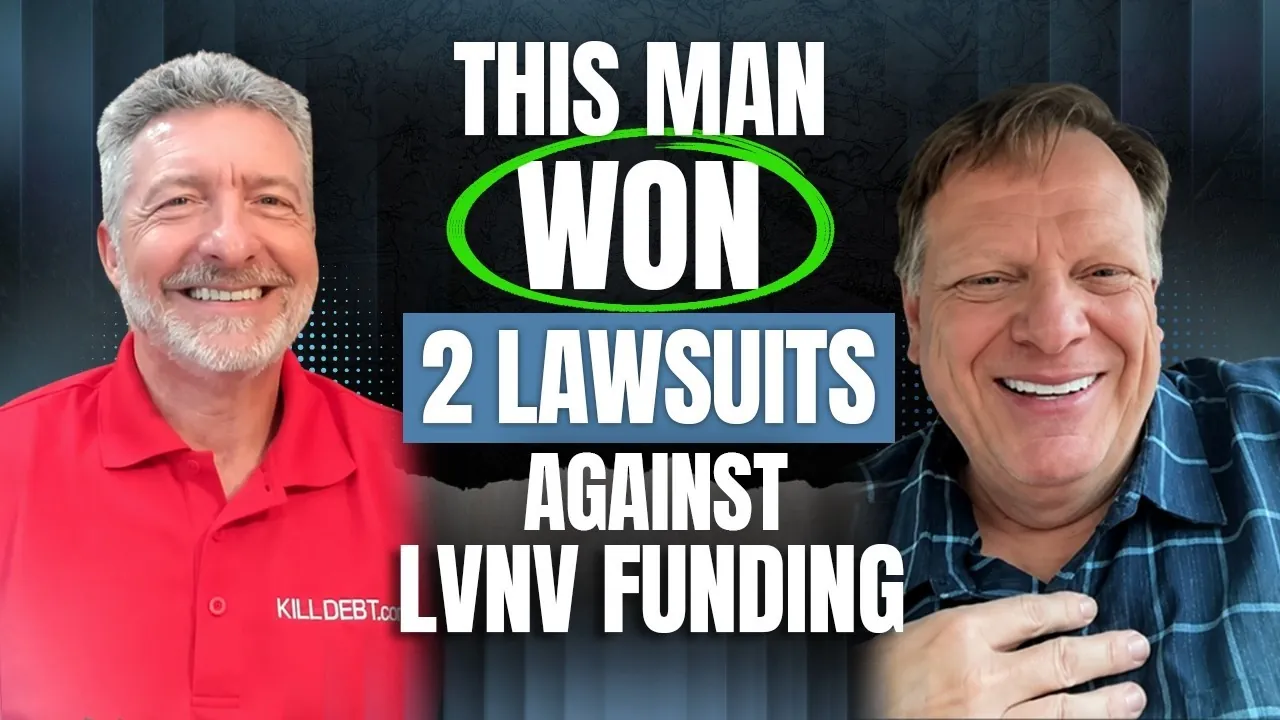
Most people who lose a debt collection case stop there. They set up a payment plan and move on.
Robert did not. He is a KillDebt member in Maryland who makes commercials and independent films for a living. He is not a lawyer. He lost his first hearing badly. Then he paid the filing fee, appealed, and won both of the cases against him.
This is his account of how he did it.
Key Takeaways
- Losing in district court is not always the end. Many states let you appeal and start over with a new trial.
- Robert's second judge allowed discovery. The collector never produced the documents.
- The defects that won the case were in paperwork the collector filed itself.
- Showing up matters. On Robert's court date, roughly 20 people did not appear and lost by default.
A collection agency wrote to Robert about an old credit card balance. He did not ignore it.
He sent validation letters by certified mail and kept the receipts. He asked for a full accounting: every charge, every fee, every interest calculation, and every payment he had made. He had been on autopay and did not believe he still owed the balance.
His position was straightforward. Prove the number and he would write a check.
They sent back a single statement. Then they sold the account to LVNV Funding.
When Robert looked up the two companies, he found they were affiliated — related entities passing the same account between them.
LVNV Funding filed suit in June 2025. Two separate cases, filed one after the other.
Robert filed an answer, a counter-affidavit, and a motion to dismiss. Maryland small claims does not permit the last two, so they were rejected. The answer stood, which is the filing that actually mattered.
He showed up with his notes and his paperwork. It did not go the way he expected.
A visiting judge handled the docket. The collector's attorney said his piece and sat down. Then the judge took over the questioning herself. Every time Robert tried to explain his position, she cut him off.
He got as far as three arguments:
He never got to finish. Judgment for the plaintiff.
Robert's read on the room afterward was blunt. The judge and the attorney knew each other. When he went back in, they were talking about their kids and their dogs.
What the docket looked like that day Robert counted about four people who showed up and settled in a back room with the collector's attorney. Around 20 more did not appear at all and took default judgments. The court ran two sessions a day, two days a week.
If you are one of the people sent to that back room, Brian's playbook for it is its own article: what to say at a debt lawsuit pretrial before you settle.
Robert went home and told his mother-in-law he was going to pay it. She told him that was fine.
Then he went to the collector's website to look at payment plans — and the payment page routed him to the affiliated company, not the one that had sued him.
Something about that flipped a switch.
He decided to appeal instead. It cost about $350 to file on both cases.
In Maryland, this kind of appeal is heard fresh. It is a new trial. Nothing from the first hearing carries over — not the testimony, not the ruling, not the judge's impression of him.
That is the part most people never learn. A bad first hearing does not have to be the final word.
Here is what changed between Robert's two proceedings on the same two cases.
| Round one: small claims | Round two: on appeal | |
|---|---|---|
| The judge | A visiting judge handling the day's docket | A judge who had spent years on collection cases |
| Time to argue | Cut off after three sentences | A full hour, uninterrupted |
| Discovery | Not normally available | Requested and granted |
| Their evidence | Accepted as filed | Tested against what they could actually produce |
| Their witness | None needed | Still none — and it mattered |
| Robert's motions | Rejected as not permitted | Motion to compel granted without a hearing |
| Result | Judgment for the plaintiff | Judgment for Robert, both cases, plus costs |
One structural point is worth knowing. Maryland's highest court has held that the formal rules of evidence do not apply in small claims trials — which is why a collector can hand up billing statements from an original creditor without producing anyone who can speak to them (Maryland Court of Appeals, 2014).
That single fact explains a great deal about how round one went, and why round two went differently.
Every state handles this differently. Some give you a completely new trial. Some only review the record from the first hearing, which is a much narrower path. Deadlines are usually short and unforgiving. Look up your own state's rule before you do anything else.
This is also where Robert signed up for KillDebt. He had been watching the free videos for a while and had not wanted to pay. After losing, he changed his mind.
He uploaded the entire lawsuit to ParkerGPT. It read the filings and started surfacing defects he had not spotted on his own.
The problems were all in documents the collector had filed itself.
The bills of sale were dated after the sales happened. Several were signed 17 to 21 days after the transfer they were supposed to document. One had no date at all — meaning it was never properly executed, yet the account moved anyway.
The forward flow agreements were missing. Every bill of sale referred to a separate master agreement setting the terms of the sale. None of those agreements were produced. Robert's argument to the judge was simple: without the terms, you cannot tell what was actually sold, or whether the right to sue came with it. The bills of sale were cover sheets to a contract nobody produced.
The ownership timeline contradicted itself. One company claimed it held the account for two days. Robert had a year of invoices with that same company's name on them.
The charge-off statement showed a zero balance.
The affidavit came from someone with no personal knowledge. When the judge asked what he meant, Robert put it plainly: the person signing works there. If she does not sign, she loses her job.
At the appeal hearing, Robert asked for discovery. He wanted the original agreement he supposedly signed, and every account statement from the beginning, so he could add it up himself.
Discovery is not normally available in small claims. The judge allowed it anyway, over the collector's objection, on the reasoning that Robert was representing himself against a firm with a team of attorneys and deserved a fair shake.
Then the collector told the court it had sent the discovery. It had not. Robert checked with the clerk's office — nothing had been filed.
What he did receive were two sets of interrogatories, both written for the same case. One set of discovery he got later belonged to somebody else's case entirely.
He answered everything on time and kept his certified mail receipts. After 30 days with nothing from the other side, he filed a motion to compel. The judge granted it without a hearing.
The response came back the next day — addressed to the court, not to him — repeating that they had sent everything and adding that discovery is not permitted in small claims anyway. They had, of course, sent him discovery themselves.
Robert wrote back with his return receipts and copies of his answers attached.
Robert built three identical binders — one for himself, one for the court, one for opposing counsel. Every exhibit tabbed and in order, starting with the first validation letter and ending with the discovery he never received.
The collector sent a third substitute attorney. She had received five pages the Friday before a Monday trial. She told the judge, on the record, that she knew nothing about the discovery dispute and could not speak to it. No witness. No custodian. She directed the court back to the original filing for the evidence.
The judge said she was disappointed. Then she gave Robert a full hour, uninterrupted, to walk through every document.
At one point opposing counsel suggested Robert had only disputed the debt when he decided to stop paying. Robert asked that it be struck — she had no knowledge of when or whether he disputed anything, and it was a personal attack rather than evidence. The judge struck it.
Before closing, the judge asked Robert to explain the forward flow agreements to her, and took his notes with her. He hand-delivered a copy to opposing counsel's office on his way home.
She did not give a deadline. Robert checked the court record every day for about two months.
When the entry finally appeared, it said an opinion had been filed and a check had been ordered. He drove to the courthouse and paid for a copy.
He read it straight through rather than skipping to the end. The first pages read badly. He was certain he had lost again and was already planning the next appeal.
Then came the paragraph that turned it. The burden was on the plaintiff. They had not met it. Judgment for the defendant.
Both cases. Plus an order for his costs — the check he had been puzzling over.
He looked up, and the clerk's office was already smiling at him.
Five things, in Robert's own order of importance.
He was also honest about the tool. ParkerGPT got a point of Maryland procedure wrong at one stage. He caught it, said so, and it corrected. His own take: being forced to check made him learn it well enough that he now remembers it.
Robert lost his first hearing. He was cut off, talked down to, and told to pay. He went home and told his family he was done.
Then he spent a filing fee, read their paperwork carefully, and beat them twice.
The collector never produced a complete chain of title. They never sent a witness. They sent a substitute attorney with five pages and no answers. That is what was on the other side of the table the whole time — in round one too, when he could not get a word in.
Sued by a debt collector? ParkerGPT reads your lawsuit and finds the defects in it — the same way it found the date gaps and missing agreements in Robert's case.
Robert is a KillDebt member who agreed to share his experience. His results are his own. Outcomes in debt collection cases depend on your facts, your documents, your state's rules, and your judge — most cases do not go this way, and many people in his position do lose. KillDebt is not a law firm and does not provide legal advice or legal representation. Nothing here is a promise or prediction about your case. Consult an attorney licensed in your state.

About the author
Brian Parker
I have over 30 years of experience defending consumers against debt collection lawsuits and have seen every tactic, threat, and pressure play that collectors use. Through KillDebt and ParkerGPT, I have systematized the proven defense strategies that actually work - so consumers can respond from a position of knowledge, not fear. My approach focuses on aggressive legal defense based on documented case success rather than false hope that leads to default judgments.