News Break
Ask Brian: The Forward Flow Play, Sewer Service, and Settling With Deletion
August 31, 2026
Blog / News Break
Brian Parker walks a real Velocity Investments complaint: a Cross River and Upstart loan, a trust from nowhere, and exhibits whose dates break the chain of title.

Brian Parker just took a new case: a Michigan client sued by Velocity Investments for $22,492 on an online personal loan. In this video he walks through the actual complaint, exhibit by exhibit, and shows why he loves this work. The paperwork does not just fail to prove the chain of title. Read closely, it disproves it.
Everything below is Brian's read of one live case, and the reason it is worth your time is that these filings are mass-produced. If Velocity or another buyer sued you on a Cross River or Upstart loan, your exhibits likely look like these, down to the same signature on the bill of sale.
Key Takeaways
- Online personal loans from platforms like Upstart, with Cross River Bank as lender, are often sold under agreements struck before you ever borrowed.
- The complaint pleads the loan agreement is in the defendant's possession, attaches no contract, and never says how the debt reached the plaintiff.
- The exhibits' own dates run backward: the bill of sale hands the debt to Velocity seven days before the original creditor's transfer document exists.
- In Michigan, MCL 600.2145 makes the counter affidavit mandatory in practice, and it cuts against the plaintiff too.
Start with what kind of loan this is. Cross River Bank, a New Jersey chartered bank, originates enormous volumes of online personal loans through platforms like Upstart Network, and sells them on. Brian has covered the mechanics before: the original creditor and the eventual buyer often agree in advance to trade a monthly volume of loans, so the sale machinery exists before any particular borrower signs anything. The forward flow agreement is written first; the borrowers arrive later.
That matters because the machine produces one-size-fits-all lawsuits. The same complaint template, the same exhibits, filed thousands of times, with documents attached regardless of whether they prove anything about the specific account being sued on. Which is exactly what Brian found here.
Paragraph one of the complaint says the plaintiff is the assignee of the defendant's account with Cross River Bank. One sentence, and that is the entire chain of title as pleaded. How the account got from Cross River to Velocity, through whose hands, on what dates, is not alleged at all.
Paragraph four does the other characteristic move. It says an agreement was delivered to the defendant in November 2023 and, to the best of the plaintiff's knowledge, is in the defendant's possession. Michigan's court rules let a plaintiff plead around attaching a written instrument by saying the other side has it, and this is that device: a tidy way to sue for breaching the terms and conditions of a contract that is nowhere in the filing. The dodge works at the pleading stage. It does not relieve them of proving the agreement's terms later.
And the theory itself is left vague. The complaint alleges the account "has become stated between the parties," which is account stated language, while also pleading an express written agreement and asking the court to prevent substantial injustice, which is unjust enrichment language. Pleading in the alternative is allowed. Pleading a fog and letting the defendant ferret out what she is accused of is how these templates work, and it is worth naming in your response.
The heart of the case is the bill of sale, and it opens the way they all do: for value received and pursuant to the terms and conditions of a purchase and sale agreement. That sentence is your discovery hook, and Brian's advice is to go hard after the master agreement it incorporates.
But look at who is selling. The bill of sale is signed by a loan holding trust, with Upstart Network acting as servicer on its behalf, assigning loans to Velocity. The trust's name is a mouthful, and Brian just calls it Mars, because as far as the complaint is concerned it may as well be on another planet: paragraph one says the account came from Cross River Bank and never mentions a trust at all. The pleading and the exhibit tell two different ownership stories, in the same filing.
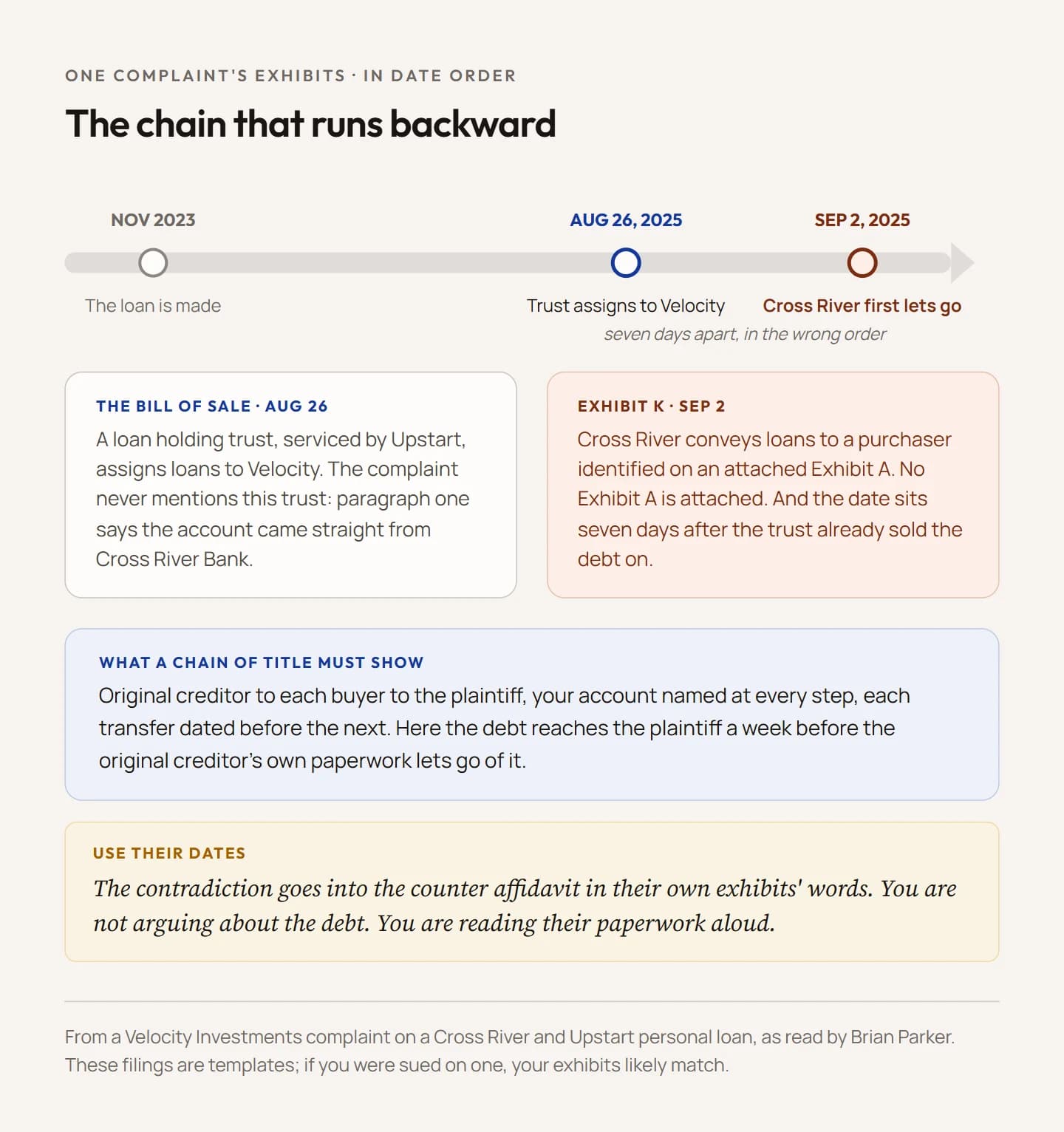
Now the part Brian calls the fun of doing this for a living. The complaint's Exhibit K is Cross River Bank's own transfer document, in which the bank conveys loans, identified by loan number on an attached Exhibit A, to a purchaser also identified on Exhibit A. Two problems.
First, there is no Exhibit A attached. The document that names which loans moved and who bought them, the two facts the whole case needs, refers to an attachment that is not in the filing. Deliberately empty language, reusable in any complaint in any state.
Second, the dates. The bill of sale assigning the debt to Velocity is signed August 26, 2025. Cross River's transfer document is dated September 2, 2025, seven days later. Read together, the trust handed Velocity a debt a week before the original creditor's own paperwork first let go of it. For the exhibits to be right, the debt left a hand it had not yet reached.
That contradiction goes straight into the counter affidavit, in their own documents' words. Brian's oldest rule of this practice: use their paperwork against them.
Since the contract is not attached, expect the case to lean on account stated. Every state has a version of the theory, and every version turns on the same word: the parties agreed that a specific balance was owed. Brian's client never agreed to anything with Velocity. She had never heard of Velocity until the lawsuit arrived. A stranger who bought a debt three years after the fact has real trouble showing the mutual assent the theory requires, and the alternative counts do not save each other: a complaint cannot ride an express written agreement and unjust enrichment to the same judgment, because the first pleads a contract and the second pleads the absence of one.
Here is the state-specific stinger. MCL 600.2145 (opens in a new tab) provides that in suits on an open account or account stated, the plaintiff's sworn affidavit of the amount due is prima facie evidence of the debt unless the defendant files a counter affidavit denying it. File a bare admit-and-deny answer with no affidavit and their numbers stand essentially unopposed. Other states have their own versions requiring a sworn or good-faith denial, so treat the counter affidavit as non-optional everywhere.
And it cuts both ways, which is where the fun returns. The same statute gives a defendant's counterclaim affidavit the same prima facie force if the plaintiff fails to answer it in kind. A strong counter affidavit paired with a counterclaim puts the template mill on a clock it usually ignores, and Brian has watched that flip cases.
Brian ends where every one of these articles ends, because the numbers demand it. In his experience eight or nine of every ten people sued never show up, a coverage attorney recites the file, and the docket becomes default judgment, default judgment, default judgment. The paperwork problems above are worth exactly nothing to the person who never answers.
So answer. File the affirmative defenses that fit, build the counter affidavit around their own exhibits, and if a court date scares you, rehearse it against the AI judge first. Members can upload the full document set from a case like this one, complaint, bill of sale, and exhibits, and ParkerGPT drafts the response from what is actually on the page.

About the author
Brian Parker
I have over 30 years of experience defending consumers against debt collection lawsuits and have seen every tactic, threat, and pressure play that collectors use. Through KillDebt and ParkerGPT, I have systematized the proven defense strategies that actually work - so consumers can respond from a position of knowledge, not fear. My approach focuses on aggressive legal defense based on documented case success rather than false hope that leads to default judgments.