News Break
Sued by Velocity Investments? Read the Dates on Their Own Exhibits
September 2, 2026
Blog / News Break
Brian Parker walks a Bounce AI lawsuit: four empty paragraphs, no contract, and an initial disclosure that certifies documents the plaintiff never produced.

After last week's walk through a Velocity Investments complaint drew a crowd, Brian Parker picked up the next case in the door: a new client sued by a plaintiff he had never faced before, a debt buyer called Bounce AI. The name is new. Nothing else is. As Brian puts it, a debt buyer is a debt buyer is a debt buyer, and this one arrived with a complaint so empty it teaches a whole lesson by itself.
The lesson has a sharper edge than usual, because this plaintiff filed something besides the complaint: an initial disclosure, signed and certified under Michigan's court rules, listing documents it has never produced. That certification is where this case gets interesting.
Key Takeaways
- An AI-branded debt buyer is still a debt collector under the FDCPA, and its own website says so in the standard disclosure language.
- "Upon information and belief" in a complaint is a tell: the attorney is pleading hope, not knowledge.
- A certified initial disclosure that lists documents but produces none is a motion to compel waiting to be filed, with sanctions behind it.
- No contract on file means no contractual attorney fees or collection costs, and demanding them anyway runs into 1692f(1).
Bounce AI's own website carries the sentence every collector must: it is a debt collector attempting to collect a debt, and any information obtained will be used for that purpose. Hold on to that, because the branding invites you to imagine something more sophisticated. Brian's view is the opposite: however sharp the spear, the FDCPA is the same gate, and the more collection a company automates, the less anyone looks at what the paperwork actually says. Which, in this case, is almost nothing.
The suit claims a debt bought from Alliant Credit Union, for over $25,000 plus about $1,600 in interest. Alliant, like the lender in the Velocity case, originates these loans through Upstart Network's platform, and Upstart-side accounts get securitized and spun through trusts on a schedule that has nothing to do with any one borrower. That context explains the complaint's most striking feature: it commits to nothing.
Paragraph two says the client and Alliant entered a contract, identified by an account number so many sales removed that nobody can say whose it is. Paragraph four says the contract was "duly assigned in the normal course of business" to the plaintiff, a sentence that names no seller, no date, and no chain, which is exactly why it appears in every complaint this firm files. Paragraph five says "plaintiff and/or its assignor" complied with the contract's terms. Which one? If you owned the account, you would know. And no contract is attached to any of it.
One phrase deserves its own flag. Paragraph three pleads, "upon information and belief," that the defendant possesses the contract the claim is based on. Whenever an attorney pleads upon information and belief, Brian reads it literally: there is no information and no belief, only hope that you will default or hand them an admission. He once defended a corporate client against a complaint in which 127 paragraphs began with those words, and told the court exactly what that meant. The burden of proof does not care how confidently a complaint is phrased.
Here is the part that separates this case from the usual empty-complaint story. Michigan, like a growing number of states, requires initial disclosures: soon after the pleadings, each side must hand over the factual basis of its claims, its witnesses, and its documents. Under MCR 2.302(A), documents in a party's possession get produced or described by category and location, and documents a party does not hold must be listed with where they are and who has them.
Bounce AI served its disclosure. It states that the promissory note obligates the defendant to make payments, that the contract permits acceleration, and that the plaintiff can recover its collection expenses under it. It lists what the plaintiff claims to possess: a membership enrollment agreement, a promissory note, a bill of sale, a chain of title, an affidavit of debt. And at the bottom, a signature certifying that the disclosure complies with the rule.
No documents came with it. No copies, no locations, nothing. A disclosure that quotes the terms of a contract nobody has produced raises Brian's favorite question in this case: what are they reading from?
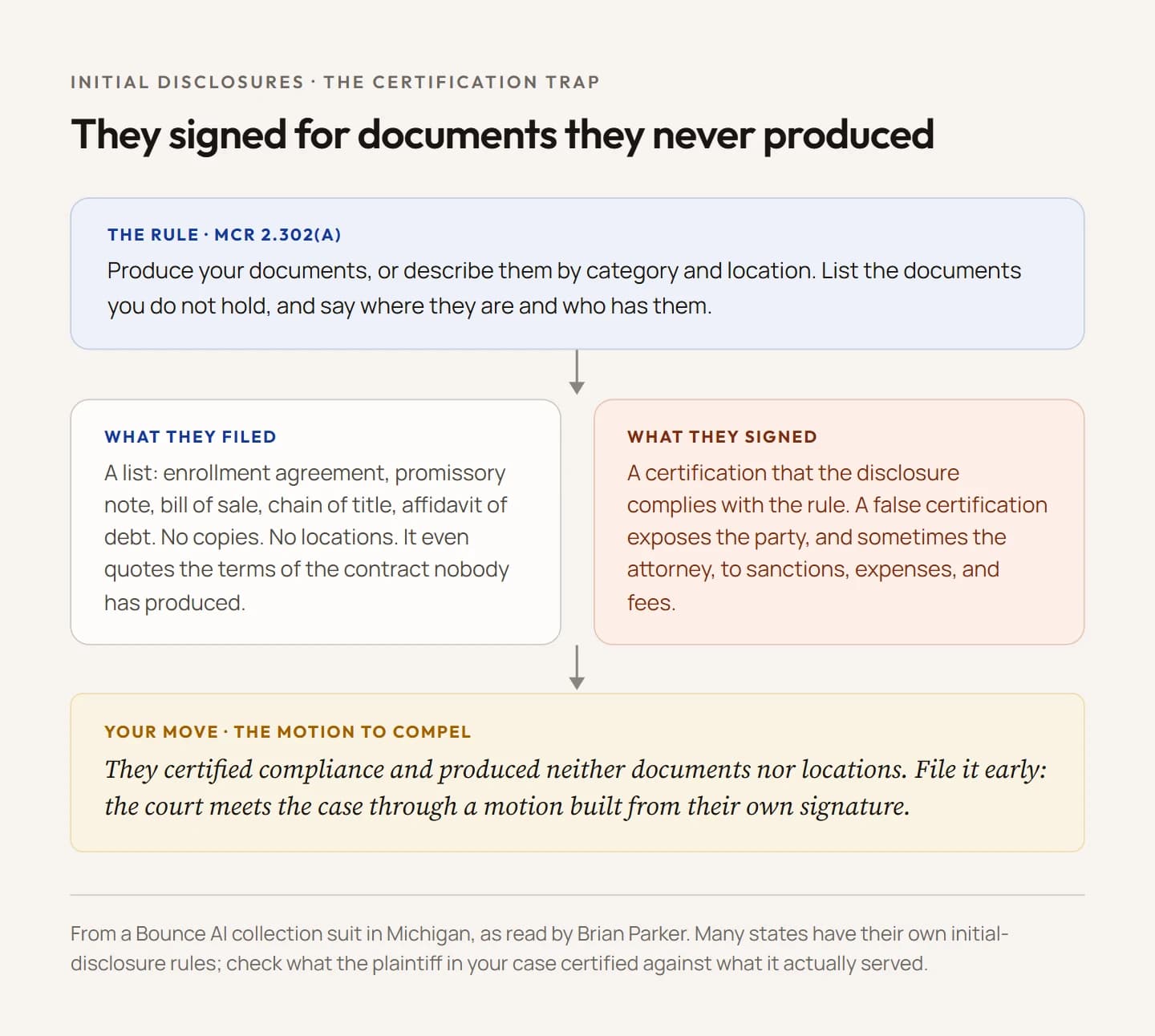
That certification is leverage, because certifying a disclosure that is false exposes the party, and sometimes the attorney personally, to sanctions, reasonable expenses, and fees. So Brian's first filing after the answer is a motion to compel: they certified compliance, they produced neither documents nor locations, and the court should hear about it early. He files it partly for the documents and partly for the bench. A judge who might drift toward the volume filer gets shown, in the case's first motion, which side certified something the record contradicts.
The missing contract has a second consequence. The American rule says each side pays its own attorney fees, and the standard exception is a contract that shifts them. This plaintiff demands collection expenses and interest "pursuant to the contract" while filing no contract, and 15 U.S.C. 1692f(1) (opens in a new tab) makes collecting any amount a violation unless the agreement creating the debt expressly authorizes it or a law permits it. Readers of the HOA convenience-fee article know that section: it is the one that turns an unauthorized charge from an annoyance into a counterclaim.
Brian's client answered with the counter affidavit this blog keeps returning to, and its content maps the case. She denies any indebtedness to Bounce AI. She has never agreed, expressly or by implication, that she owes it anything. There is no contract before the court, and she was never notified of any assignment of the debt through the entities that supposedly passed it along. That last point is worth checking in your own state: Florida, for one, requires an assignee to give written notice of the assignment before suing (opens in a new tab).
Disputing everything is not decoration. Brian read a comment this week from a viewer who followed the tactics, lost anyway, and was told by the judge it was because they never disputed the debt. The dispute comes first, in the answer, in the counter affidavit, and in every room of the courthouse; the clever arguments come second.
One more detail from the file, and it may be the whole case. The summons shows the complaint was issued February 9, 2026. The client's last payment on the account, per her own records, was January 2020. Michigan's limitations period for a claim like this is six years, and it is filing, not service, that stops the clock. So paragraph 17 of her affidavit denies making any payment to any of these companies within six years before the lawsuit was filed, which is how a statute of limitations defense gets built into the record from day one. If you have the defense, plead it, because it is waived if you never raise it.
The disclosure mismatch writes your discovery list for you. Ask for the last payment date, in writing. Ask for the full transaction history. Ask for every document their initial disclosure claims they possess, by the rule's own copy-or-location standard. And check whether they are licensed to collect in your state, because a new-name debt buyer is exactly the kind of company that misses a registration.
A closing note for the professionals reading along: legal aid societies, consumer attorneys, and debt settlement companies working this same fight can now run ParkerGPT under the enterprise plan instead of a consumer membership.

About the author
Brian Parker
I have over 30 years of experience defending consumers against debt collection lawsuits and have seen every tactic, threat, and pressure play that collectors use. Through KillDebt and ParkerGPT, I have systematized the proven defense strategies that actually work - so consumers can respond from a position of knowledge, not fear. My approach focuses on aggressive legal defense based on documented case success rather than false hope that leads to default judgments.