News Break
Paid Legal Answer Service: Professional Help for Your Debt Defense
June 9, 2026
Blog / News Break
Learn how to fight improper service of process in Florida debt lawsuits using laches and procedural defenses before deadlines expire.

Improper service of process is one of the most powerful defenses available to people facing debt collection lawsuits — and most defendants never even know it exists.
Here is a quick answer if you need it now:
What is improper service of process?
Any one of these defects can give you grounds to challenge the lawsuit, delay proceedings, or get a default judgment thrown out.
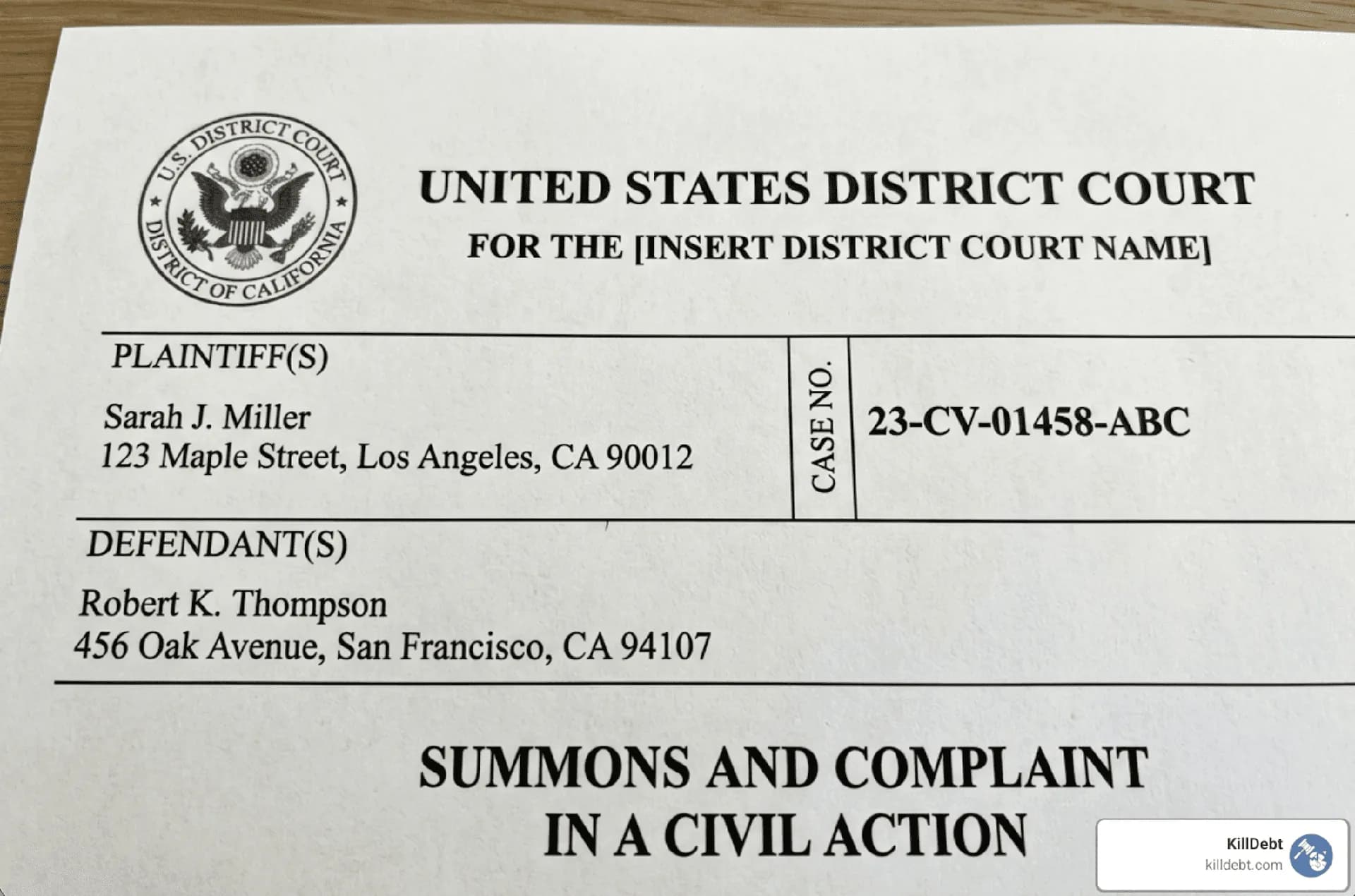
If you have a court summons in your hand right now, a deadline coming up, or a default judgment you never saw coming — this guide is for you. Debt collectors sometimes cut corners on service to win cases quickly and quietly. When they do, the law is on your side.
I'm Brian Parker, and for over 30 years I've defended consumers against debt collectors and collection law firms who rely on procedural shortcuts — including improper service of process — to score easy wins. I've seen these tactics fail when defendants know how to fight back.
At its core, service of process is not just an administrative chore. It is a constitutional requirement. Under the Fifth and Fourteenth Amendments of the U.S. Constitution, no person can be deprived of life, liberty, or property without due process of law. In civil litigation, "due process" means you have an absolute right to receive proper, formal notice that you are being sued, along with a fair opportunity to defend yourself.
Without valid service of process, a court lacks personal jurisdiction over you. This means the judge has no legal authority to issue orders, enter judgments, or authorize wage garnishments against you.
In federal courts, service is governed by Rule 4 of the Federal Rules of Civil Procedure. However, since we specialize in helping consumers in Florida and Michigan, we must look closely at state-specific rules:
If a debt collector fails to follow these rules to the letter, their lawsuit is built on quicksand. If you've just discovered a lawsuit against you, we recommend reading our What to Do When Sued by a Debt Collector: Complete First Steps Guide to protect your rights immediately.
While people often use these terms interchangeably, courts and legal practitioners distinguish between them:
To dive deeper into the difference between the actual documents you should receive, check out our guide on the Difference Between Summons & Complaint in Debt Collection Lawsuit. For a comprehensive breakdown of service compliance, you can also read Understanding Improper Service of Process | Lexitas (opens in a new tab).
Because process servers are often paid per completed service, some bad actors engage in sloppy or even fraudulent practices. The most common defects we see in debt collection cases include:

When a defendant challenges service, the court must decide whether the mistake was a minor, "technical irregularity" or a "fundamental defect."
A technical irregularity is a minor clerical error that does not affect your actual notice or prejudice your rights. For example, in the landmark New York case Ruffin v. Lion Corp., 15 N.Y.3d 578 (2010): CPLR 2001 and Disregarding Technical Defects in Service of Process , the court ruled that service by an out-of-state process server who was technically unauthorized under local residency rules was a disregardable technical defect because the defendant received actual notice and suffered no prejudice.
Conversely, a fundamental defect completely deprives the court of jurisdiction. If a process server fails to deliver the summons entirely, or serves an unauthenticated document, the defect is fundamental, and the case must be dismissed.
If you claim you were never served, but the debt collector produces an affidavit of service, the court may schedule a traverse hearing to resolve the dispute. As highlighted in Harvey v Usukumah (opens in a new tab), a defendant cannot simply offer a "conclusory denial" (e.g., "I never got it"). To get a hearing or a dismissal, you must present specific, detailed facts—such as travel records, work logs, or affidavits from third parties—proving you could not have been served at the time and place claimed.
For a step-by-step strategy on how to build these defenses, explore our Debt Lawsuit Defense Guide.
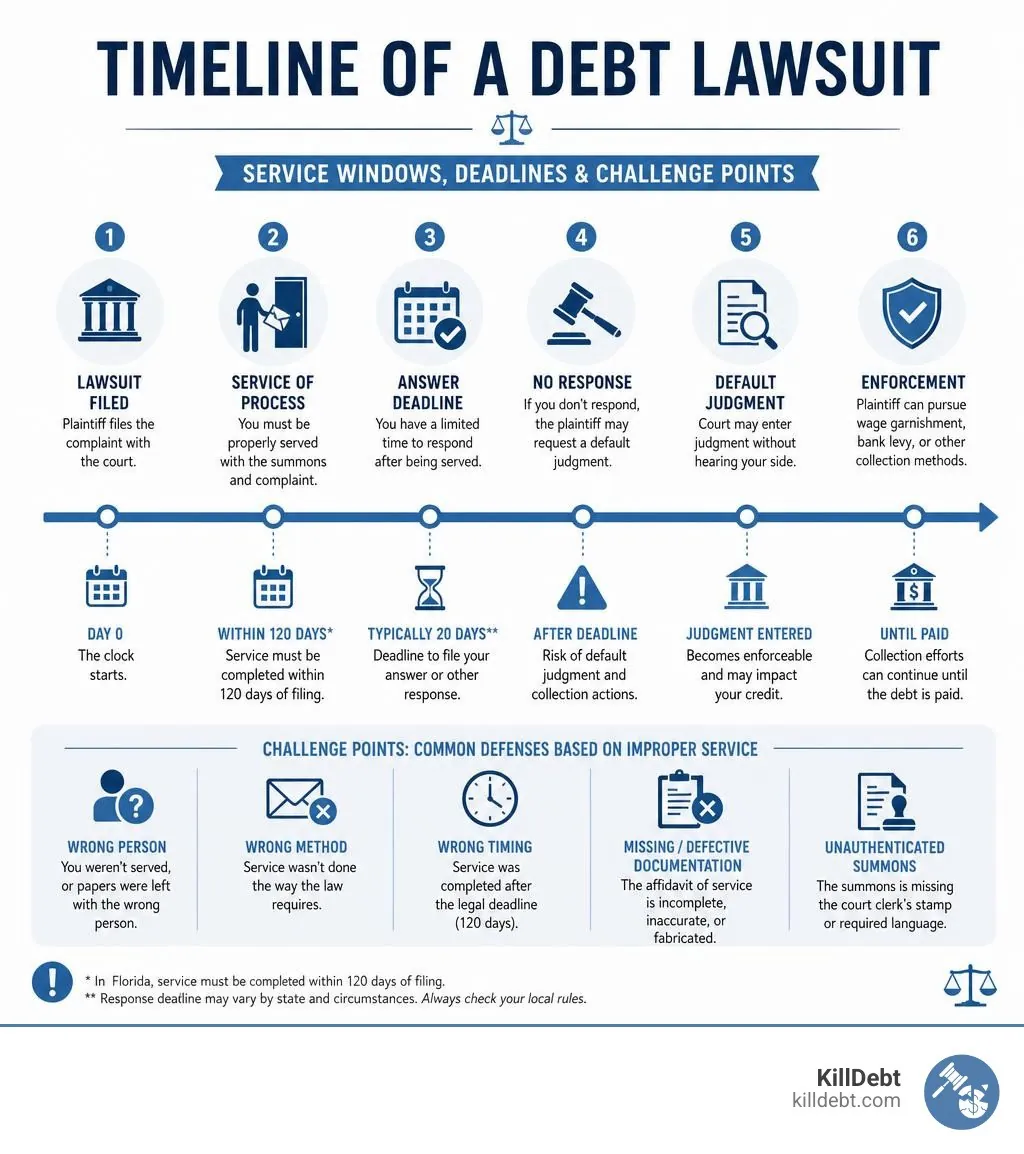
Time is a critical factor in service of process. Plaintiffs cannot hold a lawsuit over your head indefinitely without serving you.
Under Florida Rule of Civil Procedure 1.070(j) and The 2025 Florida Statutes - Online Sunshine (opens in a new tab), a plaintiff has exactly 120 days from the date the complaint is filed to serve the defendant.
In Michigan, MCR 2.102(D) dictates that a summons is only valid for 91 days from the date it was issued, though extensions can be granted under specific circumstances.
Courts look at the plaintiff's diligence when deciding whether to grant extensions. In the case of Rhonda C. Lucas v. Peter J. Warhol, the court analyzed whether a plaintiff showed "good cause" when dealing with a defendant who had no fixed address and was experiencing homelessness. The court ruled that while the plaintiff's diligent search justified extending the service timeline, attempting alternative service on an insurance-retained attorney who had no actual contact with the defendant violated due process.
If the 120-day or 91-day window expires and the statute of limitations on the debt has run out in the meantime, a dismissal "without prejudice" effectively becomes a dismissal with prejudice, meaning the debt collector can never sue you for that debt again.

If you have been victimized by improper service of process, you have several procedural tools at your disposal depending on the stage of the lawsuit:
To understand what to do in the critical first week after discovering a lawsuit, read Sued for a Debt? Here's Exactly What to Do in the First 7 Days.
What happens if a debt collector obtains a default judgment against you via "sewer service" and waits years to enforce it? This is where the equitable doctrine of laches comes into play.
Laches is a defense asserting that a party has unreasonably delayed bringing a claim or enforcing a right, and that this delay has prejudiced the opposing party. If a collector sits on an invalid default judgment for a decade while interest compiles, and only attempts to garnish your wages after key evidence or witnesses have vanished, you can argue laches. Combined with proof of improper service of process, laches can convince a judge to wipe out the judgment and any accumulated interest entirely.
When debt collectors cut corners on service, the consequences can be severe:
Defending yourself against a debt collector who has used improper service of process requires swift, strategic action. You do not have to spend thousands of dollars on an attorney to assert your constitutional rights to due process.
At KillDebt, we provide a DIY legal defense system powered by ParkerGPT—an AI trained specifically on consumer debt law and real-world court strategies developed over 30+ years by myself, attorney Brian Parker. Unlike generic AI tools, ParkerGPT analyzes your actual lawsuit documents, identifies procedural weaknesses (like defective service or expired summonses), and generates court-ready responses with step-by-step instructions.
We are also excited to introduce our brand-new tool: Court Tester!
Court Tester is an advanced AI courtroom simulation built directly on the facts of your actual case. You simply upload your real lawsuit filings, and within minutes, you can practice arguing your Motion to Dismiss or Motion to Quash in front of an AI judge, against an AI opposing counsel, all while a private AI co-counsel whispers winning legal strategies that only you can see. It is the ultimate way to build confidence and prepare your defense before you ever step foot in a courtroom.
Don't let debt collectors win by default. If you are ready to fight back, visit the KillDebt Home page today to get started.

About the author
Brian Parker
I have over 30 years of experience defending consumers against debt collection lawsuits and have seen every tactic, threat, and pressure play that collectors use. Through KillDebt and ParkerGPT, I have systematized the proven defense strategies that actually work - so consumers can respond from a position of knowledge, not fear. My approach focuses on aggressive legal defense based on documented case success rather than false hope that leads to default judgments.