News Break
The Bill of Sale Is a Receipt. Make Them Produce the Forward Flow Agreement
September 23, 2026
Blog / News Break
Brian deposed Capital One's corporate witness on the Discover merger: the notice she never received, and the ownership nobody could document.
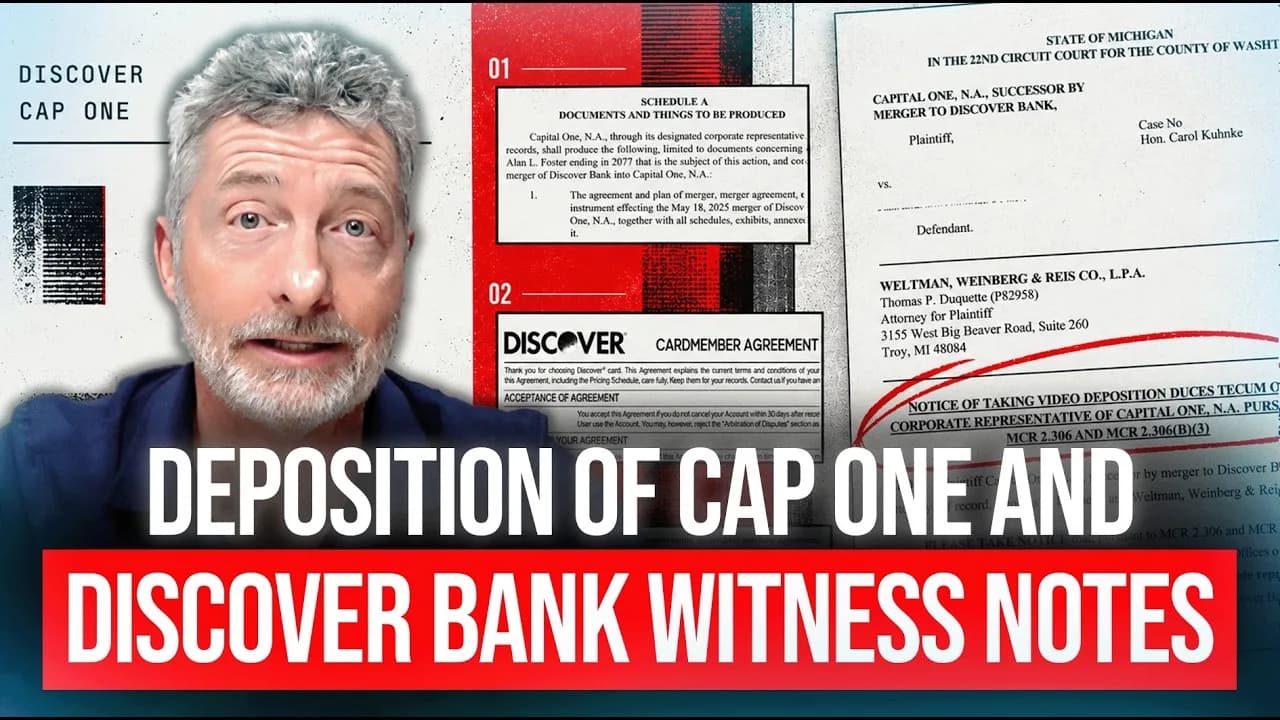
Brian recorded these notes on the plane home from Detroit, hours after deposing Capital One's corporate representative in a case built on the Discover Bank merger. Two days earlier he explained the forward flow agreement from a hotel room on the way out; this is the other end of the trip. The full two-hour deposition video is coming to the channel and the member side, and the notice disclosed exactly that, but the notes are worth having now, because what happened in that conference room is a working lesson in how ownership claims dissolve under oath.
Key Takeaways
- A corporate representative deposition names topics, not people. The company must designate someone with knowledge, on pain of sanctions.
- The witness testified she never received the deposition notice; the first time she saw it was when Brian handed it across the table.
- The merger statute vests assets without a deed, but self-executing is not self-proving. Nobody could produce a document showing the client's debt sat with Discover Bank before "day one."
- By the witness's own account, three Discover entities touch a card: you contract with one, the complaint sues on another.
Start with the rule, because the whole day turned on it. A lay witness is a named person who speaks for themselves; you can ask Sally Jones her opinion of a document. A corporate representative is different. Under Rule 30(b)(6) in federal court, and a state analog everywhere including the Michigan version Brian used, you serve a notice listing the matters for examination and the documents to be discussed, and the company chooses a person with knowledge of them. The witness speaks for the corporation. "I don't know" is not really available, because the topics arrived in advance, and a company that sends someone unprepared faces sanctions, fees, and your wasted time. The deposition notice itself is the most important document in the sequence.
Objections have a clock too: written objections to the notice's topics, served before the deposition, or the topics stand.
Brian's first question to the witness was when she received his notice. Her answer, under oath: she never had. The first time she saw the document listing everything she was designated to discuss was when Brian handed it to her at the table. No written objections had been served either, so every topic in that notice stood unobjected, and the documents it required were not in the room. The defense he encountered instead, in his telling: treating it like a lay witness deposition, plus a stream of "talking objections," the forbidden kind that coach the witness with a story instead of stating a ground in three words.
Brian cut the deposition off after two hours as the required answers were not going to come, and the motion to compel, with sanctions and fees, is in the works. The witness herself, he wants noted, was knowledgeable and professional, and by his read was set up to fail by not being given the notice. What she did say under oath is where it gets interesting.
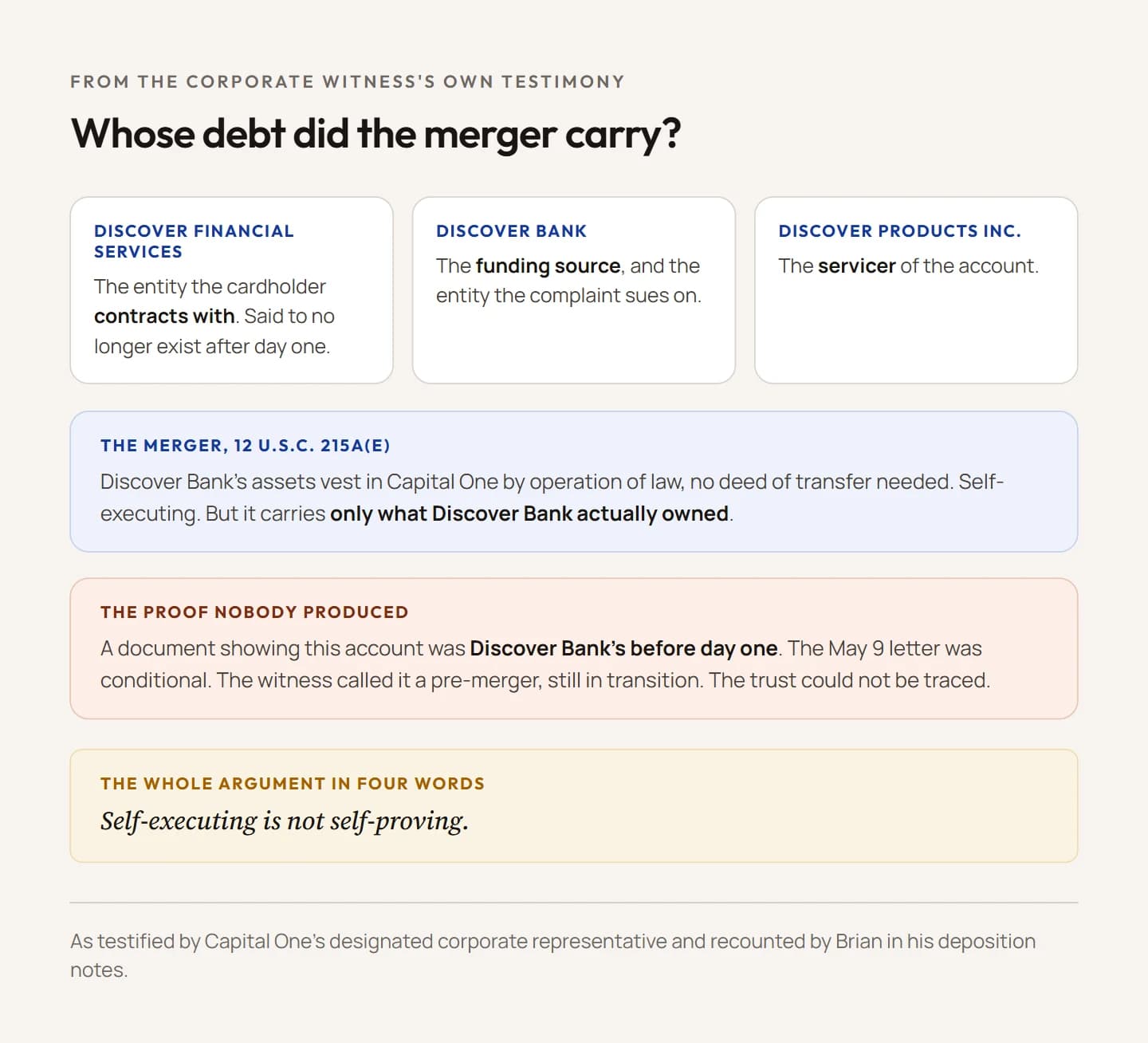
Capital One's position leans on the May 2025 merger: Discover Bank's assets vested in Capital One by operation of law, no assignment needed. The statute exists, 12 U.S.C. 215a(e), and Brian does not fight it. His point is narrower and sharper: self-executing is not self-proving. The statute transfers what Discover Bank actually owned. It does not manufacture evidence that any particular account, like his client's, was Discover Bank's property on the day the merger took effect.
Under oath, the witness called the arrangement a pre-merger, still in transition, while also calling May 18 "day one." The document the plaintiff leaned on was a May 9 letter announcing the merger would take place on May 18, conditionally, if certain things happened. Asked repeatedly for paperwork showing the merger completed, or any evidence the client's debt existed at Discover Bank before day one, nobody could produce it. The cardholder contract carried Discover Bank's terms with a small-print 2025 note that it is "now" a Capital One contract; amended Capital One terms and conditions were not on offer.
Advocates argue, Brian says, and each side calls its version the truth. The piece of paper decides. They did not have the piece of paper.
The structural testimony may matter to more cases than this one. By the witness's account: Discover Financial Services is the entity a cardholder contracts with. Discover Bank is the funding source. Discover Products Incorporated services the account. Three entities, and the complaint pleads a Discover Bank debt merged into Capital One. If the contract was with Discover Financial Services, an entity she said ceased to exist at the merger, then the question writes itself: how did that debt become Discover Bank's asset, so the merger statute could carry it? The same testimony split the debt itself three ways, receivables, accounts, and the debt, with only the receivables securitized into a trust; asked why, no answer, and asked what was in the trust before, she had no access. You cannot trace A to B without a record of A, which is the whole chain-of-title problem in one sentence.
One field note from the other side of the table: when the collection side deposed Brian's client, what they kept circling was her counter affidavit. His conclusion is the one he has taught all along, because the sworn dispute is the foundation everything above is built on: dispute the debt, swear to your facts, and make the other side answer them. It bothered them for a reason.
The deposition video lands on the channel soon; members get the notice, the matters for examination, and the follow-through as they file. Watch this space, and in the meantime the deposition cheat sheets cover the rules that decided this room.

About the author
Brian Parker
I have over 30 years of experience defending consumers against debt collection lawsuits and have seen every tactic, threat, and pressure play that collectors use. Through KillDebt and ParkerGPT, I have systematized the proven defense strategies that actually work - so consumers can respond from a position of knowledge, not fear. My approach focuses on aggressive legal defense based on documented case success rather than false hope that leads to default judgments.