News Break
The Three Kinds of Garnishment, and the Two-Month Rule Collectors Get Wrong
September 9, 2026
Blog / News Break
The notice is the one document where you move first. Brian Parker on deposing the affiant, 30(b)(6) designees, duces tecum, and the nonappearance ladder.
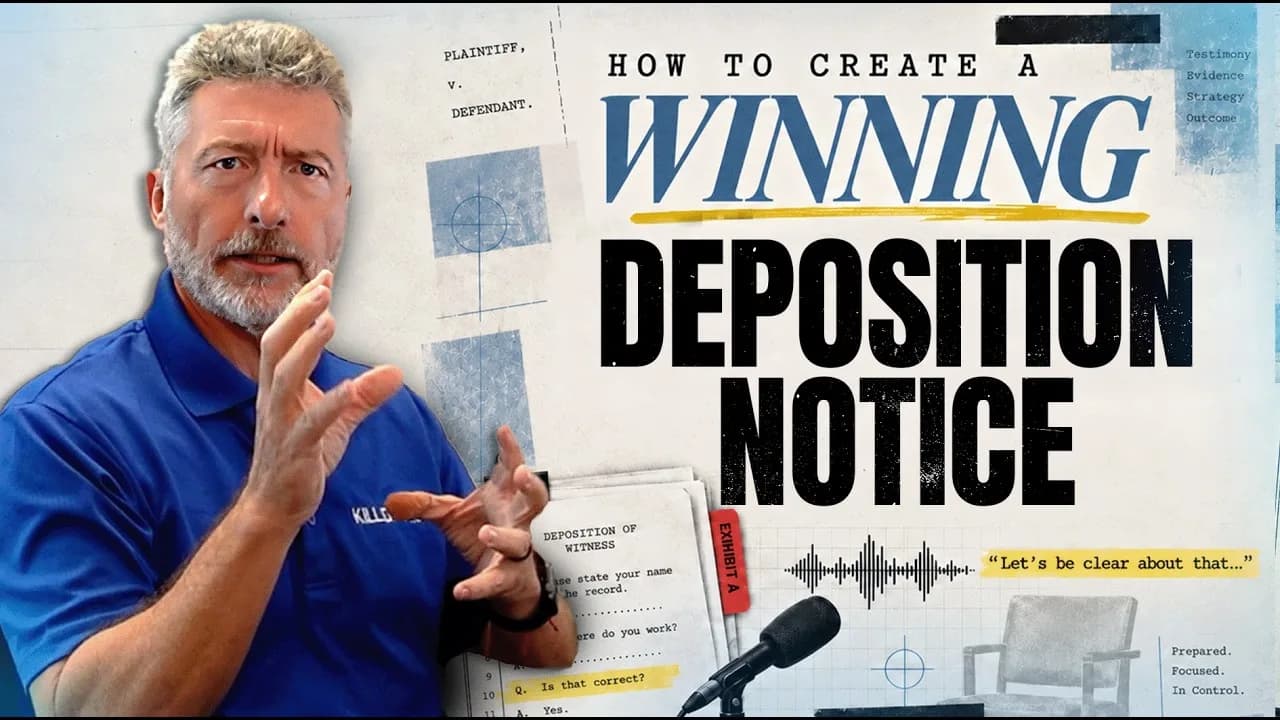
On Brian Parker's desk this week is a bill of sale from a live case, and it teaches the whole video before the video starts. At the bottom, in the collector's own words: executed without recourse except as stated in the sale and purchase agreement, with no representation or warranty of title or enforceability, express or implied. The sellers themselves would not warrant that what they sold is enforceable. The signature above those words belongs to a chief financial officer, scrawled without care, and without a date. Millions of dollars of debt changing hands, and nobody dated the page.
Next week Brian sits that signer down and asks about it, and this video is about the document that makes that conversation happen: the deposition notice. His one-word answer for what makes a good deposition is curiosity. His longer answer is that the notice is where the curiosity gets organized, and a well-built one settles cases before anyone swears an oath.
Key Takeaways
- The deposition notice is the only document in a case where you choose the subject, the witness, the date, and the place before anyone else has a say.
- Depose the person who signed something: the affiant, or the bill of sale signer. They are not expecting questions about the basis of their knowledge.
- When the other side ignores your requests, their silence becomes your record: your own date, a certificate of nonappearance, and a motion to compel.
- Tie every topic to an element of their claim, and mirror your counter affidavit. Knock out one element and the case falls.
Everything else in a lawsuit responds to something. The deposition notice is the exception: you pick the subject, the deponent, the date, the time zone, and the place, and you list the matters for examination, all before the other side says a word. That power comes with an audience, because when they object, a judge reads your notice. So build it the way you would build anything a judge grades: reasonable on its face, specific in its asks, and pointed exactly where their case is weakest.
This is also the first video Brian has aimed at the professionals as much as the members. Consumer attorneys and defense firms running this play at volume can now do it through the enterprise plan; self-represented readers can run the same play alone, because the other side is rarely ready for it either way.
A fact witness is a person you name: almost always the person who signed something. In a collection case that means the affiant behind the account stated affidavit, the same affidavit attached to thousands of one-size-fits-all complaints in Montana, Michigan, and California in the same week. Those affiants are chosen for their signature speed, not their knowledge, and Brian spent years deposing them: fly to Minnesota, sit the signer down, ask the basis of their knowledge that this specific person owes this specific debt, and watch the question land like it has never been asked before. Because it mostly has not; the business model assumes eight of ten defendants never show up at all.
An entity witness is the other kind, under Rule 30(b)(6) and its state equivalents. You do not name a person. You serve the organization with the topics you need answered, and the rule obligates it to find, designate, and prepare the person who can answer them. The collector cannot send a flunky who "seems to know what goes on around here": an unprepared designee violates the rule and exposes them to sanctions and fees. Use the entity route when the right human is invisible from outside.
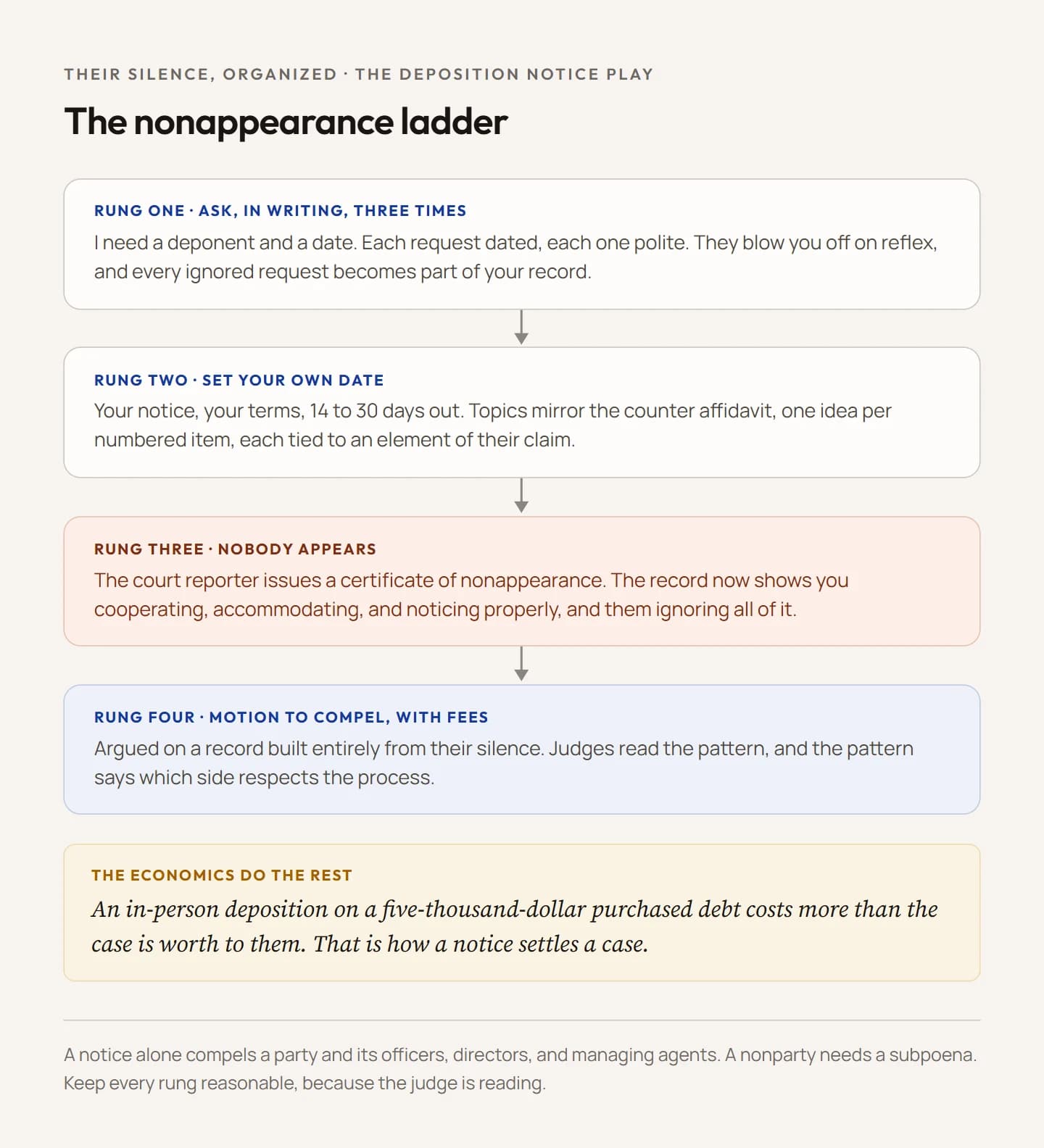
Here is the pattern Brian runs on every case that does not settle early, and it works because collection firms are not built to be litigated against.
Start by asking, in writing: I need a deponent and a date, when are you available. Then ask again. Then a third time, each request dated, each one polite. In Brian's experience they do not answer, because a defendant who fights a collection case gets blown off on reflex. Good. Every ignored request is a rung.
After two or three silent requests, set your own date with your own notice, on your terms, 14 to 30 days out so nobody can call it an ambush. The date comes, nobody appears, and the court reporter issues a certificate of nonappearance. Now the record shows you asking nicely three times, accommodating, noticing properly, and them not bothering to show. That record powers a motion to compel, with fees, and it reframes the whole case for the judge as a story about which side respects the process. Brian tells of a creditor-side case where the pattern ran so long that the judge read the record and dismissed the case with prejudice on the spot. Most end smaller and sooner: the collector who would not answer an email suddenly wants to talk settlement.
When you do write it, every line does work:
A notice duces tecum commands the witness to bring documents, and it doubles as a second, craftier request to produce. The right use is surgical: bring the original document you signed. Bring everything you reviewed before signing it. That second one bites hardest on an attorney affiant, because an attorney cannot properly sign a filing without reviewing what supports it, and in more than 30 years Brian has never once seen an affidavit arrive with the documents it references actually attached.
The discipline is limits. The more you demand, the more objectable the notice becomes and the slower everything moves. Ask for exactly what the signature depends on, nothing else.
The notice must seek legitimate discovery, and your counter affidavit keeps you honest: if a topic does not trace to something their case claims or lacks, it looks like harassment, and judges punish that. A notice alone compels only a party and its officers, directors, and managing agents; a nonparty requires a subpoena, and noticing one without it can leave you paying their costs. Keep dates reasonable, keep the paper trail of your attempts to cooperate, and check your state's notice periods, because they vary.
Two small moves for the day itself. First: "Have you read this notice?" followed by "Anything wrong with it?" Now the record shows a witness who confirmed the notice and should be prepared for every listed topic, right before the deer-in-headlights answers start. Second: "When did you receive it?" The honest answer is often this morning, a month after you served it, and that goes in the record too.
Then be curious, and go deep. Where is the debt you claim my client owes? How does a debt transfer in an assignment, in your understanding? Who owns this account, based on the document you signed, and show me why. The witness across the table signs a hundred of these a day and has never once been asked. If you are the one being deposed instead, the discipline runs the other way: the rule of five.
The deposition notices, the duces tecum riders, and the checklist for building your own are in the member library.

About the author
Brian Parker
I have over 30 years of experience defending consumers against debt collection lawsuits and have seen every tactic, threat, and pressure play that collectors use. Through KillDebt and ParkerGPT, I have systematized the proven defense strategies that actually work - so consumers can respond from a position of knowledge, not fear. My approach focuses on aggressive legal defense based on documented case success rather than false hope that leads to default judgments.