News Break
Sued by Bounce AI? The Empty Complaint, and the Certification That Bites Back
September 4, 2026
Blog / News Break
The set-aside rules moved: California's Hoehn decision, Washington's new proof-before-default act, and Brian Parker's three clocks for undoing a default.
Brian Parker's videos keep returning to one number: in his experience, eight or nine of every ten people sued on a debt never show up, a placeholder attorney collects the default, and a small balance grows into an annuity with a decade or two of interest on it. This video is for the people on the wrong side of that number, and it exists because the law underneath it just moved. A California Supreme Court decision, a first-of-its-kind Washington statute, and copycat bills in other states have all shifted how defaults get undone, and Brian's last default video predates them.
Before the update, his prevention mnemonic, because avoiding all of this is still the whole game. ACE: Answer the lawsuit. Counter affidavit, with a preliminary statement that shows the judge in two sentences why you win. Everything else attached, from the collector's own consent orders to the goofy page of their complaint you want the court holding in its hands.
Key Takeaways
- A default and a default judgment are different things on different clocks, and the default is far easier to undo.
- California's Hoehn decision killed the two-year cap on vacating a judgment void for improper service.
- Washington now requires collectors to prove the debt before taking a default judgment, effective January 2027, and other states are copying it.
- Improper service remains the strongest ground, and the proof is in the court file's own sworn affidavit.
Start with the distinction most people learn too late: a default and a default judgment are not the same thing. The default is the court noting your answer deadline passed. The judgment is the enforceable ruling that follows, in many states 21 days later. Courts are lenient in the gap: show a decent reason you deserve your day in court before the judgment enters and, in Brian's experience, most judges will give it to you. After the judgment, the same request gets harder, the excuses get graded stricter, and eventually you need what the rules call a meritorious defense plus a genuinely good cause.
So the first question when you discover a case you never answered is not "what do I argue." It is "which clock am I on."
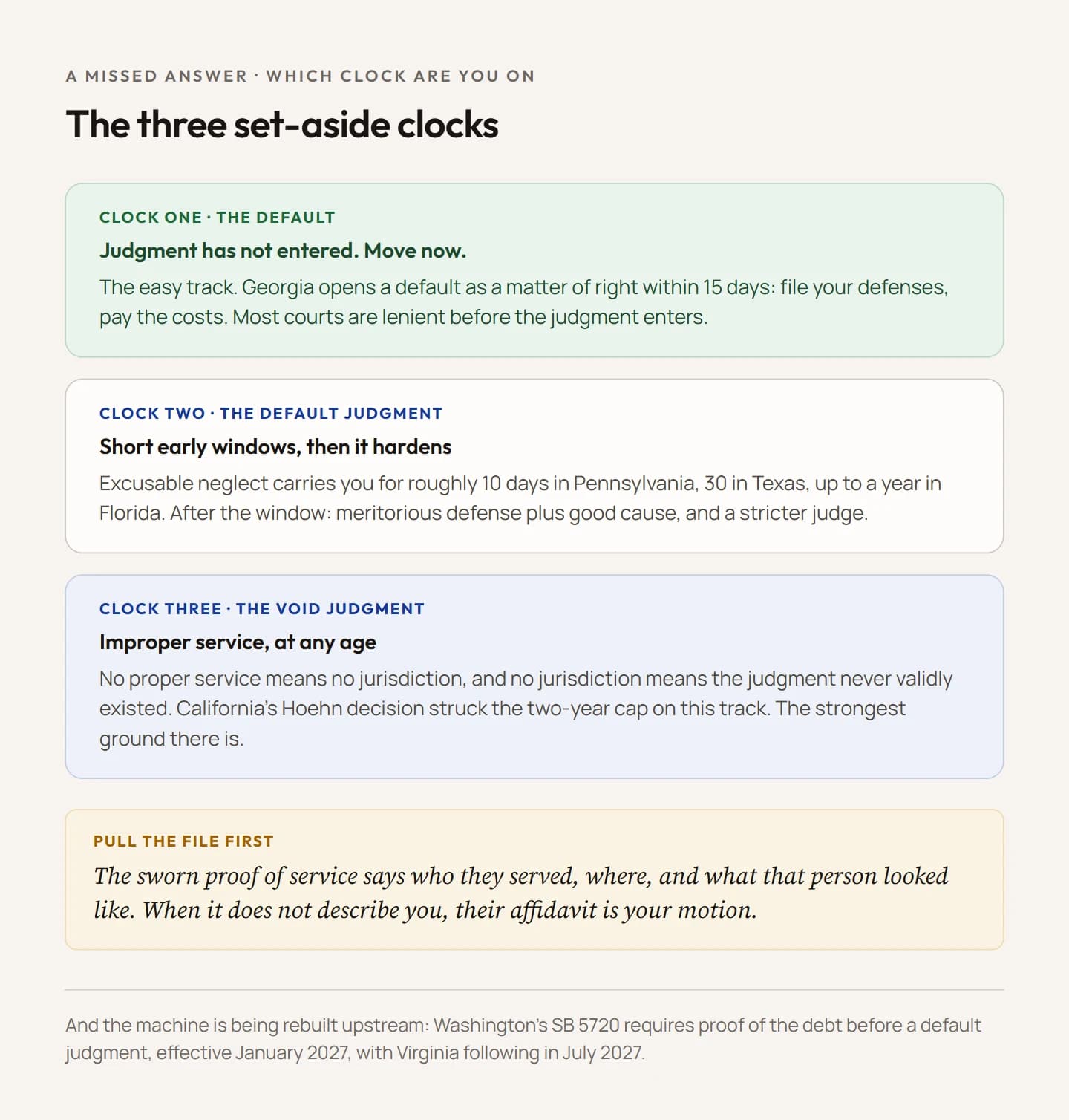
Some states make the early window almost mechanical. Georgia is the friendliest example Brian knows: within 15 days of the default, a defendant may open it as a matter of right, by filing an answer with defenses and paying costs. No begging, no showing of neglect, no judicial mood to manage. Brian's description is that it works like a speeding ticket: they mostly want the check. Count your 15 days from the date of default on the docket, not from anything else, and get the answer in.
Once judgment enters, most states still give a short grace window where "excusable neglect," the wishy-washy whoops-I-missed-it excuse, gets accepted: about 10 days in Pennsylvania from the docket entry, 30 days in Texas through a motion for new trial, up to a year in Florida under its rule, roughly a year in Michigan for most cases. Miss the early window and the standard hardens into meritorious defense plus good cause. The state-by-state chart from the video lives in the member library, and it is a starting point, not an answer: check your rule for amendments, because that is the whole reason this video exists. The mechanics of the motion are in the vacating-a-judgment guide and the set-aside walkthrough.
Brian's favorite track, and the most powerful one, is the judgment that was void from the start. If you were never properly served, the court never obtained jurisdiction over you, and a court without jurisdiction had no power to enter anything. That is not a judgment that was wrong. It is a judgment that never validly existed, and most states treat it accordingly.
California just removed the biggest trap on that track. Trial courts there had settled into a rule that even a void judgment had to be attacked within two years. In California Capital Insurance Co. v. Hoehn (opens in a new tab), the California Supreme Court reversed the court of appeal and held that the two-year cap has no basis in the statute: a motion under Code of Civil Procedure section 473(d) to vacate a judgment void for lack of proper service is not subject to it. Thirteen consumer and legal-aid organizations from around the country weighed in on the case, which tells you how far past California its logic is meant to travel. The legislature never wrote the limit, so the courts could not enforce it.
Improper service is also where your evidence is easiest to get, because the collector filed it for you. The proof of service in the court file is a sworn statement of who was served, where, when, and what they looked like. Brian has built set-aside motions out of nothing more than that affidavit beside a photograph: the server swears they handed papers to a bald, heavyset man of 60 in glasses, and the client is 35, six feet tall, with long hair. Their facts, against them.
The other change is legislative, and it inverts the default machine entirely. Washington's Senate Bill 5720 (opens in a new tab), the Uniform Consumer Debt Default Judgments Act, takes effect January 1, 2027, and it is the first law of its kind: the collector must prove the case before taking the default.
It applies to default judgments on unsecured consumer debts, secured consumer debts where only a money judgment is sought, and deficiencies after a repossession. Inside that scope, the complaint must state the account details: creditor name, account identifier, balance, and the relevant dates. The plaintiff must plead that venue is proper and that the statute of limitations is satisfied, an affirmative statement that matters because so much purchased debt is sued on past its limitations date. The documentation proving the debt must be attached to the lawsuit, which readers of the Bounce AI breakdown will recognize as the exact opposite of the one-page complaint with nothing behind it. A purchased debt requires an unbroken chain of assignment. And the complaint must travel with a plain-language notice telling the consumer what a default judgment can do to wages, bank accounts, and homes, and where free or low-cost legal help may be found.
Brian reports Virginia signed its own version in April, effective July 2027, and Pennsylvania has one introduced. These acts copy each other, so watch your own legislature.
If a garnishment is already running, that has its own moves, and Brian says the next video covers them.

About the author
Brian Parker
I have over 30 years of experience defending consumers against debt collection lawsuits and have seen every tactic, threat, and pressure play that collectors use. Through KillDebt and ParkerGPT, I have systematized the proven defense strategies that actually work - so consumers can respond from a position of knowledge, not fear. My approach focuses on aggressive legal defense based on documented case success rather than false hope that leads to default judgments.