
News Break
Default Judgments Are Getting Harder to Keep: New Rules and the Three Clocks
September 7, 2026
Blog / News Break
Wages lose protection at the bank door. Social Security never does. Brian Parker on the three garnishments, the two-month lookback, and the Huffman decision.

This is the sequel Brian Parker promised at the end of the default judgment update: what happens at the stage after the judgment, when the collector comes for the money itself. The prevention layer has not changed, and he restates it in one breath: ACE. Answer, counter affidavit, everything else. But most people who reach this video are past prevention, so this one is about the machinery of garnishment, the federal rules that limit it, and one rule that collectors routinely describe backwards.
Key Takeaways
- There are three kinds of garnishment: wages, bank accounts, and other property. Each has its own rules, forms, and deadlines.
- The wage rule and the benefit rule are opposites. Wage protection mostly dies when the paycheck hits the bank. Social Security protection follows the money.
- The two-month lookback is the minimum a bank must protect automatically, not the maximum you can claim. Collectors argue the opposite.
- A collector who takes plainly exempt funds has FDCPA exposure, and a mistake about settled law is not a defense.
People say "garnished" as if it were one thing. It is three, and the kind decides your protections, your form, and your deadline.
A wage garnishment orders your employer to withhold part of each paycheck and send it to the collector. A bank account garnishment freezes and takes money already sitting in your account. And a garnishment of other property clamps onto money owed to you before it arrives: rents, commissions, an inheritance sitting in an estate, a small business's receivables. Your first move in any garnishment review is naming which one you are facing, then asking what kind of money is at stake and what state you are in, because the state changes everything.
Here is the concept the whole video turns on. The wage rule and the benefit rule are complete opposites, and the flip happens at the moment of deposit.
Wages are protected in your employer's hands by the federal Consumer Credit Protection Act (opens in a new tab): a creditor gets the lesser of 25 percent of disposable earnings or everything above 30 times the federal minimum wage, $217.50 a week, a figure that has not moved since 1970. Your state can protect more, never less. But in most states that protection describes the paycheck, not the money. Once the check lands in your account, the wage exemption dies, and a bank levy can reach the entire balance. With more than nine in ten American workers on direct deposit, most paychecks skip the protected stage entirely. Brian counts nine states whose statutes carry the wage exemption into the account: California, Florida, Minnesota, Montana, Nevada, New Mexico, Oregon, Virginia, and Wyoming.
Federal benefits run the opposite way. Social Security, SSDI, and SSI are protected by 42 U.S.C. 407(a) (opens in a new tab), the anti-garnishment statute on the books since 1935, and the protection does not expire at the bank door. In Philpott v. Essex County Welfare Board (opens in a new tab), a unanimous Supreme Court held that deposited benefits retain their protected character: the funds were readily withdrawable and remained moneys under section 407's broad bar. The test is traceability, not time, and courts have extended it to benefits commingled with other money, so long as they trace back to the benefit. Money still inside a 401(k) or covered pension enjoys ERISA's own shield, though that one, unlike Social Security's, does not follow a distribution into the bank.
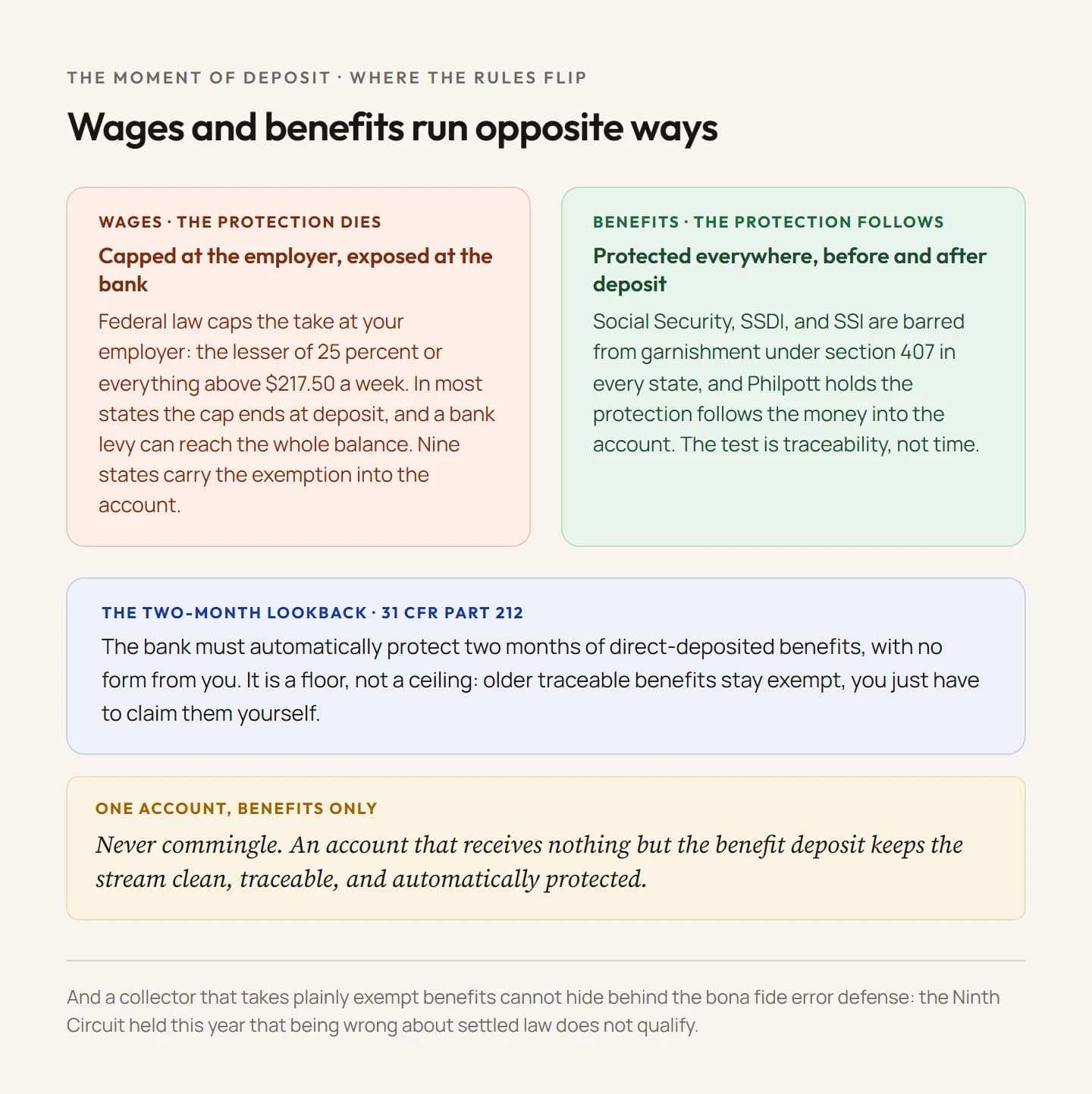
When a garnishment order reaches your bank, 31 CFR Part 212 (opens in a new tab) makes the bank do something automatically: look back two months, total every federal benefit direct deposited in that window, and leave that amount fully accessible to you. No form, no request, no hearing. The rule exists because banks used to freeze everything and beneficiaries had no way to buy groceries while the exemption got sorted out; now the bank must do that first pass on its own, and a bank that skips it faces its own liability.
Collectors have converted that shield into a talking point. You will hear, sometimes in front of a judge, that your benefits are "only protected for two months." Read the rule: it says nothing in it limits your right to assert further exemptions beyond the protected amount. The lookback is the minimum a bank protects automatically. Older deposits are still exempt under 407 and Philpott; what you lose past two months is the automatic part, which means the freeze happens and you are the one who has to undo it, with statements in hand.
One practical warning inside the machinery: the bank answers the collector fast, because in states like Michigan a garnishee that misses its disclosure deadline can owe the whole judgment itself. Nobody in that chain is racing to warn you. If you fear a garnishment is coming, watch your account, because the first notice many people get is a balance of zero.
Brian's centerpiece is a case he has covered before, back in February when the decision came down: Huffman v. JPMorgan Chase and the collector behind it, Ninth Circuit, February 12, 2026, on his telling of it.
A Social Security beneficiary opened a Chase account in 2018 and used it for one thing: his monthly benefit deposit. Nothing else ever went in. A homeowners association got a judgment against him, with over $57,000 in attorney fees stacked on it. Chase did exactly what Part 212 requires, released the two-month lookback amount, roughly $6,500, and froze the rest for the collector.
He went to the exemption hearing alone and made the right argument: the whole account was benefits, so the whole account was exempt. But he cited 42 U.S.C. 207 instead of 407. The collector looked up his citation, told the court it governed the ranks of commissioned officers, and the judge, finding the statute "at best misited," let the collector have the money. One digit.
With counsel, he moved for reconsideration with the correct citation, and the state court quashed the writ: every dollar of the account was exempt, months of deposits, all of it. Then he sued under the FDCPA for the taking, and the district court threw the case out on the bona fide error defense, awarding the other side $10,000 in fees on top. The Ninth Circuit vacated: an error resting on a plainly incorrect view of settled law cannot qualify as a bona fide error under 1692k(c), and the fee award fell with it. The defense covers clerical and factual slips, not a collector being wrong about what the law is.
Three lessons, in Brian's order. Cite the right statute every time, because one digit cost this man a hearing and months of frozen money. The bank is not your enemy and not your judge; the mechanical rule exists so banks never adjudicate exemptions, and the judge is where the rest of the fight belongs. And the collector is where liability lives: pursuing plainly exempt funds is FDCPA exposure, now with a circuit opinion closing the escape hatch.
Four states bar a private creditor from garnishing wages on an ordinary money judgment at all: Texas, Pennsylvania, South Carolina, and North Carolina, which gets there by simply providing no remedy. Each carves out the usual exceptions: support orders, taxes, federal student loans, and in Pennsylvania a residential landlord's judgment.
For bank accounts, the concept that matters most is self-executing protection: the bank applies it automatically and you file nothing. An exemption you must claim is only as good as your ability to find the form in time. Brian counts about thirteen states that automatically protect a set dollar amount in any account, California, Connecticut, Delaware, Maryland, Massachusetts, Nevada, New Mexico, New York, Ohio, Oregon, Pennsylvania, Washington, and Wisconsin among them, and he calls Delaware the best state in the country to face a garnishment in. New York adds teeth: send the creditor's attorney proof that funds are exempt and the attorney must direct the bank to release them within seven days, with costs, fees, actual damages, and up to $1,000 for a bad-faith dispute. Florida's head of family exemption can exempt all disposable earnings; Missouri cuts the take to 10 percent for heads of family; Colorado courts must enlarge the exemption where what is left cannot cover living expenses. Hardship motions like Colorado's exist in most states and go badly underused.
The retiree rules distill everything above into habits:
The garnishment objection forms, claim-of-exemption forms, the motion to quash with return of exempt funds, the motion for reconsideration, the 50-state deadline and exemption sheet, and the garnishment cheat sheet all live in the member library. The broader wage-and-bank picture is in what collectors can actually take and the wage garnishment guide.

About the author
Brian Parker
I have over 30 years of experience defending consumers against debt collection lawsuits and have seen every tactic, threat, and pressure play that collectors use. Through KillDebt and ParkerGPT, I have systematized the proven defense strategies that actually work - so consumers can respond from a position of knowledge, not fear. My approach focuses on aggressive legal defense based on documented case success rather than false hope that leads to default judgments.