Success Stories
LVNV Funding Sued Him Twice. He Beat Both Cases Without a Lawyer
September 21, 2026
Blog / News Break
Every debt buyer's bill of sale rests on a forward flow agreement they never attach. Brian Parker gives the two discovery requests that force it out.
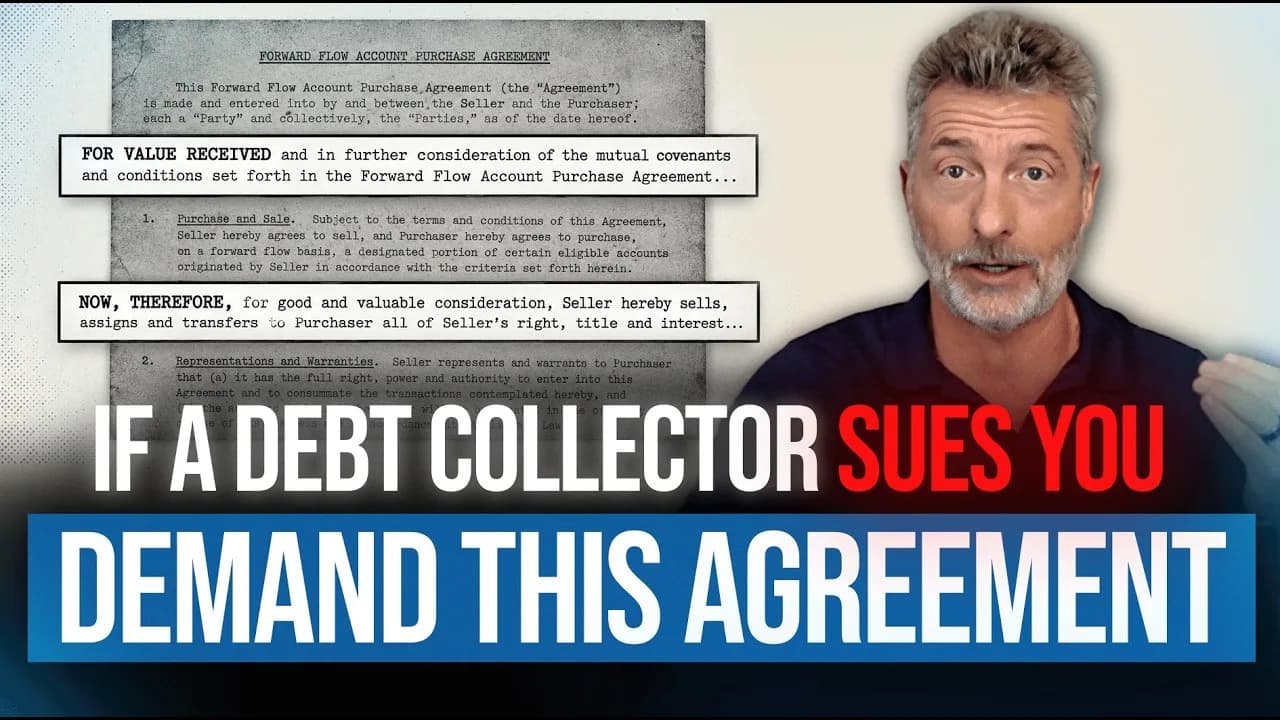
Brian Parker recorded this one from a Michigan hotel room, on the road to depose a witness about a debt that supposedly moved from Discover Bank to Capital One. Fitting, because the video revisits the subject of his most-watched video ever: the document debt collectors never want to produce. The appetite for that one told him the well was not dry, so this is the deeper read, with the actual bills of sale on screen and the two discovery requests that pry the real contract loose.
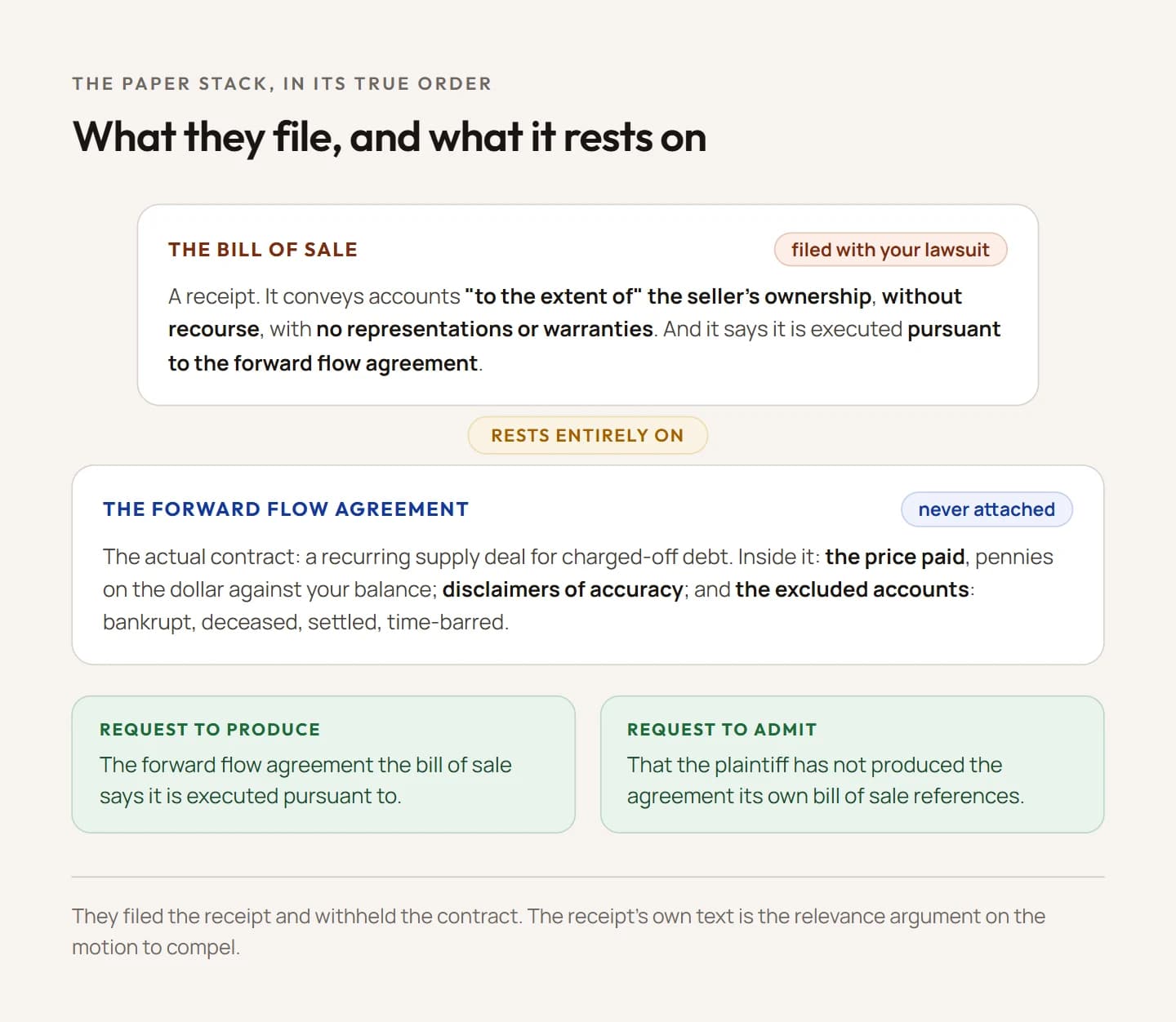
The short version: the bill of sale attached to your lawsuit is a receipt, and the forward flow agreement it depends on is the contract. Collectors file the receipt and bury the contract. Your job is to reverse that.
Key Takeaways
- A bill of sale conveys accounts "to the extent of" the seller's ownership, without recourse and without warranties. It is a receipt, not an assignment.
- Nearly every bill of sale says it is executed pursuant to a forward flow agreement. That sentence is your ticket to the contract itself.
- The forward flow agreement shows the price paid, the accuracy disclaimers, and the accounts the creditor says it is not selling.
- Two discovery requests, one to produce and one to admit, put the contradiction on the record and set up a motion to compel that judges almost always grant.
Brian walks through three real bills of sale on screen. One runs from Pentagon Federal Credit Union to Security Credit Services. One runs from Security Credit Services onward to another buyer. One runs from Barclays Bank to Midland Credit, with nearly everything redacted. Different sellers, same skeleton, and the same three phrases doing the work:
"Pursuant to the forward flow account purchase agreement." The bill of sale announces that it exists under the mutual covenants and conditions of a contract that is not attached. The document they filed is subordinate to a document they withheld.
"To the extent of its ownership." The seller conveys whatever it happened to own, and does not state that it owned your account. As Brian reads it, that is a quitclaim deed: we are not sure we own this, but to the extent we do, it is yours.
"Without recourse, without representations or warranties." No promise of title, no promise of accuracy, no right to complain. The party that sold the debt promised nothing, and the party that bought it now sues you carrying the burden of proof.
Stack that against the sworn certainty in the plaintiff's affidavit, and you have the same contradiction that sank LVNV's paperwork for one member this month: their own documents disagree with their own testimony.
A forward flow agreement is a supply contract. The creditor agrees to sell its charged-off, defaulted accounts to one buyer on a recurring schedule, at a price negotiated in advance, amended over time as prices and terms shift. The creditor clears bad paper off its balance sheet; the buyer gets a pipeline of debt to sue on, delivered not as documents but as electronic files. When Brian deposes the people in charge and asks them to show him the debt itself, the answer is a field in a spreadsheet. There is no tangible thing behind it, which is exactly why the chain of title so often cannot hold together.
Inside the agreement, when you finally get it, look for what Brian looks for:
One more layer: even taken at face value, a one-size-fits-all bill of sale is probably not a legal assignment. Assignments have requirements, and your state's statute of frauds sets conditions that a generic, no-account-named receipt usually does not meet; in Michigan, Brian's home court, the statute voids what falls short. Look up the definition in your state before you let anyone call that receipt an assignment.
The discovery pair from the video, ready to adapt:
The first makes them choose between producing the contract and refusing. The second puts the refusal on the record, where an unanswered request becomes an admission. And if they stonewall, the motion to compel argues itself: the bill of sale they filed says, in its own text, that it rests on this agreement's terms and conditions. In Brian's experience, judges almost always order it produced, and cases have a way of settling before that happens. The forward flow member handout, breaking down both documents clause by clause, is in the member library.
Serve the requests, attach the results to your ACE answer with its counter affidavit, and the receipt they filed becomes the reason their contract enters your case.

About the author
Brian Parker
I have over 30 years of experience defending consumers against debt collection lawsuits and have seen every tactic, threat, and pressure play that collectors use. Through KillDebt and ParkerGPT, I have systematized the proven defense strategies that actually work - so consumers can respond from a position of knowledge, not fear. My approach focuses on aggressive legal defense based on documented case success rather than false hope that leads to default judgments.