News Break
Debt Collector Texts: What Counts as Collection, and How to Make Them Stop
September 14, 2026
Blog / News Break
Collectors have no friends, so do not be their first. Brian Parker's ten self-inflicted mistakes in a debt lawsuit, and the enemy move that replaces each one.
Debt collectors do not have friends. Brian Parker's warning in this video is that you can accidentally become their first one, and most defendants do, through a handful of reflexes that feel polite, honest, or harmless. Each one hands the collector something it could not get on its own.
So this is the mistakes tour: ten ways to be a collector's best friend, each paired with the enemy move that replaces it. Regular readers will recognize several from their own deep-dive articles, which is the point. This is the map; the links go to the territory.
Key Takeaways
- Every explanation of how you fell behind is an admission wearing a sad story. Dispute first, always, everywhere.
- Unanswered requests to admit become admissions automatically. It is the quietest way to lose a case outright.
- A good-faith payment on a time-barred debt can restart the statute of limitations. That is why they ask for one.
- The enemy moves are all questions: who are you, what do you own, where is the proof, are you ready for trial.
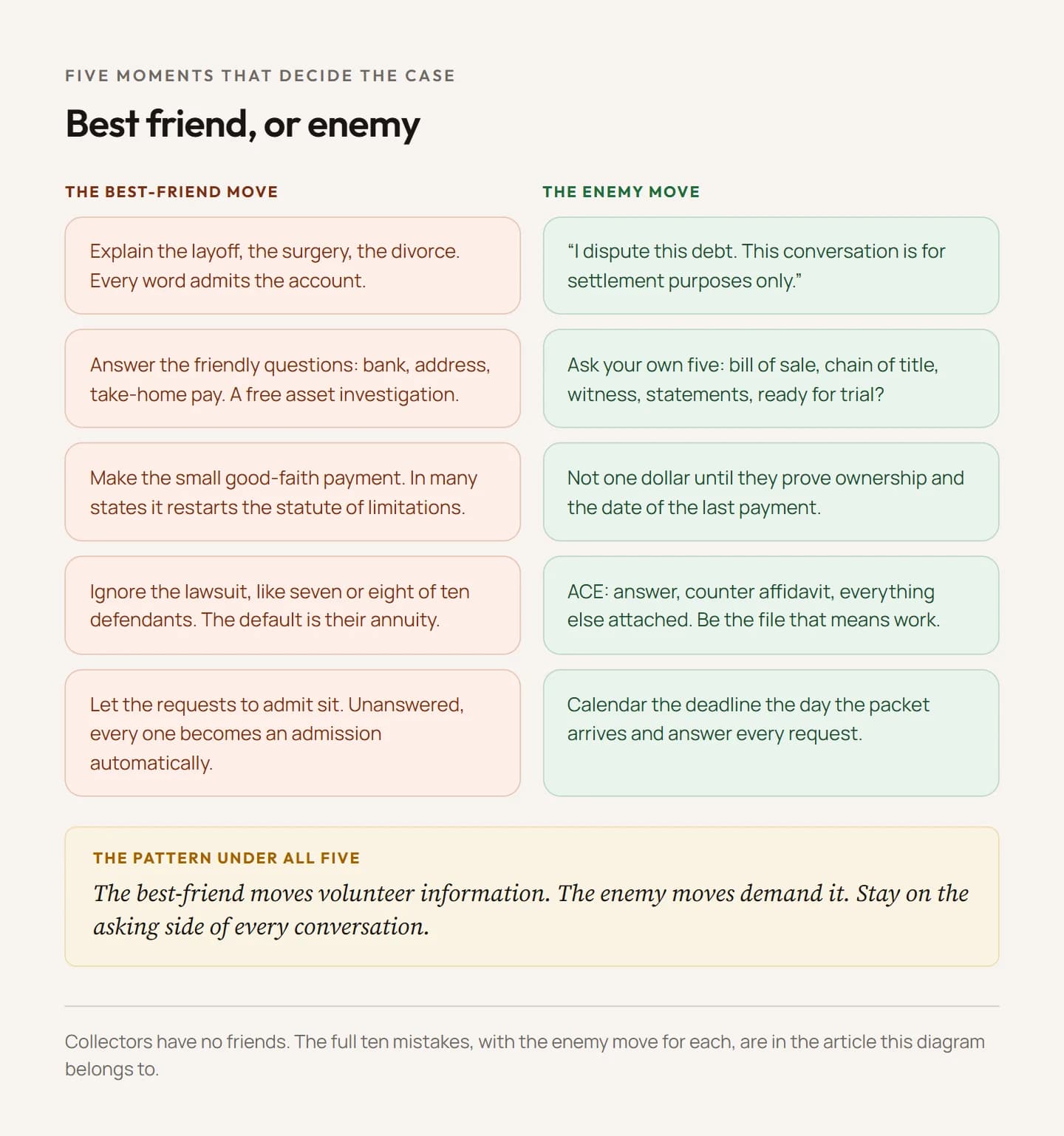
The reflex: call them up and explain the layoff, the surgery, the divorce, the ex who opened the card. All of it may be true, and every word of it acknowledges the account without the one sentence that matters. If you must talk to a collector at all, Brian wants three things said, as often as it takes: I dispute this debt. This communication is for settlement purposes only. I do not agree to anything; I am only seeking information. The story is an admission in a sad costume, and it loses cases in every room of the courthouse.
Where do you bank? Still at the same address? What is your take-home pay? Own or rent? That warm stranger, usually a coverage attorney who does not even represent your plaintiff, is running a free asset investigation. The enemy move flips the direction of the questions: am I speaking with the plaintiff's attorney? Do you have the bill of sale? How did you receive this debt? Do you even work for this plaintiff?
The debt is past the statute of limitations, which is exactly why the collector wants a small show of willing. In many states that payment revives the limitations period, six years or more of fresh lawsuit exposure, ten in Rhode Island, purchased for the price of your guilt. Before one dollar moves: show me you own this debt, tell me the statute of limitations, and tell me when the last payment was made, with proof.
Seven or eight of every ten people sued never answer, and a default judgment is an annuity. Answering is the whole game, and Brian's ACE is the shape of it: an Answer, the Counter affidavit that makes it a first impression instead of a form, and Everything else attached, their contradictory letters, the consent orders they signed with regulators. Collectors did not sign up to work. Be in the pile that means work.
An admit-deny-deny form with nothing sworn behind it settles nothing and scares nobody; the court reads it as another answer on the stack. The counter affidavit is what separates the file, because it puts facts under oath against their unsworn template, and it becomes the blueprint for everything after: discovery, depositions, the pretrial script.
Every letter from the court or the collector is potential evidence, because volume filers make mistakes in writing and never remember them. Brian tried a case against LVNV Funding in late 2025 that turned partly on a letter his client had saved: the collector's own words admitted facts that contradicted the ownership story it later told the judge, and showing the two side by side helped end the case after the first day of trial, on his account of it. Keep everything, sorted by date. Their paperwork is your exhibit list.
Mid-litigation, a packet arrives asking you to admit the account is yours, the balance is right, the plaintiff owns it. Requests for admission typically give you 28 to 30 days, and here is the trap most self-represented people never learn: whatever you do not answer is deemed admitted automatically. No hearing, no motion, no mercy. The collector proves a case it may not have been able to prove, using your silence as the evidence. Calendar the deadline the day the packet arrives and answer every request.
The judge says go work it out, and the hallway becomes the collector's office. The enemy script is settled house doctrine by now: this discussion is for settlement purposes only, I dispute this debt, may I have your name and bar number, are you the attorney of record or covering, you represent the plaintiff, correct? Then ask the five questions: bill of sale with my account on it, complete chain of assignment, records custodian in the building, statements proving this exact balance, and whether they are ready for trial with a live witness. You ask; you do not answer. And if terms are reached, nothing gets signed today: most courts allow days to return the paperwork, and the consent judgment needs the protective terms in writing, including that timely payments freeze all collection, tax intercepts, and liens until the settlement completes.
"But you owe this debt, right?" is not a neutral question, and it is not the judge's question to need answered; it sorts the docket. The answer is not your hardship history. It is: no, your honor, I do not owe this debt to this debt collector, as stated in my answer and counter affidavit. Arguing your case at a pretrial, or at the placeholder attorney, wastes the same breath: a pretrial is not the place, and the scripts exist so you never improvise.
A collector facing only your defenses risks losing and nothing more. A collector facing a counterclaim can end the case paying you, and that changes every conversation about settlement. If you built the ACE package, the counterclaim material is already in it: the violations in their letters, the defects sworn to in your counter affidavit. This is the difference between surviving the case and being, in Brian's phrase, a problem Parker, and it is how mutual walkaways get made.
One more, as a coda: be careful whose advice you take. Brian's standing test for anyone teaching this subject, himself included, is trench time: decades of state and federal collection litigation, not a sixty-second short with a disclaimer that the presenter is not an attorney. Demand the experience before you follow the advice.
The best-friend checklist card, with every mistake and its enemy move, is in the member library.

About the author
Brian Parker
I have over 30 years of experience defending consumers against debt collection lawsuits and have seen every tactic, threat, and pressure play that collectors use. Through KillDebt and ParkerGPT, I have systematized the proven defense strategies that actually work - so consumers can respond from a position of knowledge, not fear. My approach focuses on aggressive legal defense based on documented case success rather than false hope that leads to default judgments.