News Break
The Deposition Notice That Settles Debt Cases, and How to Write One
September 11, 2026
Blog / News Break
Three texts got National Credit Systems sued and kept in court. Brian Parker reads the opinion: context, standing, and the words that stop the messages.
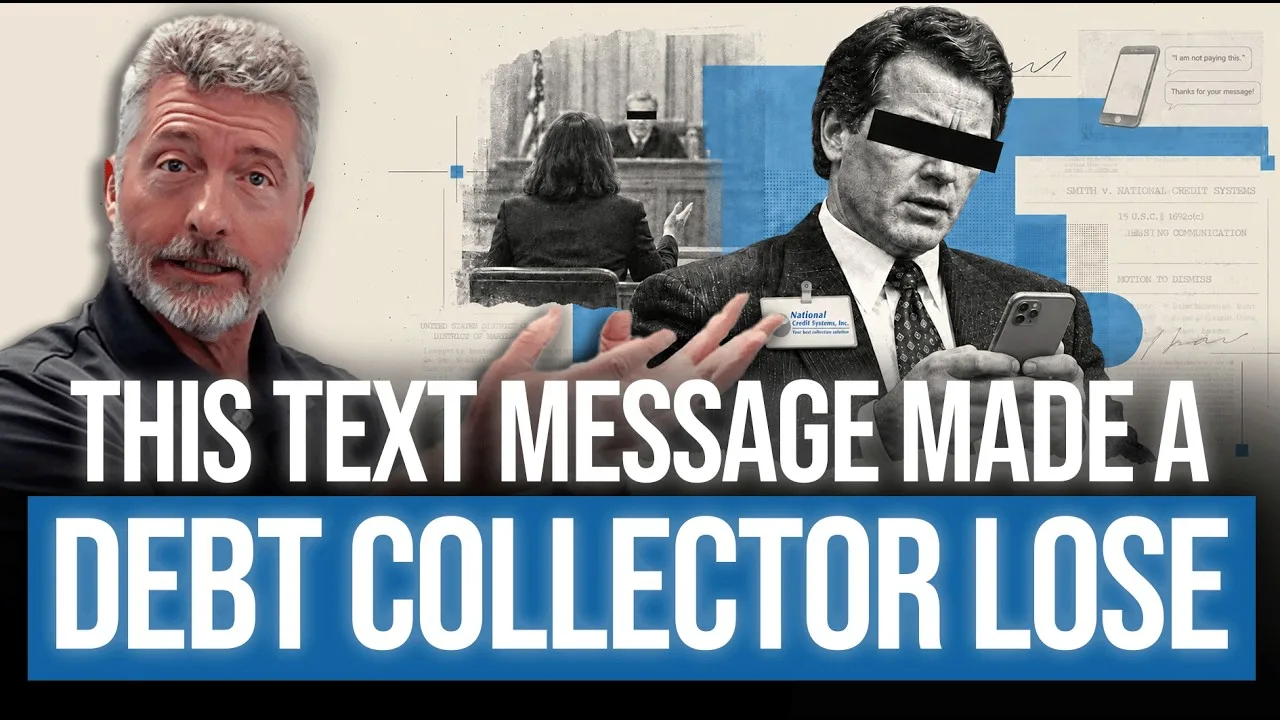
On March 31, 2025, Gloria Smith got a text from National Credit Systems, a large collector working an apartment debt. She replied that she was not paying, and added the line Brian Parker calls the most respected thing you can say in writing to a collector: I do not know who you are, or whether you even have the right person, but I am not paying this. NCS answered by asking for the email address on file. Then it asked again, minutes later.
Three texts. That is the entire factual record of Smith v. National Credit Systems in the District of Maryland, where Smith, representing herself, sued on a single count and just survived the collector's motion to dismiss. Brian reads the opinion on camera, and his verdict is characteristically honest: he would not have taken this case, he thinks it nearly deserved to lose, and it is exactly the case to learn from, because both sides made mistakes you can avoid.
Key Takeaways
- A text is a communication under the FDCPA, and a message that never mentions the debt can still be "with respect to" it. Context supplies what the words leave out.
- The cease-communication statute has two triggers, one writing requirement, and three exceptions. Know all six parts before you rely on it.
- Intangible harms can carry standing at the pleading stage, but a judge who says you pled "barely" enough is not a victory lap.
- Dispute letters and cease letters are different tools. Dispute first, in writing, every time.
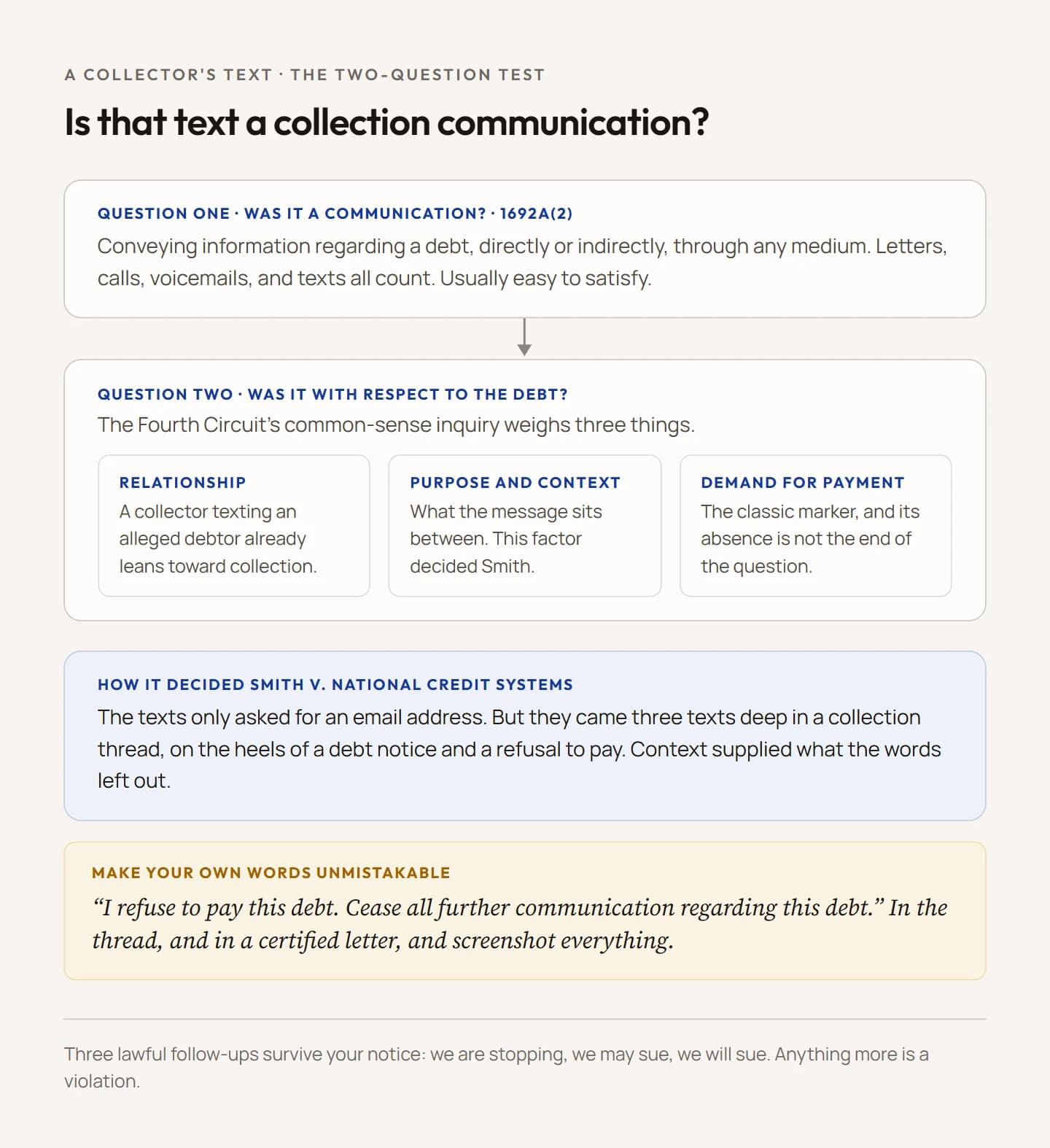
Smith sued under one subsection: 15 U.S.C. 1692c(c), ceasing communication. If a consumer notifies a debt collector in writing that she refuses to pay a debt, or that she wants the collector to stop communicating, the collector shall not communicate further with respect to that debt. Shall, not may.
Six parts matter. The notice must be in writing; a shouted stop-calling-me on the phone triggers nothing. There are two independent triggers: refusing to pay, or demanding silence, and either one works. Smith used the first, with her I-am-not-paying-this reply. And there are three exceptions that survive your notice: the collector may still write once to say its efforts are terminated, to say it may invoke a specific remedy it ordinarily invokes, or to say it will invoke one, which is how "we are going to sue you" remains lawful after a cease letter. Nobody tells consumers about the exceptions, and, remarkably, NCS's lawyers never invoked a single one.
The collector's first move was the one every federal collection plaintiff meets: standing. Nobody was harmed by a text message, they argued, so there is no case. Smith's complaint answered with a list: intrusion upon seclusion, invasion of privacy, lost productive time, decreased focus at work, frustration, emotional distress, anger, anxiety. No lost money, no credit damage.
The court held the list was enough, leaning on an unpublished Fourth Circuit decision, Ben-Davies v. Blibaum and Associates, which accepts actual intangible harms that affect a plaintiff personally. And the judge wrote the most honest line in the opinion: though the court may share NCS's doubts as to the magnitude of Smith's injuries, she has nonetheless sufficiently pled an injury in fact. Translation: I am skeptical this hurt you, but that is not today's question, because at the motion-to-dismiss stage every factual allegation is accepted as true. Allegations get that treatment; legal conclusions do not. Brian's caution for anyone tempted to celebrate: pleading "if only barely" enough is a description of a case on thin ice, not a win.
NCS's real defense was textual: our messages never mentioned the debt. We asked for an email address. That is not debt collection communication, so 1692c(c) does not apply. The judge agreed the texts lacked the classic markers, no repayment options, no restated balance, no demand.
And Smith still won the motion, because of how the Fourth Circuit decides what a message is about: a common-sense inquiry with three factors. The nature of the parties' relationship, which favored Smith, collector and alleged debtor. Whether the message demands payment, which favored NCS, since none did. And the objective purpose and context of the message, which decided the case: a request for an email address, sent on the heels of a debt notice and an unequivocal refusal to pay, is a request made with respect to that debt. The statutory definition backs that up. A communication is conveying information regarding a debt directly or indirectly, through any medium. Texts are a medium. Indirect is enough. Context supplies the information the words leave out.
Brian's practitioner read is that this opinion is as interesting for what was never argued as for what was decided.
NCS never contested whether a text message is notice "in writing." The statute requires written notice, the question is genuinely open, and the collector litigated only whether its own texts were communications. Brian cannot explain the omission, and neither could the court, which noted it.
NCS never raised the consumer-debt element. The FDCPA covers only debts arising from transactions for personal, family, or household purposes, and Smith's complaint never identified what kind of debt she was disputing. No consumer debt, no statute. Unargued.
And NCS never claimed its follow-up texts fit the three exceptions its own statute provides. The judge listed the exceptions in the opinion and noted the collector relied on none of them.
The lesson cuts both ways. Smith, filing alone, left holes in her complaint that better lawyering would have driven a truck through. NCS's lawyers, filing at collection-firm volume, never looked for the holes. Both facts are why showing up prepared beats both of them.
One more reason to know your state's collection statute: federal law required Smith to prove a collection communication, with all the with-respect-to-the-debt litigation above. Most state acts regulate collection activity, no communication element at all. Whatever a collector does in service of collecting can qualify, which is a materially easier case to plead and win.
The cease-communication checklist, the letters, and the what-to-attach guide are in the member library.

About the author
Brian Parker
I have over 30 years of experience defending consumers against debt collection lawsuits and have seen every tactic, threat, and pressure play that collectors use. Through KillDebt and ParkerGPT, I have systematized the proven defense strategies that actually work - so consumers can respond from a position of knowledge, not fear. My approach focuses on aggressive legal defense based on documented case success rather than false hope that leads to default judgments.