News Break
The Ultimate Sample Answer to Debt Collection Lawsuit Guide
April 18, 2026
Blog / News Break
Predict debt lawsuit outcome with data on defaults, defenses, and strategies to win or settle your case.

If you want to predict debt lawsuit outcome for your case, here are the key factors that matter most:
Factors that predict your debt lawsuit outcome:
| Factor | Impact on Outcome |
|---|---|
| Filing a written Answer | Reduces default judgment risk by up to 7x |
| Statute of limitations expired | Can result in full dismissal |
| Debt buyer lacks chain of title | Grounds for dismissal (lack of standing) |
| No response to summons | ~70-78% chance of default judgment against you |
| Requesting debt validation | Can halt collection and expose procedural violations |
| Bankruptcy filing | Triggers automatic stay, halting the lawsuit immediately |
Right now, Americans are carrying over $1.17 trillion in credit card debt, and about 9% of cardholders are behind on payments. That means debt lawsuits are filed every single day — and the numbers are climbing.
Here is the hard truth: most people who get sued for debt lose — not because they have no defense, but because they do nothing.
Around 70% of people sued for debt never respond to the lawsuit at all. In California, only 5.5% of defendants filed a formal answer in recent years. The result? Default judgments — automatic losses handed to creditors without any real fight.
But the data also shows something encouraging. When defendants do participate, outcomes shift dramatically. Cases move toward settlements, trials, and dismissals instead of automatic losses. In some datasets, nearly 25% of cases were dismissed after defendants simply filed an Answer.
This guide breaks down the real factors — backed by court data, legal research, and creditor behavior — that predict whether a debt lawsuit ends in your favor or against you.
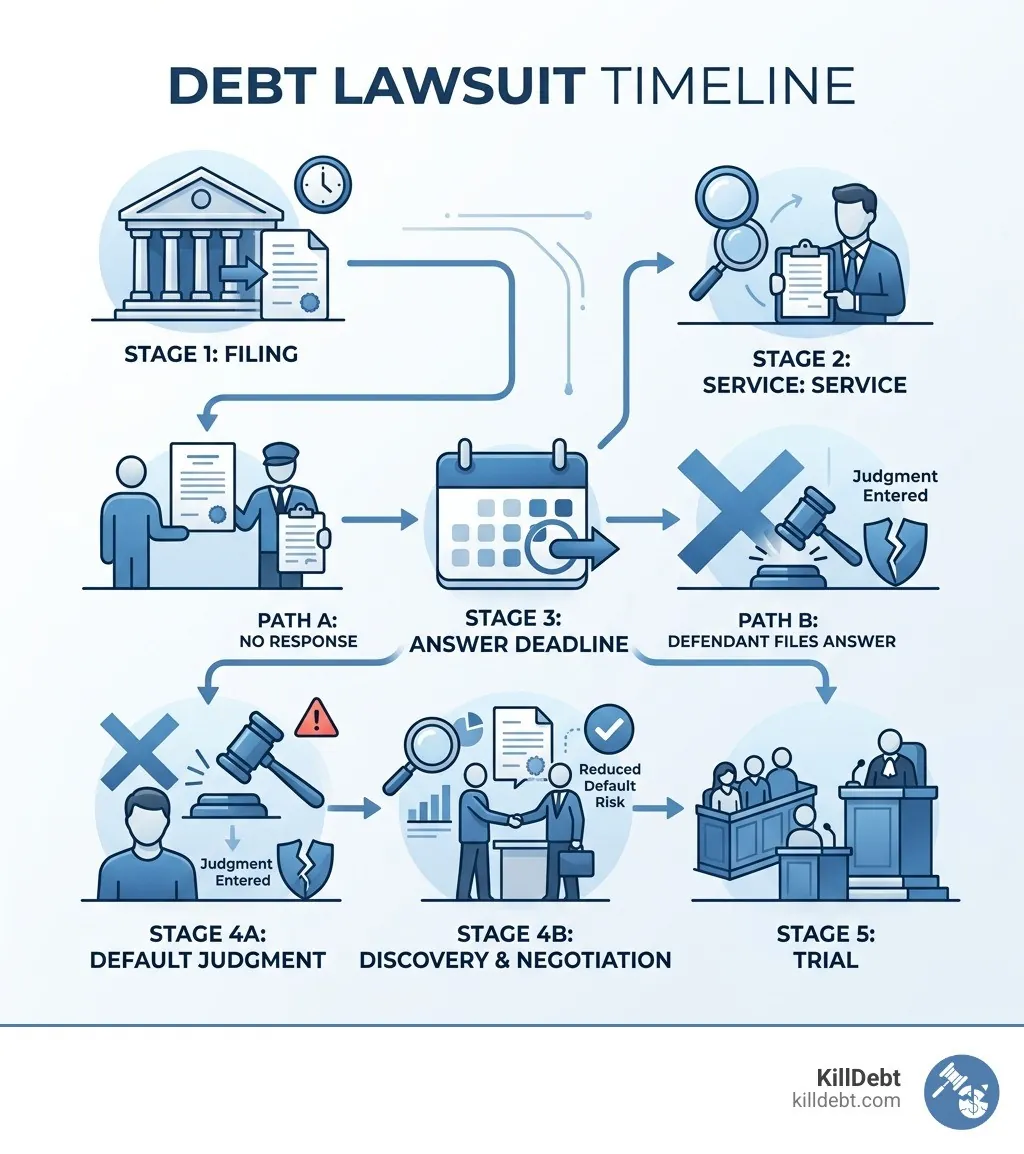
When we look at the numbers, the biggest predictor of a lawsuit's outcome isn't the amount of money you owe or even who is suing you. It is whether or not you show up. We see a massive "participation gap" in the American legal system.
According to research from Pew, around 70% of people sued for debt do not participate in the lawsuit. This leads directly to a default judgment, which is essentially a "win by forfeit" for the debt collector. Once a creditor has a default judgment, they can move to garnish your wages or seize funds from your bank account.
In Michigan, the Advancing Justice for All in Debt Collection Lawsuits (opens in a new tab) report highlights how procedural barriers keep people from defending themselves. For example, the requirement to file a formal written Answer—often accompanied by high filing fees—is a major hurdle.
The data shows that people are much more likely to participate when these barriers are removed. In a matched sample from Minnesota, 41% of small claims debt cases (where no formal answer is required) avoided default. In contrast, only 11% avoided default in district court, where a formal answer is mandatory.
| State/County | Small Claims (No Answer Required) | District/Superior (Answer Required) | Participation Increase |
|---|---|---|---|
| Minnesota | 41% Avoided Default | 11% Avoided Default | 3.7x |
| Marion County, IN | 48% Avoided Default | 23% Avoided Default | 2.1x |
As Consumer Debt Lawsuits Are Surging Again: Here's What the Data Reveals in 2024-2025 explains, we are entering a period where debt buyers are ramping up litigation. If you want to change the trajectory of your case, the first step is understanding that simply participating—filing that Answer—drastically improves your odds.
If you decide to fight, how can you predict debt lawsuit outcome with any accuracy? It comes down to scrutinizing the plaintiff's homework. Debt collectors, especially "junk debt buyers," often file lawsuits with the hope that you won't show up. When you do, their lack of evidence becomes your best weapon.
One of the most powerful predictors of dismissal is "lack of standing." This happens when the person suing you cannot prove they actually own the debt. Original creditors (like Chase or Citibank) usually have the paperwork. However, debt buyers purchase accounts for pennies on the dollar in massive digital files. Often, they lack the "chain of title"—the legal paper trail showing the debt moving from the original creditor to them.
As detailed in Who Is Suing Me? Original Creditor vs. Debt Buyer Explained, identifying a debt buyer is a major green flag for your defense. They frequently lack the original contract or monthly statements required to prove the debt's existence and amount.
In Michigan, Michigan Legal Help (opens in a new tab) notes that common defenses include:
If you have been sued by a debt collector, your goal is to force them to meet their "burden of proof." If they can't produce the contract you signed or a complete accounting of the balance, the judge may dismiss the case.
The statute of limitations (SOL) is a "kill switch" for debt lawsuits. Every state has a limit on how long a creditor has to sue you. In Florida, for instance, the statute of limitations for most credit card debt is four years. In Michigan, it is generally six years.
If the SOL has expired, the debt is "time-barred." This doesn't mean the debt vanishes, but it does mean the collector has no legal right to win a judgment in court. However, the court won't check this for you. You must raise the statute of limitations as an "affirmative defense" in your Answer.
A common trap mentioned in Debt Collection Lawsuit Myths: 7 Things That Won't Save You is "tolling" or restarting the clock. In many states, making even a $5 payment or acknowledging the debt in writing can restart the statute of limitations. If your debt is old, the best predictor of a win is a clean SOL defense.
Before a lawsuit even reaches the courtroom, your actions can set the stage for a win. Under the Fair Debt Collection Practices Act (FDCPA), you have the right to request debt validation within 30 days of a collector's first contact.
As we discuss in our guide on Debt Validation Letters, this forces the collector to stop all collection efforts until they provide proof of the debt. If they sue you without validating, or if they can't produce the documents, you have a powerful procedural defense. In fact, many collectors will simply drop the matter and move on to an easier target if they receive a well-drafted validation request.
The technicalities of how you were sued can sometimes be more important than why you were sued. For example, "service of process" is the legal requirement that you be properly notified of the lawsuit. If the collector "sewer serves" you (claims they served you but actually threw the papers in the trash), you can challenge the entire lawsuit for lack of jurisdiction.
Many people worry about representing themselves (pro se), but the data is surprisingly positive for those who try. While creditors win most cases by default, they often lose contested cases because their witnesses don't show up or their records are incomplete.
When you respond to a debt collection lawsuit, you aren't just saying "I don't owe this." You are using tools like counter-affidavits to dispute their claims under oath. This forces the creditor to bring a real witness to court, which costs them money. Often, if the debt is small (under $5,000), the cost of flying in a witness exceeds the value of the debt, leading them to offer a favorable settlement or dismiss the case entirely.
Another strategy is checking for an arbitration clause. Most credit card agreements allow you to move the case out of court and into private arbitration. Because the creditor usually has to pay the heavy arbitration fees (often $2,000+), they may decide it's not worth pursuing a $1,500 debt.
We cannot overstate this: Evidence is the Achilles' heel of debt buyers.
To win, a plaintiff must prove:
If they are missing even one of these—like the original credit agreement or the assignment of debt—they shouldn't win. In a sample of over 135,000 lawsuits, it was found that nearly 25% were dismissed just by the defendant filing an Answer and demanding proof.
Sometimes, the best way to predict debt lawsuit outcome is to change the game entirely. If the debt is valid and the creditor has the evidence, you might look at settlement or bankruptcy.
Debt Settlement: Creditors often accept 30% to 60% of the balance to avoid the hassle of a trial. However, be careful. If a creditor forgives more than $600 of debt, they are required to report it to the IRS. You will receive a 1099-C form, and that forgiven amount may be treated as taxable income.
Bankruptcy: If you are facing multiple lawsuits, filing for bankruptcy triggers an "automatic stay." This is a federal court order that immediately halts all collection lawsuits, garnishments, and phone calls. While it's a "nuclear option" for your credit, it provides a guaranteed outcome. Interestingly, machine learning models (opens in a new tab) can now predict the success of Chapter 13 bankruptcy plans with about 70% accuracy based on initial filing data.
Judgment-Proof Status: If your only income is Social Security or disability, and you have no significant assets, you may be "judgment proof." As we explain in Can Debt Collectors Take My Wages and Bank Account?, certain types of income are exempt from garnishment by law. While the creditor might still get a judgment, they won't be able to actually collect any money from you.
Predicting the outcome of a debt lawsuit doesn't require a crystal ball—it requires a strategy. The data is clear: the "system" is designed to process defaults, but it struggles when a defendant actually fights back. Whether you are in Florida or Michigan, your best chance of a dismissal or a favorable settlement starts with a strong, legally-sound response.
At KillDebt, we believe you shouldn't have to spend thousands on an attorney just to get a fair shake in court. Our DIY legal defense system is powered by ParkerGPT, an AI specifically trained on consumer debt law and real court strategies developed over 30 years by attorney Brian Parker.
Unlike generic AI, ParkerGPT analyzes your specific lawsuit documents, identifies the exact weaknesses in the collector's case, and generates court-ready responses. We’ve even introduced the Court Tester, an AI courtroom simulation. You can upload your filings and "practice" your argument against an AI judge and opposing counsel before you ever step foot in a real courtroom.
Don't let a debt collector win by default. Take control of your case and Start Your Defense Today.

About the author
Brian Parker
I have over 30 years of experience defending consumers against debt collection lawsuits and have seen every tactic, threat, and pressure play that collectors use. Through KillDebt and ParkerGPT, I have systematized the proven defense strategies that actually work - so consumers can respond from a position of knowledge, not fear. My approach focuses on aggressive legal defense based on documented case success rather than false hope that leads to default judgments.