News Break
Debt Buyer Ignoring Your Discovery? Build a Paper Trail, Then Move to Compel
November 25, 2026
Blog / News Break
A process server is at your door with a debt lawsuit. Stay calm, admit nothing, and write down what they say. Brian Parker's five steps after service.
Someone is walking up your driveway with a debt lawsuit. Do you take the papers? Do you have to sign? What if they start telling you what you owe?
Brian Parker has had that knock at his own door. He says that, 20 years later, a knock still makes him jumpy. His advice in the video below starts with one rule: stay calm, and do not admit or volunteer anything.
Key Takeaways
- Do not admit the debt, promise to pay, or explain your money troubles at the door.
- Write down the date, the time, the server's name, and their exact words.
- A process server's job is to serve papers. Brian argues that a server who pushes you to pay is collecting.
- Refusing the papers does not make the lawsuit go away. If they use alternate service, check every box on their proof of service.
Brian calls the stretch between the filing and the service garbage time. He says that until you are served, you are not yet in jeopardy. If you know a lawsuit is coming, check your court's docket every two weeks.
Use that window. Before you are a party to a lawsuit, Brian says, collectors send information more freely, so it is a good time for letters and debt validation requests. Here is what to send before you are served. Brian also says to put up a doorbell camera now. More on that in the process server playbook.
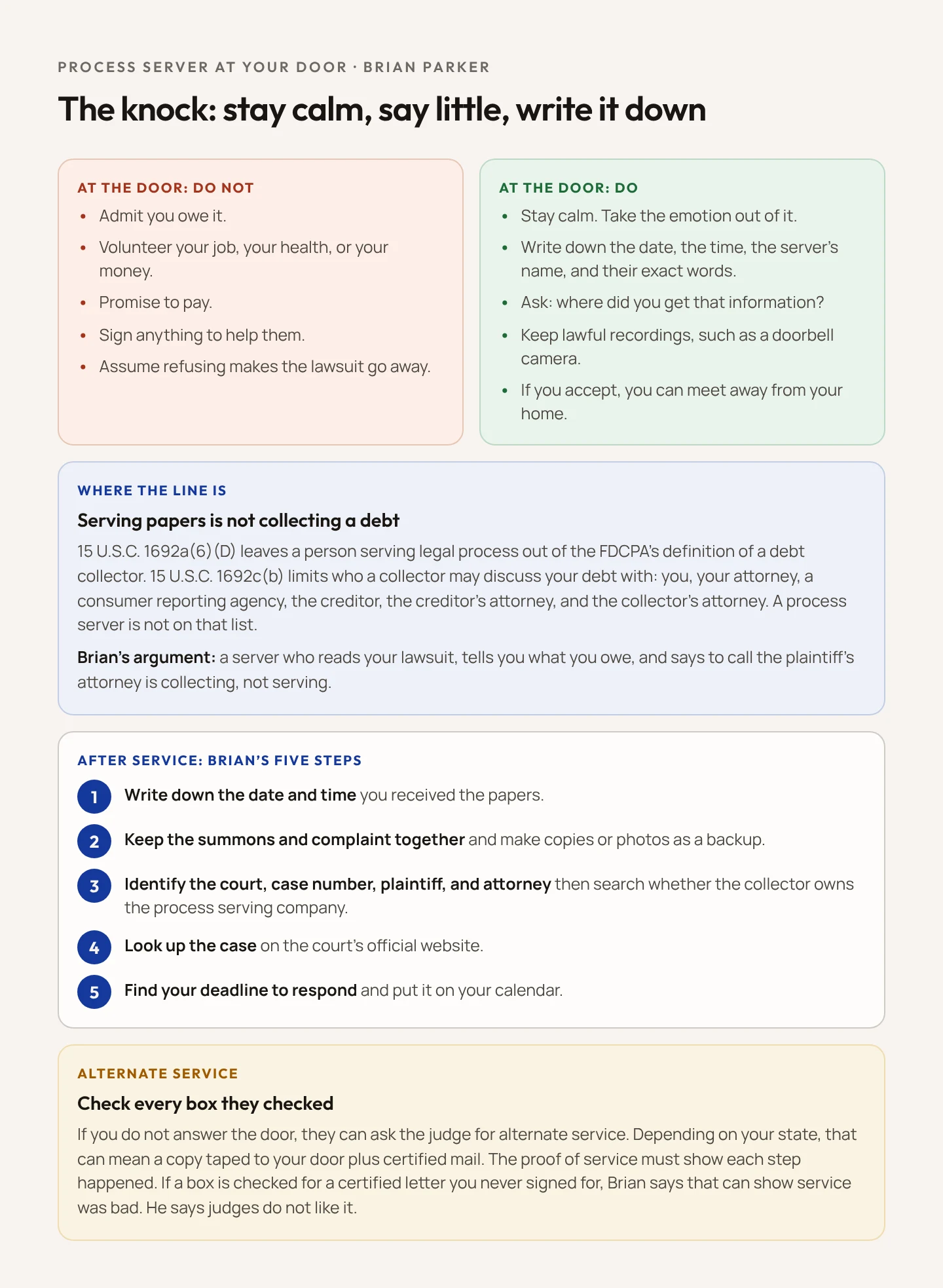
Whatever the server does, do not admit anything and do not volunteer anything. Brian's list of things that hurt you:
The server may be taking notes, and some carry a camera. If you say you owe it, you did not dispute it. Brian says the worst thing you can do is make it easy for them.
You do not have to sign anything to help them. You do not have to agree with the allegations, admit liability, or promise to pay. And accepting the papers does not mean you admit anything.
Brian says some debt collectors now own process serving companies. Even when they do not, the server gets paid by them and gets a lot of work from them. So pay attention.
Write down:
Keep a clipboard handy, or let your doorbell camera record. Brian says to keep only lawful recordings. He once had footage of a man in a homemade FedEx shirt who claimed he had a package. Brian says that case went away.
If the server tells you how much you owe, ask: "Where did you get that information?" Brian says they usually answer that they read it in your lawsuit.
The Fair Debt Collection Practices Act leaves out "any person while serving or attempting to serve legal process" from its definition of a debt collector. That is 15 U.S.C. 1692a(6)(D) (opens in a new tab). The exclusion covers serving.
Brian's argument is that it does not cover collecting. A server who says "you better call the plaintiff's attorney and set up a payment plan," or "if you don't pay, you'll get a judgment," is no longer only serving papers. Brian asks: if the server is neutral, why do they never tell you to get your own attorney?
He points to a second section. 15 U.S.C. 1692c(b) (opens in a new tab) limits who a debt collector may discuss your debt with, unless you consent or a court allows it. The list is you, your attorney, a consumer reporting agency, the creditor, the creditor's attorney, and the collector's attorney. A process server is not on it. Brian argues that a collector who hands an unsealed lawsuit to a server who then reads it and discusses it with you may be on the hook under that section. He has made the same argument about a collector who wrote the amount owed on the front of a summons.
These are Brian's arguments, and they depend on your facts. Your notes from the door are what make them possible. See what counts as a debt collector under the FDCPA.
Brian says you can check your state's rules, and that nothing requires you to help them serve you. But he is clear: do not assume that refusing the papers makes the lawsuit disappear.
If you do not answer the door, the plaintiff can go to the judge and ask for an order for alternate service. Depending on your state, that can mean a copy taped to your door plus certified mail with a return receipt. Brian adds that the cost of serving you can end up in what they say you owe, and alternate service can raise that cost.
If you decide to accept, you can do it on your terms. When a server leaves a card, call back, ask what it is about, and offer to meet somewhere else, such as a grocery store. Brian says servers usually agree. They want to finish the job.
Sometimes Brian tells clients to accept service on purpose. If garbage time showed the debt is past the statute of limitations, or the plaintiff cannot prove it owns the debt, he would rather take the case on, and possibly file a counterclaim.
With alternate service, the server swears to the court that each step happened. Brian says he sees the boxes checked all the time when one step never happened. A common example: a box checked for a certified letter nobody signed for.
Get the proof of service from the court. If it says you signed for certified mail and you did not, Brian says that is a way to show service was bad. He says judges do not like a false proof of service. Put it in your counter affidavit. More on improper service and a motion to quash service.
Then follow RACE, the plan from Brian's guide to a debt buyer lawsuit: read the summons, answer with a responsive pleading, file a counter affidavit, and add everything else. Brian says that in some states, if you do not counter their affidavit, you automatically lose. For "everything else," he attaches consent orders where regulators found the same collector broke the law.
Brian's advice: please do not call. If you must, say this first: "I'm calling for settlement purposes only, for information. I dispute that I owe anything. I just want to see what this is about." Then say as little as you can. More on what to do when a debt collector calls.
Upload your summons and complaint to ParkerGPT and ask your question in plain English. It reads the papers with you, flags the deadlines to confirm, and helps you draft the garbage-time letters, your answer, and your counter affidavit. Before a hearing, practice your argument in the Court Tester, and print a cheat sheet built from your case.

About the author
Brian Parker
I have over 30 years of experience defending consumers against debt collection lawsuits and have seen every tactic, threat, and pressure play that collectors use. Through KillDebt and ParkerGPT, I have systematized the proven defense strategies that actually work - so consumers can respond from a position of knowledge, not fear. My approach focuses on aggressive legal defense based on documented case success rather than false hope that leads to default judgments.