
Blog / News Break

Debt Collector Consent Orders: How to Use Them in Your Defense

PRA, Midland, and Resurgent signed orders promising to stop. Brian Parker shows five ways to use a consent order against the company suing you.
Consumer defense attorney Brian ParkerBrian Parker · 7 min read

The biggest debt buyers in the country have signed papers promising to stop breaking the law. Portfolio Recovery Associates signed one. So did Encore Capital, the parent of Midland. Resurgent Capital, which services LVNV Funding accounts, has signed state orders too. These are consent orders, and most people sued by these companies never hear of them.

In the video below, Brian Parker shows how to find the consent order against the company suing you, and five ways to use it. He attaches them to his answers. When a debt buyer does to you what it promised a regulator it would never do again, the court should know.

Key Takeaways

  • A consent order is a settlement with a regulator. The company admits nothing, pays, and promises to change how it operates.
  • PRA, Midland's parent Encore, and Resurgent all have orders on record. Search the CFPB and your state regulator for the company suing you.
  • Turn the order into a discovery checklist. Ask for every document it says the company must have.
  • If the company did what the order says it must not do, you may have a counterclaim under the FDCPA or the FCRA.

RACE: where consent orders fit

Brian's framework for answering a debt lawsuit is RACE.

  • R: Read the lawsuit. Read the summons and find out how many days you have to answer. Scott, the Georgia member who beat LVNV, cleared almost $40,000 in claimed debt, and Brian says the central reason was that he sat down and read the lawsuit first.
  • A: Answer with strong, good faith affirmative defenses.
  • C: Counter affidavit. Brian says nothing leaves his office without one. Here is how to file a counter affidavit.
  • E: Everything else. This video is about E, and consent orders are a big part of it.

What a consent order is

A consent order is a settlement with a government regulator. The regulator says, we think you broke the law. The company says, we admit nothing, but we will pay and change how we operate. In Brian's words, the company decides it is cheaper to pay the fines than to fight a government with a bottomless budget for legal fees.

The order then lists what the company must do and must stop doing. When the company breaks those promises in your case, the order is evidence that it knew the rule.

The orders worth knowing

Portfolio Recovery Associates: $24 million in 2023

In 2023, the CFPB ordered PRA to pay more than $24 million (opens in a new tab) for violating its 2015 order. The CFPB said PRA kept misrepresenting whether people owed debts and how much, and filed collection lawsuits without possessing or reviewing the original account level documentation.

Original account level documentation means the thing you signed, the account statements, and proof you owe the debt to the original creditor. What Brian sees in PRA cases instead is a sale file or a data spreadsheet. You did not sign that. Brian reads the order as barring PRA from claiming a debt is valid, or suing on it, unless it has verified the chain of title and holds the original documents. He says he has never seen PRA produce them, before or after 2023, and that most PRA attorneys he faces do not know the order exists.

So he attaches it. His answers tell the court about the CFPB's $24 million action against PRA for FDCPA violations, list what PRA promised to provide, and argue that the case should be dismissed because the plaintiff filed with no paperwork or assignment proof and is not the real party in interest.

Midland Credit Management and Encore Capital

Midland's parent company is Encore Capital Group. In 2015, the CFPB took action against both PRA and Encore (opens in a new tab), and said both companies filed affidavits claiming personal review of records that had not happened. In 2020, Encore settled again (opens in a new tab), and Brian says it agreed to stop suing on time-barred debt, to provide the proper disclosures and paperwork, and to stop misleading people about how much they owe.

Brian has history here. He brought class actions against Midland Funding and Encore years ago, and deposed the people who signed those affidavits. He says they had no idea what he was asking them, even though their affidavits said they had reviewed the records.

Resurgent and LVNV: the state orders

Brian notes that federal enforcement has slowed since 2024, which makes the states more important. Every state has its own collection agency regulator, and your state may have an order against the company suing you.

Brian reads a recent Minnesota consent order against Resurgent Capital Services on screen. He says Minnesota found Resurgent violated the FDCPA and Minnesota law by failing to update settled accounts to a zero balance and continuing to collect on them. He says it also found Resurgent violated the Fair Credit Reporting Act by reporting incomplete and inaccurate information on settled debts, and by failing to review the information consumers sent with their disputes. Minnesota imposed a civil penalty, its investigation costs, and a cease and desist.

Maryland is the older example. Maryland suspended the collection licenses of LVNV and Resurgent, and in the 2012 settlement (opens in a new tab) the companies paid a $1 million penalty and agreed to dismiss their pending Maryland collection cases, about 3,500 lawsuits.
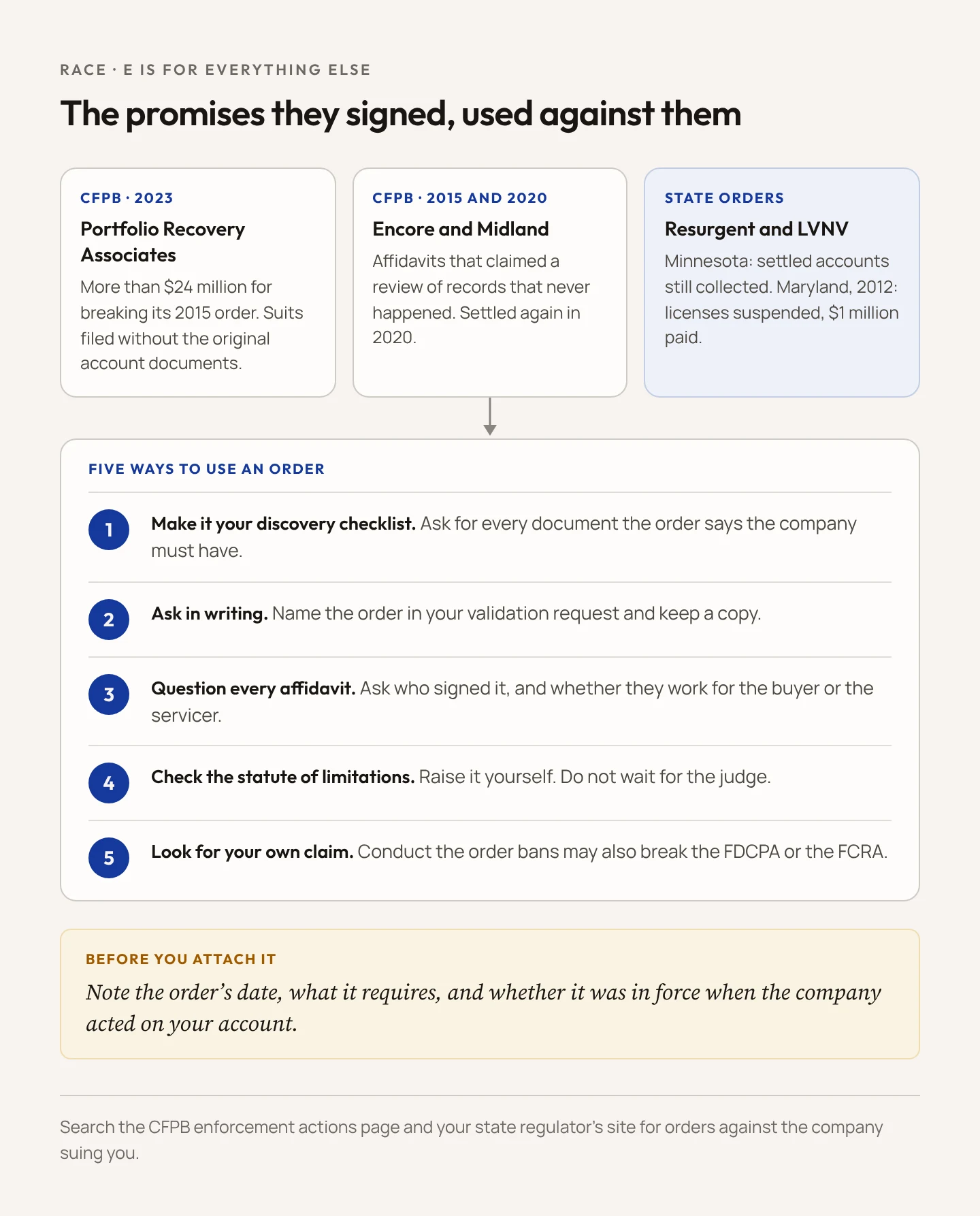
A diagram in two parts. The top row shows three cards for the orders in the article: the 2023 CFPB order against Portfolio Recovery Associates for more than 24 million dollars, the 2015 and 2020 CFPB actions against Encore and Midland, and state orders against Resurgent and LVNV in Minnesota and Maryland. An arrow leads to a numbered list of five ways to use an order: make it your discovery checklist, ask in writing for what it requires, question every affidavit, check the statute of limitations, and look for your own counterclaim. A gold panel says to note each order's date and whether it was in force when the company acted on your account.

Five ways to use a consent order

  1. Turn the order into your discovery checklist. PRA's order lists what PRA must have. Ask for those things. If PRA has them, ask why they were not attached to the complaint. If it does not, it filed the lawsuit in breach of the order.
  2. Ask in writing for everything the order says you must get. Make it part of your validation request, name the order, and keep a copy. Even if they do not answer, you have a good faith request to show the court: the order said this, I asked for it, and they still did not respond.
  3. Question every affidavit. The CFPB found in 2015 that both Encore and PRA filed affidavits claiming personal review that had not happened. Ask whether the person who signed works for the debt buyer or for a servicer like Resurgent. Brian notes Minnesota just found Resurgent's records wrong on settled accounts.
  4. Check the statute of limitations. Brian says PRA's order bars it from suing on time-barred debt and requires disclosures when it collects on one. If your debt is old, raise the statute of limitations as an affirmative defense. Do not count on the judge to raise it for you. You have to help the judge help you.
  5. Look for your own claim. If the company did to you what the order says it must not do, you may have a claim or a counterclaim under the FDCPA and the FCRA.

And always check the collector's license in your state. Brian says that in Florida, collecting without the required registration violates both the FDCPA and the Florida Consumer Collection Practices Act. Read more on what an unlicensed collector hands you.

Your checklist

  • Don't ignore the lawsuit. Remember RACE: read, answer, counter affidavit, and everything else, including the consent orders and anything else the other side got wrong.
  • Identify the plaintiff and the servicer. Midland, PRA, LVNV, Resurgent, or someone claiming to own a debt that someone else owns. Always check the chain of title.
  • Search for orders. Check the CFPB enforcement actions page (opens in a new tab) and your state regulator's site for orders against whoever is suing you.
  • Note each order's date, what it requires, and whether it was in force when the company acted on your account.
  • Build your document requests around what the order says the company must supply.
  • Raise the statute of limitations every chance you get.
  • Save your paper. Every letter, settlement agreement, and proof of payment you already have with the company now suing you.
  • Pull your credit reports from all three bureaus at annualcreditreport.com (opens in a new tab) and dispute anything wrong in writing. Brian asks every client for this snapshot, because things can change once attorneys get involved.

If court makes you nervous, the Court Tester lets you practice in private with an AI judge and an AI co-counsel, and the cheat sheets give you the questions you will be asked and how to answer them.

Sued by PRA, Midland, or LVNV? Talk to ParkerGPT about your defenses and counterclaims. It drafts the answer and the counter affidavit.

Frequently Asked Questions (FAQ)

What is a consent order in debt collection?
A consent order is a settlement between a government regulator and a company. The regulator says the company broke the law. The company does not admit it, but agrees to pay and to change how it operates. The order lists what the company must do and must stop doing, and you can hold it to those promises.
Can I use a CFPB consent order in my debt lawsuit?
Yes, as evidence and as a road map. Brian Parker attaches the relevant order to the answer when the plaintiff is doing what it promised to stop. He also builds his document requests around what the order says the company must have, such as the original account documents, and asks why they were not attached to the complaint.
Where do I find consent orders against a debt collector?
Search the CFPB enforcement actions page for the company suing you, and the company that services the account. Then search your state regulator's site, usually the banking, financial institutions, or commerce department. Note each order's date, what it requires, and whether it was in force when the company acted on your account.
What did the 2023 PRA consent order require?
In 2023 the CFPB ordered Portfolio Recovery Associates to pay more than $24 million for violating its 2015 order. Brian Parker reads the order as barring PRA from suing unless it has verified the chain of title and holds the original account level documentation. He attaches it to his answers in PRA cases.
Can I sue a debt collector for violating a consent order?
A consent order alone does not give you a lawsuit. But if the company did to you what the order says it should not do, that conduct may also break the FDCPA or the FCRA, and that gives you a claim or a counterclaim of your own. The order helps show the company knew the rule.
Consumer defense attorney Brian Parker

About the author

Brian Parker

I have over 30 years of experience defending consumers against debt collection lawsuits and have seen every tactic, threat, and pressure play that collectors use. Through KillDebt and ParkerGPT, I have systematized the proven defense strategies that actually work - so consumers can respond from a position of knowledge, not fear. My approach focuses on aggressive legal defense based on documented case success rather than false hope that leads to default judgments.

All articles