
News Break
Borrowing Statute: How Another State's Deadline Can Stop a Debt Lawsuit
October 19, 2026
Blog / Success Stories
A Georgia member served 45 discovery requests on LVNV Funding. LVNV never answered, the requests were deemed admitted, and the judge granted him summary judgment.

Scott runs a small residential elevator company in Atlanta. LVNV Funding sued him for about $15,000 on a personal loan made through Best Egg and Cross River Bank. He defended himself, and the judge granted him summary judgment and entered a final judgment in his favor.
In this interview with Brian Parker, Scott explains how. The short version: he served discovery, LVNV never answered it, and under Georgia law the unanswered requests for admission became facts in the case.
This was not Scott's first case. Five debt buyers or lenders have sued him. He has won three, including one at the Georgia Court of Appeals, and two continue. He estimates the three wins removed $40,000 to $50,000 in claimed debt.
Key Takeaways
- Scott served 15 interrogatories, 15 requests for production, and 15 requests for admission. LVNV answered none of them.
- In Georgia, a request for admission that goes unanswered for 30 days is admitted, and the admitted fact is conclusively established.
- With the facts admitted, Scott moved for summary judgment. The judge granted it.
- LVNV filed the complaint and, by Scott's account, nothing else in the case.
1. A motion to dismiss first. In August 2025, before he answered, Scott filed a motion to dismiss. He wanted to see whether LVNV would respond and how hard it would fight. LVNV did not respond to the motion. The judge denied it anyway.
2. The answer, with every defense kept alive. Scott then filed his answer. He pleaded his affirmative defenses, including the arguments from his motion to dismiss, so that the denial did not end them.
3. Discovery. He served 45 requests: 15 interrogatories, 15 requests for production, and 15 requests for admission. LVNV answered none of them.
4. The 30-day rule. Under Georgia's rule on requests for admission (opens in a new tab), a request is admitted unless the other side serves a written answer or objection within 30 days. An admitted matter is conclusively established unless the court allows the party to withdraw it, and LVNV never asked. Scott also wrote to LVNV's attorney about the missed responses, as Georgia required before a motion to compel. He got no reply.
5. Summary judgment. With the admissions in place and no documents produced, Scott moved for summary judgment. On April 1, he also filed a notice of the deemed admissions and asked the court to rule.
6. The ruling. The judge granted Scott's motion and entered a final judgment. Brian read the order: it noted that LVNV had filed nothing in the case since Scott's filings. Scott says the judge also wrote that she would have ruled for him on other grounds too.
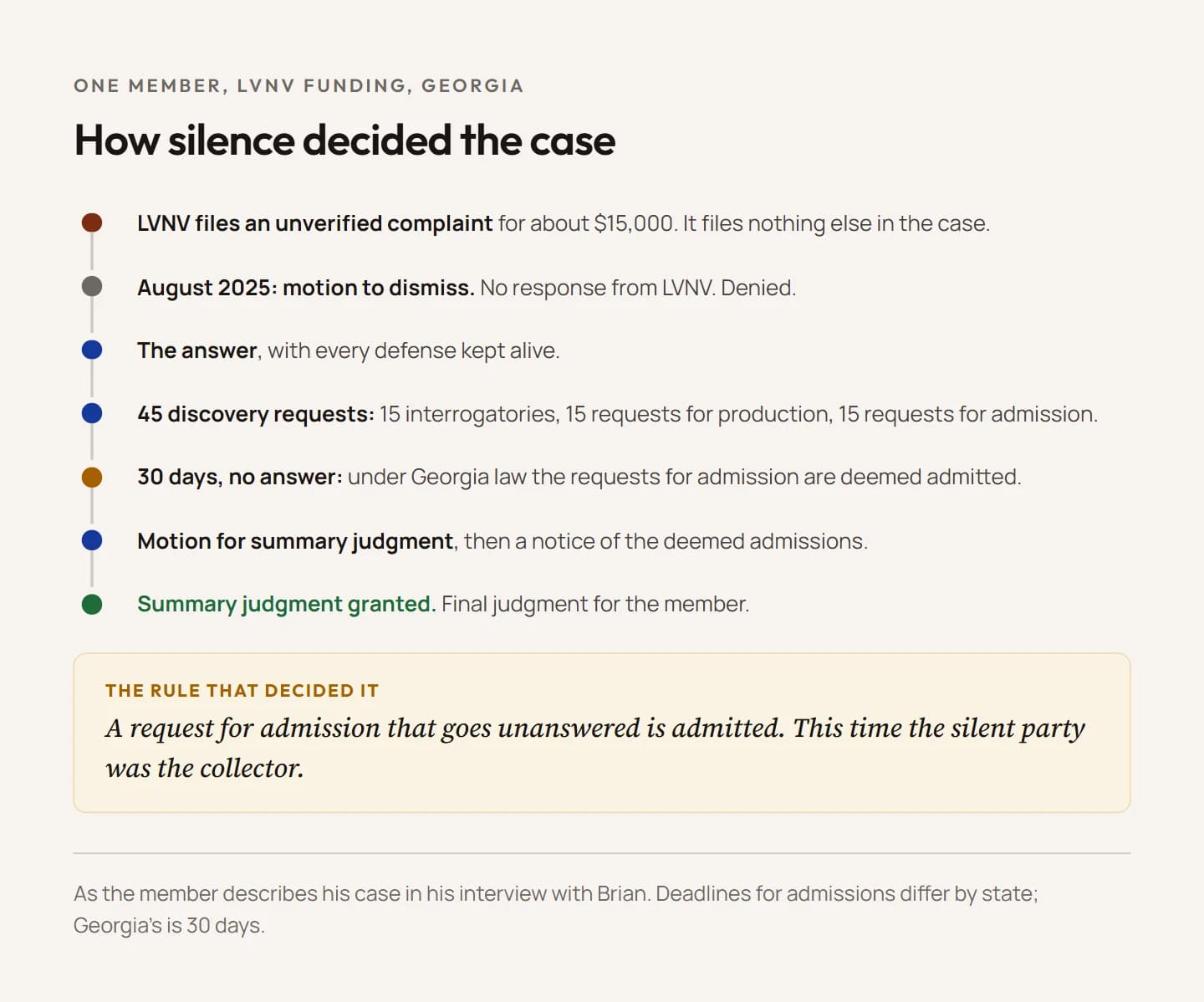
Interrogatories and requests for production ask the other side for information. A request for admission asks it to admit or deny a fact. If it says nothing, the fact is admitted.
That is why Brian calls an unanswered request one of the quietest ways to lose a case. Here the rule worked the other way. LVNV was the party that stayed silent, and the admitted facts left it with nothing to argue. The time limit is different in each state. In Michigan, one of Brian's states, it is 28 days. Our discovery guide covers the requests you may receive.
The bill of sale listed about 75 organizations as buyers from the same sale, under one servicing agent. The account had also passed through a securitized trust, and Scott says the securitization material on the platform helped him understand it. As in many debt-buyer files, the forward flow agreement behind the bill of sale was not produced. The bill of sale is only a receipt.
Scott also watches for business-records affidavits that appear late in a case. When an affidavit seems written to answer a point the judge raised in an earlier hearing, he asks how the signer can have personal knowledge of records that did not exist when the account was opened.
Read everything first. Read the complaint, what is attached to it, and what is missing. In Georgia, the complaints he received were not verified. A short unsworn complaint tells you the plaintiff is counting on a default.
Wait, then plan. Put the papers down for a while so your first reaction does not drive your filings.
Check what the documents mean. In another of his cases, Scott found that the company named in the suit had been absorbed by another company before the suit was filed. He checked public filings to trace the sale.
Check their case law. Scott found that a plaintiff's firm cited cases that did not say what the firm said they said. Read the cases, not only the citations.
Keep emotion out of your filings. Facts, rules, and statutes. Clear and short arguments. A judge can dismiss an emotional filing easily.
Use the tools for what they do best. Scott used ParkerGPT for strategy and procedure, the next move after each event in the case. He used another AI tool to tighten his writing. He says ParkerGPT suggested a filing before one hearing that led the judge to rule.
Brian has seen this in many cases over the past year. When a defendant files a real answer and serves discovery, the plaintiff's firm often stops responding. A firm built on defaults is not set up to answer 45 requests on a $15,000 file. A member in Massachusetts saw the same pattern against LVNV, and PRA dismissed a case one day after a walkaway offer.
The first step is the same in every one of these cases: answer the lawsuit, with a counter affidavit.

About the author
Brian Parker
I have over 30 years of experience defending consumers against debt collection lawsuits and have seen every tactic, threat, and pressure play that collectors use. Through KillDebt and ParkerGPT, I have systematized the proven defense strategies that actually work - so consumers can respond from a position of knowledge, not fear. My approach focuses on aggressive legal defense based on documented case success rather than false hope that leads to default judgments.