News Break
Labcorp Collection Notice Threatening Your Credit? What a Florida Appeals Court Ruled
October 7, 2026
Blog / News Break
More debt buyers skip the collection letter and file the lawsuit first. Brian Parker on who files the most, why the fear fades, and the defenses to raise.

Most people expect a collection letter first. You get the letter, you send a validation request, and the process starts there. Brian Parker says that order is changing. More debt buyers skip the letter and file the lawsuit. He recorded this video from a hotel room in North Carolina, his third state in three weeks of depositions, after he read an October 6 report in Barron's on the same subject.
This article covers three things: where the lawsuits come from, why the collector wants you afraid, and what to do in the first days after you are served.
Key Takeaways
- A letter invites a validation request. A lawsuit invites a default. That is why some debt buyers now file first.
- The Debt Collection Lab counts 7,745,145 debt collection lawsuits in only 11 states.
- Fear is the strongest part of a collection lawsuit. It ends when you file the answer.
- Find the deadline on the summons, file early, and raise every defense that applies.
The Barron's report, as Brian reads it on screen, says debt collectors are taking more consumers to court and winning. It gives two reasons: consumer debt is cheap to buy, and federal regulators have stepped back.
Brian adds a third reason from his own cases. A collection letter gives you a turn. You can dispute the debt and ask for validation, and that interrupts the collector's process. A lawsuit gives you a turn too, but most people do not take it. So the collector goes straight to the step where silence wins.
The Debt Collection Lab's lawsuit tracker (opens in a new tab) counts 7,745,145 debt collection lawsuits from 2009 to 2026. That number covers 11 states and 333 counties. It is not a national total.
Brian reads the names of the largest filers from the Lab's data. Most are debt buyers:
The local numbers show the same trend. Pew research cited in the video found that filings in St. Louis County, Missouri have doubled, that filings in Suffolk County, Massachusetts reached 168% of the 2019 level, and that Alabama reached its highest level on record. Our report on the 2026 lawsuit boom has the state figures.
One more figure explains the rest. About 4% of people who are sued over a debt have a lawyer. The plaintiff always has one.
Brian's advice on fear is not what you expect. He tells you to accept it.
Fear is the strongest part of a collection lawsuit. The collector depends on it, because a frightened person puts the papers in a drawer. But fear is a stage, and it has an end. When you file the answer, the fear stops and the work starts. From that point the collector must spend money, send an attorney, and produce paperwork.
That change matters most against a debt buyer. A debt buyer paid a small fraction of the balance, and it did not plan to fight for the account. A coverage attorney who does not know your name is often the only person it sends to court.
Find the deadline. The summons gives the number of days you have to answer. The time is different in each state, from about 14 days to 35 days in New Jersey.
Do not wait for the last day. Brian once filed an answer on time and the court still entered a default. The delivery record showed that the clerk's office had signed for the envelope. The envelope then stayed on a desk for a week. You do not want that fight. Put the date on your calendar and file early.
File a real answer. A bare admit-and-deny form gets a weak result. Use ACE: the answer, the counter affidavit that swears to your facts, and everything else attached. "Everything else" includes a consent order against the same plaintiff for the same conduct, if one exists.
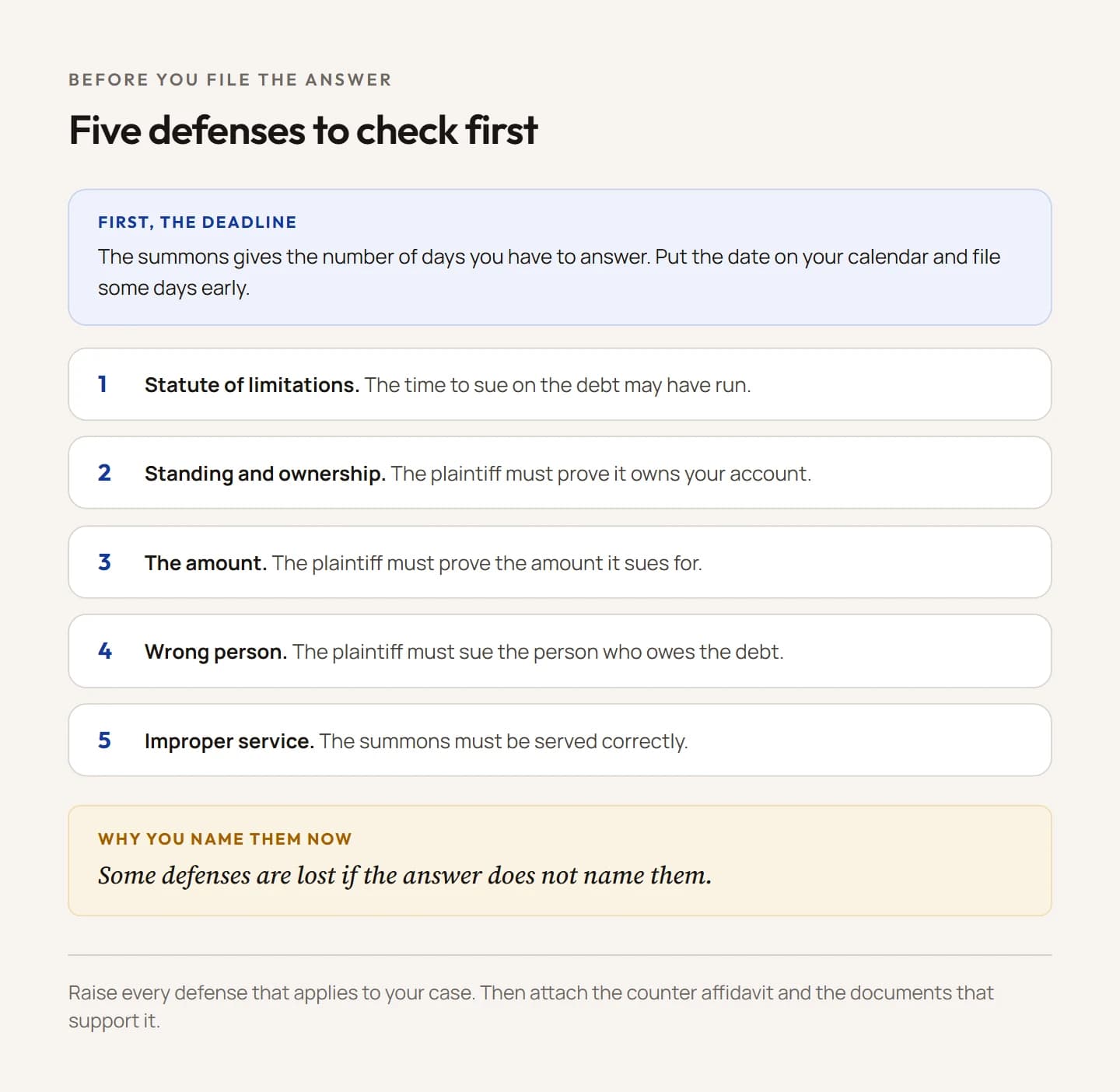
Brian lists five. Check each one against your case.
Raise every defense that applies. Some defenses are lost if the answer does not name them.
Some readers tell Brian that their state does not allow a counter affidavit. His answer: check the rules of your court. The rules that let the plaintiff file a pleading also give you the right to answer it. If a rule forbids a counter affidavit, follow the rule. If no rule forbids it, you do not need permission.
A strong answer often brings a settlement offer or a dismissal. Decide what number is right for your case before the offer comes. When you agree, get every term in writing.
The other result is the one to avoid. A default judgment lets the collector garnish wages, freeze a bank account, and put a lien on property. In some states the judgment lasts 20 years.
Members can practice the hearing in the court tester before the real one.

About the author
Brian Parker
I have over 30 years of experience defending consumers against debt collection lawsuits and have seen every tactic, threat, and pressure play that collectors use. Through KillDebt and ParkerGPT, I have systematized the proven defense strategies that actually work - so consumers can respond from a position of knowledge, not fear. My approach focuses on aggressive legal defense based on documented case success rather than false hope that leads to default judgments.