News Break
Debt Collection Mistakes: Ten Ways You Become the Collector's Best Friend
September 16, 2026
Blog / News Break
Debt collection lawsuits hit record highs in 2025-2026. See which debt buyer files the most cases, which states are getting hit hardest, and what to do if you're sued.
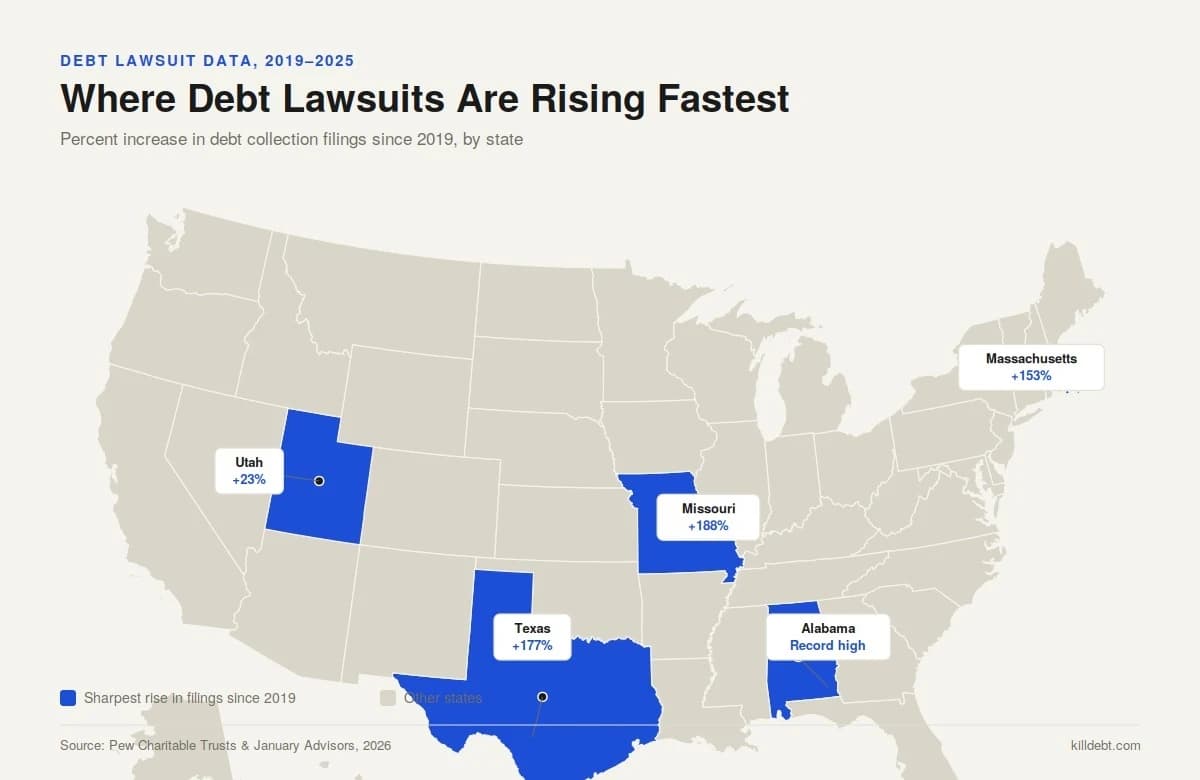
Debt collection lawsuits are climbing across nearly every state, and one company, LVNV Funding, is driving an outsized share of the surge. In the states with available court data, LVNV filed roughly five times as many cases in 2025 as it did in 2019, accounting for about 23% of all debt collection filings tracked. Meanwhile states like Missouri, Texas, Alabama, and Massachusetts are seeing filings blow past pre-pandemic peaks. If you got served with a lawsuit recently, you're not imagining it: you got caught in a real, measurable wave.
Here's what's actually going on, who's behind it, where it's hitting hardest, and what it means if you're the one holding the summons.
A few things are colliding at once:
Consumer debt is at record highs. Credit card balances hit roughly $1.25 trillion in early 2026, and persistent inflation plus higher borrowing costs have pushed more households into "survival debt," money borrowed just to cover groceries and gas, not vacations.
More accounts are charging off and getting sold. When you stop paying, the original creditor eventually writes the debt off and sells it, often for pennies on the dollar, to a debt buyer. That debt buyer now owns the right to come after you, sometimes years after the original missed payment.
Debt buyers are deliberately spending more on litigation. This isn't a guess; it's in their own investor filings. PRA Group has told investors it's intentionally increasing legal-collection spending because lawsuits are driving cash collection growth. Its operating expenses jumped by tens of millions of dollars in back-to-back quarters in 2026, almost entirely from higher legal collection costs.
Automation is doing the busywork. Researchers point to AI and automated document generation as a factor letting debt buyers file lawsuits at a scale that would've required a much bigger legal team a decade ago. The concern isn't that automation exists; it's whether anyone's actually verifying the debt is valid before the lawsuit goes out the door.
Almost nobody shows up to fight it. Less than 4% of people sued over debt have a lawyer, and in some states consumer representation is as low as 0.6%. Most cases end in a default judgment, meaning the debt buyer wins automatically because the person never responded, not because a judge reviewed the facts.
That last point matters more than almost anything else in this list. A debt buyer doesn't need a strong case. It needs you to not respond.
Debt collection lawsuits aren't spread evenly across thousands of small operators. A relatively small handful of national debt buyers file most of the cases, and the industry keeps consolidating around fewer, bigger players.
LVNV Funding is currently the standout. It's a subsidiary tied to Sherman Financial Group, and the actual machinery behind most LVNV cases (the record-keeping, the law firm relationships, the sworn statements) is run by Resurgent Capital Services. LVNV doesn't have employees who know your account; it has a servicer generating documents from a database. Court data shows LVNV increased filings by roughly 350% in some states between 2019 and 2024, and by 2025 it was responsible for close to a quarter of all filings in jurisdictions with available data.
The other names you'll see over and over on a court summons:
Both Encore and PRA have prior CFPB enforcement history for suing on debts that were inaccurate, undocumented, or unenforceable, and for using robo-signed court paperwork, meaning affidavits signed by someone with no actual personal knowledge of your account. If any of these names showed up on your court papers, that's genuinely worth knowing, because it usually means the "proof" behind the lawsuit is thinner than it looks.
Filings are up almost everywhere, but a few states stand out in 2025-2026 court data:
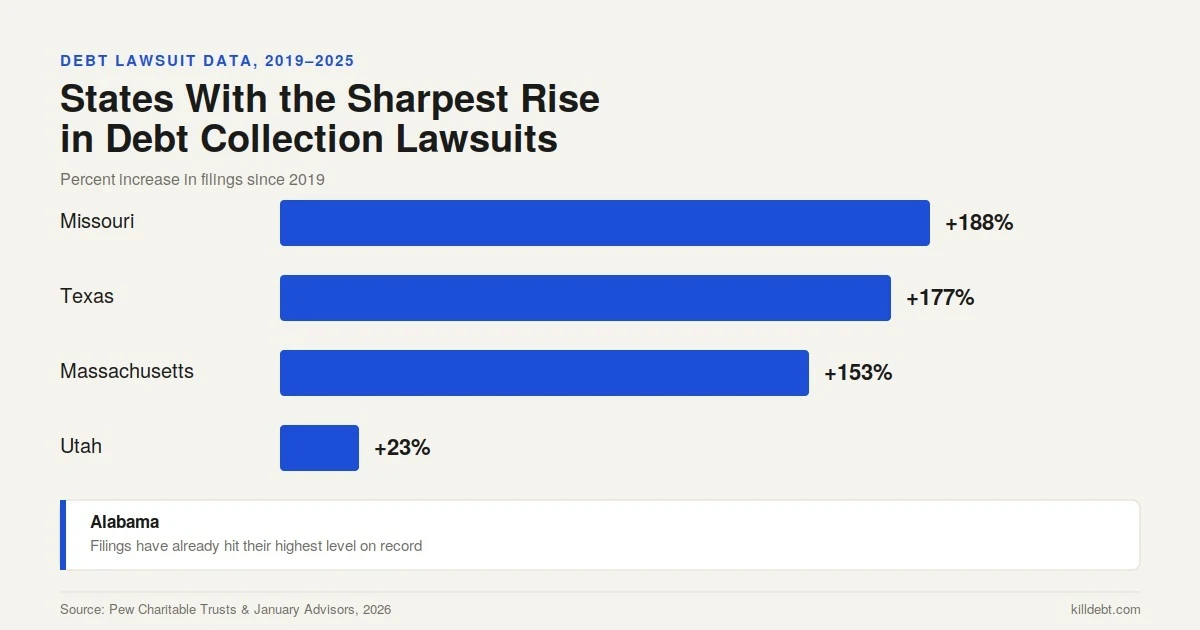
Two states, Virginia and Washington, passed new laws in 2026 requiring debt buyers to actually show their work: a recent account statement, the chain of title proving they own the debt, or the original contract, before a court will let the case move forward. That's a meaningful shift, because right now, in most states, a debt buyer can file a lawsuit and win a default judgment without ever proving it legitimately owns your specific account.
Here's the part that gets lost: owing money and being lawfully sued for it are two different things. A debt buyer has to prove it owns your exact account, that the amount is correct, and that it's suing within the statute of limitations. LVNV and similar plaintiffs are frequently unable to produce a signed assignment tying your specific debt to them; they're working off spreadsheets, not paperwork.
A default judgment doesn't check any of that. It just checks whether you showed up.
Sources: Pew Charitable Trusts, January Advisors, WebRecon, CFPB.