News Break
Is a Debt Buyer a Debt Collector Under the FDCPA? A Federal Judge Says Yes
October 5, 2026
Blog / News Break
Labcorp is paying over a hack at its debt collector. Brian Parker on his own Labcorp appeal: a creditor that threatens your credit must say your dispute goes with it.
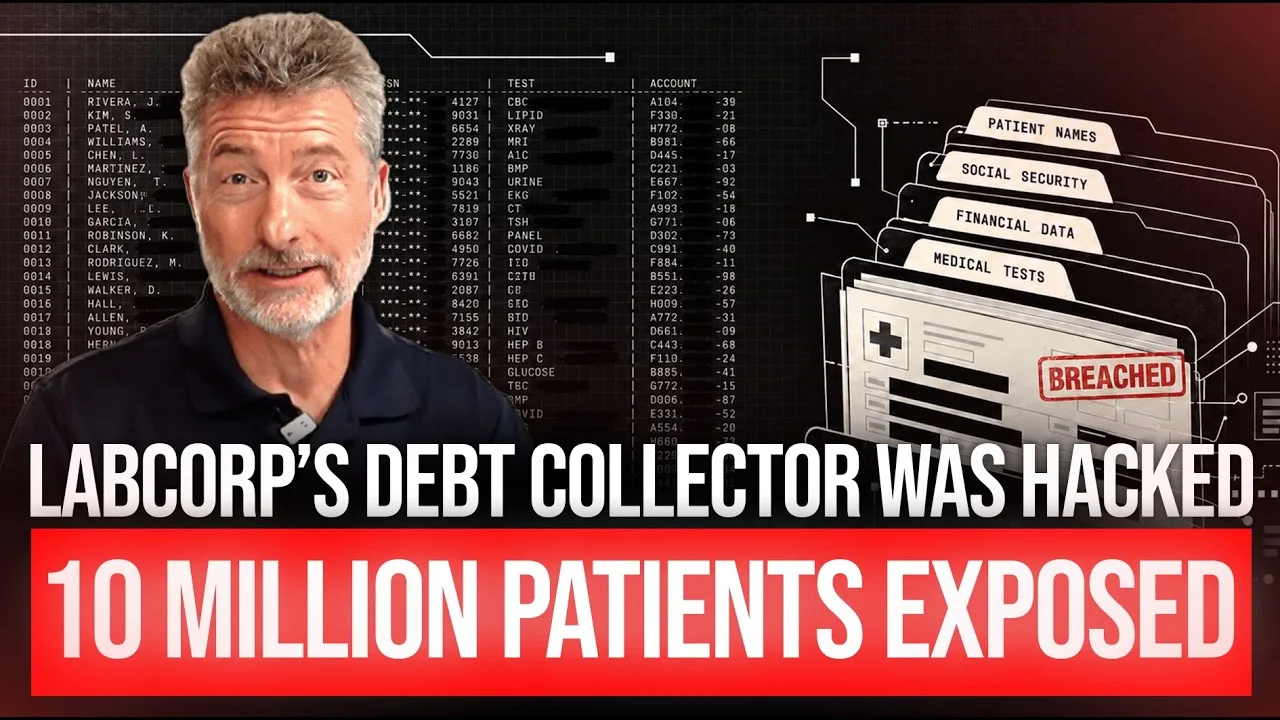
Labcorp is in the news for two settlements, and both come from the same event. A hacker had access to the computer systems of Labcorp's debt collector for about eight months. Brian Parker has his own reason to watch. He has a case against Labcorp in Florida, and the appeal in that case produced a ruling that helps anyone who gets a collection notice from a creditor.
This article covers both: what Labcorp is paying for, and what the Florida ruling lets you do.
Key Takeaways
- The breach was at American Medical Collection Agency, Labcorp's debt collector. About 10.2 million Labcorp patients were exposed.
- Labcorp agreed to pay $35 million in a class action and about $2.3 million to 44 attorneys general.
- The FDCPA does not cover most original creditors. Florida's collection statute does, and so do the statutes of many other states.
- In Florida, a creditor that threatens your credit over a debt you dispute must also tell you the dispute will be disclosed. You do not have to prove the dispute was reasonable.
The breach did not happen at Labcorp. It happened at American Medical Collection Agency, known as AMCA, which collected small medical debts for Labcorp and other healthcare companies. An intruder had access to AMCA's systems from August 1, 2018 to March 30, 2019. The exposed data included Social Security numbers, payment card information, and the names of medical tests.
Two settlements followed. In a class action in federal court in New Jersey, Labcorp agreed to pay $35 million and denied the allegations. On September 24, 2026, New York's attorney general announced (opens in a new tab) that Labcorp will pay about $2.3 million to a coalition of 44 attorneys general. That agreement also makes Labcorp set security requirements for the debt collectors it uses.
The lesson for you is simple. When a creditor sends your account to a debt collector, your data goes with it.
Brian's client had routine lab work done in Florida in January 2022. He paid in person. Then the bills started. The first one carried the heading "Collection Notice" and came from Labcorp itself. It said that failure to pay would result in referral to a collection agency and could affect his credit score.
He did the right thing. He sent a letter. It said the records were wrong and that he had paid in full, in person. It demanded that the payment demands stop, and it cited the Florida statute. It also told Labcorp that the debt was disputed for the purpose of any report to a credit reporting agency.
Labcorp answered with a second notice, marked as a final demand. It gave him 20 days. It said the account would go to an outside collection agency, and that the agency would be authorized to report the balance to the credit bureaus. It told him to protect his credit history. It said nothing about his dispute.
The FDCPA regulates debt collectors. Labcorp was the company that provided the service, so it was the creditor, and the federal statute did not reach it.
State law can. Florida's collection statute (opens in a new tab) says that no person shall do the listed acts when collecting a consumer debt. "Person" includes the creditor. The same statute is why a bank that collects its own debt in Florida must still follow collection rules.
Two subsections matter here:
The purpose is plain. A disputed account is reported as disputed. A creditor that threatens your credit must tell you that your side goes on the record too.
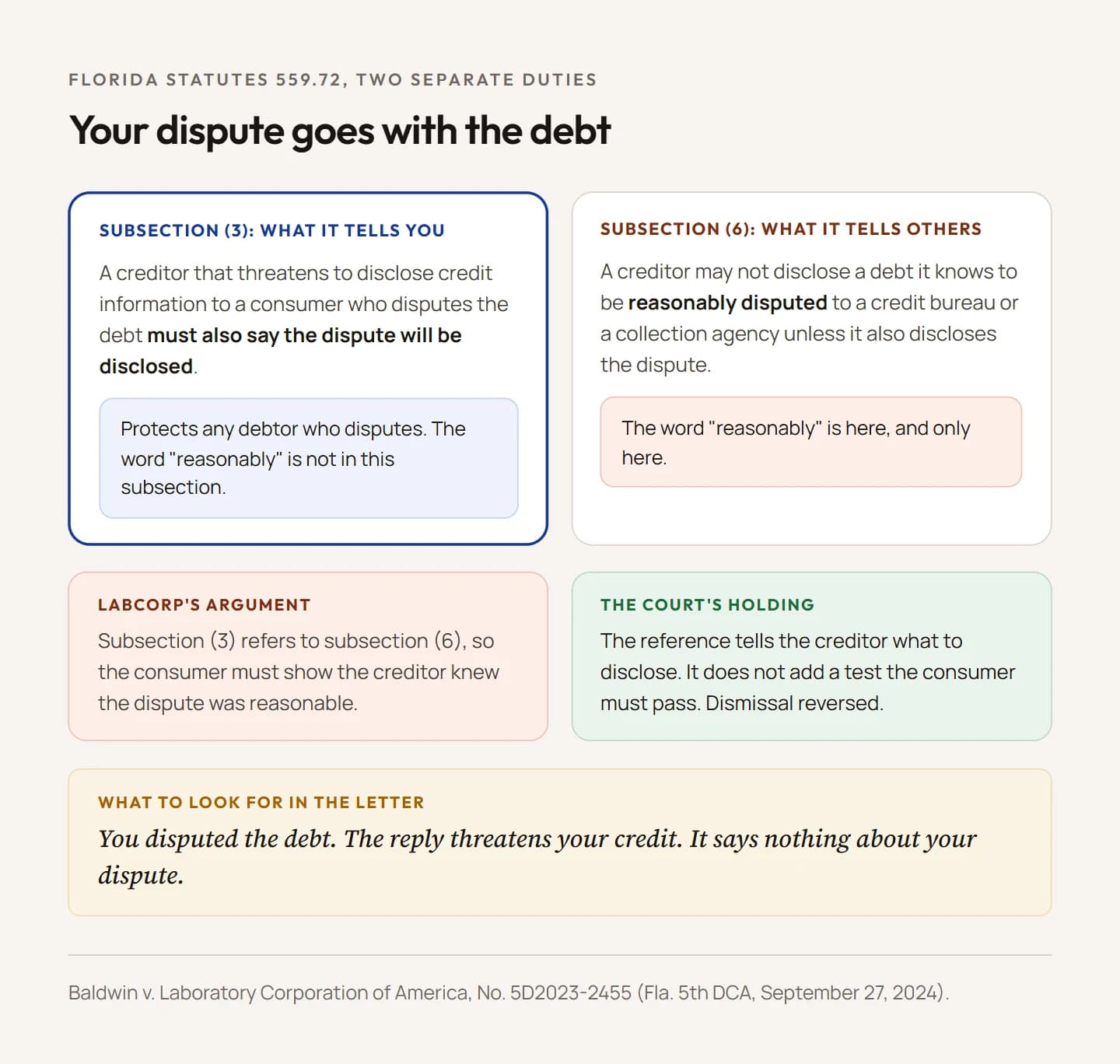
Brian filed the case as a class action. Labcorp moved to dismiss. Its argument was that subsection (3) refers to subsection (6), so the word "reasonably" comes with it. On that reading, the client had to allege that Labcorp knew his dispute was reasonable. The trial court agreed and dismissed the case with prejudice.
Brian appealed. On September 27, 2024, Florida's Fifth District Court of Appeal reversed in Baldwin v. Laboratory Corporation of America (opens in a new tab). All three judges agreed. The court held that the trial court had read subsection (3) incorrectly:
Brian says Labcorp then asked the court to clarify the opinion, to rehear the case before the full court, and to certify the question to the Florida Supreme Court, and that the court denied all three requests on November 7, 2024. The case is back in the trial court and continues.
A threat to report a debt is not illegal by itself. If you owe the debt and the report is accurate, a creditor can usually say so. The threat becomes a problem in three situations:
Many states apply their collection statutes to original creditors. Brian's list includes California's Rosenthal Act, the Texas Debt Collection Act, Maryland, Pennsylvania, Massachusetts, Wisconsin, and North Carolina. Look up your state's collection statute and find out who it covers. If its dispute rule reads like Florida's, you can attach the Baldwin opinion to your counter affidavit as persuasive authority. A Florida ruling does not bind a court in another state, but the reasoning is the same reasoning federal law uses.
Dispute it in writing. Say the records are wrong and say why. Cite your state statute. Say the debt is disputed for credit reporting purposes. Send it with proof of delivery.
Keep every letter. The client's claim exists because he kept the second notice. People who throw the mail away throw their evidence away.
Write down the harm. His letter said the phone calls had done nothing but raise his blood pressure. If the collection effort affects your health, that fact belongs in your records.
Answer if you are sued. A good letter does not replace an answer filed on time.
The dispute letter Brian's client used is in the member library, with the validation and credit report letters.

About the author
Brian Parker
I have over 30 years of experience defending consumers against debt collection lawsuits and have seen every tactic, threat, and pressure play that collectors use. Through KillDebt and ParkerGPT, I have systematized the proven defense strategies that actually work - so consumers can respond from a position of knowledge, not fear. My approach focuses on aggressive legal defense based on documented case success rather than false hope that leads to default judgments.