Success Stories
PRA Sued His Client for $13,436. One Day After His Offer, PRA Dismissed
October 2, 2026
Blog / News Break
A debt buyer admitted the conduct and claimed the FDCPA could not reach it because it owned the debt. Brian breaks down the federal ruling that said no.
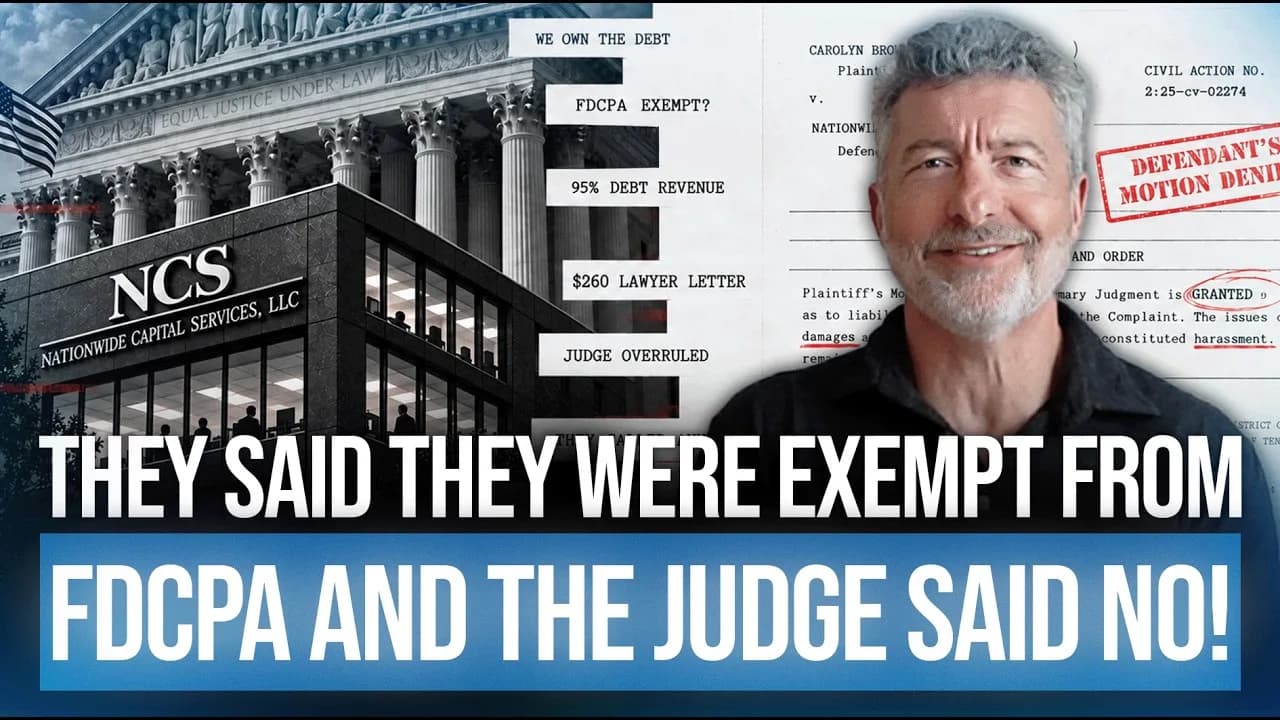
Brian recorded this one from another hotel room, this week in the 11th Circuit, about an opinion just out of the 6th: Brown v. Nationwide Capital Services, LLC, No. 2:25-cv-02274, in the Western District of Tennessee. A debt buyer, sued under the FDCPA, admitted the conduct and staked its whole defense on one claim: we own the debt, so we are a creditor, and the FDCPA does not regulate creditors. The court said no, and the way it said no matters to anyone facing a debt buyer anywhere in the country.
Key Takeaways
- The FDCPA defines a debt collector through two doors: a business whose principal purpose is collecting debts, or one that regularly collects debts owed to another. Henson closed only the second door.
- Nationwide Capital Services drew more than 90% of its revenue from buying and collecting defaulted debt, and 70 of its 80 employees held the job title debt collector. That is door one.
- Brown won summary judgment on the cease-communication and represented-consumer counts after the company kept calling past her written notice.
- Her case ran on a paper trail: a letter with proof of delivery, and documentation of every contact after it.
Ms. Brown is a senior citizen in the Memphis area who got into trouble with payday loans. Her lawyer emailed Nationwide Capital Services, which also does business under a structured-settlement name, with three things in one message: she is represented, and here is how to reach counsel; she will not pay; stop all communication. The email came with a read receipt, and NCS opened it. Three months later, NCS called her anyway, and she paid a second lawyer $260 of her limited income for one more stop-calling letter before suing.
In court, NCS did not dispute any of it. Instead it rolled the dice on a single legal argument: under the FDCPA, creditor and debt collector are mutually exclusive, we own the debt, so we are a creditor and the statute cannot touch us. Both sides moved for summary judgment on that one question, which Brian notes is a rare and telling posture: when a case comes down to one issue of law, somebody is about to lose it outright.
The company's authority was Henson v. Santander (opens in a new tab), the 2017 Supreme Court case that reshaped this corner of the law. Brian lived the before and after: in his foreclosure-defense years he sued debt buyers as debt collectors because the loans they bought were in default, and Henson ended much of that practice by holding that a company collecting a debt it owns is not collecting a debt "owed another."
But look at the statute's definition (opens in a new tab). It builds two doors into "debt collector": door one, any business whose principal purpose is the collection of debts; door two, anyone who regularly collects debts owed or due another. Henson walked through door two and expressly declined to decide door one. And door one carries no owed-to-another limit at all. When Congress writes a limiting phrase into one clause and leaves it out of the next, courts assume it meant to, because otherwise the first clause would do nothing.
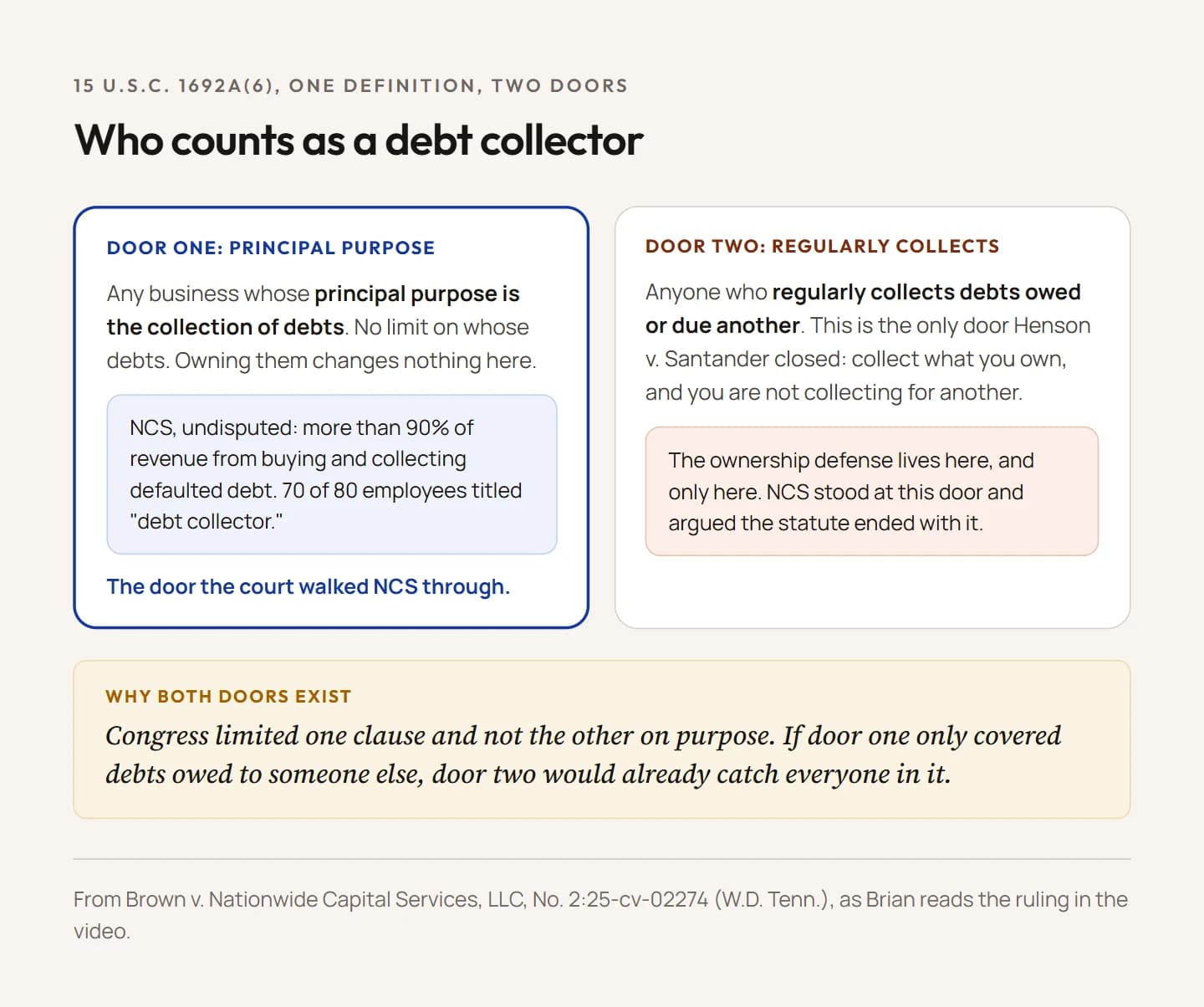
The undisputed facts did the rest. More than 90% of NCS's revenue came from acquiring and collecting defaulted consumer debt. Seventy of its eighty employees held the job title debt collector. It had no policy for making sure incoming emails, like a cease letter from a consumer's attorney, got handled at all. The court, aligning with rulings from the 3rd and 8th Circuits, held that a business like that falls within the plain language of the principal-purpose definition, and Henson does not control because the Supreme Court reserved exactly this question.
Once NCS was a debt collector, its earlier gamble collapsed on top of it. It had already conceded the conduct, so Brown won summary judgment on the cease-communication violation (opens in a new tab), for collection contact after written refusal, and on contacting a consumer it knew was represented by counsel. The harassment count she did not win as a matter of law: two calls with voicemails, the judge held, is not enough by itself, which Brian calls a fair line. The same two-door logic reaches every major debt buyer, the LVNVs, Midlands, and PRAs whose entire business is the defaulted-debt pipeline. "We own it now" is a door-two answer, and door one does not care.
Put everything in writing and prove delivery. Brown's case ran on a read receipt and a paper trail. Send the letter certified with return receipt, keep the signed copy, keep the green card, and log every contact that follows it. A violation you cannot prove happened did not happen, as far as a court can tell.
Do not accept "we are the creditor" at face value. It is a shrinking defense that big debt buyers still roll out, hoping for a friendly jurisdiction. Ask what the business actually is. If its revenue is bought defaulted debt and its staff are titled debt collectors, the principal-purpose door is standing open.
Check the license. Brown's counsel found a Tennessee consent order showing NCS had operated as a collection service on an expired license. State licensing records are public, easy to search, and an unlicensed collector hands you a defense, sometimes the whole case.
And answer with substance. None of this reaches a court unless you are in the case: the answer, the counter affidavit swearing to your facts, and everything else attached. Brian is loading the Brown complaint, motions, and exhibits into ParkerGPT's brain for members; a debt-buyer file with a shaky chain behind it is also exactly what Debt Doc Audit exists to tear down.

About the author
Brian Parker
I have over 30 years of experience defending consumers against debt collection lawsuits and have seen every tactic, threat, and pressure play that collectors use. Through KillDebt and ParkerGPT, I have systematized the proven defense strategies that actually work - so consumers can respond from a position of knowledge, not fear. My approach focuses on aggressive legal defense based on documented case success rather than false hope that leads to default judgments.