News Break
Velocity Investments Lawsuit: The Missing Contracts That Break the Case
September 28, 2026
Blog / News Break
Over 70% of debt lawsuits end in default. Brian Parker on why answering flips the case, plus four tools that work in every state against any debt buyer.
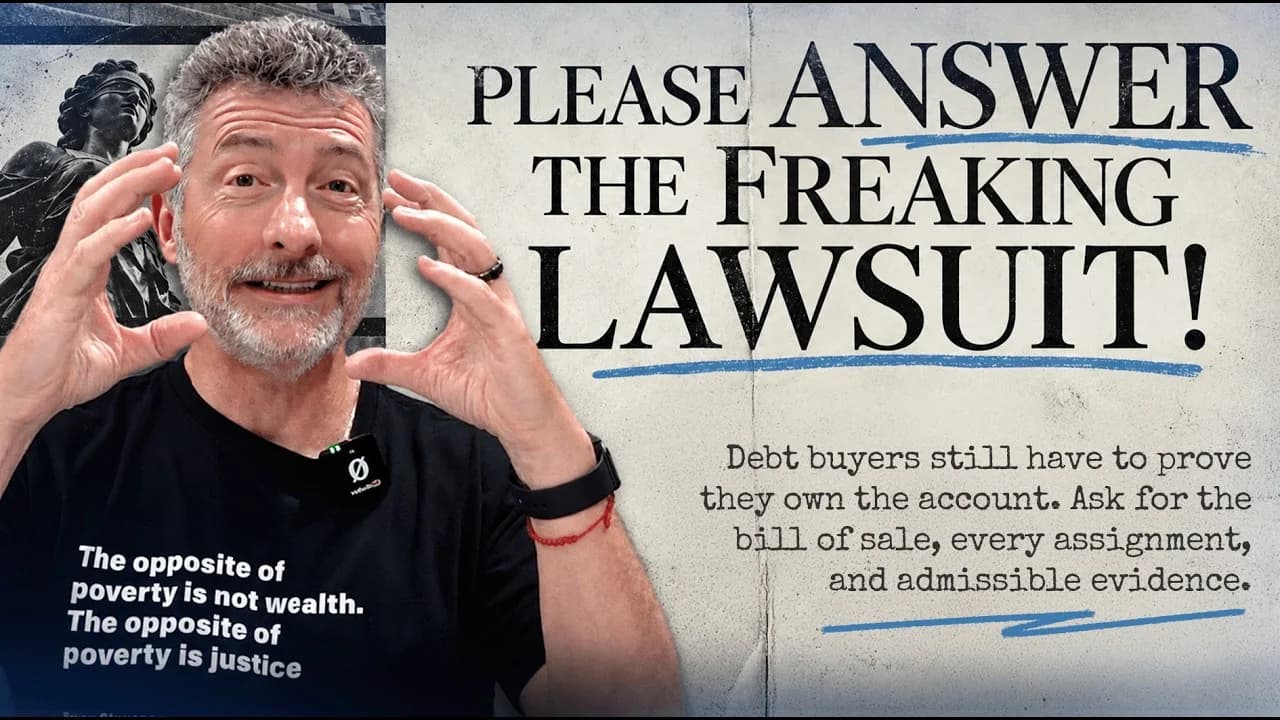
Over 70% of debt collection lawsuits end in default judgments, by Pew Charitable Trusts' count, and in some states the winner collects on that judgment for 20 years. Brian Parker's thesis in this video is blunt: the debt collection industry runs on fear, fear is strongest in the week the summons arrives, and the moment you answer the lawsuit, the whole posture of the case changes. Their plan is your default. Don't answer their prayers.
So this is the answering master class: what a strong answer looks like against a weak one, the action plan, and four tools that work in every state in the country.
Key Takeaways
- Calendar the answer deadline from the summons, then file five days early, because something always happens.
- Affirmative defenses not raised can be waived. Name them in the answer or lose them.
- The greatest answer in the world fails if it never says "I dispute owing this debt."
- Four tools travel everywhere: UCC 9-203, your state's debt-buyer statutes, the rules of evidence, and the statute of frauds.
Brian puts two answers side by side on screen. The weak one is the bare admit-and-deny form, the kind collectors love. The strong one opens with a preliminary statement that tells the court, on page one, why the complaint fails, then plants the plaintiff's own exhibit inside the answer with the defect circled. The example he shows is the live Velocity case from Monday's video: paragraph 3 pleads an assignment from Cross River Bank, and no assignment exists; the one transfer certificate carries an illegible scrawl over blank name, title, and date lines. A busy judge has a short attention span. Spend it on your best fact, up front.
Read the summons and find your deadline. Calendar it, then answer five days early. Admit nothing, and plead every affirmative defense that could apply, because statute of limitations, identity theft, and statute of frauds are the kind you can waive by silence. Challenge their evidence inside the answer and the counter affidavit. Above everything, say the sentence the greatest answer is worthless without: I dispute owing this debt to this debt collector.
Then show up to every hearing. The coverage attorney holding ten files expected ten defaults; when you appear, the usual result is his continuance, not yours. One member watched nine of ten defendants no-show on his docket, stood his ground, and left with a dismissal. And before any of it, if you caught wind of the suit early, the garbage-time letters have already stocked your file.
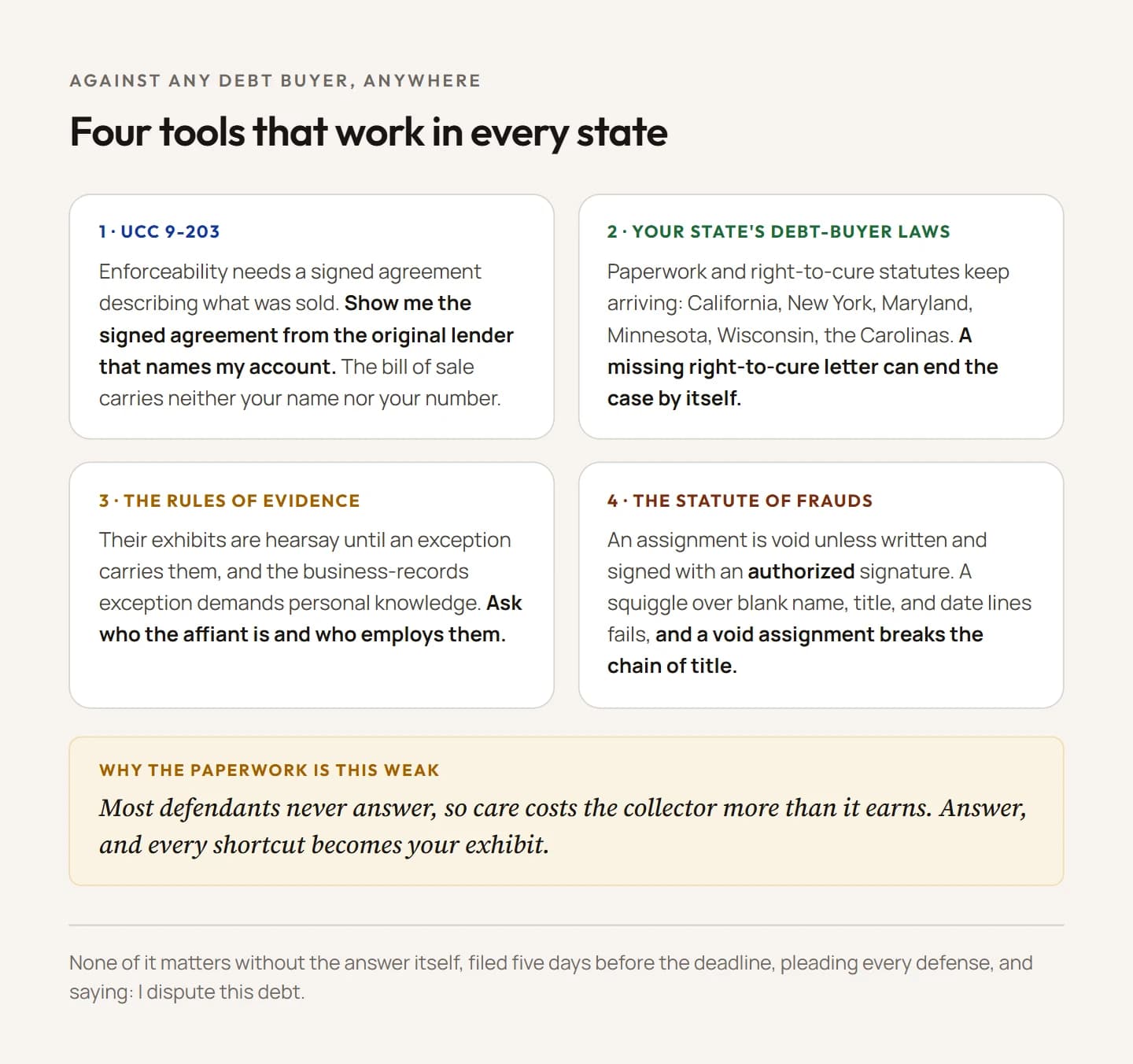
Article 9 of the Uniform Commercial Code governs sales of accounts, and section 9-203 conditions enforceability on a signed agreement describing what was sold. Brian's one-sentence version for the courtroom: show me a signed agreement from the original lender that describes the account you claim to own, because the bill of sale has neither my name nor my account number on it. And remember what a bill of sale is: a receipt, resting on a forward flow agreement they never attach. Press on that like an exposed nerve.
A wave of state paperwork laws is forcing debt buyers to bring real records and a complete chain of title. Brian's shortlist: California, New York, Maryland, Minnesota, and the Carolinas, with South Carolina's and Wisconsin's right-to-cure regimes a favorite, because a missing right-to-cure letter can end the lawsuit before you argue anything else. California goes further still: a debt buyer is not supposed to make a written demand for payment without the records showing it is the sole owner of the specific account. Look up your state before you assume you have no statute.
Do not trade the courtroom for arbitration on a debt-buyer case; the rules of evidence are your armor, not your enemy. A document asserting facts is hearsay until an exception carries it, and the business-records exception, FRE 803(6) and its state equivalents, requires a qualified witness with knowledge. The affidavits in these cases swear to an original creditor's records on behalf of a debt buyer, signed by people who, in Brian's depositions of them, sometimes work for neither. Ask who the affiant is, who employs them, and what they personally know. You have a right to the witness against you.
Every state carries a statute of frauds, an idea old enough to date to 1677 England: some agreements are void unless written and signed by the party to be held to them. Michigan's voids an assignment unless it is in writing and signed with an authorized signature, and that word does the work: an illegible squiggle with no name, no title, no date, and no shown authority is not an authorized signature. A void assignment is a broken link, and a broken link is a broken chain of title. The bills of sale he shows on screen, one listing some thirty trusts with no indication which entity is buying, selling, or signing, and no date anywhere, are exactly what the statute exists to catch.
The paperwork is sloppy because seven or eight of ten defendants never show up, so care costs the collector more than it earns. The moment you answer, every shortcut they took becomes your exhibit. The court tester lets members rehearse the hearing before walking into the real one, and the cheat sheets script the judge's likely questions. Answer, counter affidavit, everything else: ACE, every time.

About the author
Brian Parker
I have over 30 years of experience defending consumers against debt collection lawsuits and have seen every tactic, threat, and pressure play that collectors use. Through KillDebt and ParkerGPT, I have systematized the proven defense strategies that actually work - so consumers can respond from a position of knowledge, not fear. My approach focuses on aggressive legal defense based on documented case success rather than false hope that leads to default judgments.