News Break
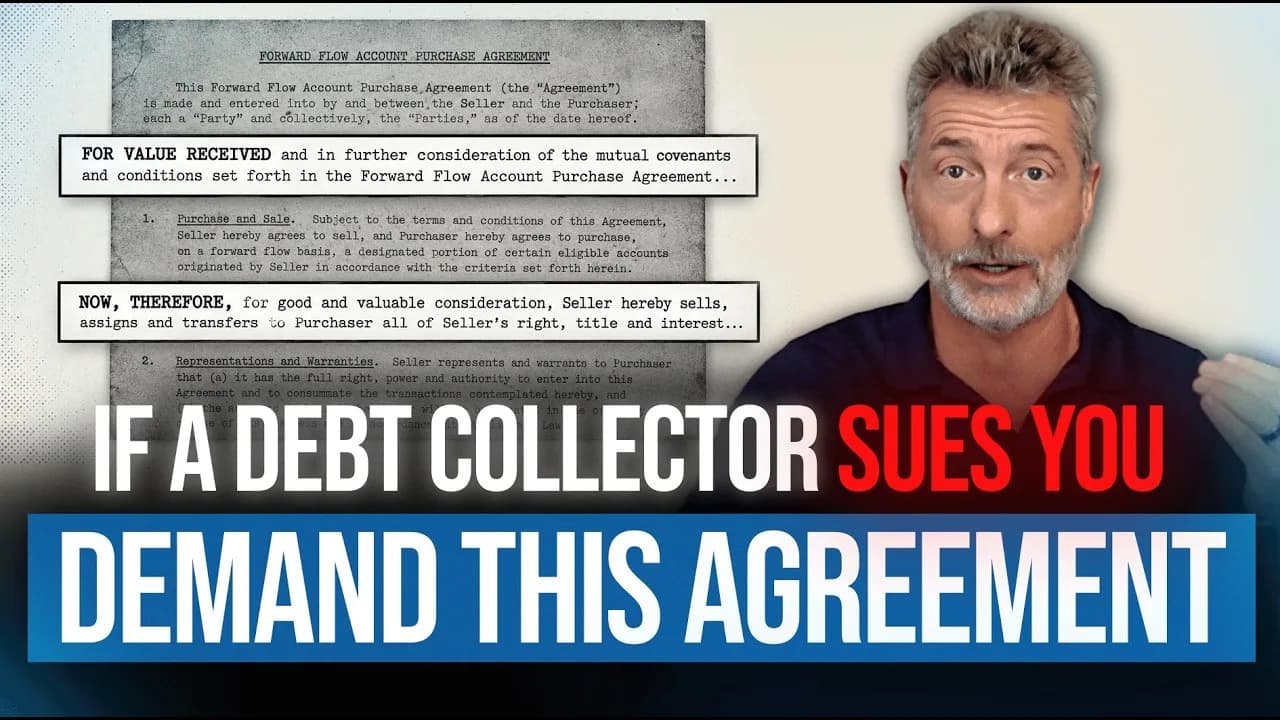
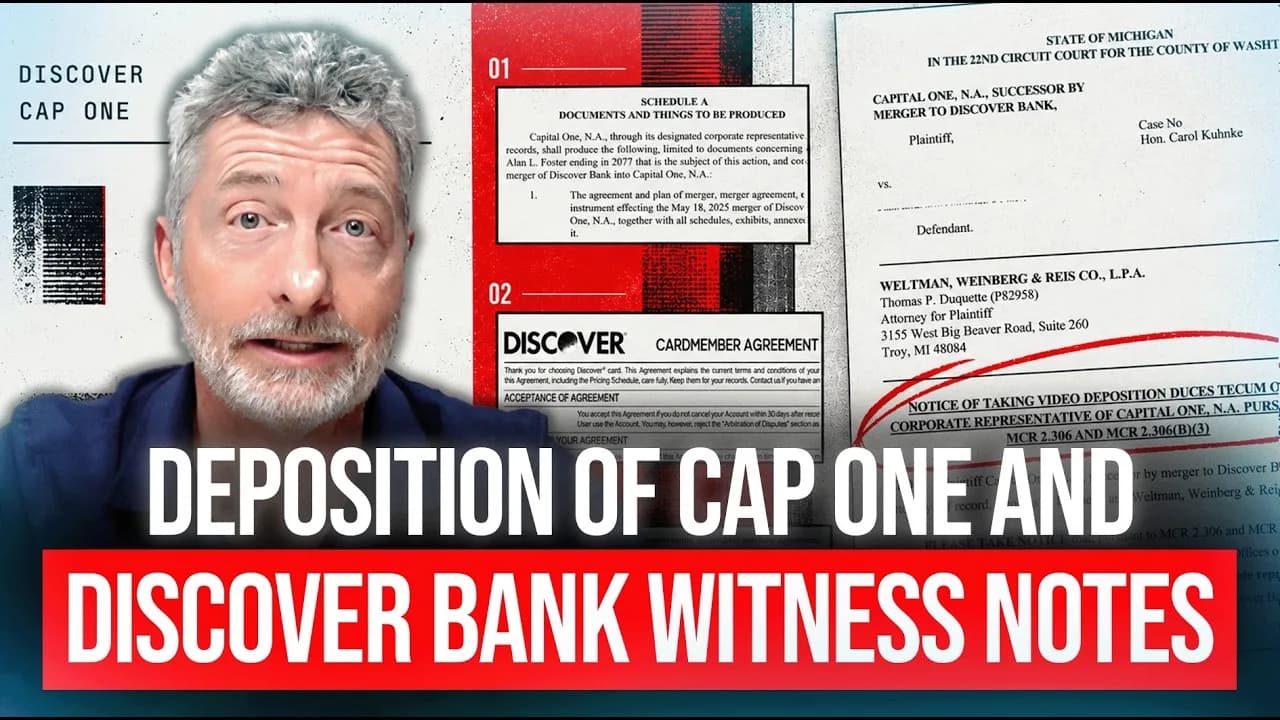
Capital One Says the Discover Merger Proves Ownership. Brian Deposed Their Witness
September 25, 2026
Blog / News Break
Brian opens a live Velocity Investments case file: a trust with no assignment, a creditor selling five days too late, and ten lessons for your answer.
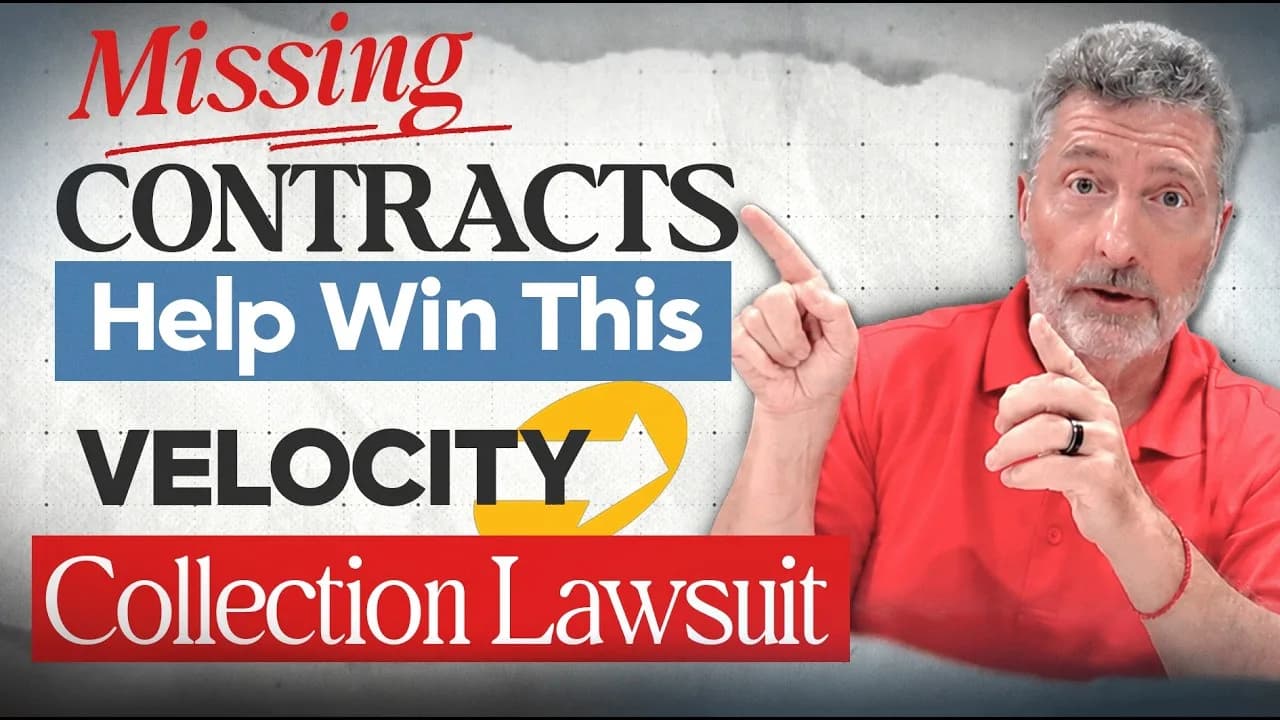
This one is the culmination video. The bill of sale is a receipt; the chain of title has to connect. Brian has taught both lessons separately, and now a new member client's case puts them to work on a live file: Velocity Investments suing on an Upstart-originated loan from Cross River Bank. He walks the actual filings on screen, and by his read, the paperwork does not survive its own dates.
He is building this client's answer now, and the point of the video is that you can run the same playbook on any debt buyer file, because it is all the same stuff.
Key Takeaways
- "Upon information and belief" means the attorney has neither. Flag every instance.
- A trust with no assignment into it sold the debt to Velocity five days before the original creditor's certificate says it first sold the debt to anyone. Sellers cannot convey what they have not received.
- The master agreements everything rests on predate the loan by years, and none of them were attached.
- The missing documents kill the case as effectively as the attached ones. Put the whole sequence on a timeline the court can swallow in one look.
Paragraph 3 of the complaint pleads that Velocity is the assignee of the defendant's account with Cross River Bank. That single sentence, Brian says, is where the case is lost for them, because everything that follows has to prove that assignment actually happened.
Paragraph 5 pleads that "upon information and belief," the contract was delivered to the defendant. Brian's standing translation: when an attorney writes information and belief, there is no information and no belief, only the hope of a default. He once faced a complaint carrying roughly 180 of them and invited the court to notice that the plaintiff did not believe its own pleading. Every instance belongs in your answer.
The "promissory note" attached? Stamped copy of the original, with a signature Brian puts on screen and declines to call a signature. If they want the original enforced, producing the original is a fair ask.
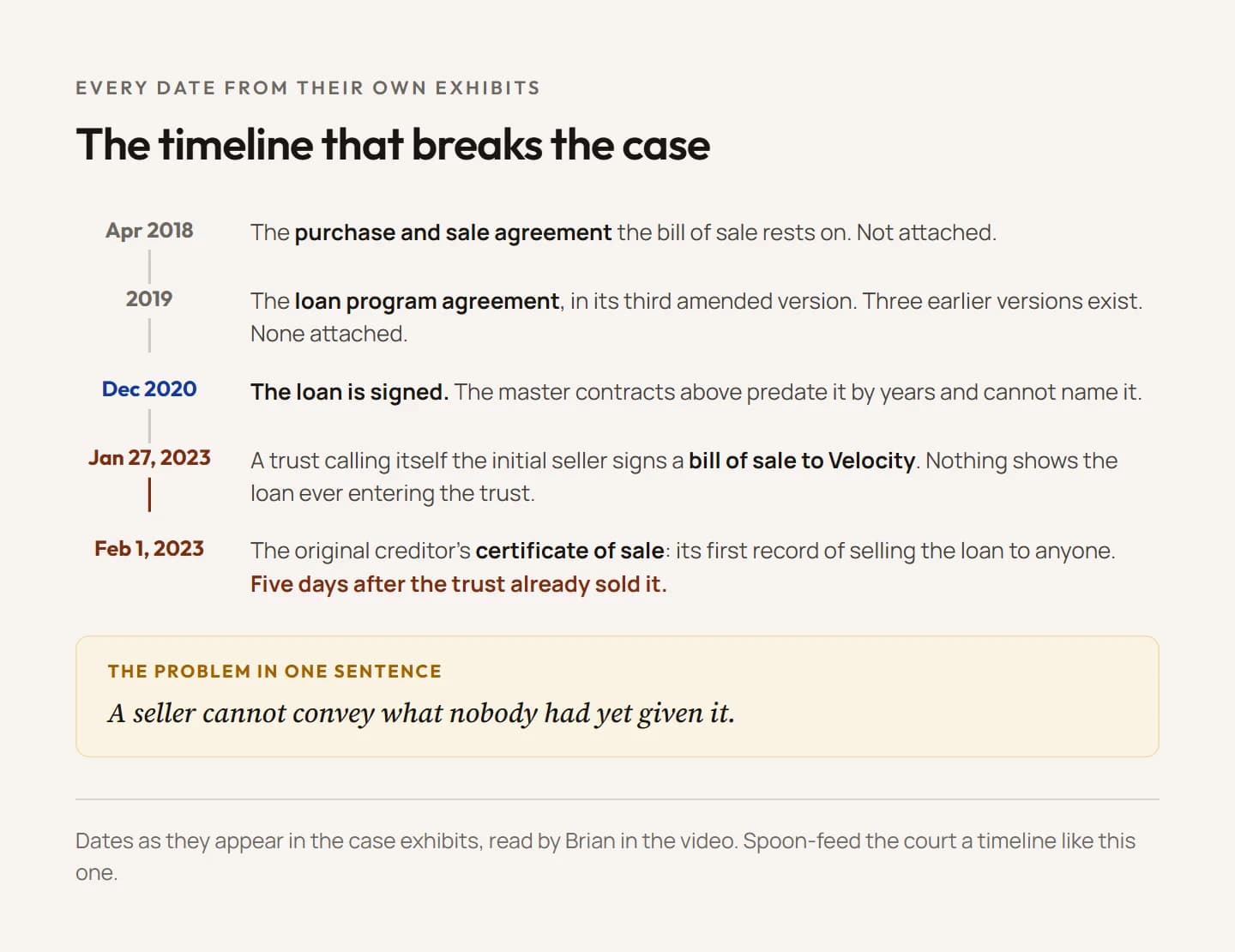
Here is the sequence in the exhibits, as Brian lines it up. The bill of sale, signed around January 27, 2023, says a trust, as "initial seller," conveyed the account to Velocity. The certificate of sale from Cross River Bank, the actual original creditor, is signed February 1, 2023: the first document in the file showing Cross River selling the loan to anyone, five days after the trust supposedly passed it downstream.
For the bill of sale to work, Cross River had to sell to the trust before the trust sold to Velocity. Nothing in the file shows the loan entering the trust at all, and the trust's own "initial seller" label collides with the fact that the initial seller of a Cross River loan is Cross River. Brian's read of why the label is there: without it, the trust has no right to hand Velocity anything. The whole reason a chain of title exists is that each link has to be a real transfer, and this chain runs backward.
The dates go deeper. The note was signed electronically in December 2020. The transfer certificate rests on a loan program agreement from 2019, in its third amended and restated version, meaning three earlier versions exist and nobody attached any of them. The bill of sale rests on a purchase and sale agreement from April 2018. Master contracts from 2018 and 2019 cannot name a loan that was not made until the end of 2020, and none of them are in the file anyway.
The transfer certificate says each conveyed loan is identified by number on the attached Exhibit A. There is no Exhibit A. The Cross River signature block is a squiggle with no name, no title, and no date, when the statutes that govern assignments look for an authorized signature. The recycled bill-of-sale signature is one Brian says he has seen across hundreds of these files. And the loan tape, when one appears, is a spreadsheet with no authentication, which proves only that someone can make a spreadsheet.
The lesson he wants held onto: missing documents are as lethal to their case as bad ones. The absence goes in the counter affidavit right beside the contradictions.
The checklist Brian closes with, compressed: demand the master agreement every bill of sale says it is executed pursuant to. Read every exhibit for the second hidden contract it references, and demand that too. Compare the master contract dates to your loan's date. Put every date on a timeline, because even a hard-pressed judge absorbs a timeline at a glance, and Brian spoon-feeds one in his own filings. Check every signature for name, title, date, and authority. Hunt for the exhibit the document promises. Treat what is missing as ammunition. Demand authentication for any loan tape. Read the contract they attach for clauses like this file's register provision, which makes an ownership register conclusive and available on written request, then make the written request and log the silence. And load the counter affidavit with all of it, because a bare admit-and-deny answer is the collector's favorite kind.
Most people sued never test any of this; seven or eight of ten never answer at all, and the file is built for them. The answer and counter affidavit Brian drafts for this client are going into ParkerGPT's brain, timeline and all, for the next member facing Velocity, or Crown Asset, or LVNV, or Midland. Same stuff, same playbook.

About the author
Brian Parker
I have over 30 years of experience defending consumers against debt collection lawsuits and have seen every tactic, threat, and pressure play that collectors use. Through KillDebt and ParkerGPT, I have systematized the proven defense strategies that actually work - so consumers can respond from a position of knowledge, not fear. My approach focuses on aggressive legal defense based on documented case success rather than false hope that leads to default judgments.