News Break
Who's Really Behind the 2026 Debt Lawsuit Boom (And Where It's Hitting Hardest)
September 17, 2026
Blog / News Break
A case can sit filed for months before anyone serves you. Brian Parker on reading the docket, the letters to send before you are a party, and what service changes.
Two comments arrived on Brian Parker's channel in the same week, from people standing in the same spot without knowing it.
The first: a letter from an attorney about a medical debt. The writer owes it and says so. He offered to pay over 60 months, the provider declined, then shut off his patient portal, so he can no longer see a bill or make a payment. The claim is $2,600 plus attorney fees. No lawsuit yet.
The second: a process server came to the door yesterday. The writer had learned from Brian not to sign anything, did not sign, and wanted to know if that was right.
Both of them know a lawsuit is coming and neither has been served. Brian has spent more than 30 years defending these cases, and his answer to both is the same: the wait is the most useful stretch of the whole case, and almost nobody uses it. He has called it garbage time before. In this video he renames it Problem Parker time, after what you can make of it.
Key Takeaways
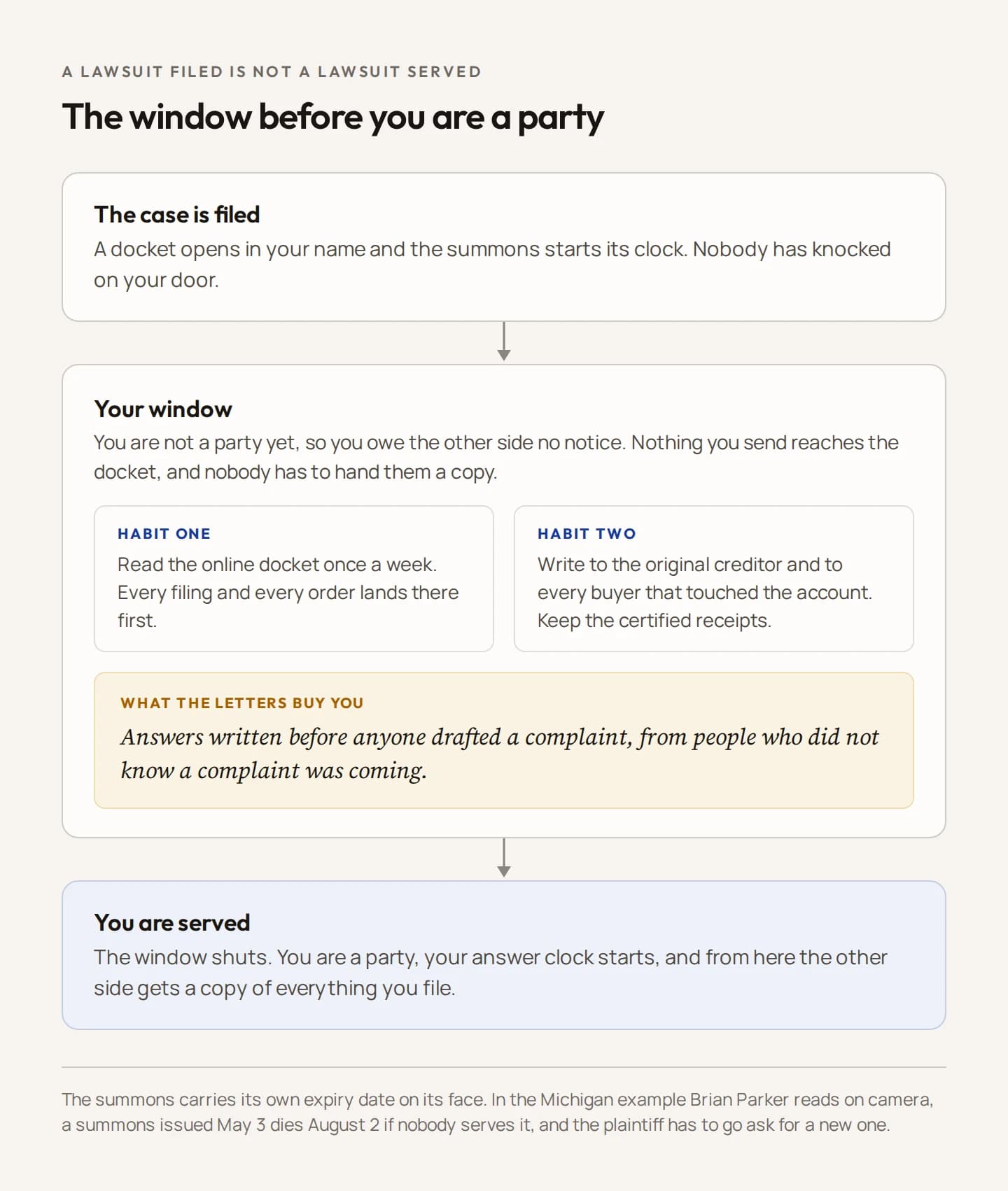
- A lawsuit filed is not a lawsuit served. The summons carries its own expiry date, and until somebody hands you the papers you are not a party to anything.
- Before service you owe the other side no notice. Letters you send now never reach the docket and nobody has to give the plaintiff a copy.
- Write to the original creditor and to every buyer that touched the account. What comes back is written by people who do not know a complaint is being drafted.
- The process server can ask you to sign an acknowledgment of service. You do not have to, and refusing does not undo the service.
Brian gets this one a lot: if I go down to the courthouse and read the complaint myself, am I served? No. Filing and service are two different events, and the gap between them is often months.
Service is the formal delivery that makes you a party. Until it happens the case exists, the docket exists, and none of your deadlines have started. The summons has its own clock running the other way: the plaintiff has a limited window to get you served before the document expires and they have to go back and ask the court for a new one. In the Michigan summons Brian reads on camera, the face of the document shows it issued May 3 and dying August 2.
The plaintiff has to beat that clock. You get the window it leaves you.
Most courts publish their dockets online, searchable by name. The docket is the running record of the case: what the plaintiff filed, what the judge ordered, what hearing is set and for when. It updates before anything reaches your mailbox.
Once you have reason to think a case exists, read it once a week. Brian's clients find out a suit was filed in a handful of ways, and the most common is a letter from a bankruptcy attorney offering to help. Those firms watch new filings and market to the defendants. Getting one feels like bad news. Treat it as an alert and go read the docket yourself.
If you cannot find a docket search for your court, call the clerk and ask how the public looks up a civil case. Clerks answer that question all day.
Once you are served, or once you appear in the case, you are a party. From that point every document you send to the court gets served on the other side too, and your filings appear on the docket with a notice saying you served them. That is how litigation works.
Before service, none of that applies. You are not a party yet, so no rule requires you to copy anyone or file anything. You can write to the original creditor, to a trust that held the account, and to every debt buyer in the chain, and the eventual plaintiff learns about it when you decide they do.
Brian gets asked whether this is sneaky. These are companies preparing to tell a court that you owe them money, and asking what they have is the most ordinary thing a person in your position can do.
Brian keeps a library of these on KillDebt, written for named creditors, trusts and debt buyers. What each one does matters more than whose letterhead it copies.
| Letter | Who receives it | What it is doing |
|---|---|---|
| Billing error notice | The card issuer | Disputes a specific error and creates a dated record that you objected |
| Securitization request | The original creditor | Asks whether the account was sold, pooled or placed in a trust |
| Debt validation | The debt buyer or collection firm | Demands the documents behind the claim before they file |
| Creditor validation | The original creditor | Pins down what the creditor says it still owns |
| Forward flow request | The original creditor | Asks for the master agreement the bill of sale refers to |
| Notary proof | The notary on their affidavit | Asks for proof the commission was valid on the day of signing |
| Attorney verification | The plaintiff's law firm | Asks for the bar number and whether that lawyer reviewed the file |
| Signature verification | Creditor and buyer | Asks who signed the affidavit and on what authority |
| Cardholder agreement | The original creditor | Asks for the version of the contract you actually signed |
| Record preservation | The debt collector | Tells them to preserve notes, logs and account records |
Send them certified with return receipt. The receipts are the point as much as the replies. Brian's phrase for what you are building is a certified history of good faith requests, and it is the thing you hand a judge later when the plaintiff says you never asked.
Somewhere in most credit card complaints sits a line saying the defendant never disputed the debt and never contacted the creditor about any problem with it. Citibank and American Express often phrase it as a failure to object to the charges. It reads like filler.
That paragraph is aimed at the Fair Credit Billing Act, which gives you the right to dispute a billing error on an open end account in writing. The notice has to reach the issuer within 60 days of the statement that carried the error. Once it does, the issuer must acknowledge it in writing within 30 days and resolve it within two billing cycles. While the dispute is open the issuer cannot try to collect the disputed amount, though you still owe the parts of the bill you are not disputing. A creditor that ignores the rules forfeits the disputed amount up to $50.
The errors it covers are specific: charges you did not authorize, goods or services you did not accept or that were not delivered as agreed, payments or credits recorded wrong, arithmetic mistakes, charges you want documentation for, and statements sent to an old address.
Brian has taken that complaint paragraph and put it straight into a counter affidavit beside a copy of the letter. Here is paragraph six saying I never disputed anything. Here is my dated dispute. A plaintiff shown to be wrong once has to work to be believed on anything else, and the pleading was generic to begin with.
Credit card balances get pooled and sold to investors. Brian raises securitization in creditor cases to reach a better settlement, for a practical reason: tracing whether a specific account was securitized is slow, awkward work, and the collection attorney does not want to do it on a case worth a few thousand dollars.
There is a second reason. Brian's argument is that a creditor which securitized an account and kept only the servicing role is not the party that owns the claim, and ownership is something a plaintiff has to prove. He is direct that this is an argument you have to make and win in the case, not a fact you can assume. He also points at a tell worth watching for: a complaint that talks about the account rather than the debt.
Send the letter during the window and you get an answer in writing. If the company later tells the court something different, you are holding the contradiction.
Debt buyers file these cases in volume, with affidavits signed by people who do not expect to be asked about them. Four letters put that to the test before anyone serves you.
The notary proof letter goes to the notary whose stamp is on the affidavit and asks for proof the commission was valid on the day it was signed. Brian says he has caught notaries and signers being untruthful this way, and that a non-answer tells you something too.
The attorney verification letter goes to the lawyer who signed the pleading: are you licensed here, what is your bar number, did you review the documents before signing. Brian describes lawyers confirming out of state paperwork under the law of a state the case is not in. Ask why, in writing, and either you get an answer or you get a silence you can show a judge.
The signature verification letter asks who signed, when, and in front of whom. The same signatures turn up on affidavits in different cases in different states, which is worth confirming before you make the argument.
The cardholder agreement letter asks the creditor for the version of the contract you actually signed. Collection firms attach a generic agreement written years after the account opened, and the terms you supposedly breached are terms the plaintiff has to show you. You will probably not get the original. You will get a letter you can hold up in court saying you asked.
These are the questions the case will turn on. Asking them now means the answers arrive before anyone on the other side is being careful.
If someone stole your identity and used it to open credit, the Fair Credit Reporting Act gives you a direct claim on the paperwork. Section 1681g(e) lets a victim demand from the business itself every record of the fraudulent transaction: the application, the documents, the statements. The business has 30 days to hand them over.
Companies resist by claiming you did not give them enough to identify the account, so remove the excuse. Send proof of identity, send the page of your credit report showing the account with the entry circled, and send the police report. Brian's pro tip for any identity theft situation is to get that police report first, before anything else.
This one is for real identity theft. Send it where it belongs and it turns the worst kind of debt claim around, and the company on the other end knows what a complete request means.
Say the process server does arrive. He may ask you to sign an acknowledgment of service. That signature proves delivery for the plaintiff and does nothing for you, so you are not required to give it. Take the papers and read the summons for your deadline. Declining to sign does not cancel the service, and avoiding the server does not end the case.
Now the file you built goes to work. You answer the complaint on time, and the counter affidavit that goes with it is stocked: their generic paragraph next to your dated dispute, their claim of ownership next to whatever the creditor told you in writing, their bill of sale next to your unanswered request for the agreement it depends on.
That matters because of who does not get this far. Fewer than 10 percent of defendants in debt collection lawsuits have a lawyer, and courts have resolved more than 70 percent of these suits by default judgment (Pew Charitable Trusts, 2020). A collection firm builds its economics on that. You turn up with a paper trail you assembled before they filed, and you land in a category the model does not account for.
KillDebt members get the letter library and Brian's cheat sheets for each step that follows, and ParkerGPT will tell you which letter fits your situation and draft it. If you are further along than this article, the timeline of a debt collection case picks up where service leaves off.

About the author
Brian Parker
I have over 30 years of experience defending consumers against debt collection lawsuits and have seen every tactic, threat, and pressure play that collectors use. Through KillDebt and ParkerGPT, I have systematized the proven defense strategies that actually work - so consumers can respond from a position of knowledge, not fear. My approach focuses on aggressive legal defense based on documented case success rather than false hope that leads to default judgments.