News Break
Answer the Debt Lawsuit: Four Tools That Work in Every State
September 30, 2026
Blog / Success Stories
Portfolio Recovery had summary judgment teed up against a weak answer. Brian amended it and subpoenaed the signer; PRA dismissed the next day.

Your answer is your first impression, and Brian Parker opens this video with the case that proves it cuts both ways. A client came to him mid-litigation: Portfolio Recovery Associates suing on a Synchrony Bank Sam's Club account for $13,436.40, a generic answer already on file, and PRA confident enough to file for summary judgment against it. Brian amended the answer, went to work on PRA's own exhibits, and on September 30, one day after his walkaway offer, PRA's counsel sent a stipulation to dismiss. This is his walkthrough of exactly what changed.
Key Takeaways
- A boilerplate answer tells the debt buyer nobody has read the file, and the reply is a summary judgment motion. An amended answer replaces it as if it never existed.
- The complaint's lynchpin was the claim that the client was notified of the sale. Florida requires that notice in writing before suit, and none existed.
- PRA's own exhibits contradicted its complaint on both the creditor's name and the amount sued for.
- Small claims may block discovery, but the subpoena power is a different rule. One subpoena and one corporate-representative demand ended the case.
The answer on file when Brian arrived was the familiar kind: deny, deny, deny, plus one affirmative defense that made him wince, a reserved right to compel arbitration. On a debt-buyer case you want the courtroom, because the rules of evidence are your armor, and arbitration trades them away. An answer like that tells the plaintiff one thing: nobody on the defense side has read the file. No counter affidavit, no discovery, no pressure. PRA read it exactly that way and moved for summary judgment.
The repair is procedural and beautiful: amend. Under the relation-back principle, the amended answer stands in place of the original as though the first had never been filed. The first impression gets rewritten, the court gets educated, and the plaintiff's easy case evaporates.
Brian hunts every complaint for its lynchpin, the allegation the whole case hangs on. Here it was paragraph 6: the account was sold and assigned to PRA, and the defendant was notified of said sale. That second clause is there because Florida law requires a debt buyer to give written notice of assignment, and pleading it covers the requirement on paper. Except nothing supported it: no letter, no proof of mailing, nothing. Alleging a statutory box was checked is not the same as checking it, and the gap went straight into the amended answer's affirmative defenses.
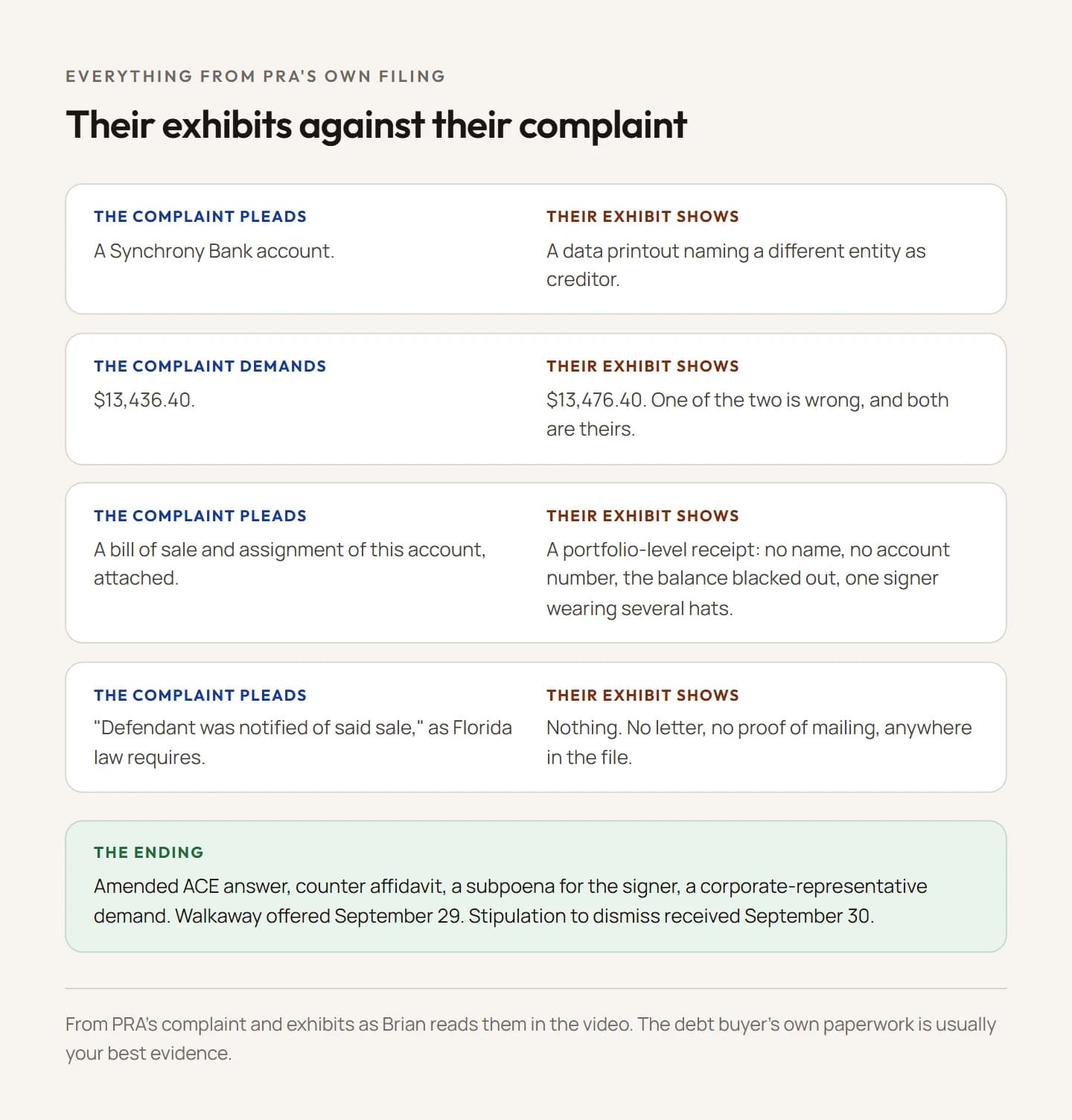
Then the exhibits did the heavy lifting, against their own side. The bill of sale was a portfolio-level document: no client name, no account number, the total sale balance blacked out, executed without recourse and only to the extent of the seller's ownership, made pursuant to a master account sale agreement, the forward flow contract, which was not attached. One signer's name appeared across four or five signature blocks for different entities, wearing a different hat each time, with no shown authority for any of them.
The data printout came unsigned, with no record of who produced it, and it named the creditor as an entity that was not Synchrony Bank at all, while the complaint pleaded Synchrony throughout. And the number: the complaint sued for $13,436.40; PRA's own supporting exhibit showed $13,476.40. Either their pleading or their proof is wrong, and both belong to them. All of it went into the counter affidavit, sworn, specific, and attached.
The courts push these cases toward small claims, where discovery is often closed and debt buyers like it that way. Brian's countermove: in most states the subpoena power lives under a different rule that the small-claims discovery restriction does not reach. So he subpoenaed the bill-of-sale signer, to explain the hats, the warranties, and the redacted numbers under oath, and demanded PRA produce a corporate representative.
Now run PRA's math: a file bought for pennies on the dollar, against an out-of-state signer's deposition, a corporate representative, a document fight over the master agreement, and hearings into the holidays. On September 29, PRA's counsel emailed, hedging on the signer, promising objections, floating delay. Brian restated the broken chain, confirmed the subpoena was being domesticated, and offered a mutual walkaway by the end of September. On September 30, the reply was a stipulation to dismiss. Case over, in Brian's telling, with the opposing attorney off to consult what he jokingly called his handlers.
Three, in Brian's own ranking. Read their exhibits, because the debt buyer's paperwork is usually your best evidence. Get sworn testimony into the file, because the counter affidavit is what separates you from the pile. And know that boilerplate gets ignored: the generic answer drew a summary judgment motion, and the amended ACE answer drew a dismissal. When the other side talks tough, don't blink. What powers you is their own file, and once they see you know it, they go away fast.

About the author
Brian Parker
I have over 30 years of experience defending consumers against debt collection lawsuits and have seen every tactic, threat, and pressure play that collectors use. Through KillDebt and ParkerGPT, I have systematized the proven defense strategies that actually work - so consumers can respond from a position of knowledge, not fear. My approach focuses on aggressive legal defense based on documented case success rather than false hope that leads to default judgments.